AWS Secrets Manager helps protect secrets needed to access applications, services, and IT resources.
enables you to easily rotate, manage, and retrieve database credentials, API keys, and other secrets throughout their lifecycle.
secure secrets by encrypting them with encryption keys managed using AWS KMS.
offers native secret rotation with built-in integration for RDS, Redshift, and DocumentDB.
supports Lambda functions to extend secret rotation to other types of secrets, including API keys and OAuth tokens.
supports IAM and resource-based policies for fine-grained access control to secrets and centralized secret rotation audit for resources in the AWS Cloud, third-party services, and on-premises.
enables secret replication in multiple AWS regions to support multi-region applications and disaster recovery scenarios.
stores the encrypted data key with the protected secret data.
Decryption
requests AWS KMS to decrypt the encrypted data key
uses the plain text data key to decrypt the protected secret data.
never stores the data key in unencrypted form, and always disposes of the data key immediately after use.
Secrets Manager Rotation
AWS Secrets Manager enables database credential rotation on a schedule.
Supports rotation as frequently as every four hours, with configurable rotation windows using cron or rate expressions.
Rotation can be configured using:
Managed rotation – the service configures and manages rotation automatically without Lambda functions (supported for RDS, Aurora, Redshift, DocumentDB).
Lambda function rotation – for custom rotation logic using Lambda functions.
Managed external secrets rotation – for third-party credentials (e.g., Salesforce, MongoDB Atlas, Confluent Cloud) without Lambda functions.
Credentials rotation does not impact the already open connections as they are not re-authenticated. Authentication happens when a connection is established.
integrates with CloudWatch Events/EventBridge to send a notification when it rotates a secret.
Rotation Strategies
Single user rotation
Updates credentials for one user in one secret.
The user’s password is changed in both the secret and the database.
Recommended when cloned users don’t have the same permissions, or for ad hoc/interactive users.
Brief period of potential sign-in failure between rotation and propagation.
Alternating users rotation
Creates a clone user with identical privileges but different password.
Alternates between two users on each rotation.
Requires a separate secret with superuser credentials.
Provides higher availability as the old version remains valid until next rotation.
Managed External Secrets
Introduced in November 2025, managed external secrets extend managed rotation to third-party SaaS credentials.
Enables centralized management and automatic rotation of credentials for third-party software providers directly from Secrets Manager.
No Lambda functions required – rotation is fully managed by Secrets Manager.
Supports standardized formats and multiple rotation strategies per SaaS provider.
Supported providers include Salesforce, MongoDB Atlas, and Confluent Cloud (expanding).
Eliminates the need for provider-specific custom rotation logic.
Language-agnostic local HTTP service that pulls and caches secrets in compute environments.
Exposes a localhost endpoint (port 2773) for applications to retrieve secrets from in-memory cache.
Reduces API calls and improves application availability.
Default cache TTL of 300 seconds (configurable).
Open source and supports pre-fetching secrets at startup and IAM role assumption (May 2026).
Supports hybrid post-quantum TLS (ML-KEM) by default since version 2.0.
Works with EC2, ECS, EKS, Lambda, and on-premises/multi-cloud environments.
AWS Workload Credentials Provider (released June 2026)
Unified lightweight client-side provider that automates deployment of ACM certificates and caching of Secrets Manager secrets.
Maintains full backwards compatibility with Secrets Manager Agent.
Works across AWS and non-AWS workloads through a single unified provider.
Uses post-quantum ML-KEM key exchange by default.
Secrets Manager Security Features
Post-Quantum TLS
Supports hybrid post-quantum key exchange using ML-KEM (Module-Lattice-based Key-Encapsulation Mechanism) for TLS connections.
Combines traditional cryptography (X25519) with post-quantum algorithms to protect against “harvest now, decrypt later” threats.
Service-side support launched in 2025; client-side support extended in April 2026.
Secrets at rest are already quantum-safe (symmetric encryption via KMS).
API Rate Limits (March 2025)
GetSecretValue: up to 10,000 requests per second
DescribeSecret: up to 40,000 requests per second
Managed Policies
SecretsManagerReadWrite – full access including redshift-serverless permission (March 2024).
AWSSecretsManagerClientReadOnlyAccess – read-only access for client applications, includes BatchGetSecretValue and ListSecrets (November 2025, updated June 2026).
Client-Side Caching
Caching libraries available for Java, Python, .NET, Go, and Rust.
Improves speed, availability, and reduces costs by minimizing API calls.
Default cache refresh interval is one hour (configurable).
Does not include cache invalidation – if a secret rotates before TTL expires, stale values may be returned.
For containerized workloads, client-side caching allows credential rotation without restarting containers.
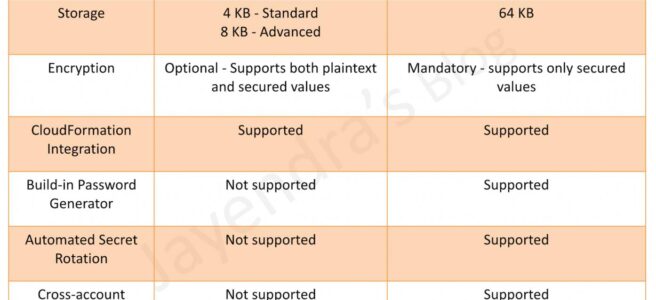
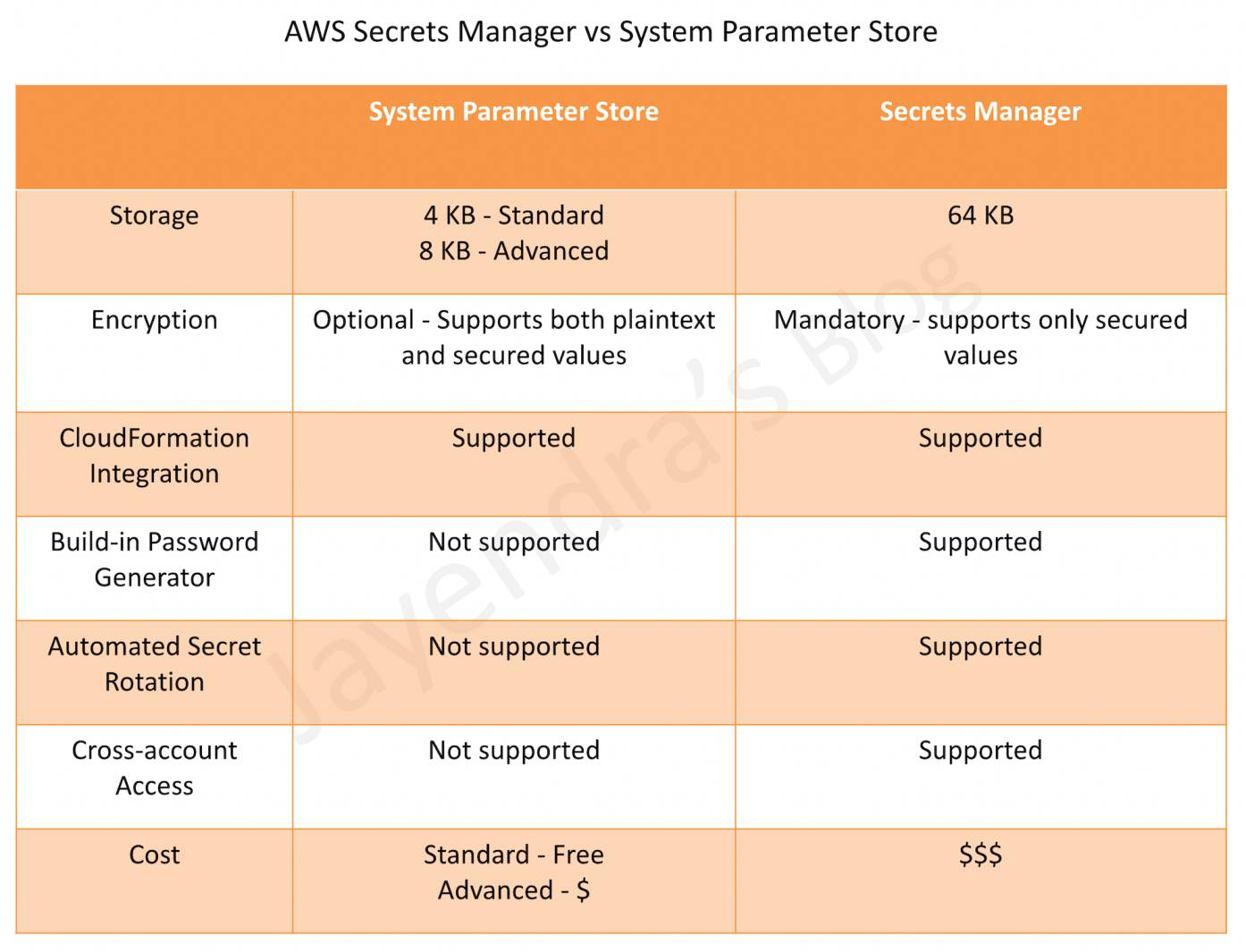
Secrets Manager vs Systems Manager Parameter Store
Key Differences:
Secrets Manager is designed specifically for secrets with built-in rotation; Parameter Store is a general-purpose configuration store.
Secrets Manager supports managed rotation (no Lambda needed for supported databases); Parameter Store requires custom Lambda for rotation.
Secrets Manager charges per secret ($0.40/month) and per API call ($0.05/10K calls); Parameter Store Standard tier is free.
Secrets Manager supports cross-region replication natively; Parameter Store does not.
Secrets Manager supports BatchGetSecretValue; Parameter Store supports GetParameters (up to 10).
AWS Recommendation (2025): Use Secrets Manager for secrets, Parameter Store for simple key-value configuration, and AWS AppConfig for feature flags and advanced dynamic configuration.
AWS Certification Exam Practice Questions
Questions are collected from Internet and the answers are marked as per my knowledge and understanding (which might differ with yours).
AWS services are updated everyday and both the answers and questions might be outdated soon, so research accordingly.
AWS exam questions are not updated to keep up the pace with AWS updates, so even if the underlying feature has changed the question might not be updated
Open to further feedback, discussion and correction.
Which AWS service makes it easy for you to easily rotate, manage, and retrieve database credentials, API keys, and other secrets throughout their lifecycle?
AWS WAF
AWS Secrets Manager
AWS Systems Manager
AWS Shield
A company uses Amazon RDS for PostgreSQL databases for its data tier. The company must implement password rotation for the databases. Which solution meets this requirement with the LEAST operational overhead?
Store the password in AWS Secrets Manager. Enable automatic rotation on the secret.
Store the password in AWS Systems Manager Parameter Store. Enable automatic rotation on the parameter.
Store the password in AWS Systems Manager Parameter Store. Write an AWS Lambda function that rotates the password.
Store the password in AWS Key Management Service (AWS KMS). Enable automatic rotation on the customer master key (CMK).
A company has multiple applications that retrieve database credentials from AWS Secrets Manager at a high rate, causing throttling. Which approach should the company use to address this issue with MINIMAL code changes?
Increase the Secrets Manager service quota for API calls.
Implement client-side caching using the Secrets Manager caching library or deploy the Secrets Manager Agent for local caching.
Store credentials in Systems Manager Parameter Store instead.
Replicate the secrets to additional regions and distribute read traffic.
A company needs to manage and rotate credentials for multiple third-party SaaS applications (Salesforce, MongoDB Atlas) with the LEAST operational overhead. Which approach should they use?
Write custom Lambda rotation functions for each SaaS provider.
Store credentials in Parameter Store and use EventBridge rules for rotation.
Use AWS Secrets Manager managed external secrets for automated rotation without Lambda functions.
Build a custom rotation service running on ECS.
A company wants to protect its secrets in transit against future quantum computing threats. Which feature of AWS Secrets Manager addresses this requirement?
Use customer-managed KMS keys for encryption at rest.
Enable secret replication across multiple regions.
Use hybrid post-quantum TLS with ML-KEM for Secrets Manager API connections.
Enable automatic secret rotation every 4 hours.
A company runs applications on-premises and in AWS. They need a language-agnostic way to retrieve secrets locally without modifying application code to use the AWS SDK. Which solution provides this capability?
Use AWS Systems Manager Parameter Store with the SSM agent.
Embed secrets in environment variables at deployment time.
Deploy the AWS Secrets Manager Agent (or Workload Credentials Provider) for local HTTP-based secret retrieval with in-memory caching.
Use AWS Lambda to periodically fetch and write secrets to a local file.
Envelope encryption is an optimized method for encrypting data that uses two different keys (Master key and Data key)
Master key is also known as Key Encryption Key – KEK and Data key is also known as Data Encryption Key – DEK.
Envelope encryption reduces the network load for the application or the cloud service as only the request and fulfillment of the much smaller data key through KMS must go over the network.
The data key is used locally by the encrypting service, avoiding the need to send the entire block of data to KMS and suffer network latency.
Root Key
A root key is an encryption key that is used to encrypt other encryption keys, such as data keys and key encryption keys. Unlike data keys and key encryption keys, root keys must be kept in plaintext so they can be used to decrypt the keys that they encrypted.
Key Management Service (KMS) generates and protects the root keys.
Key Encryption Key – KEK
A key encryption key is an encryption key that is used to encrypt a data key or another key encryption key. To protect the
Key encryption key is encrypted by using a root key.
Data Encryption Key – DEK
A data key or data encryption key is an encryption key that is used to protect data.
Data keys differ from root keys and key encryption keys, which are typically used to encrypt other encryption keys.
Envelop Encryption Process
Encryption
Create a Master Key
Generate data key.
KMS returns the plaintext and ciphertext of the data key.
The plaintext data key is used to encrypt each piece of data or resource.
The data key is encrypted under a master key defined in KMS.
The encrypted data key and encrypted data are then stored by the service.
Decryption
Retrieve the ciphertext data key and encrypted files from the persistent storage device or service.
Decrypt the ciphertext data key using the Master key. The plaintext data key is returned.
Use the plaintext data key to decrypt the files.
Encrypting the data key is more efficient than reencrypting the data under the new key because it is quicker and produces a much smaller ciphertext.
Envelope Encryption Benefits
Protecting data keys
When you encrypt a data key, you don’t have to worry about storing the encrypted data key, because the data key is inherently protected by encryption. You can safely store the encrypted data key alongside the encrypted data.
Encrypting the same data under multiple keys
Encryption operations can be time-consuming, particularly when the data being encrypted are large objects.
Instead of re-encrypting raw data multiple times with different keys, you can re-encrypt only the data keys that protect the raw data.
Combining the strengths of multiple algorithms
In general, symmetric key algorithms are faster and produce smaller ciphertexts than public key algorithms.
But public key algorithms provide inherent separation of roles and easier key management.
Envelope encryption lets you combine the strengths of each strategy.
Network Load Balancer – NLB operates at the connection level (Layer 4), routing connections to targets – EC2 instances, and containers based on IP protocol data.
NLB is suited for load balancing of TCP, UDP, TLS, and QUIC traffic.
NLB is capable of handling millions of requests per second while maintaining ultra-low latencies (~100 ms vs 400 ms for ALB)
NLB is optimized to handle sudden and volatile traffic patterns while using a single static IP address per Availability Zone.
NLB also supports TLS termination, preserves the source IP of the clients, and provides stable IP support and Zonal isolation.
NLB supports long-running connections that are very useful for WebSocket-type applications.
NLB now supports security groups (since Aug 2023), enabling filtering of traffic that NLB accepts and forwards to applications.
For TCP traffic,
the load balancer selects a target using a flow hash algorithm based on the protocol, source IP address, source port, destination IP address, destination port, and TCP sequence number.
TCP connections from a client having different source ports and sequence numbers and can be routed to different targets.
Each individual TCP connection is routed to a single target for the life of the connection.
For UDP traffic,
the load balancer selects a target using a flow hash algorithm based on the protocol, source IP address, source port, destination IP address, and destination port.
A UDP flow has the same source and destination, so it is consistently routed to a single target throughout its lifetime.
Different UDP flows have different source IP addresses and ports, so they can be routed to different targets.
For QUIC traffic,
NLB supports QUIC protocol in passthrough mode, forwarding QUIC traffic directly to targets without terminating sessions.
Session stickiness is maintained using QUIC Connection IDs, even when client IP addresses change during network roaming.
QUIC and TCP_QUIC listeners are not allowed on dualstack load balancers or load balancers with associated security groups.
back-end server authentication (MTLS) is not supported on NLB. mTLS is only supported on ALB.
Classic Load Balancer vs Application Load Balancer vs Network Load Balancer
Allows load balancing of TCP, TLS, UDP, TCP_UDP, QUIC, and TCP_QUIC traffic, routing connections to targets – EC2 instances, microservices, and containers.
High Availability
is highly available.
accepts incoming traffic from clients and distributes this traffic across the targets within the same AZ (except for Cross-zone load balancing).
monitors the health of its registered targets and routes the traffic only to healthy targets
if a health check fails and an unhealthy target is detected, it stops routing traffic to that target and reroutes traffic to remaining healthy targets.
if configured with multiple AZs and if all the targets in a single AZ fail, it routes traffic to healthy targets in the other AZs
Availability Zones
can be used to route traffic across multiple Availability Zones.
However, AZ must be enabled before the traffic is routed to that AZ.
AZ can be enabled, even after the NLB creation.
AZ can now be disabled/removed (since Feb 2025) – you can remove one or more availability zones from NLB by updating the list of enabled subnets using the ELB API, CLI, or Console.
Cross-zone load balancing works only for AZs enabled with NLB.
High Throughput
is designed to handle traffic as it grows and can load balance millions of requests/sec.
can also handle sudden volatile traffic patterns.
Low Latency
offers extremely low latencies for latency-sensitive applications.
Security Groups
NLB now supports security groups (since August 2023), enabling you to filter the traffic that your NLB accepts and forwards to your application.
Security groups can be configured with rules to ensure that NLB only accepts traffic from trusted IP addresses and centrally enforces access control policies.
Security group inbound rules can be enforced even when the load balancer converts IPv6 traffic to IPv4 or when targets are in peered VPCs.
Security group association is optional – NLBs can still be created without security groups for backward compatibility.
QUIC and TCP_QUIC listeners are not supported on NLBs with associated security groups.
Cross Zone Load Balancing
enables cross-zone loading balancing only after creating the NLB
is disabled, by default, and charges apply for inter-az traffic.
only works for the AZs that are enabled on the NLB.
can also be configured at the target group level, allowing per-target-group cross-zone settings.
Sticky Sessions
Sticky sessions (source IP affinity) are a mechanism to route requests from the same client to the same target.
Stickiness is defined at the target group level.
For QUIC traffic, stickiness is maintained using QUIC Connection IDs.
Load Balancing using IP addresses as Targets
allows load balancing of any application hosted in AWS or on-premises using IP addresses of the application backends as targets.
allows load balancing to an application backend hosted on any IP address and any interface on an instance.
ability to load balance across AWS and on-premises resources help migrate-to-cloud, burst-to-cloud or failover-to-cloud.
applications hosted in on-premises locations can be used as targets over a Direct Connect connection.
supports registering targets using IPv6 addresses (since Oct 2023).
Preserve Source IP Address
preserves client-side source IP allowing the back-end to see the client IP address.
Target groups can be created with target type as instance ID or IP address.
If targets are registered by instance ID or ECS tasks, the source IP addresses of the clients are preserved and provided to the applications.
If targets are registered by IP address
for TCP & TLS, the source IP addresses are the private IP addresses of the load balancer nodes. Use Proxy Protocol.
for UDP & TCP_UDP, it is enabled by default and the source IP addresses of the clients are preserved.
Static IP support
automatically provides a static IP per Availability Zone (subnet) that can be used by applications as the front-end IP of the load balancer.
creates a network interface for each enabled AZ. Each load balancer node in the AZ uses this network interface to get a static IP address.
Internet-facing load balancer can optionally associate one Elastic IP address per subnet.
Elastic IP support
an Elastic IP per Availability Zone (subnet) can also be assigned, optionally, thereby providing a fixed IP.
Configurable TCP Idle Timeout
TCP idle timeout can now be configured to any value between 60-6000 seconds (since Sep 2024).
The default idle timeout for TCP flows is 350 seconds.
Previously, this was a fixed value of 350 seconds that could not be modified.
Configurable timeout helps reduce latency for long-lived traffic flows by maintaining target stickiness for the optimal duration.
The connection idle timeout for TLS listeners remains fixed at 350 seconds.
UDP connections have a fixed 120 second idle timeout.
Clients or targets can use TCP keepalive packets to restart the idle timeout.
Health Checks
supports both network and application target health checks using HTTP, HTTPS, and TCP.
Network-level health check
is based on the overall response of the underlying target (instance or a container) to normal traffic.
target is marked unavailable if it is slow or unable to respond to new connection requests
Application-level health check
is based on a specific URL on a given target to test the application health deeper
Target group health settings can be configured to define minimum healthy target count/percentage and actions when thresholds are not met (since Nov 2022).
Unhealthy target connection termination can be disabled, allowing active connections to persist even when targets fail health checks (since Oct 2023).
Route 53 will direct traffic to load balancer nodes in other AZs, if there are no healthy targets with NLB or if the NLB itself is unhealthy
if NLB is unresponsive, Route 53 will remove the unavailable load balancer IP address from service and direct traffic to an alternate Network Load Balancer in another region.
Zonal Shift and Autoshift (Route 53 ARC)
NLB integrates with Amazon Application Recovery Controller (ARC) for zonal shift capabilities.
Zonal Shift allows you to manually shift NLB traffic away from an impaired Availability Zone.
Zonal Autoshift allows AWS to automatically shift traffic away from an AZ when it detects a potential failure, reducing time to recovery.
Zonal shift is disabled by default and must be enabled on each NLB.
Works only when cross-zone load balancing is turned off (the default for NLB).
Provides automated recovery without manual intervention during AZ impairments.
supports long-lived TCP connections ideal for WebSocket-type of applications
with configurable idle timeout (60-6000 seconds), long-lived connections can be maintained optimally.
Central API Support
uses the same API as Application Load Balancer.
enables you to work with target groups, health checks, and load balance across multiple ports on the same EC2 instance to support containerized applications.
Robust Monitoring and Auditing
integrated with CloudWatch to report Network Load Balancer metrics.
CloudWatch provides metrics such as Active Flow count, Healthy Host Count, New Flow Count, Processed bytes, ZonalHealthStatus, and more.
integrated with CloudTrail to track API calls to the NLB
Resource Map (since Apr 2024) provides a visual representation of load balancer resources and their relationships in the console.
Enhanced Logging
NLB access logs capture information about TLS requests sent to the load balancer, stored in Amazon S3.
Flow Logs feature helps record all requests sent to the load balancer.
Flow Logs capture information about the IP traffic going to and from network interfaces in the VPC.
Flow log data is stored using CloudWatch Logs.
Zonal Isolation
is designed for application architectures in a single zone.
can be enabled in a single AZ to support architectures that require zonal isolation
automatically fails-over to other healthy AZs, if something fails in an AZ
it’s recommended to configure the load balancer and targets in multiple AZs for achieving high availability
Zonal DNS Name
supports DNS names for each of its nodes.
by default, resolving the Regional NLB DNS name returns the IP address for all NLB nodes in all enabled AZs.
can be used to determine the IP address of each node.
useful to minimize latency and inter-az data transfer costs.
Zonal DNS Affinity (since Oct 2023) allows clients resolving the load balancer DNS to receive an IP address in the same AZ they are in, supporting affinity levels of 100%, 85%, or 0%.
TLS Offloading
NLB supports client TLS session termination, allowing TLS termination tasks to be offloaded to the load balancer while preserving the source IP address for back-end applications.
Predefined security policies can be selected for TLS listeners to meet compliance and security standards.
Supports SNI (Server Name Indication) to serve multiple secure websites using a single TLS listener.
Supports RSA 3072-bit and ECDSA 256/384/521-bit certificates via ACM (since Jan 2024).
Supports FIPS 140-3 cryptographic modules for TLS termination (since Nov 2023).
Supports Post-Quantum TLS (PQ-TLS) key exchange using ML-KEM768 to protect against “Harvest Now, Decrypt Later” (HNDL) attacks (since Nov 2025).
ALPN (Application-Layer Protocol Negotiation) policies supported for TLS listeners.
IP Address Types
IPv4 – clients connect using IPv4 addresses only.
Dualstack – clients can connect using both IPv4 and IPv6 addresses.
UDP over IPv6 is supported for dualstack load balancers (since Oct 2024).
Internal dualstack NLB access through the internet gateway is blocked to prevent unintended internet access.
Weighted Target Groups
NLB supports weighted target groups (since Nov 2025), allowing multiple target groups per listener with configurable weights ranging from 0 to 999.
Enables blue/green deployments, canary deployments, application migration, and A/B testing with zero downtime.
Eliminates the need for multiple load balancers to perform traffic splitting.
Provides precise control over traffic distribution between target groups.
QUIC Protocol Support
NLB supports QUIC protocol in passthrough mode (since Nov 2025), forwarding QUIC traffic directly to targets without terminating sessions.
Maintains session stickiness using QUIC Connection IDs, even when client IP addresses change during network roaming.
Ideal for mobile-first applications where clients frequently switch between cellular and WiFi networks.
Reduces end-to-end application latency by 25-30% compared to traditional protocols.
TCP_QUIC listeners support HTTP/3 applications with automatic fallback to HTTPS on TCP 443.
Limitations: QUIC/TCP_QUIC listeners are not allowed on dualstack load balancers, load balancers with associated security groups, or NLBs with UDP/TCP_UDP listeners. Only one QUIC or TCP_QUIC listener allowed per NLB.
Secondary IPv4 Addresses
NLB supports configuring up to 7 additional (secondary) IPv4 addresses on its egress network interfaces (since Jul 2025).
Increases concurrent connections per target from 64K to 512K by overcoming the 64K TCP ephemeral port constraint.
Helps resolve port allocation errors in high-connection-count scenarios where source IP preservation cannot be used.
Configurable via the secondary_ips.auto_assigned.per_subnet attribute (valid range: 0-7).
Once set, this value cannot be decreased.
LCU Capacity Reservations
NLB supports Load Balancer Capacity Unit (LCU) Reservations (since Nov 2024) to reserve a static minimum capacity.
Ideal for planned events with sudden high traffic (product launches, sales, traffic migrations).
NLB continues to auto-scale based on traffic, but capacity won’t go below the configured minimum.
Each LCU equals 2.2 Mbps of processed bandwidth.
You pay for reserved LCUs and any additional usage above the reservation.
Advantages over Classic Load Balancer
Ability to handle volatile workloads and scale to millions of requests per second, without the need of pre-warming
Support for static IP/Elastic IP addresses for the load balancer
Support for registering targets by IP address, including targets outside the VPC (on-premises) for the load balancer.
Support for routing requests to multiple applications on a single EC2 instance. A single instance or IP address can be registered with the same target group using multiple ports.
Support for containerized applications. Using Dynamic port mapping, ECS can select an unused port when scheduling a task and register the task with a target group using this port.
Support for monitoring the health of each service independently, as health checks are defined at the target group level and many CloudWatch metrics are reported at the target group level. Attaching a target group to an Auto Scaling group enables scaling each service dynamically based on demand
Support for security groups, enabling centralized access control policies
Support for QUIC protocol for low-latency mobile-first applications
Support for weighted target groups enabling blue/green and canary deployments
Network Load Balancer Limitations
can’t associate Security Groups with NLBs – NLB now supports security groups (since Aug 2023)
can’t disable/remove an AZ once you enable it – NLB now supports removing AZs (since Feb 2025)
can’t modify ENIs created by NLB in each AZ
can’t change EIPs and Private IPs attached to the ENIs after NLB creation.
can’t register EC2 instances by instance ID for instances in another VPC even if VPC peering is done.
QUIC/TCP_QUIC listeners not allowed on dualstack NLBs or NLBs with security groups.
mTLS (Mutual TLS) is not supported – only available on ALB.
TLS listener idle timeout is fixed at 350 seconds and cannot be modified.
Network Load Balancer with AWS PrivateLink
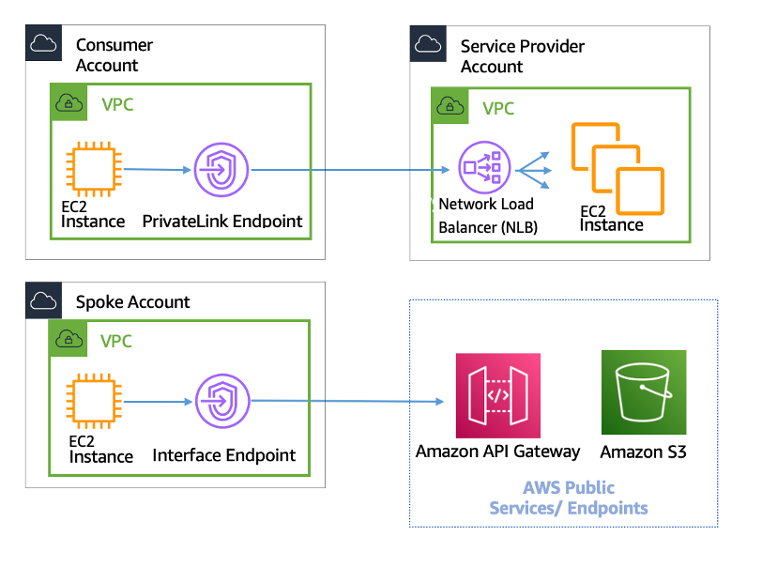
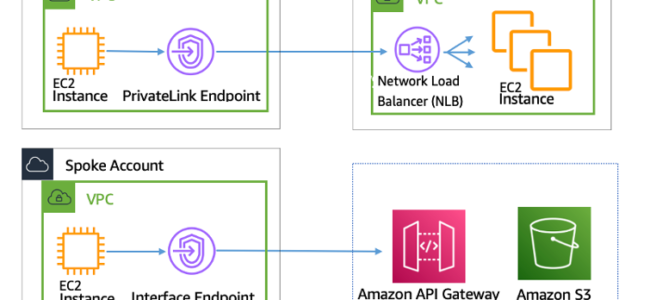
Interface Endpoints can be used to create custom applications in VPC and configure them as an AWS PrivateLink-powered service (referred to as an endpoint service) exposed through a Network Load Balancer. The custom applications can be hosted within AWS or on-premises.
Network Load Balancer Pricing
charged for each hour or partial hour that an NLB is running and the number of Load Balancer Capacity Units (LCU) used per hour.
An LCU is a metric for determining NLB pricing
An LCU defines the maximum resource consumed in any one of the dimensions (new connections/flows, active connections/flows, bandwidth and rule evaluations) the Network Load Balancer processes your traffic.
If using LCU Capacity Reservations, you pay for reserved LCUs per minute plus any additional LCUs used beyond the reservation.
AWS Certification Exam Practice Questions
Questions are collected from Internet and the answers are marked as per my knowledge and understanding (which might differ with yours).
AWS services are updated everyday and both the answers and questions might be outdated soon, so research accordingly.
AWS exam questions are not updated to keep up the pace with AWS updates, so even if the underlying feature has changed the question might not be updated
Open to further feedback, discussion and correction.
A company wants to use load balancer for their application. However, the company wants to forward the requests without any header modification. What service should the company use?
Classic Load Balancer
Network Load Balancer
Application Load Balancer
Use Route 53
A company is hosting an application in AWS for third party access. The third party needs to whitelist the application based on the IP. Which AWS service can the company use in the whitelisting of the IP address?
AWS Application Load Balancer
AWS Classic Load balancer
AWS Network Load Balancer
AWS Route 53
A company wants to restrict inbound traffic to their Network Load Balancer to only specific trusted IP ranges. What is the recommended approach?
Use NACLs on the NLB subnet
Configure WAF with NLB
Associate a security group with the NLB and configure inbound rules
Use Route 53 health checks to filter traffic
A company needs to perform a blue/green deployment for a TCP-based application running behind a Network Load Balancer. They want to gradually shift traffic from the old version to the new version. What is the MOST operationally efficient approach?
Create two NLBs and use Route 53 weighted routing
Use AWS CodeDeploy with two target groups
Configure weighted target groups on the NLB listener to distribute traffic between blue and green target groups
Manually deregister targets from the existing target group and register new targets
A mobile gaming company uses Network Load Balancer for their real-time game servers. Players frequently switch between WiFi and cellular networks, causing connection drops. Which NLB feature helps maintain session continuity during network changes?
Source IP affinity sticky sessions
TCP keepalive packets
QUIC protocol support with Connection ID-based stickiness
Cross-zone load balancing
A company runs a high-throughput application behind an NLB with IP-type targets. They are experiencing TCP port allocation errors because they have over 64,000 concurrent connections to a single target. What should they do?
Enable cross-zone load balancing to distribute traffic
Switch to instance-type targets
Configure secondary IPv4 addresses on the NLB egress interface
Add more targets to the target group
A company wants to ensure their NLB can handle a planned traffic spike during a product launch event without relying on auto-scaling warm-up time. What feature should they use?
Pre-warming request to AWS Support
Cross-zone load balancing
Multiple target groups with higher weights
LCU Capacity Reservations
An organization wants to protect their TLS-terminated NLB traffic against future quantum computing threats. Which NLB feature addresses this concern?
FIPS 140-3 security policies
Post-Quantum TLS (PQ-TLS) security policies with ML-KEM768
AWS IAM Identity Center (formerly AWS Single Sign-On)
📢 Service Rebranded: AWS Single Sign-On (AWS SSO) was renamed to AWS IAM Identity Center in July 2022. All functionality remains the same. SDKs, CLI, and APIs retain the sso namespace for backward compatibility.
AWS IAM Identity Center is a cloud-based service that makes it easy to centrally manage single sign-on (SSO) access to all AWS accounts and cloud applications.
IAM Identity Center helps manage access and permissions to commonly used third-party software as a service (SaaS) applications, AWS managed applications, as well as custom applications that support SAML 2.0.
IAM Identity Center includes an AWS access portal where end-users can find and access all their assigned AWS accounts, cloud applications, and custom applications in one place.
IAM Identity Center is the recommended service for managing workforce access to AWS applications and multiple AWS accounts.
IAM Identity Center is available at no additional cost in all AWS commercial, GovCloud, and China Regions where it is supported.
IAM Identity Center Features
AWS Organizations Integration
Natively integrates with AWS Organizations and enumerates all the AWS accounts.
Configures and maintains all the necessary permissions for accounts automatically, without requiring any additional setup in individual accounts.
SSO access to AWS accounts and cloud applications
Helps manage Single Sign-On across all AWS accounts, cloud applications, AWS managed applications, and custom SAML 2.0–based applications, without custom scripts or third-party SSO solutions.
Supports pre-integrated business applications including Salesforce, Box, Microsoft 365, and hundreds of others.
Create and manage users and groups in IAM Identity Center
Provides a built-in identity store to create and manage users and groups directly.
Supports connecting to an existing AWS Managed Microsoft AD directory through AWS Directory Service.
Supports external identity providers (IdPs) via SAML 2.0 and SCIM 2.0 for automated user provisioning.
Leverage existing corporate identities
Integrates with Microsoft Active Directory through AWS Directory Service.
Supports external IdPs including Okta Universal Directory, Microsoft Entra ID (formerly Azure AD), Ping Identity, JumpCloud, and others.
Permission Sets
Permission sets are collections of one or more IAM policies that define the access for users/groups.
IAM Identity Center creates IAM roles based on permission sets and attaches the specified policies in each assigned account.
Multiple permission sets can be assigned to the same user.
Permissions can be based on common job functions or customized to meet specific security requirements.
Multi-factor Authentication (MFA)
Supports enforcement of MFA for all users, including requirement to set up MFA during sign-in.
AWS Management – AWS Systems Manager Change Manager
AWS AI/ML – Amazon SageMaker Unified Studio
AWS Storage – AWS Transfer Family web apps
Monitoring – AWS CloudTrail for auditing all administrative and access activity
AWS Certification Exam Practice Questions
Questions are collected from Internet and the answers are marked as per my knowledge and understanding (which might differ with yours).
AWS services are updated everyday and both the answers and questions might be outdated soon, so research accordingly.
AWS exam questions are not updated to keep up the pace with AWS updates, so even if the underlying feature has changed the question might not be updated
Open to further feedback, discussion and correction.
Which of the following can a customer use to enable single sign-on (SSO) to the AWS Console?
Amazon Connect
AWS IAM Identity Center (formerly AWS Single Sign-On)
Amazon Pinpoint
Amazon Rekognition
A company uses AWS Organizations with multiple AWS accounts. The company needs to provide centralized access management for all accounts. Users should be able to sign in once and access multiple accounts based on their job function. What is the recommended approach?
Create IAM users in each account and configure cross-account roles
Use AWS IAM Identity Center with permission sets to manage multi-account access
Use Amazon Cognito user pools for workforce identity federation
Create a custom SAML identity provider in each account
A company uses AWS Organizations and AWS IAM Identity Center. The company needs to restrict development teams to use only specific AWS Regions and specific AWS services. Which solution meets this requirement with the LEAST operational overhead?
Use IAM Identity Center to set up service-linked roles with IAM policy conditions
Deactivate AWS STS in Regions that developers are not allowed to use
Create SCPs that include Condition, Resource, and NotAction elements to allow access to only specific Regions and services
For each account, create tailored identity-based policies for IAM Identity Center
A company wants to connect their existing Okta Universal Directory as the identity source for AWS IAM Identity Center. Which protocol does IAM Identity Center use for automatic provisioning of users and groups from Okta?
OAuth 2.0
OpenID Connect (OIDC)
SCIM 2.0 (System for Cross-domain Identity Management)
LDAP
A company is using AWS IAM Identity Center and wants to grant fine-grained permissions to users based on their department and cost center attributes from their identity provider. Which IAM Identity Center feature should they use?
Permission boundaries
Service Control Policies (SCPs)
Resource-based policies
Attribute-Based Access Control (ABAC)
An analytics team needs to access data across Amazon Redshift, Amazon S3 via Lake Formation, and Amazon QuickSight using their corporate identity without managing separate credentials for each service. Which IAM Identity Center feature enables this?
AWS Route 53 routing policy determines how AWS would respond to the DNS queries and provides multiple routing policy options.
Simple Routing Policy
Simple routing policy is a simple round-robin policy and can be applied when there is a single resource doing the function for the domain e.g. web server that serves content for the website.
Simple routing helps configure standard DNS records, with no special Route 53 routing such as weighted or latency.
Route 53 responds to the DNS queries based on the values in the resource record set e.g. IP address in an A record.
Simple routing does not allow the creation of multiple records with the same name and type, but multiple values can be specified in the same record, such as multiple IP addresses.
Route 53 displays all the values to resolve it recursively in random order and the resolver displays the values for the client. The client then chooses a value and resends the query.
Simple routing policy does not support health checks, so the record would be returned to the client even if it is unhealthy.
With Alias record enabled, only one AWS resource or one record can be specified in the current hosted zone.
Simple routing can be used to create records in a private hosted zone.
Weighted Routing Policy
Weighted routing policy helps route traffic to different resources in specified proportions (weights) e.g., 75% to one server and 25% to theother during a pilot release
Weights can be assigned between any number from 0 to 255 inclusive.
Weighted routing policy can be applied when there are multiple resources that perform the same function e.g., webservers serving the same site
Weighted resource record sets allow associating multiple resources with a single DNS name.
Weighted routing policy use cases include
load balancing between regions
A/B testing and piloting new versions of software
To create a group of weighted resource record sets, two or more resource record sets can be created that has the same combination of DNS name and type, and each resource record set is assigned a unique identifier and a relative weight.
When processing a DNS query, Route 53 searches for a resource record set or a group of resource record sets that have the specified name and type.
Route 53 selects one from the group. The probability of any one resource record set being selected depends on its weight as a proportion of the total weight for all resource record sets in the group for e.g., suppose www.example.com has three resource record sets with weights of 1 (20%), 1 (20%), and 3 (60%)(sum = 5). On average, Route 53 selects each of the first two resource records sets one-fifth of the time and returns the third resource record set three-fifths of the time.
Weighted routing policy supports health checks.
Weighted routing can be used to create records in a private hosted zone.
Latency-based Routing (LBR) Policy
Latency-based Routing Policy helps respond to the DNS query based on which data center gives the user the lowest network latency.
Latency-based routing policy can be used when there are multiple resources performing the same function and Route 53 needs to be configured to respond to the DNS queries with the resources that provide the fastest response with the lowest latency.
A latency resource record set can be created for the EC2 resource in each region that hosts the application. When Route 53 receives a query for the corresponding domain, it selects the latency resource record set for the EC2 region that gives the user the lowest latency. Route 53 then responds with the value associated with that resource record set for e.g., you might have web servers for example.com in the EC2 data centers in Ireland and in Tokyo. When a user browses example.com from Singapore, Route 53 will pick up the data center (Tokyo) which has the lowest latency from the user’s location
Latency between hosts on the Internet can change over time as a result of changes in network connectivity and routing. Latency-based routing is based on latency measurements performed over a period of time, and the measurements reflect these changes for e.g. if the latency from the user in Singapore to Ireland improves, the user can be routed to Ireland
Latency-based routing cannot guarantee users from the same geographic will be served from the same location for any compliance reason
Latency resource record sets can be created using any record type that Route 53 supports except NS or SOA.
Latency-based routing policy supports health checks.
Latency-based routing can be used to create records in a private hosted zone.
Failover Routing Policy
Failover routing policy allows active-passive failover configuration, in which one resource (primary) takes all traffic when it’s healthy and the other resource (secondary) takes all traffic when the first isn’t healthy.
Route 53 health checking agents will monitor each location/endpoint of the application to determine its availability.
Failover routing policy is applicable for Public hosted zones only.
Failover routing can be used to create records in a private hosted zone.
Geolocation Routing Policy
Geolocation routing policy helps respond to DNS queries based on the geographic location of the users i.e. location from which the DNS queries originate.
Geolocation routing policy use cases include
localization of content and presenting some or all of the website in the user’s language
restrict distribution of content to only the locations in which you have distribution rights.
balancing load across endpoints in a predictable, easy-to-manage way, so that each user location is consistently routed to the same endpoint.
Geolocation routing policy allows geographic locations to be specified by continent, country, or by state (only in the US)
Geolocation record sets, if created, for overlapping geographic regions for e.g. continent, and then for the country within the same continent, priority goes to the smallest geographic region, which allows some queries for a continent to be routed to one resource and queries for selected countries on that continent to a different resource
Geolocation works by mapping IP addresses to locations, which might not be mapped to an exact geographic location.
A default resource record set can be created to handle these queries and also the ones which do not have an explicit record set created.
Route 53 returns a “no answer” response for queries from those locations if a default resource record set is not created.
Two geolocation resource record sets that specify the same geographic location cannot be created.
Route 53 supports the edns-client-subnet extension of EDNS0 (EDNS0 adds several optional extensions to the DNS protocol.) to improve the accuracy of geolocation routing.
Geolocation routing can be used to create records in a private hosted zone. For private hosted zones, Route 53 responds to DNS queries based on the AWS Region of the VPC that the query originated from.
Geoproximity Routing Policy
Geoproximity routing helps route traffic to the resources based on the geographic location of the users and the resources.
Geoproximity routing can be configured with a bias to optionally choose to route more traffic or less to a given resource. A bias expands or shrinks the size of the geographic region from which traffic is routed to a resource.
A positive bias (1 to 99) increases the size of the geographic region, routing more traffic to the resource. A negative bias (-1 to -99) shrinks the region.
Route 53 supports specifying the resource location using the AWS Region, AWS Local Zone group, or latitude and longitude coordinates.
Geoproximity routing is now available as a standard routing policy for DNS records in both public and private hosted zones (expanded in January 2024), in addition to being available through Route 53 Traffic Flow.
Route 53 Traffic flow supports geoproximity routing for AWS Local Zones (since October 2023), enabling reduced latency for end users connecting to applications in their nearest Local Zone.
Geoproximity routing supports health checks.
IP-based Routing Policy
IP-based routing (launched June 2022) allows fine-tuning DNS routing based on the source IP address of the DNS query, using user-IP-to-endpoint mappings.
IP-based routing gives granular control to optimize performance or reduce network costs by uploading data to Route 53 in the form of client IP to location mappings.
IP-based routing use cases include:
Routing end users from certain ISPs to specific endpoints to optimize network transit costs or performance.
Adding overrides to existing Route 53 routing types, such as geolocation routing, based on knowledge of clients’ physical locations.
IP ranges are managed using CIDR collections and CIDR locations:
CIDR block – An IP range in CIDR notation, e.g., 192.0.2.0/24 or 2001:DB8::/32
CIDR location – A named list of CIDR blocks, e.g., example-isp-seattle = [192.0.2.0/24, 203.0.113.0/22]
CIDR collection – A named collection of locations that can be reused across records
For IPv4, CIDR blocks between 1 and 24 bits are supported. For IPv6, CIDR blocks between 1 and 48 bits are supported.
For DNS queries with a CIDR longer than the one specified in the collection, Route 53 matches it to the shorter CIDR.
A default (“*”) location can be used to handle queries that don’t match any specified CIDR block.
IP-based routing cannot be used for records in a private hosted zone.
IP-based routing supports health checks.
Multivalue Routing Policy
Multivalue routing helps return multiple values, e.g. IP addresses for the web servers, in response to DNS queries.
Multivalue routing also helps check the health of each resource, so only the values for healthy resources are returned.
Route 53 responds to DNS queries with up to eight healthy records and gives different answers to different DNS resolvers.
Multivalue answer routing is not a substitute for a load balancer, but the ability to return multiple health-checkable IP addresses is a way to use DNS to improve availability and load balancing.
To route traffic approximately randomly to multiple resources, such as web servers, one multivalue answer record can be created for each resource and, optionally, associate a Route 53 health check with each record. If a web server becomes unavailable after the resolver caches a response, client software can try another IP address in the response.
Multivalue answer routing can be used to create records in a private hosted zone.
Route 53 Traffic Flow
Route 53 Traffic Flow helps easily manage traffic globally through a variety of routing types combined with DNS Failover in order to enable a variety of low-latency, fault-tolerant architectures.
Traffic Flow provides a visual editor to easily manage how the end-users are routed to the application’s endpoints – whether in a single AWS region or distributed around the globe.
Traffic Flow introduced a new enhanced visual editor (March 2025) with a clearer sidebar-based configuration, undo/redo functionality, and a built-in JSON text editor for directly editing traffic policy documents in the browser.
Traffic Flow routes traffic based on multiple criteria, such as endpoint health, geographic location, and latency.
Traffic Flow’s versioning feature maintains a history of changes to the traffic policies to allow easy rollback to the previous version.
Traffic Flow supports geoproximity routing for AWS Local Zones.
Route 53 Routing Policies in Private Hosted Zones
Route 53 supports the following routing policies in private hosted zones:
Simple routing
Failover routing
Multivalue answer routing
Weighted routing
Latency-based routing (supported since March 2022)
Geolocation routing (supported since March 2022; routes based on the AWS Region of the VPC the query originates from)
Geoproximity routing (supported since January 2024)
IP-based routing is not supported in private hosted zones.
Route 53 Complex Routing Policies
Route 53 can be used to define more complex and nested routing policies
A combination of alias records (such as weighted alias and failover alias) and non-alias records can be used to build a decision tree that gives you greater control over how Route 53 responds to requests.
Resources would be created from the bottom of the tree
Route 53 Application Recovery Controller (ARC)
Route 53 Application Recovery Controller (ARC) helps prepare for and quickly mitigate impairments for applications on AWS.
ARC provides routing controls – simple on/off switches hosted on a highly available cluster – that can be used to control routing of client traffic in and out of application cells (regions or availability zones).
Routing controls support failover across any AWS service that has a DNS endpoint.
ARC supports:
Zonal Shift – Temporarily move traffic away from an impaired Availability Zone
Zonal Autoshift – Automatically shift traffic away from AZs with detected impairments
Routing Control – Manually control traffic routing across regions with extreme reliability
Safety rules can be configured to prevent simultaneous disabling of all routing controls, ensuring at least one region remains active.
ARC routing control health checks integrate with Route 53 failover records to enable instant DNS-based failover.
Route 53 Accelerated Recovery
Route 53 Accelerated Recovery (launched November 2025) provides a 60-minute recovery time objective (RTO) for regaining the ability to make DNS changes to public hosted zone records if AWS services in US East (N. Virginia) become unavailable.
When enabled, Route 53 achieves built-in failover of the control plane to the Oregon Region (us-west-2).
DNS resolution for existing records continues to function normally during any disruption; accelerated recovery specifically addresses the ability to make changes to DNS records.
Accelerated recovery must be explicitly enabled per public hosted zone.
Route 53 Global Resolver
Route 53 Global Resolver (GA March 2026) provides managed anycast DNS resolution for clients outside AWS VPCs, including on-premises data centers, branch offices, and remote locations.
Global Resolver uses anycast IP addresses that automatically route DNS queries to the nearest AWS Region for optimal latency and availability.
Key capabilities include:
Resolution of public internet domains and private domains associated with Route 53 private hosted zones from any location
DNS traffic filtering to prevent DNS-based data exfiltration
Encrypted queries via DNS-over-HTTPS (DoH) and DNS-over-TLS (DoT)
Centralized logging for compliance and security monitoring
Multi-region deployment with automatic failover
Available across 30+ AWS Regions with support for both IPv4 and IPv6 DNS query traffic.
AWS Certification Exam Practice Questions
Questions are collected from Internet and the answers are marked as per my knowledge and understanding (which might differ with yours).
AWS services are updated everyday and both the answers and questions might be outdated soon, so research accordingly.
AWS exam questions are not updated to keep up the pace with AWS updates, so even if the underlying feature has changed the question might not be updated
Open to further feedback, discussion and correction.
You have deployed a web application targeting a global audience across multiple AWS Regions under the domain name example.com. You decide to use Route 53 Latency-Based Routing to serve web requests to users from the region closest to the user. To provide business continuity in the event of server downtime you configure weighted record sets associated with two web servers in separate Availability Zones per region. During a DR test you notice that when you disable all web servers in one of the regions Route 53 does not automatically direct all users to the other region. What could be happening? (Choose 2 answers)
Latency resource record sets cannot be used in combination with weighted resource record sets.
You did not setup an http health check for one or more of the weighted resource record sets associated with the disabled web servers
The value of the weight associated with the latency alias resource record set in the region with the disabled servers is higher than the weight for the other region.
One of the two working web servers in the other region did not pass its HTTP health check
You did not set “Evaluate Target Health” to “Yes” on the latency alias resource record set associated with example.com in the region where you disabled the servers.
The compliance department within your multi-national organization requires that all data for your customers that reside in the European Union (EU) must not leave the EU and also data for customers that reside in the US must not leave the US without explicit authorization. What must you do to comply with this requirement for a web based profile management application running on EC2?
Run EC2 instances in multiple AWS Availability Zones in single Region and leverage an Elastic Load Balancer with session stickiness to route traffic to the appropriate zone to create their profile (should be in 2 different regions – US and Europe)
Run EC2 instances in multiple Regions and leverage Route 53’s Latency Based Routing capabilities to route traffic to the appropriate region to create their profile (Latency based routing policy would not guarantee the compliance requirement)
Run EC2 instances in multiple Regions and leverage a third party data provider to determine if a user needs to be redirect to the appropriate region to create their profile
Run EC2 instances in multiple AWS Availability Zones in a single Region and leverage a third party data provider to determine if a user needs to be redirect to the appropriate zone to create their profile(should be in 2 different regions – US and Europe)
A US-based company is expanding their web presence into Europe. The company wants to extend their AWS infrastructure from Northern Virginia (us-east-1) into the Dublin (eu-west-1) region. Which of the following options would enable an equivalent experience for users on both continents?
Use a public-facing load balancer per region to load-balance web traffic, and enable HTTP health checks.
Use a public-facing load balancer per region to load-balance web traffic, and enable sticky sessions.
Use Amazon Route 53, and apply a geolocation routing policy to distribute traffic across both regions
Use Amazon Route 53, and apply a weighted routing policy to distribute traffic across both regions.
You have been asked to propose a multi-region deployment of a web-facing application where a controlled portion of your traffic is being processed by an alternate region. Which configuration would achieve that goal?
Route 53 record sets with weighted routing policy
Route 53 record sets with latency based routing policy
Auto Scaling with scheduled scaling actions set
Elastic Load Balancing with health checks enabled
Your company is moving towards tracking web page users with a small tracking image loaded on each page. Currently you are serving this image out of us-east, but are starting to get concerned about the time it takes to load the image for users on the west coast. What are the two best ways to speed up serving this image? Choose 2 answers
Use Route 53’s Latency Based Routing and serve the image out of us-west-2 as well as us-east-1
Serve the image out through CloudFront
Serve the image out of S3 so that it isn’t being served of your web application tier
Use EBS PIOPs to serve the image faster out of your EC2 instances
Your API requires the ability to stay online during AWS regional failures. Your API does not store any state, it only aggregates data from other sources – you do not have a database. What is a simple but effective way to achieve this uptime goal?
Use a CloudFront distribution to serve up your API. Even if the region your API is in goes down, the edge locations CloudFront uses will be fine.
Use an ELB and a cross-zone ELB deployment to create redundancy across datacenters. Even if a region fails, the other AZ will stay online.
Create a Route53 Weighted Round Robin record, and if one region goes down, have that region redirect to the other region.
Create a Route53 Latency Based Routing Record with Failover and point it to two identical deployments of your stateless API in two different regions. Make sure both regions use Auto Scaling Groups behind ELBs. (Refer link)
A company needs to route DNS traffic for their application based on the IP addresses of their clients. They want to optimize costs by routing traffic from a specific ISP to a particular endpoint. Which Route 53 routing policy should they use?
Geolocation routing policy
Latency-based routing policy
IP-based routing policy
Weighted routing policy
A company uses Route 53 to manage DNS for their multi-region application. They want to ensure that during a regional AWS outage, they can still make DNS changes to their public hosted zone within 60 minutes. Which Route 53 feature should they enable?
Route 53 Application Recovery Controller
Route 53 Failover routing policy
Route 53 Accelerated Recovery for public hosted zones
Route 53 Global Resolver
A company wants to route traffic to the geographically nearest resource and also wants to shift more traffic to a newly launched region by expanding its geographic catchment area. Which Route 53 routing policy should they use?
Geolocation routing policy with a default record
Latency-based routing policy
Weighted routing policy with regional endpoints
Geoproximity routing policy with a positive bias for the new region
An organization with branch offices needs secure DNS resolution for both public domains and Route 53 private hosted zones from their on-premises locations. They require encrypted DNS queries and centralized logging. Which Route 53 feature best meets these requirements?
Route 53 Resolver (also known as VPC Resolver) provides automatic DNS resolution within the VPC. It can help resolve DNS queries between VPCs and on-premises networks.
By default, Resolver answers DNS queries for VPC domain names such as domain names for EC2 instances or ELB load balancers.
Route 53 Resolver performs recursive lookups against public name servers for all other domain names.
However, on-premises instances cannot resolve Route 53 DNS entries and Route 53 cannot resolve on-premises DNS entries.
DNS resolution between VPC and on-premises network can be configured over a Direct Connect or VPN connection.
Route 53 Resolver is regional.
To use inbound or outbound forwarding, create a Resolver endpoint in the VPC.
As part of the definition of an endpoint, specify the IP addresses to forward inbound DNS queries to or the IP addresses that outbound queries originate from. For each IP address specified, Resolver automatically creates a VPC elastic network interface.
Resolver endpoints support DNS over UDP (Do53) and DNS-over-HTTPS (DoH) protocols for encrypted DNS queries.
Resolver endpoints support Server Name Indication (SNI) validation for DoH connections, enabling verification of the server’s identity.
Resolver rules and DNS Firewall rule groups can be shared across accounts using AWS Resource Access Manager (RAM).
Inbound Endpoint – Forward DNS queries from resolvers on your network to AWS
DNS resolvers on the on-premises networks can forward DNS queries to Resolver in a specified VPC.
This enables DNS resolvers to easily resolve domain names for AWS resources such as EC2 instances or records in a Route 53 private hosted zone.
Inbound endpoints support Do53 and DoH protocols.
Inbound endpoints can be used for DNS delegation, allowing subdomain authority to be delegated between on-premises and cloud infrastructure.
Outbound Endpoint – Conditionally forward queries from a VPC to resolvers on your network
Route 53 Resolver can be configured to forward queries that it receives from EC2 instances in the VPCs to DNS resolvers on the on-premises networks.
To forward selected queries, Resolver rules can be created that specify the domain names for the DNS queries that you want to forward (such as example.com), and the IP addresses of the DNS resolvers on the on-premises network that you want to forward the queries to.
If a query matches multiple rules (example.com, acme.example.com), Resolver chooses the rule with the most specific match (acme.example.com) and forwards the query to the IP addresses that you specified in that rule.
Outbound endpoints support Do53 and DoH protocols for encrypting forwarded DNS traffic.
Resolver Rules
Resolver rules control which DNS queries are forwarded to on-premises resolvers and which are resolved locally.
Forward rules – Forward DNS queries for a specified domain name to the IP addresses of on-premises DNS resolvers.
System rules – Selectively override the behavior defined in a forward rule. A system rule causes Resolver to resolve the query locally (within the VPC).
Auto-defined system rules – Automatically created rules for AWS-specific domain names and reverse DNS queries.
If a “.” (dot) or “com” forward rule is created, it is recommended to also create a system rule for amazonaws.com to ensure AWS service resolution works correctly.
Resolver rules can be shared across AWS accounts using AWS RAM, enabling centralized DNS forwarding management.
Resolver Query Logging
Resolver query logging allows logging of all DNS queries made by resources within VPCs.
Logs can be sent to Amazon CloudWatch Logs, Amazon S3, or Amazon Data Firehose.
Query logs include information such as the domain name queried, source IP, response code, and the Route 53 Resolver endpoint or firewall rule that processed the query.
Query logging configurations can be shared across AWS accounts.
Only unique queries are logged; queries answered from the Resolver cache are not logged.
DNSSEC Validation
Route 53 Resolver supports DNSSEC validation, which verifies that DNS responses have not been tampered with in transit.
When DNSSEC validation is enabled, Resolver validates the authenticity and integrity of DNS responses from public nameservers for DNSSEC-signed domains.
DNSSEC validation provides protection against DNS spoofing and cache poisoning attacks.
DNSSEC validation can be enabled per VPC.
Resolver Endpoint Metrics
Route 53 Resolver provides detailed CloudWatch metrics for monitoring endpoint health and performance.
Capacity Utilization metric – Helps monitor whether the endpoint is approaching query capacity limits. (Launched June 2025)
Detailed metrics – Include P90 response latency, SERVFAIL/NXDOMAIN/REFUSED/FORMERR response tracking, and target name server availability for outbound endpoints. (Launched December 2025)
Metrics are available at the Resolver Network Interface and Target Name Server levels.
Route 53 Resolver DNS Firewall
Route 53 Resolver DNS Firewall lets you control access to sites and block DNS-level threats for DNS queries going out from your VPC through the Route 53 VPC Resolver.
DNS Firewall allows you to define domain name filtering rules in rule groups that you associate with your VPCs.
You can specify lists of domain names to allow or block, and customize responses for blocked queries (NXDOMAIN, NODATA, or specific DNS responses).
DNS Firewall only filters on the domain name; it does not resolve that name to an IP address to be blocked.
DNS Firewall filters DNS traffic only; it does not filter other application layer protocols (HTTPS, SSH, TLS, FTP, etc.).
DNS Firewall is a feature of Route 53 VPC Resolver and doesn’t require any additional Resolver setup.
DNS Firewall rule groups can be shared across accounts using AWS RAM, managed centrally with AWS Firewall Manager, and applied via Route 53 Profiles.
AWS Managed Domain Lists
AWS provides managed domain lists for known threats, including malware, botnet command and control, and newly registered domains.
Content categories – adult/mature content, gambling, social media, gaming, and other web content types. (Added May 2026)
DNS Firewall Advanced
DNS Firewall Advanced provides intelligent, real-time protection against sophisticated DNS-based threats beyond static domain lists. (Launched November 2024)
DNS Tunneling Detection – Identifies and blocks attempts to use DNS as a covert channel for data exfiltration or command-and-control communication.
Domain Generation Algorithm (DGA) Detection – Identifies and blocks queries to domains created by DGAs commonly used by malware.
Dictionary-based DGA Detection – Detects sophisticated DGA variants that use dictionary words to create more legitimate-looking domains. (Added November 2025)
DNS Firewall Advanced works by inspecting DNS payload characteristics including timestamps, request frequency, query strings, and query length/type/size.
Palo Alto Networks Advanced DNS Security integration (Preview) – Enables enforcement of third-party threat intelligence categories including fast-flux protection, DNS tunneling, DNS rebinding, and DGA detection directly within DNS Firewall rules. (June 2026)
Route 53 Profiles
Route 53 Profiles allow you to define a standard DNS configuration and apply it to multiple VPCs in the same AWS Region. (Launched April 2024)
A Profile can include Route 53 private hosted zone (PHZ) associations, Resolver forwarding rules, and DNS Firewall rule groups.
When you update a Profile, its settings are propagated to all associated VPCs automatically.
Profiles can be shared across AWS accounts using AWS RAM for centralized DNS management.
Profiles simplify multi-account DNS management by eliminating the need to manage individual resource associations per VPC.
Route 53 Profiles is a regional service.
Route 53 Global Resolver
Route 53 Global Resolver is a managed anycast DNS resolver accessible from anywhere over the internet. (Preview November 2025, GA March 2026)
Provides DNS resolution for both public internet domains and Route 53 private hosted zones from on-premises, branch offices, and remote clients.
Uses globally distributed anycast IP addresses that route queries to the nearest available AWS Region.
Supports multiple DNS protocols: DNS over UDP (Do53), DNS-over-HTTPS (DoH), and DNS-over-TLS (DoT).
Requires client authentication via token-based authentication (DoH/DoT) or ACL-based IP/CIDR allowlisting (Do53/DoT/DoH).
Includes built-in DNS traffic filtering using the same DNS Firewall rule capabilities (managed domain lists, custom lists, and advanced protections).
Provides centralized query logging to CloudWatch, S3, or Data Firehose.
Supports DNSSEC validation for public domains.
Must be deployed in a minimum of two AWS Regions for high availability with automatic failover.
Allows adding and removing AWS Regions dynamically for flexible geographic coverage. (May 2026)
Available across 30 AWS Regions with IPv4 and IPv6 support.
Protected against DDoS threats using AWS Shield.
Global Resolver vs VPC Resolver
Global Resolver – Internet-reachable via anycast IPs, designed for on-premises/remote clients, supports Do53/DoH/DoT, requires client authentication.
VPC Resolver – Default VPC recursive resolver, accessible by VPC-hosted clients or via VPN/Direct Connect through Resolver endpoints, DNS encryption available only for hybrid queries over endpoints.
AWS Certification Exam Practice Questions
Questions are collected from Internet and the answers are marked as per my knowledge and understanding (which might differ with yours).
AWS services are updated everyday and both the answers and questions might be outdated soon, so research accordingly.
AWS exam questions are not updated to keep up the pace with AWS updates, so even if the underlying feature has changed the question might not be updated
Open to further feedback, discussion and correction.
A company wants to install a new private intranet service using Amazon EC2 instances inside a Virtual Private Cloud (VPC). The VPC is connected to the company’s on-premises network using an AWS Site-to-Site VPN. The new service must communicate with the on-premises services already in place. On-premises services are accessed using company-owned hostnames. for instance, a DNS zone. This DNS zone is entirely on-premises and accessible only via the company’s private network. To connect the new service with current services, a solutions architect must guarantee that the new service can resolve hostnames on the company’s example domain. Which solution satisfies these criteria?
Create an empty private zone in Route 53 for company.example. Add an additional NS record to the company’s on-premises company.example zone that points to the authoritative name servers for the new private zone in Route 53.
Turn on DNS hostnames for the VPC. Configure a new outbound endpoint with Route 53 Resolver. Create a Resolver rule to forward requests for company.example to the on-premises name servers.
Turn on DNS hostnames for the VPC. Configure a new inbound resolver endpoint with Route 53 Resolver. Configure the on-premises DNS server to forward requests for company.example to the new resolver.
Use AWS Systems Manager to configure a run document that will install a hosts file that contains any required hostnames. Use an Amazon EventBridge rule to run the document when an instance is entering the running state.
A company operates in a hybrid environment with multiple VPCs and on-premises data centers. The security team requires all DNS traffic from VPCs to be inspected for data exfiltration attempts and queries to known malicious domains must be blocked. Which solution provides the most comprehensive protection?
Create Network ACLs to block DNS traffic to known malicious IP addresses.
Configure security groups to restrict DNS traffic to specific DNS resolvers only.
Configure Route 53 Resolver DNS Firewall with AWS managed domain lists for known threats and DNS Firewall Advanced rules for DNS tunneling and DGA detection, then associate the rule groups with all VPCs.
Deploy third-party DNS security appliances in each VPC and route all DNS traffic through them.
A multinational organization needs to provide secure DNS resolution for remote employees and branch offices accessing both public internet domains and internal applications hosted in AWS. The solution must encrypt DNS traffic and support centralized security policies. Which approach is most appropriate?
Deploy Route 53 Resolver inbound endpoints in every AWS Region and configure on-premises DNS forwarders to send queries over VPN tunnels.
Configure Route 53 Global Resolver with token-based authentication for remote clients and DNS Firewall rules to filter queries, using DoH or DoT for encryption.
Set up a fleet of EC2 instances running BIND DNS servers with custom filtering and forward all client traffic through a VPN.
Use Route 53 VPC Resolver with outbound endpoints and share Resolver rules across accounts using RAM.
A company has 50 AWS accounts within an AWS Organization. They want to apply consistent DNS configurations—including private hosted zone associations, Resolver forwarding rules, and DNS Firewall rule groups—to all VPCs across accounts in the same Region. What is the most operationally efficient solution?
Manually associate each private hosted zone, Resolver rule, and DNS Firewall rule group to each VPC individually.
Use AWS RAM to share all DNS resources to each account and write automation scripts to associate them.
Create a Route 53 Profile containing the DNS configuration, share it across accounts using AWS RAM, and associate it with all VPCs.
Deploy CloudFormation StackSets to create identical DNS configurations in each account.
A solutions architect wants to monitor the health and performance of Route 53 Resolver outbound endpoints that forward DNS queries to on-premises servers. They need to detect when target name servers become unavailable and when response latency increases. Which approach provides the required visibility?
Enable VPC Flow Logs and filter for DNS traffic on port 53.
Configure Resolver query logging and parse logs for timeout patterns.
Enable detailed CloudWatch metrics for the Resolver endpoints to monitor P90 response latency, error responses (SERVFAIL, REFUSED), and target name server availability.
Create a Lambda function that periodically sends test DNS queries and measures response times.
EBS provides durable block-level storage for use with EC2 instances
EBS volumes are off-instance, network-attached storage (NAS) that persists independently from the running life of a single EC2 instance.
EBS volume is attached to an instance and can be used as a physical hard drive, typically by formatting it with the file system of your choice and using the file I/O interface provided by the instance operating system.
EBS volume can be used to boot an EC2 instance (EBS-root AMIs only), and multiple EBS volumes can be attached to a single EC2 instance.
EBS volume can be attached to a single EC2 instance only at any point in time.
EBS Multi-Attach volume can be attached to multiple EC2 instances (up to 16 Nitro-based instances in the same AZ). Multi-Attach is supported on io1 and io2 Block Express volumes.
EBS provides the ability to take point-in-time snapshots, which are persisted in S3. These snapshots can be used to instantiate new EBS volumes and to protect data for long-term durability
EBS snapshots can be copied across AWS regions as well, making it easier to leverage multiple AWS regions for geographical expansion, data center migration, and disaster recovery
All EBS volume types are designed for 99.999% availability.
EBS Volume Types
Amazon EBS provides six volume types divided into two major categories:
SSD-backed storage for transactional workloads (databases, virtual desktops, boot volumes)
HDD-backed storage for throughput-intensive workloads (MapReduce, log processing)
General Purpose SSD (gp3) — baseline 3,000 IOPS and 125 MiB/s at any size; scales up to 64 TiB, 80,000 IOPS, and 2,000 MiB/s (enhanced Sep 2025). Performance provisioned independently of capacity. 99.8%-99.9% durability.
General Purpose SSD (gp2) — burstable performance tied to volume size (3 IOPS/GiB, up to 16,000 IOPS). Being superseded by gp3 for new workloads.
Provisioned IOPS SSD (io2 Block Express) — highest performance block storage: up to 256,000 IOPS, 4,000 MiB/s throughput, 64 TiB capacity, sub-millisecond latency. 99.999% durability (100X more durable than gp3). Supports Multi-Attach and NVMe reservations for shared storage fencing.
Provisioned IOPS SSD (io1) — previous generation Provisioned IOPS; up to 64,000 IOPS and 1,000 MiB/s. 99.8%-99.9% durability.
Throughput Optimized HDD (st1) — low-cost HDD for frequently accessed, throughput-intensive workloads; up to 500 MiB/s. Cannot be a boot volume.
Cold HDD (sc1) — lowest cost HDD for less frequently accessed workloads; up to 250 MiB/s. Cannot be a boot volume.
Magnetic (standard) — previous generation volume type with lower performance. AWS recommends migrating to current generation volume types.
Ideal Usage Patterns
EBS is meant for data that changes relatively frequently and requires long-term persistence.
EBS volume provides access to raw block-level storage and is particularly well-suited for use as the primary storage for a database or file system
EBS Provisioned IOPS volumes (io2 Block Express) are particularly well-suited for use with databases applications that require a high and consistent rate of random disk reads and writes, such as Oracle, SAP HANA, Microsoft SQL Server, and SAS Analytics.
gp3 volumes are ideal for a wide variety of workloads including virtual desktops, medium-sized databases, development/test environments, and boot volumes.
st1 volumes are ideal for big data, data warehouses, and log processing.
sc1 volumes are ideal for infrequently accessed cold data requiring lowest storage cost.
Anti-Patterns
Temporary Storage
EBS volume persists independent of the attached EC2 life cycle.
For temporary storage such as caches, buffers, queues, etc it is better to use local instance store volumes, SQS, or ElastiCache
Highly-durable storage
For highly durable storage, use S3 or Glacier which provides 99.999999999% (11 9’s) annual durability per object. EBS io2 Block Express offers 99.999% durability, while gp3/gp2/io1 offer 99.8%-99.9% durability.
Static data or web content
For static web content, where data infrequently changes, EBS with EC2 would require a web server to serve the pages.
S3 may represent a more cost-effective and scalable solution for storing this fixed information and is served directly out of S3.
EBS Performance
EBS provides multiple volume types that differ in performance characteristics and pricing, allowing you to tailor storage performance and cost to application needs.
EBS Volumes can be attached and striped across multiple similarly-provisioned EBS volumes using RAID 0 or logical volume manager software, thus aggregating available IOPS, total volume throughput, and total volume size.
gp3 volumes offer cost-effective storage with independently configurable IOPS and throughput. Baseline: 3,000 IOPS and 125 MiB/s; scalable up to 80,000 IOPS and 2,000 MiB/s (as of Sep 2025).
io2 Block Express volumes deliver predictable, high performance for I/O intensive workloads: up to 256,000 IOPS, 4,000 MiB/s throughput, with sub-millisecond latency. Supports 1,000 IOPS per GB provisioned.
As EBS volumes are network-attached devices, other network I/O performed by the instance, as well as the total load on the shared network, can affect individual EBS volume performance.
EBS-optimized instances deliver dedicated throughput between EC2 and EBS. Latest Nitro-based instances (e.g., C8gn, M8gn, R8gn in 48xlarge/metal sizes) support up to 120 Gbps EBS bandwidth and 480,000 IOPS (as of Apr 2026).
Each separate EBS volume can be configured independently with its own type and performance settings.
EBS Durability & Availability
EBS volumes are designed to be highly available and reliable.
EBS volume data is replicated across multiple servers in a single AZ to prevent the loss of data from the failure of any single component.
All EBS volume types are designed for 99.999% availability.
io2 Block Express volumes provide 99.999% durability (0.001% annual failure rate) — 100X more durable than other volume types.
gp3, gp2, and io1 volumes provide 99.8%-99.9% durability (0.1%-0.2% annual failure rate).
EBS snapshots are incremental, point-in-time backups, containing only the data blocks changed since the last snapshot.
Frequent snapshots are recommended to maximize both the durability and availability of EBS data.
EBS snapshots provide an easy-to-use disk clone or disk image mechanism for backup, sharing, and disaster recovery.
EBS Snapshots Archive
EBS Snapshots Archive offers up to 75% lower snapshot storage costs for snapshots stored for 90 days or longer that are rarely accessed.
Snapshots in the standard tier are incremental; when archived, they are converted to full snapshots and moved to the archive tier.
Archived snapshots can be restored to the standard tier when needed (restoration takes 24-72 hours).
AWS Backup now supports EBS Snapshots Archive in backup policies for automated lifecycle management.
EBS now displays full snapshot size information in Console and via DescribeSnapshots API (full-snapshot-size-in-bytes field, Feb 2025).
EBS Elastic Volumes
Elastic Volumes allows you to dynamically increase capacity, tune performance, and change the type of live volumes with no downtime or performance impact.
EBS volumes can be resized dynamically (increased only, cannot be reduced in size).
As of Jan 2026, EBS supports up to 4 Elastic Volumes modifications per volume within a rolling 24-hour window (previously limited to 1 modification per 6 hours).
gp3: charged per GB-month of provisioned storage, plus separately for provisioned IOPS (above 3,000) and throughput (above 125 MiB/s)
gp2: charged per GB-month of provisioned storage (IOPS included based on size)
io2/io1: charged per GB-month of provisioned storage and per Provisioned IOPS-month
st1/sc1: charged per GB-month of provisioned storage
EBS snapshots are charged per GB-month of data stored. Snapshots are incremental and compressed, so storage used is generally much less than volume size.
EBS Snapshots Archive tier costs up to 75% less than standard snapshot storage (minimum 90-day retention).
EBS snapshot copy is charged for data transferred between regions, plus standard snapshot charges in the destination region.
EBS volume storage capacity is allocated at creation time, and you are charged for allocated storage even if not fully used.
EBS Scalability and Elasticity
EBS volumes can easily and rapidly be provisioned and released to scale in and out with changing storage demands.
EBS volumes can be resized dynamically using Elastic Volumes (increase only, cannot be reduced).
Volume type and performance can be changed without detaching the volume or stopping the instance.
Up to 4 modifications are allowed per 24-hour rolling window.
Interfaces
AWS offers management APIs for EBS through REST-based APIs, AWS CLI, and SDKs, which can be used to create, delete, describe, attach, and detach EBS volumes, as well as to create, delete, and describe snapshots and copy snapshots across regions.
Amazon also offers the same capabilities through the AWS Management Console.
EBS Direct APIs allow you to read and write data directly to/from EBS snapshots without needing to attach them to an instance — useful for backup, disaster recovery, and data migration.
Instance Store volumes are also referred to as Ephemeral Storage.
Instance Store volumes provide temporary block-level storage and consist of a preconfigured and pre-attached block of disk storage on the same physical server as the EC2 instance.
Instance storage amount depends on the Instance type; larger instances provide both more and larger instance store volumes.
Modern instance store volumes use NVMe SSD storage on Nitro-based instances, delivering high random I/O performance with low latency.
C8gd, M8gd, R8gd (Graviton4): up to 11.4 TB of NVMe SSD local storage, 3X more than previous generation
C8id, M8id, R8id (Intel Xeon 6): up to 22.8 TB of NVMe SSD local storage, 3X more than 6th-gen instances
Instance store volumes, unlike EBS volumes, cannot be detached or attached to another instance.
Data on instance store volumes persists only during the life of the associated EC2 instance — data is lost when the instance stops, terminates, or the underlying hardware fails.
Ideal Usage Patterns
EC2 local instance store volumes are fast, free (included in the price of the EC2 instance) “scratch volumes” best suited for storing temporary data that is continually changing, such as buffers, caches, scratch data, or data that is replicated for durability.
NVMe SSD-backed instances are ideally suited for many high performance database workloads. e.g., NoSQL databases like Cassandra, MongoDB, and real-time analytics.
High storage instances support much higher storage density per EC2 instance and are ideally suited for applications that benefit from high sequential I/O performance across very large datasets. e.g., data warehouses, Hadoop/Spark storage nodes, distributed file systems.
Machine learning training workloads that need fast local scratch storage for datasets and checkpoints.
Anti-Patterns
Persistent storage
For persistent virtual disk storage similar to a physical disk drive for files or other data that must persist longer than the lifetime of a single EC2 instance, EBS volumes or S3 are more appropriate.
Relational database storage
In most cases, relational databases require storage that persists beyond the lifetime of a single EC2 instance, making EBS volumes the natural choice.
Shared storage
Instance store volumes are dedicated to a single EC2 instance, and cannot be shared with other systems or users.
If you need storage that can be detached from one instance and attached to a different instance, or if you need the ability to share data easily, EBS volumes, EFS, or S3 are better choices.
Snapshots
If you need the convenience, long-term durability, availability, and shareability of point-in-time disk snapshots, EBS volumes are a better choice.
Instance Store Performance
EC2 instance virtual machine and the local instance store volumes are located on the same physical server, providing very fast access with low latency, particularly for sequential access.
Because the bandwidth to the disks is not limited by the network, aggregate sequential throughput for multiple instance volumes can be higher than for the same number of EBS volumes.
NVMe SSD instance store volumes provide from tens of thousands to hundreds of thousands of low-latency, random 4 KB IOPS.
To further increase aggregate IOPS or improve sequential disk throughput, multiple instance store volumes can be grouped together using RAID 0 (disk striping) software.
High storage instances are capable of delivering multi-GB/sec sequential read and write performance.
AWS provides detailed NVMe statistics for instance store volumes to help optimize latency-sensitive workloads (available 2025).
Instance Store Durability and Availability
EC2 local instance store volumes are NOT intended to be used as durable disk storage.
Data persists only during the life of the associated EC2 instance.
Data is lost when: instance is stopped or terminated, underlying disk drive fails, or instance hibernates.
Always replicate important data to EBS, S3, or other durable storage.
Cost Model
Cost of the EC2 instance includes any local instance store volumes if the instance type provides them.
While there is no additional charge for data storage on local instance store volumes, data transferred to and from instance store volumes from other AZs or outside an EC2 region may incur data transfer charges.
Additional charges apply for any persistent storage used (S3, Glacier, EBS volumes, EBS snapshots).
Scalability and Elasticity
Local instance store volumes are tied to a particular EC2 instance and are fixed in number and size for a given EC2 instance type.
Scalability and elasticity of this storage are tied to the number of EC2 instances running.
Interfaces
Instance store volumes are specified using the block device mapping feature of the EC2 API and the AWS Management Console.
To the EC2 instance, an instance store volume appears just like a local disk drive. Use the native file system I/O interfaces of the chosen operating system to read and write data.
On Nitro-based instances, instance store volumes are exposed as NVMe block devices.
EBS vs Instance Store Comparison
Feature
EBS
Instance Store
Persistence
Persists independently of instance
Ephemeral — lost on stop/terminate
Network
Network-attached
Physically attached (local)
Snapshots
Supported (incremental, cross-region)
Not supported
Boot volume
Yes
No (legacy only)
Resize
Yes (Elastic Volumes)
Fixed per instance type
Max IOPS
256,000 (io2 Block Express)
Millions (NVMe, instance-dependent)
Max size per volume
64 TiB
Instance-type dependent (up to 22.8 TB)
Durability
99.999% (io2) / 99.8-99.9% (others)
None — ephemeral
Multi-Attach
Yes (io1/io2, up to 16 instances)
No
Cost
Pay per provisioned GB + IOPS/throughput
Included in instance price
AWS Certification Exam Practice Questions
Questions are collected from Internet and the answers are marked as per my knowledge and understanding (which might differ with yours).
AWS services are updated everyday and both the answers and questions might be outdated soon, so research accordingly.
AWS exam questions are not updated to keep up the pace with AWS updates, so even if the underlying feature has changed the question might not be updated
Open to further feedback, discussion and correction.
Which of the following provides the fastest storage medium?
Amazon S3
Amazon EBS using Provisioned IOPS (PIOPS)
SSD Instance (ephemeral) store (SSD Instance Storage provides hundreds of thousands of IOPS on some instance types, much faster than any network-attached storage)
AWS Storage Gateway
A company needs a block storage volume with the highest durability for a mission-critical Oracle database. Which EBS volume type should they choose?
gp3
gp2
io2 Block Express (io2 Block Express provides 99.999% durability — 100X more durable than other volume types, designed for mission-critical applications)
io1
An application requires a single EBS volume with 50,000 IOPS. Which volume type(s) can meet this requirement? (Choose TWO)
gp3 (gp3 now supports up to 80,000 IOPS as of Sep 2025)
gp2 (gp2 max is 16,000 IOPS)
io2 Block Express (io2 Block Express supports up to 256,000 IOPS)
st1 (st1 is HDD-backed and optimized for throughput, not IOPS)
Which statements about EBS Elastic Volumes are correct? (Choose TWO)
You can increase volume size without detaching or stopping the instance
You can decrease volume size dynamically (Volume size can only be increased, not decreased)
Up to 4 modifications are allowed per volume within a 24-hour rolling window
Volume modifications require a reboot to take effect (No downtime or reboot required)
A company wants to reduce costs for EBS snapshots that are retained for compliance for 2 years but rarely accessed. What should they use?
S3 Glacier Deep Archive
EBS Snapshots Archive (EBS Snapshots Archive provides up to 75% lower costs for snapshots stored 90+ days that are rarely accessed)
Delete the snapshots and use AMIs instead
Use sc1 volumes instead of snapshots
Which of the following is true about EC2 Instance Store volumes? (Choose TWO)
Data is lost when the instance is stopped or terminated
Instance store volumes can be detached and attached to another instance (Instance store volumes cannot be detached)
Instance store volumes provide lower latency than EBS because they are physically attached
Instance store volumes support point-in-time snapshots (Snapshots are not supported for instance store)
A company needs to attach a single high-performance EBS volume to 8 EC2 instances in the same AZ for a clustered application. Which solution is appropriate?
Use gp3 with Multi-Attach (Multi-Attach is not supported on gp3)
Use io2 Block Express with Multi-Attach (io2 Block Express supports Multi-Attach to up to 16 Nitro-based instances in the same AZ with NVMe reservations for I/O fencing)
Use instance store volumes shared via NFS
Use st1 with Multi-Attach (Multi-Attach is not supported on HDD volumes)
AWS Global Accelerator is a networking service that helps improve the availability and performance of the applications to global users.
AWS Global Accelerator optimizes the path to applications to keep packet loss, jitter, and latency consistently low.
helps improve the performance of the applications by lowering first-byte latency (the round trip time for a packet to go from a client to your endpoint and back again) and jitter (the variation of latency), and increasing throughput (amount of data transferred in a second) as compared to the public internet.
Global Accelerator uses the vast, well-monitored, congestion-free, redundant AWS global network to route TCP and UDP traffic to a healthy application endpoint in the closest AWS Region to the user.
is a global service that supports endpoints in multiple AWS Regions.
uses a global network of 130 Points of Presence in 95 cities across 53 countries.
supports AWS application endpoints, such as ALBs, NLBs, EC2 Instances, and Elastic IPs without making user-facing changes.
supports endpoints in 33 AWS Regions including recent additions like Mexico (Central), Asia Pacific (Malaysia), Asia Pacific (Thailand), and Asia Pacific (Taipei).
provides two global static public IPs that act as a fixed entry point to the application hosted in one or more AWS Regions, improving availability.
helps anycast the static IP addresses from the AWS edge network which serves as the frontend interface of the applications.
Using static IP addresses ensures you don’t need to make any client-facing changes or update DNS records as you modify or replace endpoints.
allows you to bring your own IP addresses (BYOIP) and use them as a fixed entry point to the application endpoints.
supports cross-account BYOIP, enabling the use of bring-your-own IP addresses across multiple AWS accounts.
Global Accelerator allocates two static IPv4 addresses serviced by independent network zones which are isolated units with their own set of physical infrastructure and service IP addresses from a unique IP subnet. If one IP address from a network zone becomes unavailable, due to network disruptions or IP address blocking by certain client networks, the client applications can retry using the healthy static IP address from the other isolated network zone.
supports both IPv4 and dual-stack (IPv4 + IPv6) accelerators. For dual-stack, Global Accelerator provides a total of four addresses: two static IPv4 addresses and two static IPv6 addresses.
dual-stack accelerators support routing IPv6 traffic to Application Load Balancers, Network Load Balancers, and EC2 instance endpoints.
continuously monitors the health of the application endpoints by using TCP, HTTP, and HTTPS health checks.
automatically re-routes the traffic to the nearest healthy available endpoint to mitigate endpoint failure.
terminates TCP connections from clients at AWS edge locations and, almost concurrently, establishes a new TCP connection with your endpoints. This gives clients faster response times (lower latency) and increased throughput. TCP termination at the edge is supported for both IPv4 and IPv6 traffic.
supports Client Affinity which helps build stateful applications.
supports Client IP address preservation for ALBs, EC2 instances, and NLBs (with security groups enabled). Client IP address preservation is not supported for Elastic IP address endpoints.
integrates with AWS Shield Standard, which minimizes application downtime and latency from DDoS attacks by using always-on network flow monitoring and automated in-line mitigation. AWS Shield Advanced can be enabled for enhanced DDoS detection and mitigation.
does not support on-premises endpoints. However, an NLB can be configured to address the on-premises endpoints while Global Accelerator points to the NLB.
supports cross-account attachments, allowing a single accelerator to route traffic to endpoints across multiple AWS accounts.
integrates with the AWS Load Balancer Controller for Kubernetes, enabling declarative management of accelerators, listeners, and endpoint groups using Kubernetes Custom Resource Definitions (CRDs).
Global Accelerator Types
Standard Accelerator
Standard accelerators automatically route traffic to a healthy endpoint that is nearest to the user.
Designed to load balance traffic across endpoints and regions.
Supports weighted routing using traffic dials and endpoint weights.
Ideal for web applications, API acceleration, gaming (UDP), IoT (MQTT), VoIP, and HTTP use cases requiring static IP addresses or fast regional failover.
Custom Routing Accelerator
Custom routing accelerators allow using application logic to deterministically route users to a specific Amazon EC2 instance and port.
Maps each port on the accelerator to a specific destination (EC2 instance private IP address and port).
Users are still routed over the AWS global network for performance benefits.
Ideal for interactive applications such as multi-player gaming, EdTech, social media, video collaboration, and real-time communications (VoIP/SIP).
Integrates with matchmaking servers or session border controllers to deterministically send user traffic to specific EC2 destinations.
Client IP address preservation is always enabled for custom routing accelerator endpoints.
Cross-Account Support
Global Accelerator supports cross-account attachments that allow a single accelerator to route traffic to endpoints across multiple AWS accounts.
Resource owners create a cross-account attachment to authorize resources in their account to be added to an accelerator by another account.
Cross-account BYOIP support allows using bring-your-own IP addresses from shared CIDR blocks across accounts.
Simplifies multi-account architectures by enabling centralized traffic management through a single accelerator.
S3 Multi-Region Access Points
S3 Multi-Region Access Points use Global Accelerator transparently to provide a single global endpoint to access data sets replicated across multiple AWS Regions.
Based on AWS Global Accelerator, S3 Multi-Region Access Points consider factors like network congestion and the requesting application’s location to dynamically route requests to the lowest latency copy of data.
Enables building multi-region applications with the same architecture used in a single region.
Monitoring
Global Accelerator integrates with Amazon CloudWatch for monitoring.
Global Accelerator and CloudFront both use the AWS global network and its edge locations around the world.
Both services integrate with AWS Shield for DDoS protection.
Performance
CloudFront improves performance for both cacheable content (such as images and videos) and dynamic content (such as API acceleration and dynamic site delivery).
Global Accelerator improves performance for a wide range of applications over TCP or UDP by proxying packets at the edge to applications running in one or more AWS Regions.
Use Cases
CloudFront is a good fit for HTTP use cases
Global Accelerator is a good fit for non-HTTP use cases, such as gaming (UDP), IoT (MQTT), or VoIP, as well as for HTTP use cases that require static IP addresses or deterministic, fast regional failover.
Caching
CloudFront supports Edge caching
Global Accelerator does not support Edge Caching.
IP Addresses
CloudFront uses dynamic IP addresses for edge locations.
Global Accelerator provides static anycast IP addresses as a fixed entry point.
AWS Certification Exam Practice Questions
Questions are collected from Internet and the answers are marked as per my knowledge and understanding (which might differ with yours).
AWS services are updated everyday and both the answers and questions might be outdated soon, so research accordingly.
AWS exam questions are not updated to keep up the pace with AWS updates, so even if the underlying feature has changed the question might not be updated
Open to further feedback, discussion and correction.
What features does AWS Global Accelerator provide? (Select TWO)
Improved security
Improved durability
Improved performance
Improved cost optimization
Improved availability
A company that develops web applications has launched hundreds of Application Load Balancers (ALBs) in multiple Regions. The company wants to create an allow list for the IPs of all the load balancers on its firewall device. A solutions architect is looking for a one-time, highly available solution to address this request, which will also help reduce the number of IPs that need to be allowed by the firewall. What should the solutions architect recommend to meet these requirements?
Create an AWS Lambda function to keep track of the IPs for all the ALBs in different Regions. Keep refreshing this list.
Set up a Network Load Balancer (NLB) with Elastic IPs. Register the private IPs of all the ALBs as targets to this NLB.
Launch AWS Global Accelerator and create endpoints for all the Regions. Register all the ALBs in different Regions to the corresponding endpoints.
Set up an Amazon EC2 instance, assign an Elastic IP to this EC2 instance, and configure the instance as a proxy to forward traffic to all the ALBs.
A company operates a multi-player online gaming platform with game servers deployed across multiple AWS Regions. The company needs to route players to specific game servers based on matchmaking logic while maintaining low latency. Which AWS service and accelerator type should the solutions architect use?
AWS Global Accelerator with standard accelerator and endpoint weights
AWS Global Accelerator with custom routing accelerator
Amazon CloudFront with Lambda@Edge for routing logic
Amazon Route 53 with latency-based routing
A company has a multi-account AWS architecture and wants to route traffic through a single AWS Global Accelerator to endpoints in different AWS accounts. What feature should the solutions architect use?
AWS Resource Access Manager (RAM) sharing
VPC peering between accounts
Global Accelerator cross-account attachments
AWS Organizations service control policies
A company requires both IPv4 and IPv6 connectivity for their global application. They want to use AWS Global Accelerator with static IP addresses for both protocols. What type of accelerator should they create?
Standard accelerator with BYOIP addresses
Dual-stack accelerator
Custom routing accelerator with IPv6 enabled
Standard accelerator with two separate configurations
📅 Last Updated: June 2026 | Added: OpenSearch Service, AWS AppSync, VPC Lattice, App Runner alias targets; clarified record type support for alias-to-alias records.
Route 53 Alias records are similar to CNAME records, but there are some important differences.
Supported Resources
Alias records support selected AWS resources
Elastic Load Balancers (Application, Network, and Classic Load Balancers)
CloudFront distributions
Amazon API Gateway (custom regional and edge-optimized APIs)
Elastic Beanstalk environments
S3 Website (bucket configured as static website)
AWS Global Accelerator
VPC Interface Endpoints
Amazon OpenSearch Service custom domain endpoints (Added 2024)
AWS AppSync domain names
AWS App Runner services (Note: App Runner is no longer accepting new customers as of April 30, 2026)
Amazon VPC Lattice service domain endpoints (Added June 2025)
Route 53 record in the same hosted zone
Alias records do not support
EC2 DNS endpoint
RDS DNS endpoint
Non-AWS DNS endpoints
CNAME record can redirect DNS queries to any DNS record (AWS or non-AWS)
Zone Apex or Root domain like example.com
Alias record supports mapping Zone Apex records
CNAME record does not support Zone Apex records (per DNS RFC standards)
Charges
Route 53 doesn’t charge for alias queries to AWS resources
Route 53 charges for CNAME queries
Note: A CNAME record pointing to another Route 53 record incurs charges for both queries
Record Type
For AWS resource targets (ELB, CloudFront, S3, etc.), alias records support A (IPv4) or AAAA (IPv6) record types
For alias records pointing to another record in the same hosted zone, all record types are supported except NS and SOA
CNAME record redirects DNS queries for a record name regardless of the record type specified in the DNS query, such as A or AAAA
TTL (Time to Live)
When an alias record points to an AWS resource, you cannot set the TTL; Route 53 uses the default TTL for the resource
When an alias record points to another record in the same hosted zone, Route 53 uses the TTL of the target record
CNAME records allow custom TTL configuration
Health Checking
Alias records support “Evaluate Target Health” which integrates with the target resource’s health
For ELB and Elastic Beanstalk, Evaluate Target Health provides routing away from unhealthy resources
For highly available services (S3, API Gateway, Global Accelerator, OpenSearch, VPC Lattice), use Route 53 health checks instead
Route 53 Alias vs CNAME Comparison
Key Considerations for Alias Records
Automatic IP Resolution – Route 53 automatically recognizes changes in the resource’s IP addresses (e.g., when an ELB’s IP changes)
No Extra Hop – Unlike CNAME which requires an additional DNS lookup, alias records resolve directly to IP addresses
IPv6 Support – For CloudFront, ELB, and OpenSearch Service, create separate A (IPv4) and AAAA (IPv6) alias records
Cross-Account Support – Alias records can point to resources in different AWS accounts (e.g., a CloudFront distribution in another account)
AWS Certification Exam Practice Questions
Questions are collected from Internet and the answers are marked as per my knowledge and understanding (which might differ with yours).
AWS services are updated everyday and both the answers and questions might be outdated soon, so research accordingly.
AWS exam questions are not updated to keep up the pace with AWS updates, so even if the underlying feature has changed the question might not be updated
Open to further feedback, discussion and correction.
Which of the following statements are true about Amazon Route 53 resource records? Choose 2 answers
An Alias record can map one DNS name to another Amazon Route 53 DNS name.
A CNAME record can be created for your zone apex.
An Amazon Route 53 CNAME record can point to any DNS record hosted anywhere.
TTL can be set for an Alias record in Amazon Route 53.
An Amazon Route 53 Alias record can point to any DNS record hosted anywhere.
How can the domain’s zone apex for example “myzoneapexdomain com” be pointed towards an Elastic Load Balancer?
By using an AAAA record
By using an A record
By using an Amazon Route 53 CNAME record
By using an Amazon Route 53 Alias record
A company hosts its website using Amazon S3 static website hosting. They want to use their domain’s zone apex (example.com) to point to the S3 bucket. Which record type should they use?
CNAME record pointing to the S3 website endpoint
Alias record of type A pointing to the S3 website endpoint
A record with the IP address of the S3 bucket
MX record pointing to the S3 bucket
Which of the following AWS resources can be targets for a Route 53 Alias record? (Choose 3)
Application Load Balancer
RDS database instance
CloudFront distribution
EC2 instance public DNS
Amazon OpenSearch Service custom domain
What is the primary advantage of using a Route 53 Alias record instead of a CNAME record when routing traffic to an AWS Elastic Load Balancer?
Alias records support more record types than CNAME
Alias records can point to non-AWS resources
Alias records can be used at the zone apex and don’t incur query charges for AWS resources
AWS CloudFront helps write your own code to customize how the CloudFront distributions process HTTP requests and responses.
The code runs close to the viewers (users) to minimize latency, and without having to manage servers or other infrastructure.
Custom code can manipulate the requests and responses that flow through CloudFront, perform basic authentication and authorization, generate HTTP responses at the edge, and more.
CloudFront Edge Functions currently supports three types
CloudFront Functions now supports origin modification, allowing you to conditionally change or update origin servers on each request from the viewer request event.
Previously, origin modification was only possible using Lambda@Edge on the origin request event.
Supports updating all existing origin capabilities such as setting custom headers, adjusting timeouts, setting Origin Shield, or changing the primary origin in origin groups.
Uses helper methods from the cloudfront module: updateRequestOrigin(), selectRequestOriginById(), and createRequestOriginGroup().
Requires JavaScript runtime 2.0.
In April 2025, VPC Origin modification was also added, enabling routing to private VPC origins from CloudFront Functions.
Available at no additional charge.
CloudFront Functions – New Capabilities (Nov 2025)
Edge Location Metadata – Access the three-letter airport code of the serving edge location and expected Regional Edge Cache (REC). Enables geo-specific content routing or compliance requirements (e.g., directing European users to GDPR-compliant origins).
Raw Query String Retrieval – Access the complete, unprocessed query string as received from the viewer, preserving special characters and encoding that may be altered during standard parsing.
Advanced Origin Overrides – Customize SSL/TLS handshake parameters including Server Name Indication (SNI). Useful for multi-tenant setups where CloudFront connects through CNAME chains resolving to servers with different certificate domains. Parameters include hostHeader, sni, allowedCertificateNames, and originOverrides.
Available at no additional charge in all CloudFront edge locations.
Amazon CloudFront KeyValueStore
is a low-latency, globally distributed datastore for CloudFront Functions (launched Nov 2023).
allows storing key-value pairs that can be read by CloudFront Functions at the edge without making a network call.
enables dynamic updates to configuration data without deploying code changes.
requires CloudFront Functions using JavaScript runtime 2.0.
eliminates the need for environment variables (which are not supported in CloudFront Functions).
use cases:
URL redirects and rewrites based on dynamic mappings
A/B testing configuration
Feature flags
Access control lists
SaaS tenant routing at the edge
Geo-based routing configuration
supports operations via CloudFront API using Signature Version 4A (SigV4A):
GetKey – retrieve a single key
PutKey – add or update a key
DeleteKey – remove a key
ListKeys – list all keys
data is eventually consistent across all edge locations.
Lambda@Edge
are Lambda functions and visible on the Lambda dashboard.
supports Node.js and Python languages (currently supports Node.js 18, 20, 22, 24 and Python 3.9-3.13)
runs in Regional Edge Caches (13 locations globally)
JSON Structured Logs – Function logs can now be output in structured JSON format, making it easier to search, filter, and analyze large volumes of log entries without custom logging libraries.
Log Level Granularity – Switch log levels (ERROR, DEBUG, INFO) instantly without code changes, useful for real-time issue investigation.
Custom CloudWatch Log Group Selection – Choose which CloudWatch log group Lambda@Edge sends logs to, simplifying log aggregation and management at scale.
Configurable via Lambda APIs, Lambda console, AWS CLI, AWS SAM, and AWS CloudFormation.
CloudFront Connection Functions
is a newer type of edge function specifically designed for mutual TLS (mTLS) validation at the edge (launched 2025).
executes during the TLS handshake, before HTTP request processing begins.
Each event type (viewer request, origin request, origin response, and viewer response) can have only one edge function association.
CloudFront Functions and Lambda@Edge in viewer events (viewer request and viewer response) cannot be combined on the same cache behavior.
CloudFront does not invoke edge functions for viewer response events when the origin returns an HTTP status code 400 or higher.
Edge functions for viewer response events cannot modify the HTTP status code of the response, regardless of whether the response came from the origin or the CloudFront cache.
Lambda@Edge functions must be created in US East (N. Virginia) region and must use a numbered version (not $LATEST or aliases).
CloudFront Functions cannot access the request body, make network calls, or use timers.
Origin modification in CloudFront Functions runs on every request (viewer request event), whereas Lambda@Edge origin modification only runs on cache misses (origin request event).
AWS Certification Exam Practice Questions
Questions are collected from Internet and the answers are marked as per my knowledge and understanding (which might differ with yours).
AWS services are updated everyday and both the answers and questions might be outdated soon, so research accordingly.
AWS exam questions are not updated to keep up the pace with AWS updates, so even if the underlying feature has changed the question might not be updated
Open to further feedback, discussion and correction.
You’ve been given the requirement to customize the content which is distributed to users via a CloudFront Distribution. The content origin is an S3 bucket. How could you achieve this?
Add an event to the S3 bucket. Make the event invoke a Lambda function to customize the content before rendering
Add a Step Function. Add a step with a Lambda function just before the content gets delivered to the users.
Use Lambda@Edge
Use a separate application on an EC2 Instance for this purpose.
A company’s packaged application dynamically creates and returns single-use text files in response to user requests. The company is using Amazon CloudFront for distribution but wants to further reduce data transfer costs. The company cannot modify the application’s source code. What should a solutions architect do to reduce costs?
Use Lambda@Edge to compress the files as they are sent to users.
Enable Amazon S3 Transfer Acceleration to reduce the response times.
Enable caching on the CloudFront distribution to store generated files at the edge.
Use Amazon S3 multipart uploads to move the files to Amazon S3 before returning them to users.
A company needs to dynamically route CloudFront requests to different origin servers based on the viewer’s geographic location with sub-millisecond latency. The routing configuration changes frequently. Which solution meets these requirements with the LEAST operational overhead?
Use Lambda@Edge with a DynamoDB table for routing rules
Use CloudFront Functions with KeyValueStore for routing configuration
Use multiple CloudFront distributions with Route 53 geolocation routing
Use CloudFront cache behaviors with path-based routing
A development team needs to implement URL redirects for a website served through CloudFront. The redirect mappings change weekly and currently contain 500 entries. They need sub-millisecond performance. Which approach is MOST efficient?
Use Lambda@Edge to query a database for redirect mappings
Configure CloudFront cache behaviors for each redirect
Use CloudFront Functions with KeyValueStore to store redirect mappings
Use an Application Load Balancer with listener rules for redirects
A company wants to dynamically route requests to different backend origins based on customer subscription tier. Requests include the tier as a header. The company wants this logic executed on every request with the lowest possible latency. Which edge function approach should they use?
Lambda@Edge on origin request event
Lambda@Edge on viewer request event
CloudFront Functions with origin modification on viewer request event
CloudFront Functions on viewer response event
A solutions architect needs to implement custom mutual TLS certificate validation that checks client certificates against a revocation list at CloudFront edge locations. The revocation list is updated hourly. Which solution is MOST appropriate?
Use Lambda@Edge to validate certificates on viewer request
Use CloudFront Connection Functions with KeyValueStore for the revocation list
Use CloudFront Functions to check certificate headers