Table of Contents
hide
AWS Secrets Manager
- AWS Secrets Manager helps protect secrets needed to access applications, services, and IT resources.
- enables you to easily rotate, manage, and retrieve database credentials, API keys, and other secrets throughout their lifecycle.
- secure secrets by encrypting them with encryption keys managed using AWS KMS.
- offers native secret rotation with built-in integration for RDS, Redshift, and DocumentDB.
- supports Lambda functions to extend secret rotation to other types of secrets, including API keys and OAuth tokens.
- supports IAM and resource-based policies for fine-grained access control to secrets and centralized secret rotation audit for resources in the AWS Cloud, third-party services, and on-premises.
- enables secret replication in multiple AWS regions to support multi-region applications and disaster recovery scenarios.
- supports private access using VPC Interface endpoints
- supports dual-stack (IPv4 and IPv6) endpoints for all regions.
- supports BatchGetSecretValue API to retrieve up to 20 secrets in a single API call, reducing latency and API call costs.
- supports cost allocation tags to categorize and track secret costs by department, team, or application in AWS Cost Explorer.
- supports hybrid post-quantum TLS using ML-KEM to protect secrets against future quantum computing threats.
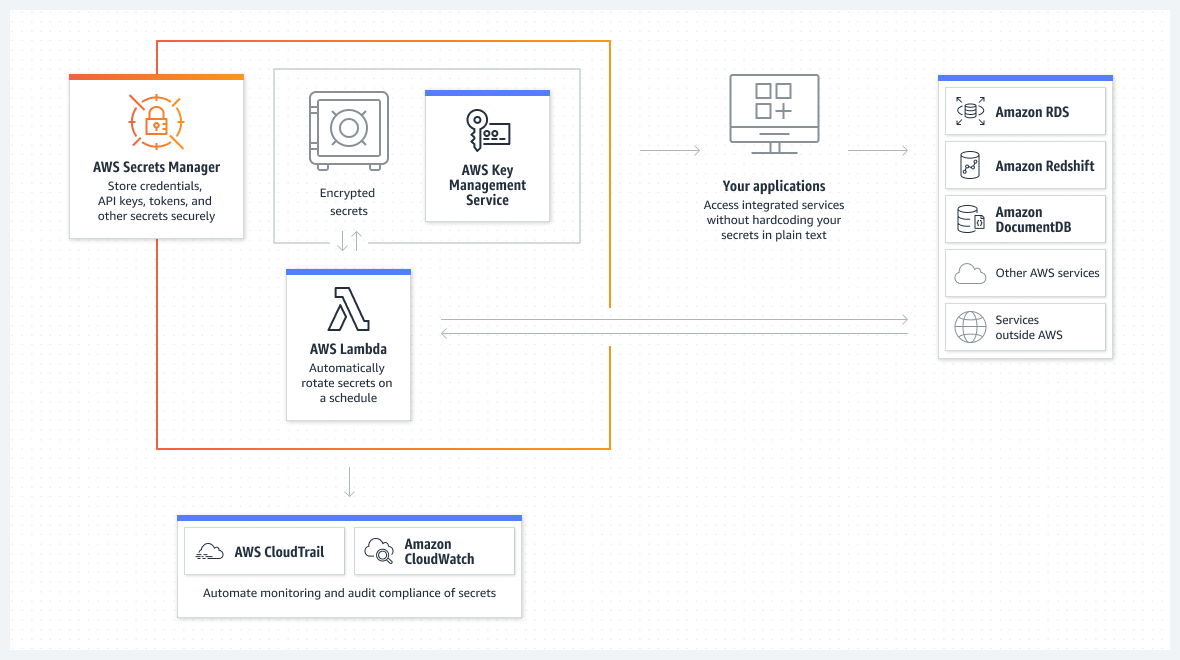
Secrets Manager with KMS
- Encryption
- encrypts a new version of the protected secret data by requesting AWS KMS to generate a new data key from the KMS key.
- uses this data key for envelope encryption.
- stores the encrypted data key with the protected secret data.
- Decryption
- requests AWS KMS to decrypt the encrypted data key
- uses the plain text data key to decrypt the protected secret data.
- never stores the data key in unencrypted form, and always disposes of the data key immediately after use.
Secrets Manager Rotation
- AWS Secrets Manager enables database credential rotation on a schedule.
- Supports rotation as frequently as every four hours, with configurable rotation windows using cron or rate expressions.
- Rotation can be configured using:
- Managed rotation – the service configures and manages rotation automatically without Lambda functions (supported for RDS, Aurora, Redshift, DocumentDB).
- Lambda function rotation – for custom rotation logic using Lambda functions.
- Managed external secrets rotation – for third-party credentials (e.g., Salesforce, MongoDB Atlas, Confluent Cloud) without Lambda functions.
- Credentials rotation does not impact the already open connections as they are not re-authenticated. Authentication happens when a connection is established.
- integrates with CloudWatch Events/EventBridge to send a notification when it rotates a secret.
Rotation Strategies
- Single user rotation
- Updates credentials for one user in one secret.
- The user’s password is changed in both the secret and the database.
- Recommended when cloned users don’t have the same permissions, or for ad hoc/interactive users.
- Brief period of potential sign-in failure between rotation and propagation.
- Alternating users rotation
- Creates a clone user with identical privileges but different password.
- Alternates between two users on each rotation.
- Requires a separate secret with superuser credentials.
- Provides higher availability as the old version remains valid until next rotation.
Managed External Secrets
- Introduced in November 2025, managed external secrets extend managed rotation to third-party SaaS credentials.
- Enables centralized management and automatic rotation of credentials for third-party software providers directly from Secrets Manager.
- No Lambda functions required – rotation is fully managed by Secrets Manager.
- Supports standardized formats and multiple rotation strategies per SaaS provider.
- Supported providers include Salesforce, MongoDB Atlas, and Confluent Cloud (expanding).
- Eliminates the need for provider-specific custom rotation logic.
Secrets Manager Agent & Workload Credentials Provider
- Secrets Manager Agent (released July 2024)
- Language-agnostic local HTTP service that pulls and caches secrets in compute environments.
- Exposes a localhost endpoint (port 2773) for applications to retrieve secrets from in-memory cache.
- Reduces API calls and improves application availability.
- Default cache TTL of 300 seconds (configurable).
- Open source and supports pre-fetching secrets at startup and IAM role assumption (May 2026).
- Supports hybrid post-quantum TLS (ML-KEM) by default since version 2.0.
- Works with EC2, ECS, EKS, Lambda, and on-premises/multi-cloud environments.
- AWS Workload Credentials Provider (released June 2026)
- Unified lightweight client-side provider that automates deployment of ACM certificates and caching of Secrets Manager secrets.
- Maintains full backwards compatibility with Secrets Manager Agent.
- Works across AWS and non-AWS workloads through a single unified provider.
- Uses post-quantum ML-KEM key exchange by default.
Secrets Manager Security Features
- Post-Quantum TLS
- Supports hybrid post-quantum key exchange using ML-KEM (Module-Lattice-based Key-Encapsulation Mechanism) for TLS connections.
- Combines traditional cryptography (X25519) with post-quantum algorithms to protect against “harvest now, decrypt later” threats.
- Service-side support launched in 2025; client-side support extended in April 2026.
- Secrets at rest are already quantum-safe (symmetric encryption via KMS).
- API Rate Limits (March 2025)
- GetSecretValue: up to 10,000 requests per second
- DescribeSecret: up to 40,000 requests per second
- Managed Policies
- SecretsManagerReadWrite – full access including redshift-serverless permission (March 2024).
- AWSSecretsManagerClientReadOnlyAccess – read-only access for client applications, includes BatchGetSecretValue and ListSecrets (November 2025, updated June 2026).
Client-Side Caching
- Caching libraries available for Java, Python, .NET, Go, and Rust.
- Improves speed, availability, and reduces costs by minimizing API calls.
- Default cache refresh interval is one hour (configurable).
- Does not include cache invalidation – if a secret rotates before TTL expires, stale values may be returned.
- For containerized workloads, client-side caching allows credential rotation without restarting containers.
Secrets Manager vs Systems Manager Parameter Store
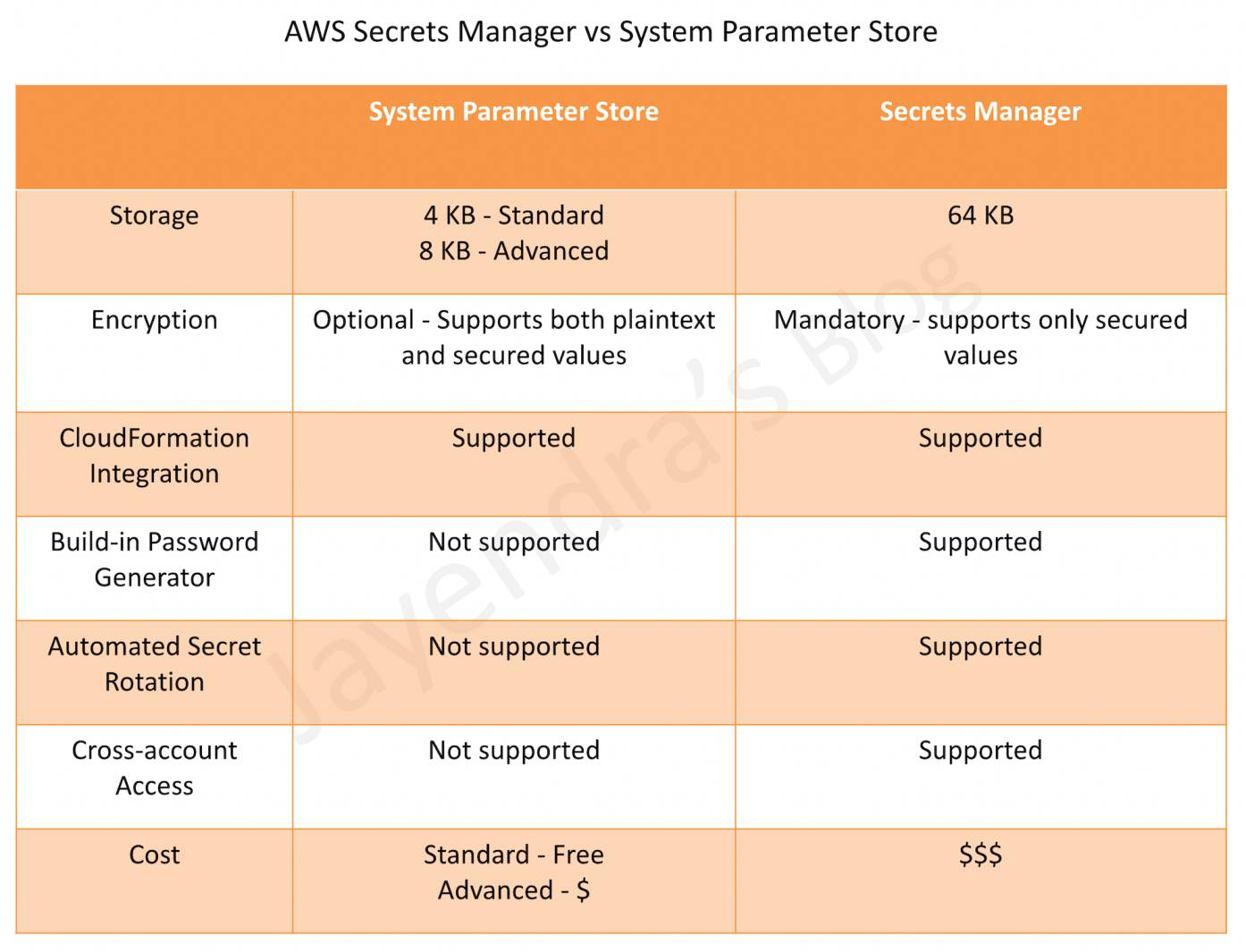
- Key Differences:
- Secrets Manager is designed specifically for secrets with built-in rotation; Parameter Store is a general-purpose configuration store.
- Secrets Manager supports managed rotation (no Lambda needed for supported databases); Parameter Store requires custom Lambda for rotation.
- Secrets Manager charges per secret ($0.40/month) and per API call ($0.05/10K calls); Parameter Store Standard tier is free.
- Secrets Manager supports cross-region replication natively; Parameter Store does not.
- Secrets Manager supports BatchGetSecretValue; Parameter Store supports GetParameters (up to 10).
- AWS Recommendation (2025): Use Secrets Manager for secrets, Parameter Store for simple key-value configuration, and AWS AppConfig for feature flags and advanced dynamic configuration.
AWS Certification Exam Practice Questions
- Questions are collected from Internet and the answers are marked as per my knowledge and understanding (which might differ with yours).
- AWS services are updated everyday and both the answers and questions might be outdated soon, so research accordingly.
- AWS exam questions are not updated to keep up the pace with AWS updates, so even if the underlying feature has changed the question might not be updated
- Open to further feedback, discussion and correction.
- Which AWS service makes it easy for you to easily rotate, manage, and retrieve database credentials, API keys, and other secrets throughout their lifecycle?
- AWS WAF
- AWS Secrets Manager
- AWS Systems Manager
- AWS Shield
- A company uses Amazon RDS for PostgreSQL databases for its data tier. The company must implement password rotation for the databases. Which solution meets this requirement with the LEAST operational overhead?
- Store the password in AWS Secrets Manager. Enable automatic rotation on the secret.
- Store the password in AWS Systems Manager Parameter Store. Enable automatic rotation on the parameter.
- Store the password in AWS Systems Manager Parameter Store. Write an AWS Lambda function that rotates the password.
- Store the password in AWS Key Management Service (AWS KMS). Enable automatic rotation on the customer master key (CMK).
- A company has multiple applications that retrieve database credentials from AWS Secrets Manager at a high rate, causing throttling. Which approach should the company use to address this issue with MINIMAL code changes?
- Increase the Secrets Manager service quota for API calls.
- Implement client-side caching using the Secrets Manager caching library or deploy the Secrets Manager Agent for local caching.
- Store credentials in Systems Manager Parameter Store instead.
- Replicate the secrets to additional regions and distribute read traffic.
- A company needs to manage and rotate credentials for multiple third-party SaaS applications (Salesforce, MongoDB Atlas) with the LEAST operational overhead. Which approach should they use?
- Write custom Lambda rotation functions for each SaaS provider.
- Store credentials in Parameter Store and use EventBridge rules for rotation.
- Use AWS Secrets Manager managed external secrets for automated rotation without Lambda functions.
- Build a custom rotation service running on ECS.
- A company wants to protect its secrets in transit against future quantum computing threats. Which feature of AWS Secrets Manager addresses this requirement?
- Use customer-managed KMS keys for encryption at rest.
- Enable secret replication across multiple regions.
- Use hybrid post-quantum TLS with ML-KEM for Secrets Manager API connections.
- Enable automatic secret rotation every 4 hours.
- A company runs applications on-premises and in AWS. They need a language-agnostic way to retrieve secrets locally without modifying application code to use the AWS SDK. Which solution provides this capability?
- Use AWS Systems Manager Parameter Store with the SSM agent.
- Embed secrets in environment variables at deployment time.
- Deploy the AWS Secrets Manager Agent (or Workload Credentials Provider) for local HTTP-based secret retrieval with in-memory caching.
- Use AWS Lambda to periodically fetch and write secrets to a local file.