AWS Secrets Manager vs Systems Manager Parameter Store

AWS Secrets Manager vs Systems Parameter Store

AWS Secrets Manager vs Systems Manager Parameter Store

🆕 Major Updates (2024-2026)

  • Parameter Store Cross-Account Sharing (Feb 2024): Parameter Store now supports cross-account sharing via AWS Resource Access Manager (RAM) for advanced parameters.
  • Secrets Manager – Managed External Secrets (Nov 2025): New secret type enabling automatic rotation for third-party SaaS credentials (Salesforce, MongoDB Atlas, Confluent Cloud, Datadog, Snowflake).
  • Secrets Manager Agent (Jul 2024): Open-source agent providing localhost-based secret caching to reduce API calls and improve availability.
  • Secrets Manager Limit Increase: Maximum secrets per account increased from 40,000 to 500,000 per Region.
  • Secrets Manager – BatchGetSecretValue API (Nov 2023): Retrieve up to 20 secrets in a single API call.
  • Secrets Manager – Cost Allocation Tags (May 2025): Tag secrets and track costs by department, team, or application in AWS Cost Explorer.
  • AWS Workload Credentials Provider (Jun 2026): Unified provider for caching secrets and deploying certificates across AWS and non-AWS workloads.

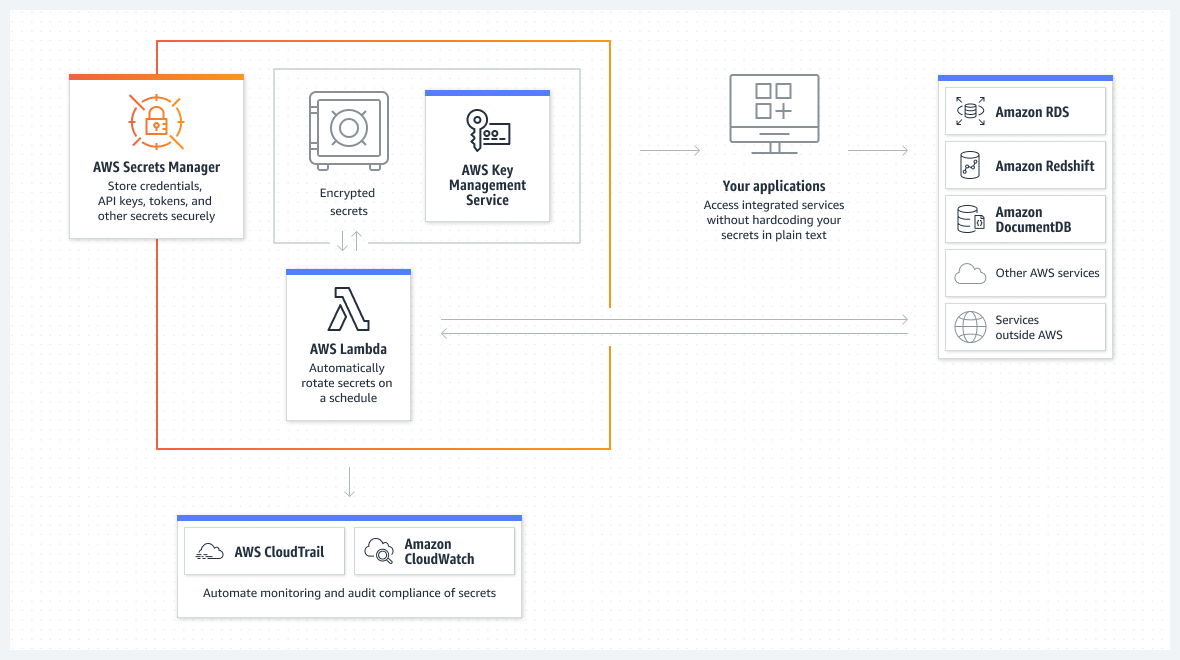
  • AWS Secrets Manager helps protect secrets needed to access applications, services, and IT resources and can easily rotate, manage, and retrieve database credentials, API keys, and other secrets throughout their lifecycle.
  • AWS Systems Manager Parameter Store provides secure, scalable, centralized, hierarchical storage for configuration data and secret management and can store data such as passwords, database strings, etc.

AWS Secrets Manager vs Systems Parameter Store

Key Differences

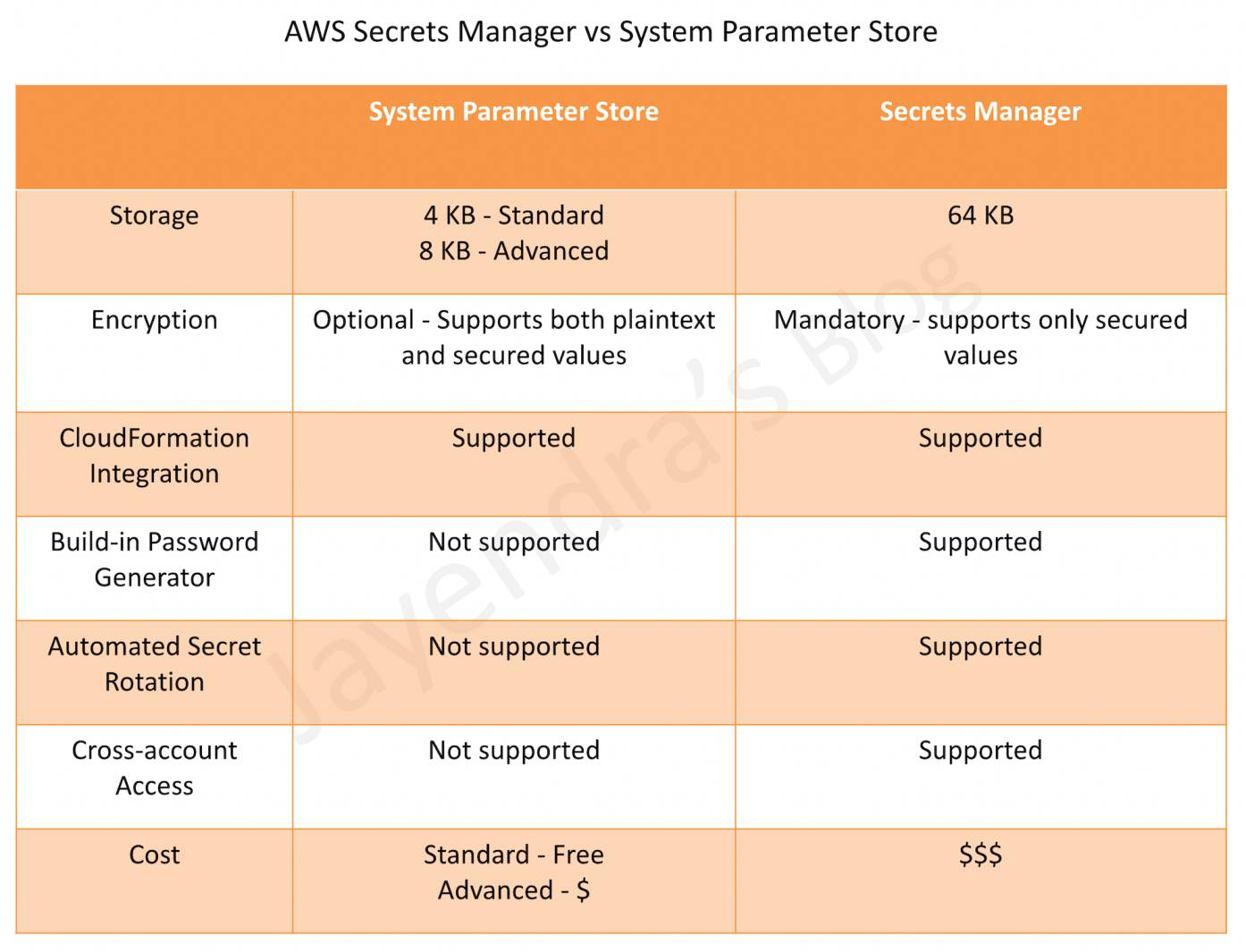
  • Storage (Limits keep on upgrading)
    • AWS Systems Manager Parameter Store allows us to store up to
      • Standard tier – 10,000 parameters per Region, each of which can be up to 4KB
      • Advanced tier – 100,000 parameters per Region, each of which can be up to 8KB
    • AWS Secrets Manager supports up to 500,000 secrets per account per Region, each of which can be up to 64KB.
  • Encryption
    • Encryption is optional for Systems Manager Parameter Store (use SecureString parameter type for encryption)
    • Encryption is mandatory for Secrets Manager and you cannot opt out. Secrets are always encrypted at rest using AWS KMS keys.
  • Automated Secret Rotation
    • Systems Manager Parameter Store does not support out-of-the-box secrets rotation.
    • AWS Secrets Manager enables automatic secret rotation on a schedule, supporting native rotation for RDS, Redshift, DocumentDB, and other AWS databases.
    • NEW: Secrets Manager now supports Managed External Secrets for automatic rotation of third-party SaaS credentials (Salesforce, MongoDB Atlas, Confluent Cloud, Datadog, Snowflake) without requiring custom Lambda rotation functions.
  • Cross-account Access
    • UPDATE (Feb 2024): Systems Manager Parameter Store now supports cross-account sharing of advanced parameters via AWS Resource Access Manager (RAM). Shared parameters provide read-only access to consumers. SecureString parameters require sharing the KMS key separately.
    • AWS Secrets Manager supports cross-account access through resource-based IAM policies attached directly to the secret.
  • Multi-Region Replication
    • Systems Manager Parameter Store does not support automatic cross-region replication.
    • AWS Secrets Manager supports automatic multi-region replication, keeping replicas in sync with the primary secret for disaster recovery and low-latency access.
  • Batch Retrieval
    • Systems Manager Parameter Store supports GetParameters to retrieve up to 10 parameters in a single call.
    • AWS Secrets Manager supports BatchGetSecretValue API to retrieve up to 20 secrets in a single call, reducing latency and API call costs.
  • Cost (keeps on changing)
    • Secrets Manager is comparatively costlier than the Systems Manager Parameter Store.
    • AWS Systems Manager Parameter Store:
      • Standard tier: No additional charge (standard throughput)
      • Advanced tier: $0.05 per advanced parameter per month
      • API interactions (advanced or higher throughput): $0.05 per 10,000 API interactions
    • AWS Secrets Manager: $0.40 per secret per month, and $0.05 per 10,000 API calls.
  • Infrastructure (CloudFormation)
    • Parameter Store: SecureString parameters cannot be created via AWS CloudFormation (only String and StringList types are supported).
    • Secrets Manager secrets can be fully managed via CloudFormation including rotation configuration.

New Features (2024-2026)

AWS Secrets Manager – Managed External Secrets

  • Launched November 2025, Managed External Secrets is a new secret type that extends automatic rotation to third-party SaaS credentials.
  • Provides first-class integration with supported partners including Salesforce, MongoDB Atlas, Confluent Cloud, Datadog, and Snowflake.
  • Eliminates the need to write and maintain custom Lambda rotation functions for supported third-party services.
  • Handles the complete secret lifecycle including creation, rotation, and revocation.
  • Reference: AWS Documentation – Managed External Secrets

AWS Secrets Manager Agent

  • Open-source agent (released July 2024) that provides localhost-based secret retrieval and in-memory caching.
  • Runs as a sidecar or daemon, opening a local HTTP endpoint (localhost:2773) for secret retrieval.
  • Reduces API calls to Secrets Manager and improves application availability.
  • Includes SSRF protection, configurable TTL, cache size, and connection limits.
  • NEW (May 2026): Supports pre-fetching secrets at startup and IAM role assumption for cross-account secret retrieval.
  • Reference: AWS Documentation – Secrets Manager Agent

Parameter Store Cross-Account Sharing

  • Announced February 2024, advanced parameters can now be shared across AWS accounts using AWS RAM.
  • Supports sharing with specific accounts, organizational units, or entire AWS Organizations.
  • Consumer accounts receive read-only access (GetParameter, GetParameters, DescribeParameters).
  • SecureString parameters require the KMS key to be shared separately.
  • Cross-account sharing is only available for advanced tier parameters ($0.05/parameter/month).
  • Reference: AWS Documentation – Shared Parameters

AWS Workload Credentials Provider (June 2026)

  • Unified lightweight client-side provider that automates deployment of ACM certificates and caching of Secrets Manager secrets.
  • Works across both AWS and non-AWS workloads.
  • Maintains backwards compatibility with the Secrets Manager Agent.
  • Reference: AWS Announcement

AWS Certification Exam Practice Questions

  • Questions are collected from Internet and the answers are marked as per my knowledge and understanding (which might differ with yours).
  • AWS services are updated everyday and both the answers and questions might be outdated soon, so research accordingly.
  • AWS exam questions are not updated to keep up the pace with AWS updates, so even if the underlying feature has changed the question might not be updated
  • Open to further feedback, discussion and correction.
  1. A company uses Amazon RDS for PostgreSQL databases for its data tier. The company must implement password rotation for the databases. Which solution meets this requirement with the LEAST operational overhead?
    1. Store the password in AWS Secrets Manager. Enable automatic rotation on the secret.
    2. Store the password in AWS Systems Manager Parameter Store. Enable automatic rotation on the parameter.
    3. Store the password in AWS Systems Manager Parameter Store. Write an AWS Lambda function that rotates the password.
    4. Store the password in AWS Key Management Service (AWS KMS). Enable automatic rotation on the customer master key (CMK).
  2. A company needs to share configuration parameters across multiple AWS accounts in an organization. The parameters are non-sensitive and change infrequently. Which solution is the MOST cost-effective?
    1. Store the parameters in AWS Secrets Manager with a resource-based policy for cross-account access.
    2. Store the parameters in AWS Systems Manager Parameter Store as advanced parameters and share them using AWS Resource Access Manager (RAM).
    3. Store the parameters in an Amazon S3 bucket with cross-account access policies.
    4. Store the parameters in AWS Systems Manager Parameter Store as standard parameters and use IAM cross-account roles.
  3. A company uses third-party SaaS applications and needs to manage API credentials for these services. The credentials must be automatically rotated without custom code. Which AWS service and feature should the company use?
    1. AWS Systems Manager Parameter Store with a scheduled Lambda function
    2. AWS Secrets Manager with a custom Lambda rotation function
    3. AWS Secrets Manager with Managed External Secrets
    4. AWS KMS with automatic key rotation
  4. A development team wants to reduce API calls to AWS Secrets Manager from their containerized application while maintaining access to up-to-date secrets. Which approach provides the LEAST operational overhead?
    1. Implement a custom caching layer using Redis
    2. Deploy the AWS Secrets Manager Agent as a sidecar container
    3. Store secrets in environment variables at container startup
    4. Use the AWS Parameters and Secrets Lambda Extension
  5. A solutions architect needs to provide cross-account access to encrypted configuration data stored in AWS Systems Manager Parameter Store. Which combination of steps is required? (Select TWO)
    1. Create the parameter as an advanced parameter and share it using AWS RAM
    2. Create a resource-based policy on the parameter
    3. Share the KMS key used to encrypt the SecureString parameter with the consuming account
    4. Create an IAM role in the consuming account with ssm:GetParameter permission
    5. Store the parameter as a standard parameter and enable cross-account access

References

AWS Security Services Cheat Sheet

AWS Identity and Security Services

AWS Security Services Cheat Sheet

AWS Identity and Security Services

AWS IAM Identity Center (Successor to AWS SSO)

  • is a centralized workforce identity management service that provides single sign-on (SSO) access to multiple AWS accounts and business applications.
  • was renamed from AWS Single Sign-On (AWS SSO) in July 2022.
  • enables administrators to define, customize, and assign fine-grained access across AWS accounts and applications.
  • provides workforce users a portal to access AWS accounts and cloud applications assigned to them.
  • supports integration with external identity providers (IdPs) like Microsoft Active Directory, Okta, and Azure AD.
  • simplifies multi-account access management through AWS Organizations integration.
  • provides temporary credentials instead of long-term IAM user credentials.
  • supports attribute-based access control (ABAC) for fine-grained permissions.

Key Management Service – KMS

  • is a managed encryption service that allows the creation and control of encryption keys to enable data encryption.
  • provides a highly available key storage, management, and auditing solution to encrypt the data across AWS services & within applications.
  • uses hardware security modules (HSMs) that are FIPS 140-3 Security Level 3 certified (upgraded from FIPS 140-2 in May 2023).
  • seamlessly integrates with several AWS services to make encrypting data in those services easy.
  • supports multi-region keys, which are AWS KMS keys in different AWS Regions. Multi-Region keys are not global and each multi-region key needs to be replicated and managed independently.
  • supports External Key Store (XKS) capability (November 2022) allowing customers to store and control encryption keys on-premises or outside AWS cloud while using AWS KMS.
  • provides three key store options: Default KMS key store, CloudHSM custom key store, and External key store (XKS).

CloudHSM

  • provides secure cryptographic key storage to customers by making hardware security modules (HSMs) available in the AWS cloud
  • helps manage your own encryption keys using FIPS 140-3 Level 3 validated HSMs (upgraded from FIPS 140-2).
  • single tenant, dedicated physical device to securely generate, store, and manage cryptographic keys used for data encryption
  • are inside the VPC (not EC2-classic) & isolated from the rest of the network
  • can use VPC peering to connect to CloudHSM from multiple VPCs
  • integrated with Amazon Redshift and Amazon RDS for Oracle
  • EBS volume encryption, S3 object encryption and key management can be done with CloudHSM but requires custom application scripting
  • is NOT fault-tolerant and would need to build a cluster as if one fails all the keys are lost
  • enables quick scaling by adding and removing HSM capacity on-demand, with no up-front costs.
  • automatically load balance requests and securely duplicates keys stored in any HSM to all of the other HSMs in the cluster.
  • expensive, prefer AWS Key Management Service (KMS) if cost is a criteria.

AWS Payment Cryptography

  • is a managed service for payment processing cryptographic operations (launched June 2023).
  • provides payment-specific HSMs that replace on-premises payment hardware security modules.
  • helps meet PCI (Payment Card Industry) security requirements and compliance needs.
  • supports cryptographic operations like PIN generation, validation, and credit/debit card security code processing.
  • manages underlying physical HSM infrastructure and key management automatically.
  • integrates with AWS IAM for authorization and AWS CloudTrail for auditing.
  • enables payment processing workloads to move to the cloud securely.
  • provides elastic scaling for payment cryptography operations.

AWS Private Certificate Authority (Private CA)

  • is a managed private certificate authority service for issuing and managing private SSL/TLS certificates.
  • removes upfront investment and ongoing maintenance costs of operating your own private CA.
  • supports two operating modes: General-purpose mode (certificates with any validity period) and Short-lived certificate mode (certificates valid up to 7 days, launched February 2023).
  • integrates with AWS Certificate Manager (ACM) for automated certificate provisioning and renewal.
  • supports Private CA Connector for Active Directory (September 2023) enabling AWS Private CA as drop-in replacement for self-managed enterprise CAs without local agents.
  • provides audit and compliance support through AWS CloudTrail integration.
  • enables certificate-based authentication for services like Amazon WorkSpaces.

AWS WAF

  • is a web application firewall that helps monitor the HTTP/HTTPS traffic and allows controlling access to the content.
  • helps protect web applications from attacks by allowing rules configuration that allow, block, or monitor (count) web requests based on defined conditions. These conditions include IP addresses, HTTP headers, HTTP body, URI strings, SQL injection and cross-site scripting.
  • helps define Web ACLs, which is a combination of Rules that is a combinations of Conditions and Action to block or allow
  • integrated with CloudFront, Application Load Balancer (ALB), API Gateway services commonly used to deliver content and applications
  • supports custom origins outside of AWS, when integrated with CloudFront
  • provides AWS WAF Fraud Control with three capabilities:
    • Account Takeover Prevention (ATP) – Launched February 2022, protects login pages against credential stuffing attacks
    • Account Creation Fraud Prevention (ACFP) – Launched June 2023, detects and blocks automated bot-based account creation
    • Bot Control – Detects and controls common bots and targeted bots that use advanced evasion techniques
  • supports Challenge and CAPTCHA actions for bot mitigation at no additional cost with Fraud Control.
  • offers usage-based tiered pricing for Fraud Control (introduced June 2023).

AWS Verified Access

  • provides VPN-less, secure access to corporate applications (GA April 2023).
  • implements Zero Trust security model for application access without traditional VPN.
  • validates each application request against identity and device security requirements before granting access.
  • integrates with identity providers (IdPs) and device management systems for authentication and authorization.
  • uses Cedar policy language for fine-grained access control policies.
  • supports AWS WAF integration for additional web application protection.
  • provides signed identity context to end applications for additional security.
  • simplifies remote access management and improves user experience compared to VPN.
  • eliminates VPN infrastructure management overhead.

Amazon Verified Permissions

  • is a fully managed fine-grained authorization service for custom applications (GA June 2023).
  • uses Cedar, an open-source policy language released May 2023, for defining authorization policies.
  • enables developers to externalize authorization logic from application code.
  • provides centralized policy management and administration.
  • offers millisecond-latency authorization decisions with provably correct results.
  • supports policy validation using automated reasoning to prevent misconfigurations.
  • integrates with identity providers for user and group information.
  • enables fine-grained permissions based on user attributes, resource attributes, and context.
  • provides policy versioning and audit capabilities.
  • follows “explicit permit” and “forbid overrides permit” principles.

AWS Secrets Manager

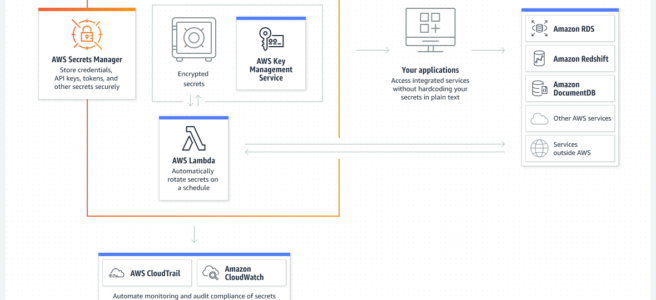
  • helps protect secrets needed to access applications, services, and IT resources.
  • enables you to easily rotate, manage, and retrieve database credentials, API keys, and other secrets throughout their lifecycle.
  • secure secrets by encrypting them with encryption keys managed using AWS KMS.
  • offers native secret rotation with built-in integration for RDS, Redshift, and DocumentDB.
  • supports Lambda functions to extend secret rotation to other types of secrets, including API keys and OAuth tokens.
  • supports IAM and resource-based policies for fine-grained access control to secrets and centralized secret rotation audit for resources in the AWS Cloud, third-party services, and on-premises.
  • enables secret replication in multiple AWS regions (launched March 2021) to support multi-region applications and disaster recovery scenarios.
  • automatically keeps replica secrets in sync with primary secret including rotation.
  • supports private access using VPC Interface endpoints

AWS Shield

  • is a managed service that provides protection against Distributed Denial of Service (DDoS) attacks for applications running on AWS
  • provides protection for all AWS customers against common and most frequently occurring infrastructure (layer 3 and 4) attacks like SYN/UDP floods, reflection attacks, and others to support high availability of applications on AWS.
  • provides AWS Shield Advanced with additional protections against more sophisticated and larger attacks for applications running on EC2, ELB, CloudFront, AWS Global Accelerator, and Route 53.

AWS GuardDuty

  • offers threat detection that enables continuous monitoring and protects the AWS accounts and workloads.
  • is a Regional service
  • analyzes continuous streams of meta-data generated from AWS accounts and network activity found in AWS CloudTrail Events, EKS audit logs, VPC Flow Logs, and DNS Logs.
  • integrated threat intelligence
  • combines machine learning, anomaly detection, network monitoring, and malicious file discovery, utilizing both AWS-developed and industry-leading third-party sources to help protect workloads and data on AWS
  • supports suppression rules, trusted IP lists, and thread lists.
  • provides Malware Protection to detect malicious files on EBS volumes
  • provides EKS Runtime Monitoring (March 2023) using fully managed EKS add-on for visibility into container runtime activities (file access, process execution, network connections).
  • provides RDS Protection (March 2023) for profiling and monitoring access activity to Amazon Aurora databases.
  • provides Lambda Protection for monitoring AWS Lambda function invocations and runtime behavior.
  • can identify specific containers within EKS clusters that are potentially compromised and detect privilege escalation attempts.
  • operates completely independently from the resources so there is no risk of performance or availability impacts on the workloads.

Amazon Inspector

  • is a vulnerability management service that continuously scans the AWS workloads for vulnerabilities
  • automatically discovers and scans EC2 instances and container images residing in Elastic Container Registry (ECR) for software vulnerabilities and unintended network exposure.
  • supports AWS Lambda function scanning for vulnerabilities in application code and dependencies.
  • provides CI/CD integration (November 2023) with open-source plugins for Jenkins, TeamCity, and other CI/CD tools to scan container images at build time.
  • enables vulnerability scanning directly from CI/CD pipelines wherever they are running without activating Inspector service.
  • scans Lambda functions on each deployment or update of application code or dependencies.
  • creates a finding, when a software vulnerability or network issue is discovered, that describes the vulnerability, rates its severity, identifies the affected resource, and provides remediation guidance.
  • is a Regional service.
  • requires Systems Manager (SSM) agent to be installed and enabled for EC2 scanning.

Amazon Security Lake

  • is a fully managed security data lake service (GA November 2023).
  • automatically centralizes security data from AWS environments, SaaS providers, on-premises, and cloud sources into a purpose-built data lake.
  • normalizes security data into the Open Cybersecurity Schema Framework (OCSF) standard format.
  • aggregates data from AWS services like CloudTrail, VPC Flow Logs, Route 53 logs, and third-party sources.
  • enables comprehensive security data analysis across entire organization.
  • automatically collects data for existing and new accounts with multi-account support.
  • stores security data in customer’s own AWS account for data ownership and control.
  • integrates with analytics tools like Amazon Athena, Amazon OpenSearch, and third-party SIEM solutions.
  • supports cross-region data aggregation for centralized security monitoring.
  • pricing based on data ingestion volume and normalization (no charge for third-party or custom data).

Amazon Detective

  • helps analyze, investigate, and quickly identify the root cause of potential security issues or suspicious activities.
  • automatically collects log data from the AWS resources and uses machine learning, statistical analysis, and graph theory to build a linked set of data to easily conduct faster and more efficient security investigations.
  • enables customers to view summaries and analytical data associated with CloudTrail logs, EKS audit logs, VPC Flow Logs.
  • provides detailed summaries, analysis, and visualizations of the behaviors and interactions amongst your AWS accounts, EC2 instances, AWS users, roles, and IP addresses.
  • maintains up to a year of aggregated data
  • is a Regional service and needs to be enabled on a region-by-region basis.
  • is a multi-account service that aggregates data from monitored member accounts under a single administrative account within the same region.
  • has no impact on the performance or availability of the AWS infrastructure since it retrieves the log data and findings directly from the AWS services.

AWS Security Hub

  • a cloud security posture management service that performs security best practice checks, aggregates alerts, and enables automated remediation.
  • collects security data from across AWS accounts, services, and supported third-party partner products and helps you analyze your security trends and identify the highest priority security issues.
  • is Regional abut supports cross-region aggregation of findings.
  • automatically runs continuous, account-level configuration and security checks based on AWS best practices and industry standards which include CIS Foundations, PCI DSS.
  • consolidates the security findings across accounts and provider products and displays results on the Security Hub console.
  • supports integration with Amazon EventBridge. Custom actions can be defined when a finding is received.
  • has multi-account management through AWS Organizations integration, which allows delegating an administrator account for the organization.
  • works with AWS Config to perform most of its security checks for controls

AWS Macie

  • Macie is a data security service that discovers sensitive data by using machine learning and pattern matching, provides visibility into data security risks, and enables automated protection against those risks.
  • provides an inventory of the S3 buckets and automatically evaluates and monitors the buckets for security and access control.
  • automates the discovery, classification, and reporting of sensitive data.
  • generates a finding for you to review and remediate as necessary if it detects a potential issue with the security or privacy of the data, such as a bucket that becomes publicly accessible.
  • provides multi-account support using AWS Organizations to enable Macie across all of the accounts.
  • is a regional service and must be enabled on a region-by-region basis and helps view findings across all the accounts within each Region.
  • supports VPC Interface Endpoints to access Macie privately from a VPC without an internet gateway, NAT device, VPN connection, or AWS Direct Connect connection.

AWS Artifact

  • is a self-service audit artifact retrieval portal that provides customers with on-demand access to AWS’ compliance documentation and agreements
  • can use AWS Artifact Reports to download AWS security and compliance documents, such as AWS ISO certifications, Payment Card Industry (PCI), and System and Organization Control (SOC) reports.

AWS Security Services – Practice Questions

  1. A company needs to manage encryption keys with FIPS 140-3 Level 3 compliance and wants AWS to handle the infrastructure. Which service should they use?
    • A. AWS CloudHSM
    • B. AWS KMS ✓
    • C. AWS Secrets Manager
    • D. AWS Certificate Manager
  2. A financial institution needs to process payment card transactions in the cloud while meeting PCI compliance requirements. Which service should they use?
    • A. AWS CloudHSM
    • B. AWS KMS
    • C. AWS Payment Cryptography ✓
    • D. AWS Private CA
  3. A company wants to provide secure access to corporate applications without using VPN. Which service implements Zero Trust access?
    • A. AWS Client VPN
    • B. AWS Verified Access ✓
    • C. AWS Direct Connect
    • D. AWS PrivateLink
  4. A development team needs to externalize authorization logic from their application and use fine-grained permissions. Which service should they use?
    • A. AWS IAM
    • B. Amazon Cognito
    • C. Amazon Verified Permissions ✓
    • D. AWS IAM Identity Center
  5. A company needs to centralize security data from multiple AWS accounts and third-party sources for analysis. Which service should they use?
    • A. AWS Security Hub
    • B. Amazon Security Lake ✓
    • C. Amazon Detective
    • D. AWS CloudTrail
  6. Which AWS service can detect runtime threats in EKS containers including file access and process execution?
    • A. Amazon Inspector
    • B. AWS Security Hub
    • C. Amazon GuardDuty ✓
    • D. Amazon Detective
  7. A company wants to scan container images for vulnerabilities in their CI/CD pipeline before deployment. Which service supports this?
    • A. AWS Config
    • B. Amazon Inspector ✓
    • C. AWS Security Hub
    • D. Amazon GuardDuty
  8. Which service can protect login pages from credential stuffing attacks and account takeover attempts?
    • A. AWS Shield
    • B. AWS WAF Fraud Control ✓
    • C. Amazon GuardDuty
    • D. AWS Firewall Manager
  9. A company needs to replicate secrets across multiple regions for disaster recovery. Which service supports this?
    • A. AWS Systems Manager Parameter Store
    • B. AWS Secrets Manager ✓
    • C. AWS KMS
    • D. AWS Certificate Manager
  10. Which service was renamed from AWS Single Sign-On (SSO) in July 2022?
    • A. AWS IAM
    • B. Amazon Cognito
    • C. AWS IAM Identity Center ✓
    • D. AWS Directory Service

References

AWS Secrets Manager

AWS Secrets Manager

AWS Secrets Manager

  • AWS Secrets Manager helps protect secrets needed to access applications, services, and IT resources.
  • enables you to easily rotate, manage, and retrieve database credentials, API keys, and other secrets throughout their lifecycle.
  • secure secrets by encrypting them with encryption keys managed using AWS KMS.
  • offers native secret rotation with built-in integration for RDS, Redshift, and DocumentDB.
  • supports Lambda functions to extend secret rotation to other types of secrets, including API keys and OAuth tokens.
  • supports IAM and resource-based policies for fine-grained access control to secrets and centralized secret rotation audit for resources in the AWS Cloud, third-party services, and on-premises.
  • enables secret replication in multiple AWS regions to support multi-region applications and disaster recovery scenarios.
  • supports private access using VPC Interface endpoints
  • supports dual-stack (IPv4 and IPv6) endpoints for all regions.
  • supports BatchGetSecretValue API to retrieve up to 20 secrets in a single API call, reducing latency and API call costs.
  • supports cost allocation tags to categorize and track secret costs by department, team, or application in AWS Cost Explorer.
  • supports hybrid post-quantum TLS using ML-KEM to protect secrets against future quantum computing threats.

AWS Secrets Manager

Secrets Manager with KMS

  • Encryption
    • encrypts a new version of the protected secret data by requesting AWS KMS to generate a new data key from the KMS key.
    • uses this data key for envelope encryption.
    • stores the encrypted data key with the protected secret data.
  • Decryption
    • requests AWS KMS to decrypt the encrypted data key
    • uses the plain text data key to decrypt the protected secret data.
    • never stores the data key in unencrypted form, and always disposes of the data key immediately after use.

Secrets Manager Rotation

  • AWS Secrets Manager enables database credential rotation on a schedule.
  • Supports rotation as frequently as every four hours, with configurable rotation windows using cron or rate expressions.
  • Rotation can be configured using:
    • Managed rotation – the service configures and manages rotation automatically without Lambda functions (supported for RDS, Aurora, Redshift, DocumentDB).
    • Lambda function rotation – for custom rotation logic using Lambda functions.
    • Managed external secrets rotation – for third-party credentials (e.g., Salesforce, MongoDB Atlas, Confluent Cloud) without Lambda functions.
  • Credentials rotation does not impact the already open connections as they are not re-authenticated. Authentication happens when a connection is established.
  • integrates with CloudWatch Events/EventBridge to send a notification when it rotates a secret.

Rotation Strategies

  • Single user rotation
    • Updates credentials for one user in one secret.
    • The user’s password is changed in both the secret and the database.
    • Recommended when cloned users don’t have the same permissions, or for ad hoc/interactive users.
    • Brief period of potential sign-in failure between rotation and propagation.
  • Alternating users rotation
    • Creates a clone user with identical privileges but different password.
    • Alternates between two users on each rotation.
    • Requires a separate secret with superuser credentials.
    • Provides higher availability as the old version remains valid until next rotation.

Managed External Secrets

  • Introduced in November 2025, managed external secrets extend managed rotation to third-party SaaS credentials.
  • Enables centralized management and automatic rotation of credentials for third-party software providers directly from Secrets Manager.
  • No Lambda functions required – rotation is fully managed by Secrets Manager.
  • Supports standardized formats and multiple rotation strategies per SaaS provider.
  • Supported providers include Salesforce, MongoDB Atlas, and Confluent Cloud (expanding).
  • Eliminates the need for provider-specific custom rotation logic.

Secrets Manager Agent & Workload Credentials Provider

  • Secrets Manager Agent (released July 2024)
    • Language-agnostic local HTTP service that pulls and caches secrets in compute environments.
    • Exposes a localhost endpoint (port 2773) for applications to retrieve secrets from in-memory cache.
    • Reduces API calls and improves application availability.
    • Default cache TTL of 300 seconds (configurable).
    • Open source and supports pre-fetching secrets at startup and IAM role assumption (May 2026).
    • Supports hybrid post-quantum TLS (ML-KEM) by default since version 2.0.
    • Works with EC2, ECS, EKS, Lambda, and on-premises/multi-cloud environments.
  • AWS Workload Credentials Provider (released June 2026)
    • Unified lightweight client-side provider that automates deployment of ACM certificates and caching of Secrets Manager secrets.
    • Maintains full backwards compatibility with Secrets Manager Agent.
    • Works across AWS and non-AWS workloads through a single unified provider.
    • Uses post-quantum ML-KEM key exchange by default.

Secrets Manager Security Features

  • Post-Quantum TLS
    • Supports hybrid post-quantum key exchange using ML-KEM (Module-Lattice-based Key-Encapsulation Mechanism) for TLS connections.
    • Combines traditional cryptography (X25519) with post-quantum algorithms to protect against “harvest now, decrypt later” threats.
    • Service-side support launched in 2025; client-side support extended in April 2026.
    • Secrets at rest are already quantum-safe (symmetric encryption via KMS).
  • API Rate Limits (March 2025)
    • GetSecretValue: up to 10,000 requests per second
    • DescribeSecret: up to 40,000 requests per second
  • Managed Policies
    • SecretsManagerReadWrite – full access including redshift-serverless permission (March 2024).
    • AWSSecretsManagerClientReadOnlyAccess – read-only access for client applications, includes BatchGetSecretValue and ListSecrets (November 2025, updated June 2026).

Client-Side Caching

  • Caching libraries available for Java, Python, .NET, Go, and Rust.
  • Improves speed, availability, and reduces costs by minimizing API calls.
  • Default cache refresh interval is one hour (configurable).
  • Does not include cache invalidation – if a secret rotates before TTL expires, stale values may be returned.
  • For containerized workloads, client-side caching allows credential rotation without restarting containers.

Secrets Manager vs Systems Manager Parameter Store

AWS Secrets Manager vs Systems Parameter Store

  • Key Differences:
    • Secrets Manager is designed specifically for secrets with built-in rotation; Parameter Store is a general-purpose configuration store.
    • Secrets Manager supports managed rotation (no Lambda needed for supported databases); Parameter Store requires custom Lambda for rotation.
    • Secrets Manager charges per secret ($0.40/month) and per API call ($0.05/10K calls); Parameter Store Standard tier is free.
    • Secrets Manager supports cross-region replication natively; Parameter Store does not.
    • Secrets Manager supports BatchGetSecretValue; Parameter Store supports GetParameters (up to 10).
  • AWS Recommendation (2025): Use Secrets Manager for secrets, Parameter Store for simple key-value configuration, and AWS AppConfig for feature flags and advanced dynamic configuration.

AWS Certification Exam Practice Questions

  • Questions are collected from Internet and the answers are marked as per my knowledge and understanding (which might differ with yours).
  • AWS services are updated everyday and both the answers and questions might be outdated soon, so research accordingly.
  • AWS exam questions are not updated to keep up the pace with AWS updates, so even if the underlying feature has changed the question might not be updated
  • Open to further feedback, discussion and correction.
  1. Which AWS service makes it easy for you to easily rotate, manage, and retrieve database credentials, API keys, and other secrets throughout their lifecycle?
    1. AWS WAF
    2. AWS Secrets Manager
    3. AWS Systems Manager
    4. AWS Shield
  2. A company uses Amazon RDS for PostgreSQL databases for its data tier. The company must implement password rotation for the databases. Which solution meets this requirement with the LEAST operational overhead?
    1. Store the password in AWS Secrets Manager. Enable automatic rotation on the secret.
    2. Store the password in AWS Systems Manager Parameter Store. Enable automatic rotation on the parameter.
    3. Store the password in AWS Systems Manager Parameter Store. Write an AWS Lambda function that rotates the password.
    4. Store the password in AWS Key Management Service (AWS KMS). Enable automatic rotation on the customer master key (CMK).
  3. A company has multiple applications that retrieve database credentials from AWS Secrets Manager at a high rate, causing throttling. Which approach should the company use to address this issue with MINIMAL code changes?
    1. Increase the Secrets Manager service quota for API calls.
    2. Implement client-side caching using the Secrets Manager caching library or deploy the Secrets Manager Agent for local caching.
    3. Store credentials in Systems Manager Parameter Store instead.
    4. Replicate the secrets to additional regions and distribute read traffic.
  4. A company needs to manage and rotate credentials for multiple third-party SaaS applications (Salesforce, MongoDB Atlas) with the LEAST operational overhead. Which approach should they use?
    1. Write custom Lambda rotation functions for each SaaS provider.
    2. Store credentials in Parameter Store and use EventBridge rules for rotation.
    3. Use AWS Secrets Manager managed external secrets for automated rotation without Lambda functions.
    4. Build a custom rotation service running on ECS.
  5. A company wants to protect its secrets in transit against future quantum computing threats. Which feature of AWS Secrets Manager addresses this requirement?
    1. Use customer-managed KMS keys for encryption at rest.
    2. Enable secret replication across multiple regions.
    3. Use hybrid post-quantum TLS with ML-KEM for Secrets Manager API connections.
    4. Enable automatic secret rotation every 4 hours.
  6. A company runs applications on-premises and in AWS. They need a language-agnostic way to retrieve secrets locally without modifying application code to use the AWS SDK. Which solution provides this capability?
    1. Use AWS Systems Manager Parameter Store with the SSM agent.
    2. Embed secrets in environment variables at deployment time.
    3. Deploy the AWS Secrets Manager Agent (or Workload Credentials Provider) for local HTTP-based secret retrieval with in-memory caching.
    4. Use AWS Lambda to periodically fetch and write secrets to a local file.

References

AWS Identity & Security Services Cheat Sheet
AWS Identity & Security Services Cheat Sheet

AWS Identity and Security Services

📌 Last Updated: June 2026 — Includes AWS Security Hub reimagined (re:Invent 2025), AWS Security Agent (GA March 2026), mandatory MFA enforcement for all root users, GuardDuty Extended Threat Detection, and IAM Identity Center multi-Region replication.

AWS Identity Services Cheat Sheet

AWS Security Services Cheat Sheet

AWS Identity & Security Services Overview

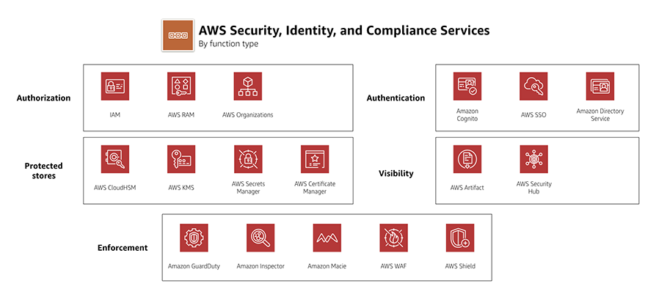
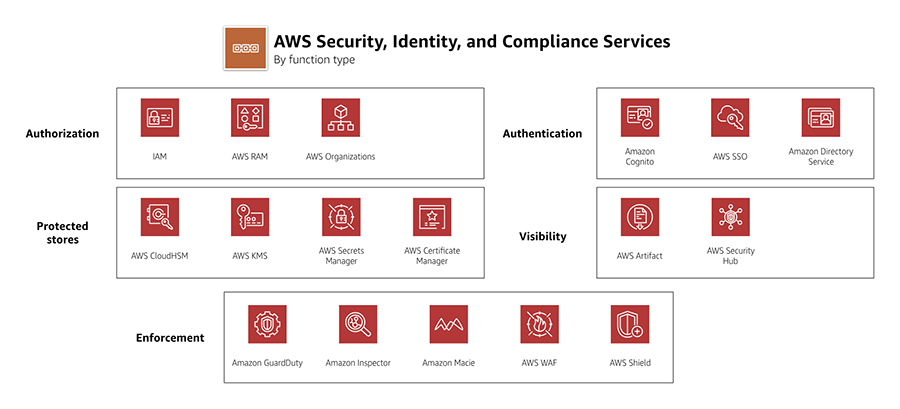
AWS Security, Identity, and Compliance services provide a comprehensive set of tools to help protect data, accounts, and workloads. These services are organized into the following categories:

Identity and Access Management

  • AWS Identity and Access Management (IAM) – Securely manage access to AWS services and resources using users, groups, roles, and policies
  • AWS IAM Identity Center (formerly AWS SSO) – Centrally manage SSO access to multiple AWS accounts and business applications
    • Now supports multi-Region replication (Feb 2026) for high availability
    • Supports IPv6 dual-stack endpoints
  • Amazon Cognito – Customer identity and access management (CIAM) for web and mobile apps
    • Now supports passwordless authentication with passkeys (FIDO2/WebAuthn), email OTP, and SMS OTP (Nov 2024)
    • New feature tiers: Essentials and Plus (Nov 2024)
    • Managed Login for pre-built authentication UIs
  • Amazon Verified Permissions – Scalable, fine-grained authorization using Cedar policy language for custom applications
  • AWS Resource Access Manager (RAM) – Securely share AWS resources across accounts and within AWS Organizations
  • AWS Directory Service – Managed Microsoft Active Directory in the AWS Cloud

Detection and Response

  • Amazon GuardDuty – Intelligent threat detection that continuously monitors for malicious activity
    • Extended Threat Detection (re:Invent 2024) – AI/ML-powered attack sequence identification across multiple data sources
    • Now covers EC2, ECS, EKS, S3, and IAM attack sequences
    • Custom entity lists for domain-based threat intelligence (Sept 2025)
  • Amazon Detective – Analyze, investigate, and identify root cause of security findings using ML and graph theory
  • Amazon Inspector – Automated vulnerability management for EC2 instances and container images in ECR
  • AWS Security Hub – Cloud security posture management (CSPM) and unified security operations
    • Reimagined at re:Invent 2025 – Unifies GuardDuty, Inspector, and other services into a single experience
    • Near real-time analytics and risk prioritization (GA Dec 2025)
    • Extended Plan (GA Feb 2026) – Full-stack enterprise security with 21 curated partner solutions across 9 categories
    • Expanding to multicloud environments
  • AWS Security Agent (GA March 2026) – AI-powered frontier agent for proactive application security
    • Automated security reviews tailored to organizational requirements
    • On-demand context-aware penetration testing
    • Full repository code scanning (Preview May 2026)
    • Operates like a human penetration tester – identifies, exploits, and validates vulnerabilities

Data Protection

Network and Application Protection

  • AWS WAF – Web application firewall to protect against common web exploits and bots
  • AWS Shield – Managed DDoS protection (Standard and Advanced tiers)
  • AWS Network Firewall – Managed network firewall for VPC with stateful inspection and IPS
  • AWS Firewall Manager – Centrally configure and manage firewall rules across accounts in AWS Organizations

Security Data Management and Compliance

  • Amazon Security Lake – Centralize security data from AWS, SaaS, on-premises using OCSF standard
    • Achieved FedRAMP High and Moderate authorization (April 2025)
  • AWS Audit Manager – Continuously audit AWS usage for risk and compliance assessment
  • AWS Artifact – On-demand access to AWS security and compliance reports

Key Updates (2024-2026)

  • MFA Enforcement (2024-2025) – AWS now mandates MFA for all root users across all account types. Prevents over 99% of password-related attacks.
  • AWS Security Hub Reimagined (re:Invent 2025) – Completely redesigned to unify security services into a single experience with near real-time analytics and AI-driven risk prioritization.
  • AWS Security Agent (GA March 2026) – First AI-powered frontier agent for autonomous application security testing and code scanning.
  • GuardDuty Extended Threat Detection (re:Invent 2024) – AI/ML attack sequence identification now covers EC2, ECS, EKS workloads.
  • IAM Identity Center Multi-Region (Feb 2026) – Replicate identity center configuration across multiple AWS Regions for high availability.
  • Amazon Cognito Passwordless (Nov 2024) – Native passkey support with FIDO2/WebAuthn, email OTP, and SMS OTP authentication.
  • Centralized Root Access Management (Nov 2024) – Centrally manage root credentials and perform privileged tasks across AWS Organizations member accounts.
  • Agentic AI Security Framework (2025) – New Agentic AI Security Scoping Matrix for securing autonomous AI systems.

AWS Certification Relevance

  • Solutions Architect (Associate/Professional) – IAM, VPC security, encryption, Security Hub, GuardDuty
  • Security Specialty – All services in depth, including Security Lake, Detective, Macie, Inspector
  • SysOps Administrator – Security Hub, Config, GuardDuty, IAM best practices
  • Developer Associate – Cognito, IAM roles, KMS, Secrets Manager
  • DevOps Professional – Security automation, Inspector, Security Hub integrations