Amazon Inspector
⚠️ Amazon Inspector Classic – End of Support
Amazon Inspector Classic reached End of Life (EOL) on May 20, 2026. The Inspector Classic console and all Classic resources are no longer accessible.
Migration: Use Amazon Inspector (v2) which provides automated, continuous scanning with significantly expanded capabilities including Lambda scanning, agentless EC2 scanning, CI/CD integration, and code security scanning.
- Amazon Inspector is an automated vulnerability management service that continuously scans AWS workloads for software vulnerabilities and unintended network exposure.
- automatically discovers and scans EC2 instances, container images in Amazon ECR and within CI/CD tools, AWS Lambda functions, and code repositories for software vulnerabilities and unintended network exposure.
- creates a finding when a software vulnerability or network issue is discovered, that describes the vulnerability, rates its severity, identifies the affected resource, and provides remediation guidance.
- calculates a highly contextualized Inspector risk score for each finding by correlating CVE information with factors such as network access and exploitability to prioritize the most critical vulnerabilities.
- is a Regional service and configurations need to be repeated across each region.
- supports both agent-based and agentless scanning for EC2 instances.
- uses the Systems Manager (SSM) agent for agent-based scanning to collect software inventory and configurations.
- offers agentless scanning using EBS volume snapshots for instances without SSM Agent installed or configured.
- SSM agents can be set up as VPC Interface endpoints to avoid sending any information over the internet.
- uses an IAM
AWSServiceRoleForAmazonInspector2service-linked-role linked directly to Inspector with all the permissions required to call other AWS services on your behalf. - has multi-account management through AWS Organizations integration, which allows delegating an administrator account for the organization.
- supports organization-wide management through AWS Organizations policies to centrally configure and manage scan types across all accounts, selected OUs, or individual accounts.
- integrates with AWS Security Hub which collects and centralizes the security data from across the AWS accounts, services, and other supported products.
- is available both as a standalone service and as a core capability within AWS Security Hub.
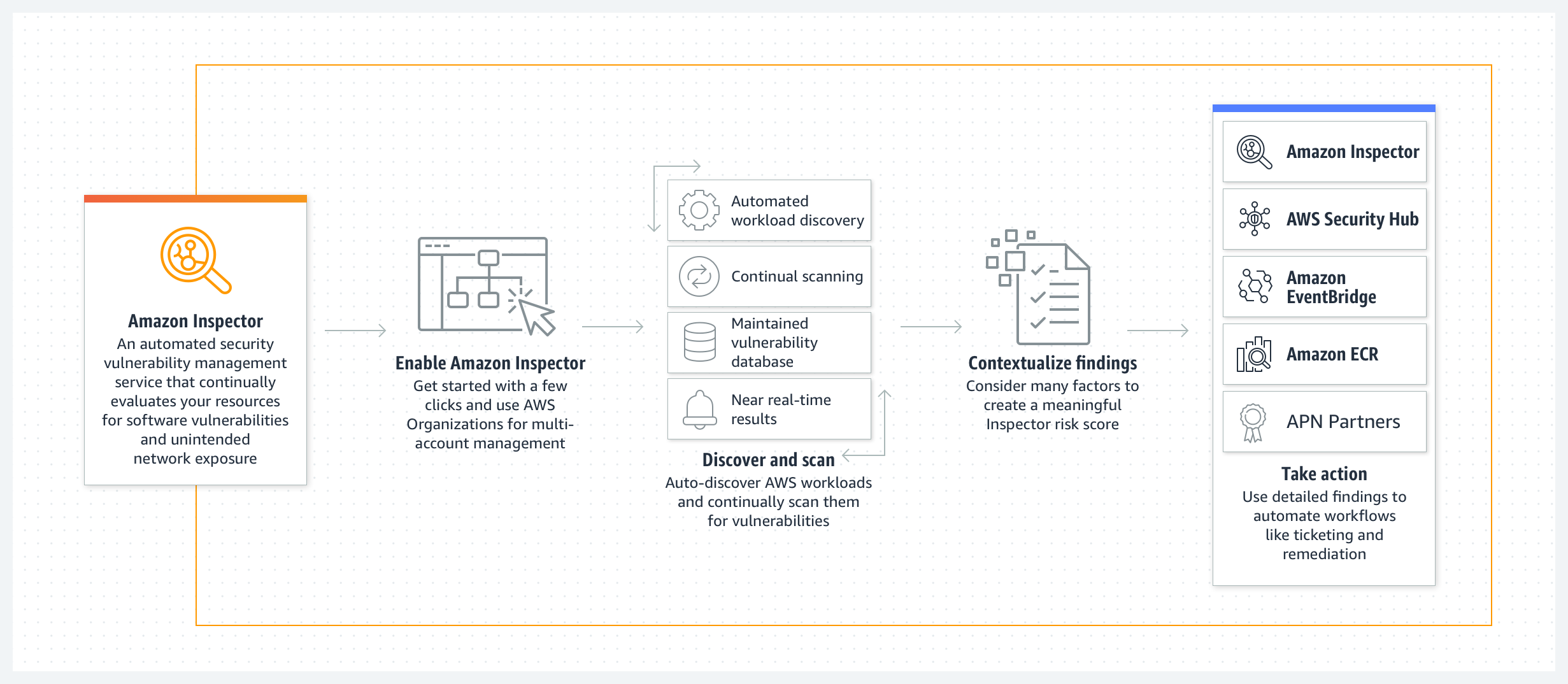
AWS Inspector Features
- Continuously scan environments for vulnerabilities and network exposure
- automatically discovers and begins scanning eligible resources without the need to manually schedule or configure assessment scans.
- all resources are continually rescanned when new CVEs are published or when changes occur, including new software installation on an EC2 instance or updates to code repositories.
- Assess vulnerabilities accurately with the Inspector Risk score
- Inspector calculates a highly contextualized risk score by correlating CVE information with environmental factors such as network reachability and exploitability data.
- helps prioritize the most critical findings and vulnerable resources.
- Identify high-impact findings with the Inspector dashboard
- offers a high-level view of findings from across your environment.
- Manage findings using customizable views
- Inspector console offers a Findings view.
- users can use filters and suppression rules to generate customized finding reports.
- suppression rules allow suppression of findings based on criteria defined by the organization for acceptable risks.
- Automatic closure of remediated findings
- automatically detects if a vulnerability has been patched or remediated and changes the state of the finding to “Closed” without manual intervention.
- Monitor and process findings with other services and systems
- publishes findings to
- Amazon EventBridge, which can then be monitored and processed in near-real time as part of the existing security and compliance workflows or routed to SNS, Lambda, etc.
- AWS Security Hub.
- Amazon ECR for container image vulnerabilities, enabling resource owners to view and remediate.
- publishes findings to
- Detailed coverage monitoring
- provides a comprehensive, near real-time overview of organization-wide environment coverage.
- highlights resources not being actively monitored and provides guidance on how to include them.
Inspector Scanning Types
Amazon EC2 Scanning
- scans EC2 instances for common vulnerabilities and exposures (CVEs), network exposure issues, and operating system and programming language package vulnerabilities.
- performs network reachability scans once every 12 hours and package vulnerability scans on a variable cadence depending on the scan method.
- supports two scanning methods:
- Agent-based scanning – uses the SSM Agent to collect software inventory from running instances.
- Agentless scanning – takes snapshots of EBS volumes to extract data without installing an agent. GA since April 2024.
- Enhanced EC2 Scanning (VM Scanner) – uses the Amazon Inspector VM Scanner (replacing the older SSM plugin) for more granular package collection with fewer compute resources. Installed and updated via SSM associations.
- supports expanded agentless scanning including Windows OS vulnerability scanning without requiring an agent (March 2026).
- Deep inspection for Linux-based instances automatically scans for programming language package vulnerabilities (Python, Java, Node.js, Go, etc.) beyond OS-level packages.
Amazon ECR Container Image Scanning
- scans container images in Amazon ECR for software vulnerabilities.
- supports scratch, distroless, and Chainguard images for minimal and security-focused container base images.
- maps ECR images to their deployment footprint across Amazon ECS tasks and Amazon EKS pods.
- provides insights on deployment scope – when images were last used, how many tasks or pods are using them, and which clusters are running the image.
- helps prioritize remediation based on actual image usage and deployment status.
AWS Lambda Function Scanning
- scans Lambda functions for software vulnerabilities in their application packages and dependencies.
- Lambda code scanning scans custom proprietary application code for code security vulnerabilities such as injection flaws, data leaks, weak cryptography, or missing encryption based on AWS security best practices.
- upon detecting code vulnerabilities, generates actionable security findings with detector name, impacted code snippets, and remediation suggestions.
- uses generative AI and automated reasoning to provide in-context code patches for multiple classes of vulnerabilities.
- can scan both Lambda functions and layers; by addressing vulnerabilities at foundational layers, it improves security of all downstream Lambda functions.
- does not support scanning Lambda functions encrypted with customer managed keys.
CI/CD Pipeline Scanning
- integrates with developer tools like Jenkins and TeamCity for container image assessments within CI/CD pipelines.
- pushes security earlier in the software development lifecycle (shift-left).
- findings are available in the CI/CD tool’s dashboard, allowing automated actions like blocking builds or image pushes to registries.
- CI/CD tools can be hosted anywhere – in AWS, on-premises, or hybrid clouds.
- uses the Amazon Inspector SBOM Generator (Sbomgen) to produce a Software Bill of Materials and the Inspector Scan API to scan for vulnerabilities.
- supports custom CI/CD integrations via the SBOM Generator and Scan API combination.
Code Security Scanning (June 2025)
- expands vulnerability management to application source code through native integration with GitHub and GitLab (SCM tools).
- delivers three core capabilities:
- Static Application Security Testing (SAST) – analyzes application source code for security vulnerabilities.
- Software Composition Analysis (SCA) – evaluates third-party dependencies for known vulnerabilities.
- Infrastructure as Code (IaC) scanning – validates infrastructure definitions for misconfigurations.
- findings are surfaced both in the Inspector console for an aggregated view across the organization and within the SCM platform as fast feedback for developers.
- enables consistent vulnerability management from code to compute resources running on AWS.
CIS Benchmark Assessments
- supports the Center for Internet Security (CIS) Benchmarks for on-demand and targeted assessments against OS-level CIS configuration benchmarks for EC2 instances.
- supports both Level 1 and Level 2 configuration benchmark checks.
- supported operating systems include Amazon Linux 2, Windows Server 2019, and Windows Server 2022.
- CIS scans can be run across AWS Organization accounts.
- launched January 2024.
Inspector Finding Types
- Package Vulnerability
- identifies software packages exposed to common vulnerabilities and exposures (CVEs).
- generated for EC2 instances, ECR container images, and Lambda functions.
- supports Java Gradle inventory and scanning (January 2026), plus MySQL, MariaDB, PHP, Jenkins-core, 7zip (Windows), Elasticsearch, and Curl/LibCurl.
- Network Reachability
- indicates allowed network paths to EC2 instances in the environment.
- generated only for EC2 resources.
- Code Vulnerability
- identifies code security vulnerabilities in Lambda functions and code repositories.
- includes missing encryption, data leaks, injection flaws, and weak cryptography.
- provides code snippets and AI-powered remediation suggestions.
SBOM (Software Bill of Materials)
- offers automated and centralized management of SBOM exports.
- enables easy export of a consolidated SBOM for all monitored resources to a pre-configured S3 bucket.
- supports industry standard formats (CycloneDX).
- SBOM artifacts can be used with Amazon Athena queries or Amazon QuickSight dashboards for insights and trend visualization.
- Amazon Inspector SBOM Generator (Sbomgen) is used behind the scenes for ECR scanning, Lambda scanning, and agentless EC2 scanning.
Multi-Account Management
- supports simplified one-click onboarding and integration with AWS Organizations.
- allows assigning an Inspector Delegated Administrator (DA) account that can start and configure all member accounts and consolidate findings.
- supports organization-wide management through AWS Organizations policies (November 2025) to centrally configure scan types – EC2 scanning, ECR scanning, Lambda Standard and Code Scanning, and Code Security – across all accounts, selected OUs, or individual accounts.
- new accounts are automatically onboarded when Inspector policies are configured.
AWS Certification Exam Practice Questions
- Questions are collected from Internet and the answers are marked as per my knowledge and understanding (which might differ with yours).
- AWS services are updated everyday and both the answers and questions might be outdated soon, so research accordingly.
- AWS exam questions are not updated to keep up the pace with AWS updates, so even if the underlying feature has changed the question might not be updated
- Open to further feedback, discussion and correction.
- Which of the following services allows you to analyze EC2 Instances against pre-defined security templates to check for vulnerabilities?
- AWS Trusted Advisor
- AWS Inspector
- AWS WAF
- AWS Shield
- Your company has a set of AWS resources which consists of EC2 Instances. The Security departments need to run vulnerability analysis on these machines to ensure that the Instances comply with the latest security standards. Which of the following would you implement for this requirement?
- AWS WAF
- AWS Snowball
- AWS CloudFront
- AWS Inspector
- A company wants to scan its EC2 instances for software vulnerabilities without installing any additional software or agents on the instances. Which Amazon Inspector feature should they use?
- Agent-based scanning with SSM Agent
- Agentless scanning
- CIS Benchmark assessments
- Network reachability analysis
- A development team wants to detect vulnerabilities in their container images before deploying to production. They use Jenkins as their CI/CD tool. Which Amazon Inspector capability should they use?
- Amazon ECR Enhanced Scanning
- Amazon Inspector CI/CD pipeline integration with Jenkins plugin
- Amazon Inspector Lambda code scanning
- Amazon Inspector network reachability scan
- Which Amazon Inspector finding type identifies code security issues such as injection flaws, data leaks, and missing encryption in Lambda functions?
- Package Vulnerability
- Network Reachability
- Code Vulnerability
- Configuration Vulnerability
- A security team wants to centrally manage Amazon Inspector scan types across all accounts in their AWS Organization without manual configuration for each account. Which feature should they use?
- Inspector Delegated Administrator
- AWS Config rules
- Amazon Inspector policies through AWS Organizations
- AWS Security Hub standards
- Which of the following scan types does Amazon Inspector Code Security provide? (Choose THREE)
- Static Application Security Testing (SAST)
- Dynamic Application Security Testing (DAST)
- Software Composition Analysis (SCA)
- Infrastructure as Code (IaC) scanning
- Penetration testing