AWS Global Accelerator
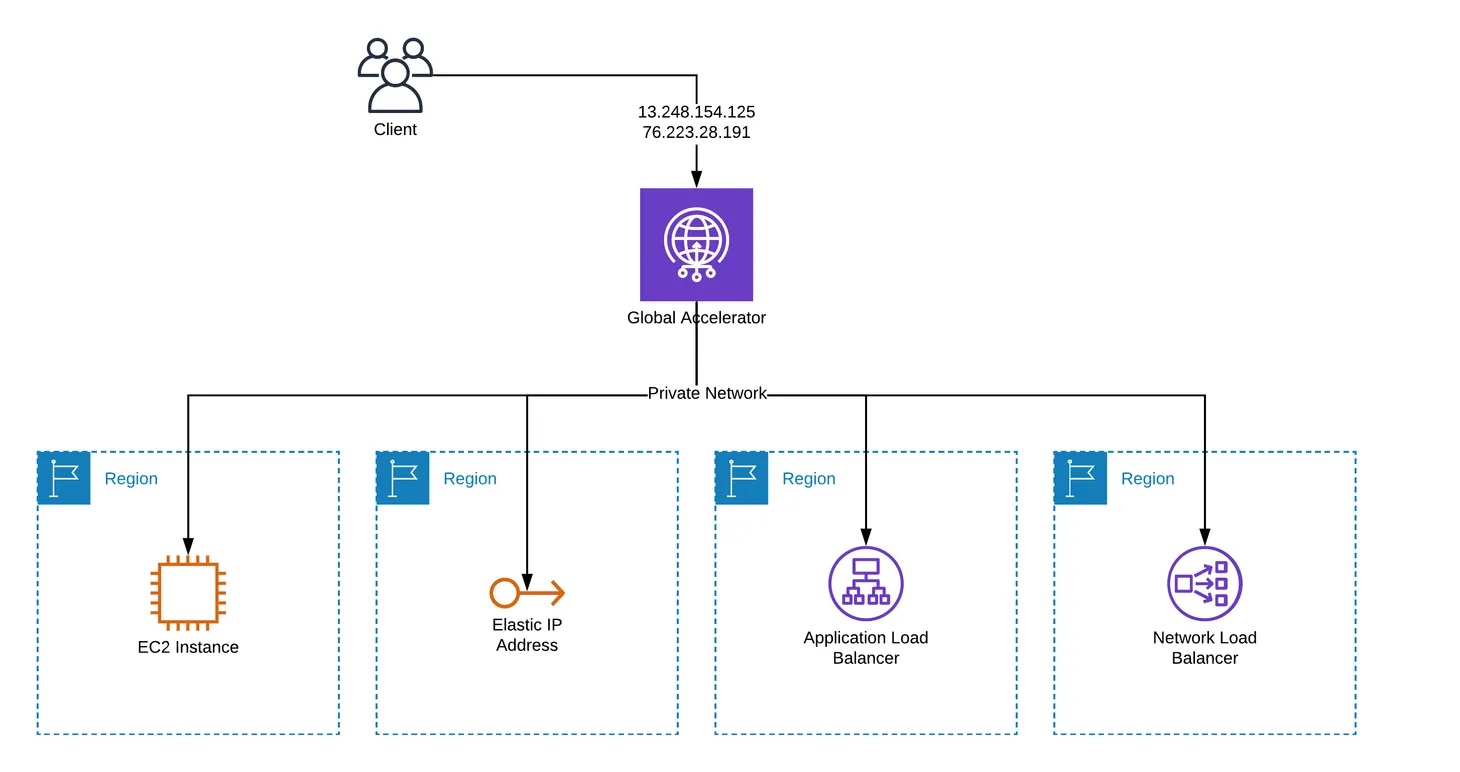
- AWS Global Accelerator is a networking service that helps improve the availability and performance of the applications to global users.
- AWS Global Accelerator optimizes the path to applications to keep packet loss, jitter, and latency consistently low.
- helps improve the performance of the applications by lowering first-byte latency (the round trip time for a packet to go from a client to your endpoint and back again) and jitter (the variation of latency), and increasing throughput (amount of data transferred in a second) as compared to the public internet.
- Global Accelerator uses the vast, well-monitored, congestion-free, redundant AWS global network to route TCP and UDP traffic to a healthy application endpoint in the closest AWS Region to the user.
- is a global service that supports endpoints in multiple AWS Regions.
- uses a global network of 130 Points of Presence in 95 cities across 53 countries.
- supports AWS application endpoints, such as ALBs, NLBs, EC2 Instances, and Elastic IPs without making user-facing changes.
- supports endpoints in 33 AWS Regions including recent additions like Mexico (Central), Asia Pacific (Malaysia), Asia Pacific (Thailand), and Asia Pacific (Taipei).
- provides two global static public IPs that act as a fixed entry point to the application hosted in one or more AWS Regions, improving availability.
- helps anycast the static IP addresses from the AWS edge network which serves as the frontend interface of the applications.
- Using static IP addresses ensures you don’t need to make any client-facing changes or update DNS records as you modify or replace endpoints.
- allows you to bring your own IP addresses (BYOIP) and use them as a fixed entry point to the application endpoints.
- supports cross-account BYOIP, enabling the use of bring-your-own IP addresses across multiple AWS accounts.
- Global Accelerator allocates two static IPv4 addresses serviced by independent network zones which are isolated units with their own set of physical infrastructure and service IP addresses from a unique IP subnet. If one IP address from a network zone becomes unavailable, due to network disruptions or IP address blocking by certain client networks, the client applications can retry using the healthy static IP address from the other isolated network zone.
- supports both IPv4 and dual-stack (IPv4 + IPv6) accelerators. For dual-stack, Global Accelerator provides a total of four addresses: two static IPv4 addresses and two static IPv6 addresses.
- dual-stack accelerators support routing IPv6 traffic to Application Load Balancers, Network Load Balancers, and EC2 instance endpoints.
- continuously monitors the health of the application endpoints by using TCP, HTTP, and HTTPS health checks.
- automatically re-routes the traffic to the nearest healthy available endpoint to mitigate endpoint failure.
- terminates TCP connections from clients at AWS edge locations and, almost concurrently, establishes a new TCP connection with your endpoints. This gives clients faster response times (lower latency) and increased throughput. TCP termination at the edge is supported for both IPv4 and IPv6 traffic.
- supports Client Affinity which helps build stateful applications.
- supports Client IP address preservation for ALBs, EC2 instances, and NLBs (with security groups enabled). Client IP address preservation is not supported for Elastic IP address endpoints.
- integrates with AWS Shield Standard, which minimizes application downtime and latency from DDoS attacks by using always-on network flow monitoring and automated in-line mitigation. AWS Shield Advanced can be enabled for enhanced DDoS detection and mitigation.
- does not support on-premises endpoints. However, an NLB can be configured to address the on-premises endpoints while Global Accelerator points to the NLB.
- supports cross-account attachments, allowing a single accelerator to route traffic to endpoints across multiple AWS accounts.
- integrates with the AWS Load Balancer Controller for Kubernetes, enabling declarative management of accelerators, listeners, and endpoint groups using Kubernetes Custom Resource Definitions (CRDs).
Global Accelerator Types
Standard Accelerator
- Standard accelerators automatically route traffic to a healthy endpoint that is nearest to the user.
- Designed to load balance traffic across endpoints and regions.
- Supports weighted routing using traffic dials and endpoint weights.
- Ideal for web applications, API acceleration, gaming (UDP), IoT (MQTT), VoIP, and HTTP use cases requiring static IP addresses or fast regional failover.
Custom Routing Accelerator
- Custom routing accelerators allow using application logic to deterministically route users to a specific Amazon EC2 instance and port.
- Maps each port on the accelerator to a specific destination (EC2 instance private IP address and port).
- Users are still routed over the AWS global network for performance benefits.
- Ideal for interactive applications such as multi-player gaming, EdTech, social media, video collaboration, and real-time communications (VoIP/SIP).
- Integrates with matchmaking servers or session border controllers to deterministically send user traffic to specific EC2 destinations.
- Client IP address preservation is always enabled for custom routing accelerator endpoints.
Cross-Account Support
- Global Accelerator supports cross-account attachments that allow a single accelerator to route traffic to endpoints across multiple AWS accounts.
- Resource owners create a cross-account attachment to authorize resources in their account to be added to an accelerator by another account.
- Cross-account BYOIP support allows using bring-your-own IP addresses from shared CIDR blocks across accounts.
- Simplifies multi-account architectures by enabling centralized traffic management through a single accelerator.
S3 Multi-Region Access Points
- S3 Multi-Region Access Points use Global Accelerator transparently to provide a single global endpoint to access data sets replicated across multiple AWS Regions.
- Based on AWS Global Accelerator, S3 Multi-Region Access Points consider factors like network congestion and the requesting application’s location to dynamically route requests to the lowest latency copy of data.
- Enables building multi-region applications with the same architecture used in a single region.
Monitoring
- Global Accelerator integrates with Amazon CloudWatch for monitoring.
- CloudWatch metrics include:
- ProcessedBytesIn / ProcessedBytesOut – traffic volume
- NewFlowCount – new TCP/UDP flows per minute
- HealthyEndpointCount / UnhealthyEndpointCount – endpoint health
- ActiveFlowCount – active flows (added March 2024)
- PacketsProcessed – total packets processed (added March 2024)
- TCP_AGA_Reset_Count, TCP_Client_Reset_Count, TCP_Endpoint_Reset_Count – TCP reset metrics for troubleshooting (added March 2024)
- Supports flow logs to capture information about IP traffic going to and from network interfaces in the accelerator (60-second capture window).
Global Accelerator vs CloudFront
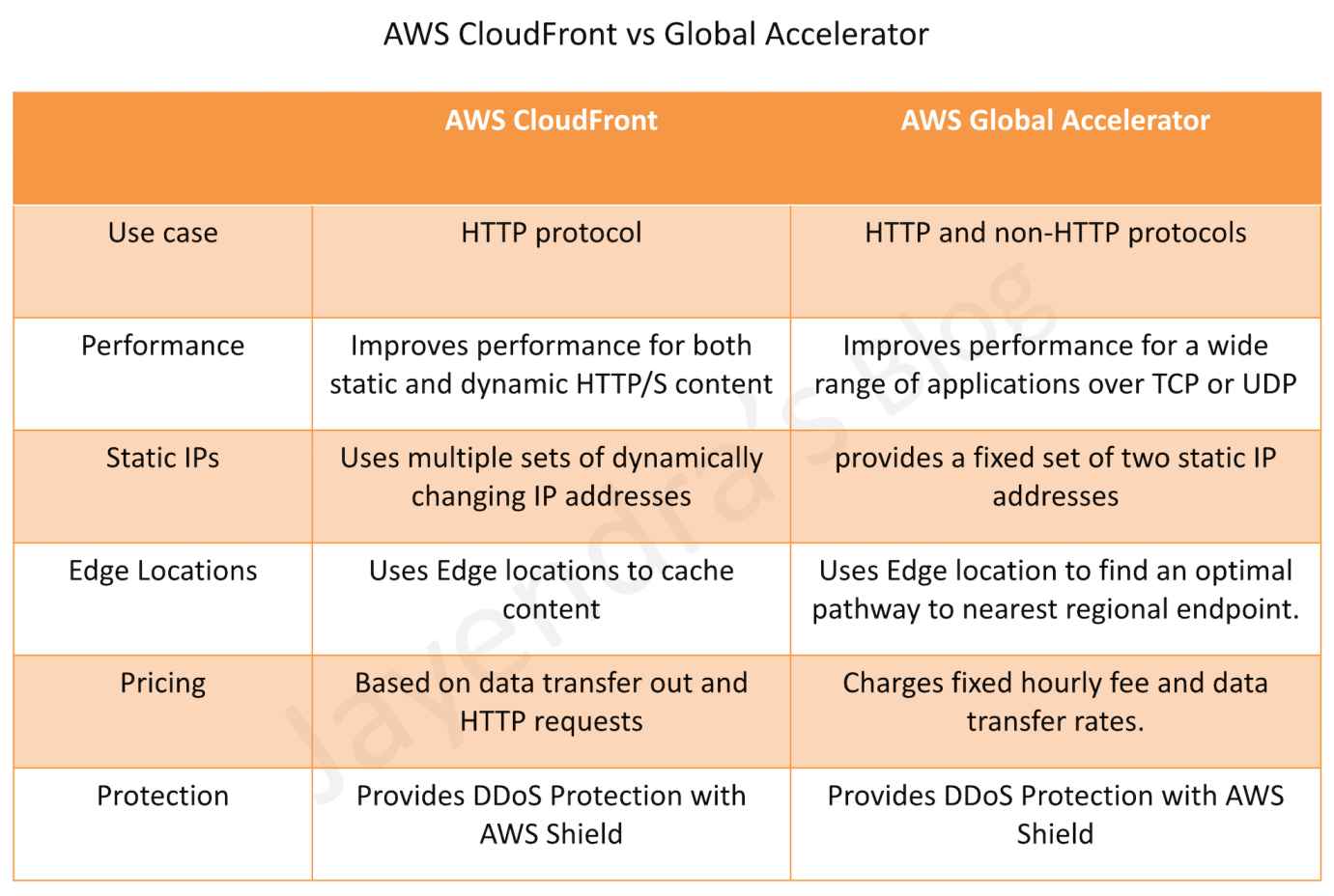
- Global Accelerator and CloudFront both use the AWS global network and its edge locations around the world.
- Both services integrate with AWS Shield for DDoS protection.
- Performance
- CloudFront improves performance for both cacheable content (such as images and videos) and dynamic content (such as API acceleration and dynamic site delivery).
- Global Accelerator improves performance for a wide range of applications over TCP or UDP by proxying packets at the edge to applications running in one or more AWS Regions.
- Use Cases
- CloudFront is a good fit for HTTP use cases
- Global Accelerator is a good fit for non-HTTP use cases, such as gaming (UDP), IoT (MQTT), or VoIP, as well as for HTTP use cases that require static IP addresses or deterministic, fast regional failover.
- Caching
- CloudFront supports Edge caching
- Global Accelerator does not support Edge Caching.
- IP Addresses
- CloudFront uses dynamic IP addresses for edge locations.
- Global Accelerator provides static anycast IP addresses as a fixed entry point.
AWS Certification Exam Practice Questions
- Questions are collected from Internet and the answers are marked as per my knowledge and understanding (which might differ with yours).
- AWS services are updated everyday and both the answers and questions might be outdated soon, so research accordingly.
- AWS exam questions are not updated to keep up the pace with AWS updates, so even if the underlying feature has changed the question might not be updated
- Open to further feedback, discussion and correction.
- What features does AWS Global Accelerator provide? (Select TWO)
- Improved security
-
Improved durability
-
Improved performance
-
Improved cost optimization
-
Improved availability
- A company that develops web applications has launched hundreds of Application Load Balancers (ALBs) in multiple Regions. The company wants to create an allow list for the IPs of all the load balancers on its firewall device. A solutions architect is looking for a one-time, highly available solution to address this request, which will also help reduce the number of IPs that need to be allowed by the firewall. What should the solutions architect recommend to meet these requirements?
- Create an AWS Lambda function to keep track of the IPs for all the ALBs in different Regions. Keep refreshing this list.
- Set up a Network Load Balancer (NLB) with Elastic IPs. Register the private IPs of all the ALBs as targets to this NLB.
- Launch AWS Global Accelerator and create endpoints for all the Regions. Register all the ALBs in different Regions to the corresponding endpoints.
- Set up an Amazon EC2 instance, assign an Elastic IP to this EC2 instance, and configure the instance as a proxy to forward traffic to all the ALBs.
- A company operates a multi-player online gaming platform with game servers deployed across multiple AWS Regions. The company needs to route players to specific game servers based on matchmaking logic while maintaining low latency. Which AWS service and accelerator type should the solutions architect use?
- AWS Global Accelerator with standard accelerator and endpoint weights
- AWS Global Accelerator with custom routing accelerator
- Amazon CloudFront with Lambda@Edge for routing logic
- Amazon Route 53 with latency-based routing
- A company has a multi-account AWS architecture and wants to route traffic through a single AWS Global Accelerator to endpoints in different AWS accounts. What feature should the solutions architect use?
- AWS Resource Access Manager (RAM) sharing
- VPC peering between accounts
- Global Accelerator cross-account attachments
- AWS Organizations service control policies
- A company requires both IPv4 and IPv6 connectivity for their global application. They want to use AWS Global Accelerator with static IP addresses for both protocols. What type of accelerator should they create?
- Standard accelerator with BYOIP addresses
- Dual-stack accelerator
- Custom routing accelerator with IPv6 enabled
- Standard accelerator with two separate configurations