AWS CloudFront vs Global Accelerator
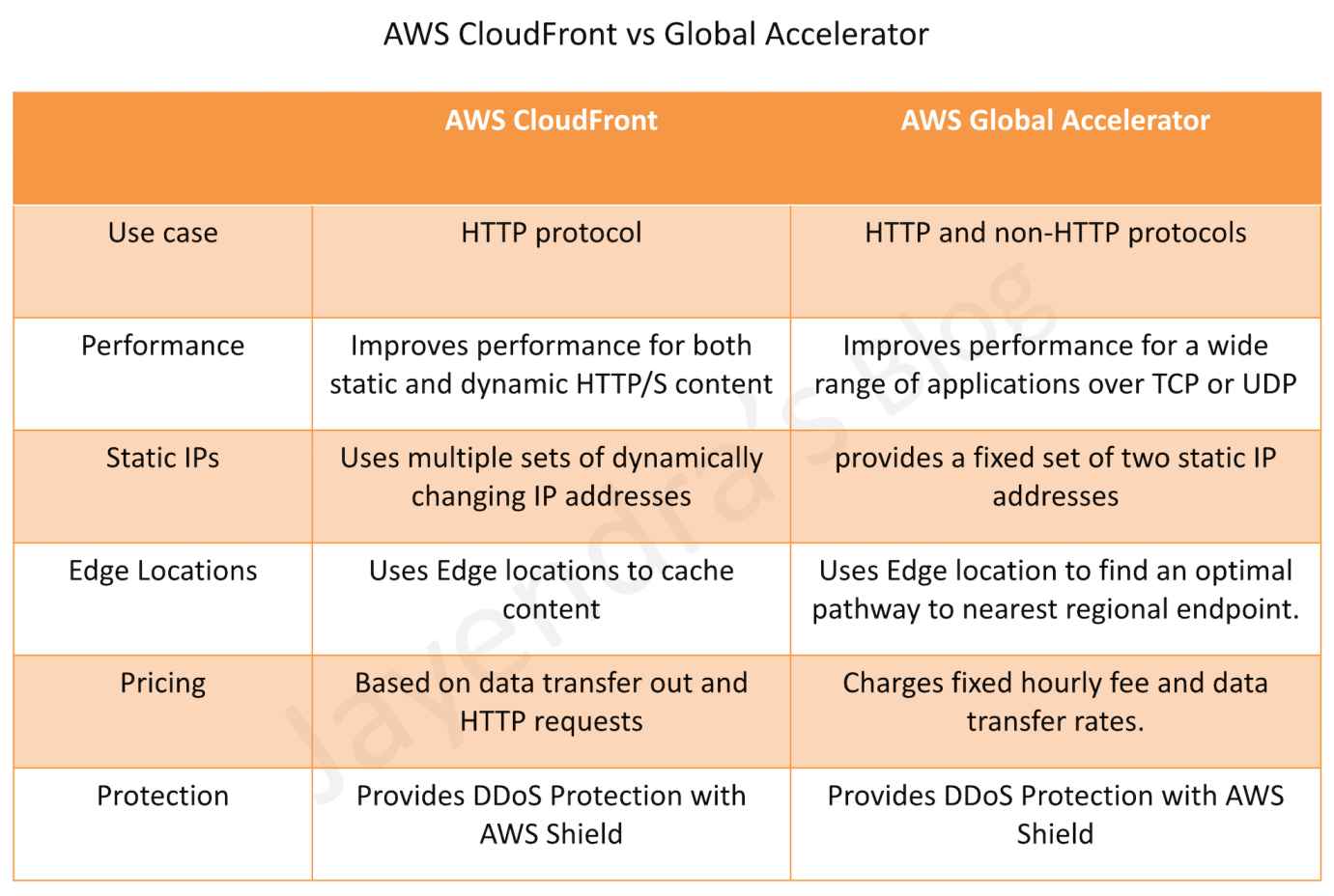
- Global Accelerator and CloudFront both use the AWS global network and its edge locations around the world.
- Both services integrate with AWS Shield for DDoS protection.
- Both services operate from AWS edge locations (Points of Presence), but with different scale:
- CloudFront uses 750+ PoPs in 100+ cities across 50+ countries, plus 1,140+ Embedded PoPs in 300+ cities.
- Global Accelerator uses 130 PoPs in 95 cities across 53 countries.
- Performance
- CloudFront improves performance for both cacheable content (such as images and videos) and dynamic content (such as API acceleration and dynamic site delivery).
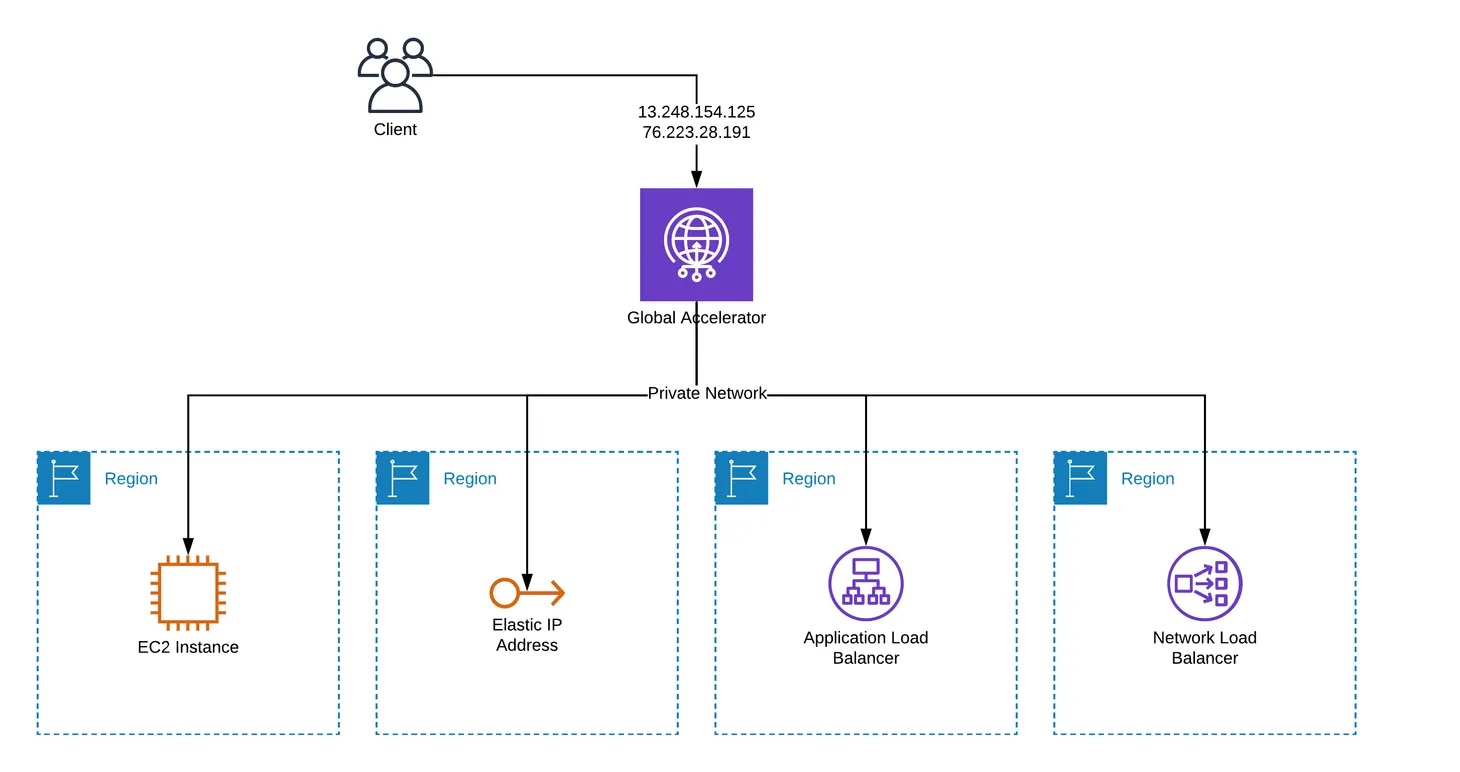
- Global Accelerator improves performance for a wide range of applications over TCP or UDP by proxying packets at the edge to applications running in one or more AWS Regions.
- Use Cases
- CloudFront is a good fit for HTTP use cases, including web content delivery, API acceleration, video streaming, and serverless edge compute.
- Global Accelerator is a good fit for non-HTTP use cases, such as gaming (UDP), IoT (MQTT), or VoIP, as well as for HTTP use cases that require static IP addresses or deterministic, fast regional failover.
- Caching
- CloudFront supports Edge caching with Regional Edge Caches (RECs) and Origin Shield for optimized cache-hit ratios.
- Global Accelerator does not support Edge Caching. It routes traffic over the AWS backbone to the optimal regional endpoint.
- Static IP Addresses
- CloudFront now supports Anycast Static IPs (launched Nov 2024), providing a dedicated set of static IP addresses for allowlisting, zero-rating, and apex domain support.
- Global Accelerator provides two static anycast IPv4 addresses (and optionally two IPv6 addresses with dual-stack) per accelerator, serviced by independent network zones for fault tolerance.
- Protocol Support
- CloudFront supports HTTP and HTTPS (with TLSv1.3), WebSocket, and gRPC.
- Global Accelerator supports TCP and UDP at the transport layer, enabling broader protocol coverage including non-HTTP workloads.
- Failover
- CloudFront supports origin failover for GET and HEAD requests using origin groups with primary and secondary origins.
- Global Accelerator provides instant, deterministic failover across AWS Regions based on continuous health monitoring (TCP, HTTP, HTTPS health checks).
- Edge Compute
- CloudFront offers edge compute via CloudFront Functions (lightweight, sub-millisecond execution at all edge locations) and Lambda@Edge (general-purpose serverless compute).
- Global Accelerator does not provide edge compute capabilities.
- IP Address Management
- CloudFront supports Bring Your Own IP (BYOIP) through VPC IPAM integration for both IPv4 (/24) and IPv6 (/48) address ranges (launched Nov 2025).
- Global Accelerator supports BYOIP allowing up to two /24 IPv4 address ranges per accelerator.
- Security
- CloudFront integrates with AWS WAF, AWS Shield (Standard and Advanced), and supports field-level encryption, signed URLs/cookies, and Origin Access Control (OAC).
- Global Accelerator integrates with AWS Shield (Standard and Advanced) for DDoS protection but does not support WAF integration.
Key Feature Differences (Summary Table)
| Feature | CloudFront | Global Accelerator |
|---|---|---|
| Type | Content Delivery Network (CDN) | Network layer traffic accelerator |
| Caching | Yes (Edge + Regional Edge Caches + Origin Shield) | No |
| Protocols | HTTP, HTTPS, WebSocket, gRPC | TCP, UDP |
| Static IPs | Yes (Anycast Static IPs – Nov 2024) | Yes (2 IPv4 + 2 IPv6 with dual-stack) |
| Edge Compute | CloudFront Functions + Lambda@Edge | No |
| WAF Integration | Yes | No |
| VPC Origins | Yes (private ALB/NLB/EC2) | No |
| Custom Routing | No | Yes (deterministic EC2 routing) |
| Health Checks | Origin failover (GET/HEAD only) | TCP, HTTP, HTTPS (instant regional failover) |
| Dual-Stack (IPv6) | Yes | Yes (dual-stack accelerators with NLB endpoints) |
| BYOIP | Yes (via VPC IPAM, IPv4 + IPv6) | Yes (up to two /24 IPv4 ranges) |
| Kubernetes Integration | No native integration | Yes (AWS Load Balancer Controller CRDs) |
Recent Feature Updates (2024-2026)
CloudFront Updates
- Anycast Static IPs (Nov 2024) – Dedicated static IP addresses for allowlisting, zero-rating traffic with ISPs, and apex domain support. IPv6 support added Nov 2025.
- VPC Origins (Nov 2024) – Connect CloudFront directly to private ALBs, NLBs, or EC2 instances in private subnets without public internet exposure. Cross-account support added Nov 2025.
- Embedded Points of Presence (Feb 2024) – PoPs deployed directly within ISP networks for large-scale video streaming and game downloads, with 1,140+ Embedded PoPs in 300+ cities.
- Flat-Rate Pricing Plans (Nov 2025) – Bundled CDN, WAF, DDoS protection, bot management, Route 53, CloudWatch Logs, edge compute, and S3 storage into predictable monthly pricing with no overage charges.
- Tag-Based Cache Invalidation (May 2026) – Native support to tag cached objects and invalidate by tag directly through the CloudFront API.
- BYOIP via VPC IPAM (Nov 2025) – Bring your own IPv4 and IPv6 addresses to CloudFront using IPAM’s BYOIP for global services.
- CloudFront KeyValueStore (Nov 2023) – Low-latency global data store for CloudFront Functions enabling dynamic edge decisions without code redeployment.
- Simplified Console Experience (Jun 2025) – New user-friendly interface with automated certificate provisioning and DNS configuration.
Global Accelerator Updates
- Kubernetes Integration (Jan 2026) – AWS Load Balancer Controller now supports Global Accelerator through declarative Kubernetes CRDs for managing accelerators, listeners, and endpoint groups.
- Expanded Region Support – Now supports 33 AWS Regions including Mexico (Central), Asia Pacific (Malaysia, Thailand, Taipei) as of Oct 2025.
- Dual-Stack NLB Endpoints (Nov 2023) – IPv6 traffic routing directly to dual-stack NLB endpoints for end-to-end IPv6 connectivity.
- Client IP Preservation for NLB (Aug 2023) – Maintains source IP address for packets arriving at NLB endpoints configured behind Global Accelerator.
- Dual-Stack NLB Support for Standard Accelerators (Mar 2024) – Adding dual-stack NLBs to standard accelerators.
When to Use Which
- Choose CloudFront when:
- Delivering cacheable web content (images, videos, static files)
- Accelerating APIs and dynamic HTTP/HTTPS content
- Needing edge compute (CloudFront Functions or Lambda@Edge)
- Requiring WAF integration for application-layer security
- Serving content from private origins via VPC Origins
- Needing bundled security (WAF + Shield + CDN) with flat-rate pricing
- Choose Global Accelerator when:
- Running non-HTTP workloads (gaming/UDP, IoT/MQTT, VoIP)
- Needing deterministic, instant multi-region failover
- Requiring static IP addresses as fixed entry points (since its inception)
- Using custom routing to deterministically route users to specific EC2 instances (e.g., multiplayer gaming matchmaking)
- Needing Kubernetes-native management of global traffic acceleration
- Running multi-region S3 workloads via S3 Multi-Region Access Points
- Use both together when:
- Needing CDN caching for web content AND fast failover for backend APIs
- Building multi-tier applications with both HTTP and non-HTTP components
AWS Certification Exam Practice Questions
- Questions are collected from Internet and the answers are marked as per my knowledge and understanding (which might differ with yours).
- AWS services are updated everyday and both the answers and questions might be outdated soon, so research accordingly.
- AWS exam questions are not updated to keep up the pace with AWS updates, so even if the underlying feature has changed the question might not be updated
- Open to further feedback, discussion and correction.
- A company wants to improve the availability and performance of its stateless UDP-based workload. The workload is deployed on Amazon EC2 instances in multiple AWS Regions. What should a solutions architect recommend to accomplish this?
- Place the EC2 instances behind Network Load Balancers (NLBs) in each Region. Create an accelerator using AWS Global Accelerator. Use the NLBs as endpoints for the accelerator.
- Place the EC2 instances behind Application Load Balancers (ALBs) in each Region. Create an accelerator using AWS Global Accelerator. Use the ALBs as endpoints for the accelerator.
- Place the EC2 instances behind Network Load Balancers (NLBs) in each Region. Create a CloudFront distribution with an origin that uses Route 53 latency-based routing to route requests to the NLBs.
- Place the EC2 instances behind Application Load Balancers (ALBs) in each Region. Create a CloudFront distribution with an origin that uses Route 53 latency-based routing to route requests to the ALBs.
- A media company delivers live streaming video to millions of global viewers. They need to reduce buffering during peak events while keeping origin infrastructure costs low. Which AWS service is the best fit?
- AWS Global Accelerator with NLB endpoints in each Region
- Amazon CloudFront with Origin Shield enabled and Embedded Points of Presence for large-scale delivery
- Amazon CloudFront with Global Accelerator as the origin
- AWS Global Accelerator with custom routing to direct viewers to specific EC2 instances
- A gaming company wants to route players to specific EC2 game server instances based on matchmaking logic. The application uses UDP and players are distributed globally. Which solution provides the lowest latency and deterministic routing?
- Amazon CloudFront with Lambda@Edge for routing logic
- AWS Global Accelerator with standard routing and NLB endpoints
- AWS Global Accelerator with custom routing accelerator mapping ports to specific EC2 instances
- Amazon Route 53 latency-based routing with health checks
- A company requires its web application origin servers to remain in private subnets with no public internet access, while still serving global users with low latency. Which solution meets these requirements?
- AWS Global Accelerator with private NLB endpoints
- Amazon CloudFront with VPC Origins pointing to private ALB/NLB/EC2 instances
- Amazon CloudFront with an origin in a public subnet protected by Security Groups
- AWS Global Accelerator with EC2 instances using Elastic IP addresses
- A company needs static IP addresses for their content delivery to satisfy partner allowlisting requirements. Previously this was only available with Global Accelerator. Which CloudFront feature now addresses this requirement?
- CloudFront Origin Access Control (OAC)
- CloudFront Anycast Static IPs
- CloudFront Dedicated IP Custom SSL
- CloudFront BYOIP via VPC IPAM
- A company running a multi-region application on Kubernetes (EKS) wants to add global traffic acceleration with automatic failover. They prefer managing infrastructure declaratively through Kubernetes resources. Which approach is most operationally efficient?
- Create Global Accelerator manually via AWS Console and add EKS NLB endpoints
- Use the AWS Load Balancer Controller with Global Accelerator CRDs to declaratively manage accelerators through Kubernetes
- Use Amazon CloudFront with Route 53 failover routing
- Use Amazon Route 53 with latency-based routing and health checks