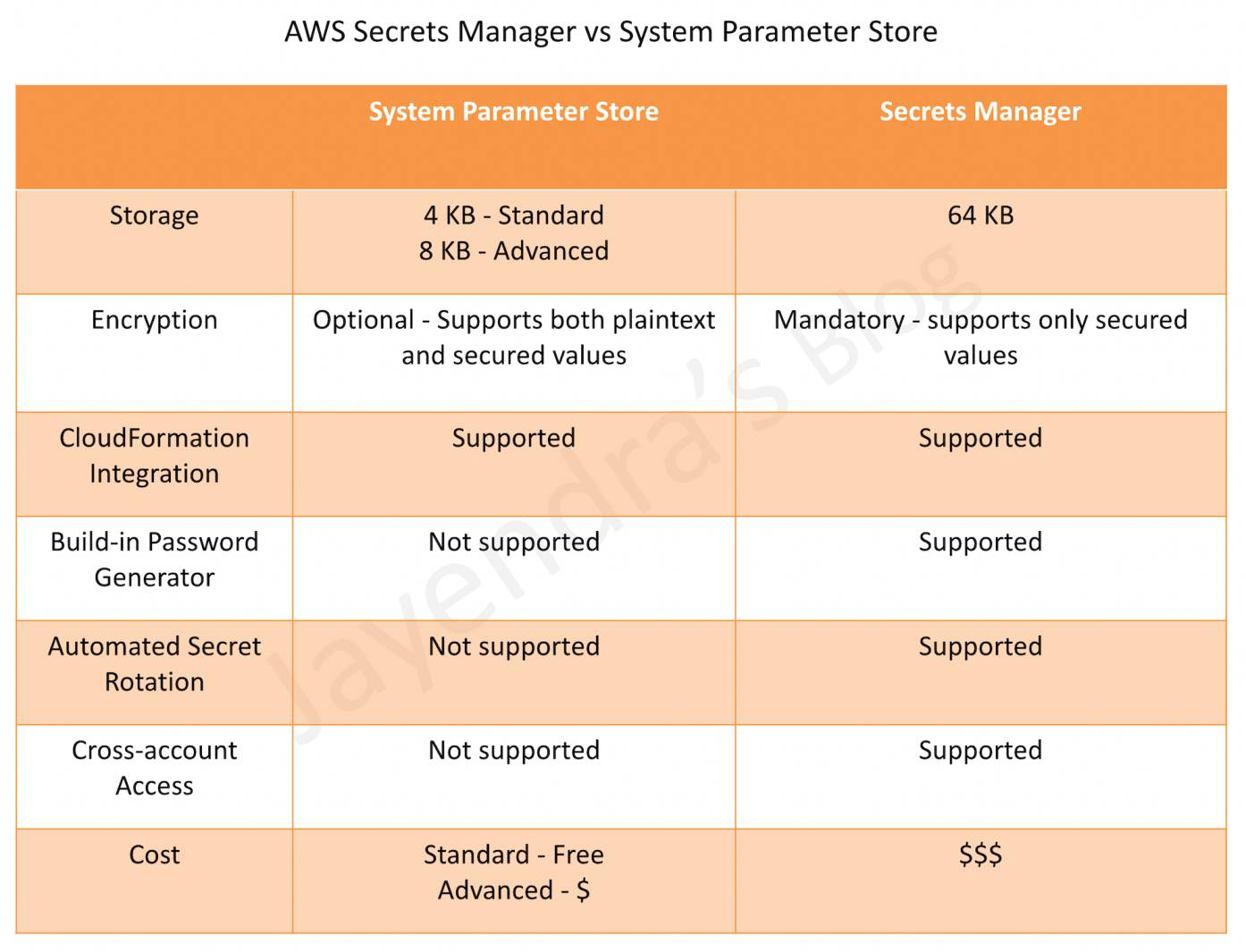
AWS Secrets Manager vs Systems Manager Parameter Store
🆕 Major Updates (2024-2026)
Parameter Store Cross-Account Sharing (Feb 2024): Parameter Store now supports cross-account sharing via AWS Resource Access Manager (RAM) for advanced parameters.
Secrets Manager – Managed External Secrets (Nov 2025): New secret type enabling automatic rotation for third-party SaaS credentials (Salesforce, MongoDB Atlas, Confluent Cloud, Datadog, Snowflake).
Secrets Manager Agent (Jul 2024): Open-source agent providing localhost-based secret caching to reduce API calls and improve availability.
Secrets Manager Limit Increase: Maximum secrets per account increased from 40,000 to 500,000 per Region.
Secrets Manager – BatchGetSecretValue API (Nov 2023): Retrieve up to 20 secrets in a single API call.
Secrets Manager – Cost Allocation Tags (May 2025): Tag secrets and track costs by department, team, or application in AWS Cost Explorer.
AWS Workload Credentials Provider (Jun 2026): Unified provider for caching secrets and deploying certificates across AWS and non-AWS workloads.
AWS Secrets Manager helps protect secrets needed to access applications, services, and IT resources and can easily rotate, manage, and retrieve database credentials, API keys, and other secrets throughout their lifecycle.
AWS Systems Manager Parameter Store provides secure, scalable, centralized, hierarchical storage for configuration data and secret management and can store data such as passwords, database strings, etc.
Key Differences
Storage (Limits keep on upgrading)
AWS Systems Manager Parameter Store allows us to store up to
Standard tier – 10,000 parameters per Region, each of which can be up to 4KB
Advanced tier – 100,000 parameters per Region, each of which can be up to 8KB
AWS Secrets Manager supports up to 500,000 secrets per account per Region, each of which can be up to 64KB.
Encryption
Encryption is optional for Systems Manager Parameter Store (use SecureString parameter type for encryption)
Encryption is mandatory for Secrets Manager and you cannot opt out. Secrets are always encrypted at rest using AWS KMS keys.
Automated Secret Rotation
Systems Manager Parameter Store does not support out-of-the-box secrets rotation.
AWS Secrets Manager enables automatic secret rotation on a schedule, supporting native rotation for RDS, Redshift, DocumentDB, and other AWS databases.
NEW: Secrets Manager now supports Managed External Secrets for automatic rotation of third-party SaaS credentials (Salesforce, MongoDB Atlas, Confluent Cloud, Datadog, Snowflake) without requiring custom Lambda rotation functions.
Cross-account Access
UPDATE (Feb 2024): Systems Manager Parameter Store now supports cross-account sharing of advanced parameters via AWS Resource Access Manager (RAM). Shared parameters provide read-only access to consumers. SecureString parameters require sharing the KMS key separately.
AWS Secrets Manager supports cross-account access through resource-based IAM policies attached directly to the secret.
Multi-Region Replication
Systems Manager Parameter Store does not support automatic cross-region replication.
AWS Secrets Manager supports automatic multi-region replication, keeping replicas in sync with the primary secret for disaster recovery and low-latency access.
Batch Retrieval
Systems Manager Parameter Store supports GetParameters to retrieve up to 10 parameters in a single call.
AWS Secrets Manager supports BatchGetSecretValue API to retrieve up to 20 secrets in a single call, reducing latency and API call costs.
Cost (keeps on changing)
Secrets Manager is comparatively costlier than the Systems Manager Parameter Store.
AWS Systems Manager Parameter Store:
Standard tier: No additional charge (standard throughput)
Advanced tier: $0.05 per advanced parameter per month
API interactions (advanced or higher throughput): $0.05 per 10,000 API interactions
AWS Secrets Manager: $0.40 per secret per month, and $0.05 per 10,000 API calls.
Infrastructure (CloudFormation)
Parameter Store: SecureString parameters cannot be created via AWS CloudFormation (only String and StringList types are supported).
Secrets Manager secrets can be fully managed via CloudFormation including rotation configuration.
New Features (2024-2026)
AWS Secrets Manager – Managed External Secrets
Launched November 2025, Managed External Secrets is a new secret type that extends automatic rotation to third-party SaaS credentials.
Provides first-class integration with supported partners including Salesforce, MongoDB Atlas, Confluent Cloud, Datadog, and Snowflake.
Eliminates the need to write and maintain custom Lambda rotation functions for supported third-party services.
Handles the complete secret lifecycle including creation, rotation, and revocation.
Questions are collected from Internet and the answers are marked as per my knowledge and understanding (which might differ with yours).
AWS services are updated everyday and both the answers and questions might be outdated soon, so research accordingly.
AWS exam questions are not updated to keep up the pace with AWS updates, so even if the underlying feature has changed the question might not be updated
Open to further feedback, discussion and correction.
A company uses Amazon RDS for PostgreSQL databases for its data tier. The company must implement password rotation for the databases. Which solution meets this requirement with the LEAST operational overhead?
Store the password in AWS Secrets Manager. Enable automatic rotation on the secret.
Store the password in AWS Systems Manager Parameter Store. Enable automatic rotation on the parameter.
Store the password in AWS Systems Manager Parameter Store. Write an AWS Lambda function that rotates the password.
Store the password in AWS Key Management Service (AWS KMS). Enable automatic rotation on the customer master key (CMK).
A company needs to share configuration parameters across multiple AWS accounts in an organization. The parameters are non-sensitive and change infrequently. Which solution is the MOST cost-effective?
Store the parameters in AWS Secrets Manager with a resource-based policy for cross-account access.
Store the parameters in AWS Systems Manager Parameter Store as advanced parameters and share them using AWS Resource Access Manager (RAM).
Store the parameters in an Amazon S3 bucket with cross-account access policies.
Store the parameters in AWS Systems Manager Parameter Store as standard parameters and use IAM cross-account roles.
A company uses third-party SaaS applications and needs to manage API credentials for these services. The credentials must be automatically rotated without custom code. Which AWS service and feature should the company use?
AWS Systems Manager Parameter Store with a scheduled Lambda function
AWS Secrets Manager with a custom Lambda rotation function
AWS Secrets Manager with Managed External Secrets
AWS KMS with automatic key rotation
A development team wants to reduce API calls to AWS Secrets Manager from their containerized application while maintaining access to up-to-date secrets. Which approach provides the LEAST operational overhead?
Implement a custom caching layer using Redis
Deploy the AWS Secrets Manager Agent as a sidecar container
Store secrets in environment variables at container startup
Use the AWS Parameters and Secrets Lambda Extension
A solutions architect needs to provide cross-account access to encrypted configuration data stored in AWS Systems Manager Parameter Store. Which combination of steps is required? (Select TWO)
Create the parameter as an advanced parameter and share it using AWS RAM
Create a resource-based policy on the parameter
Share the KMS key used to encrypt the SecureString parameter with the consuming account
Create an IAM role in the consuming account with ssm:GetParameter permission
Store the parameter as a standard parameter and enable cross-account access