AWS Certified Solutions Architect – Professional (SAP-C02) Exam Learning Path
- AWS Certified Solutions Architect – Professional (SAP-C02) exam is the upgraded pattern of the previous Solution Architect – Professional SAP-C01 exam and was released in Nov. 2022.
- SAP-C02 is quite similar to SAP-C01 but has included some new services.
- SAP-C02 remains the current version as of 2026 — AWS has not announced a successor exam version.
AWS Certified Solutions Architect – Professional (SAP-C02) Exam Content
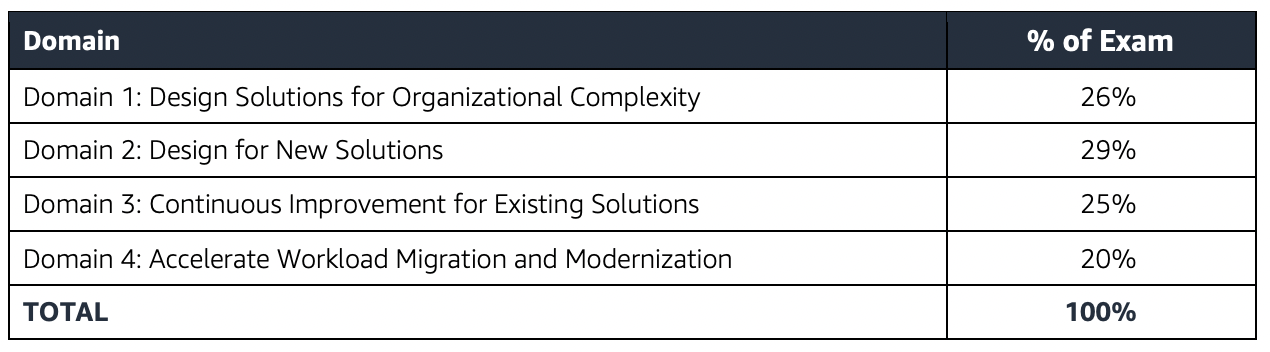
- AWS Certified Solutions Architect – Professional (SAP-C02) exam validates the ability to complete tasks within the scope of the AWS Well-Architected Framework
- Design for organizational complexity
- Design for new solutions
- Continuously improve existing solutions
- Accelerate workload migration and modernization
Refer to AWS Certified Solutions Architect – Professional Exam Guide
AWS Certified Solutions Architect – Professional (SAP-C02) Exam Resources
- Online Courses
- Stephane Maarek – Ultimate AWS Certified Solutions Architect Professional
- Adrian Cantrill – AWS Certified Solutions Architect – Professional
- Adrian Cantrill – AWS Professional Bundle
- DolfinEd AWS Certified Solutions Architect Professional (E-Study Guide & Lab Guides Included)
- Whizlabs – AWS Solutions Architect Professional Online Course
- Coursera – AWS Cloud Solutions Architect Professional Certificate
- Practice tests
AWS Certified Solutions Architect – Professional (SAP-C02) Exam Summary
- Professional exams are tough, lengthy, and tiresome. Most of the questions and answers options have a lot of prose and a lot of reading that needs to be done, so be sure you are prepared and manage your time well.
- Each solution involves multiple AWS services.
- AWS Certified Solutions Architect – Professional (SAP-C02) exam has 65 questions to be solved in 170 minutes.
- SAP-C02 exam includes two types of questions, multiple-choice and multiple-response.
- SAP-C02 has a scaled score between 100 and 1,000. The scaled score needed to pass the exam is 750.
- Each question mainly touches multiple AWS services.
- Professional exams currently cost $ 300 + tax.
- You can get an additional 30 minutes if English is your second language by requesting Exam Accommodations. It might not be needed for Associate exams but is helpful for Professional and Specialty ones.
- As always, mark the questions for review and move on and come back to them after you are done with all.
- As always, having a rough architecture or mental picture of the setup helps focus on the areas that you need to improve. Trust me, you will be able to eliminate 2 answers for sure and then need to focus on only the other two. Read the other 2 answers to check the difference area and that would help you reach the right answer or at least have a 50% chance of getting it right.
- AWS exams can be taken either remotely or online, I prefer to take them online as it provides a lot of flexibility. Just make sure you have a proper place to take the exam with no disturbance and nothing around you.
- Also, if you are taking the AWS Online exam for the first time try to join at least 30 minutes before the actual time as I have had issues with both PSI and Pearson with long wait times.
AWS Certified Solutions Architect – Professional (SAP-C02) Exam Topics
AWS Certified Solutions Architect – Professional (SAP-C02) focuses a lot on concepts and services related to Architecture & Design, Scalability, High Availability, Disaster Recovery, Migration, Security, and Cost Control.
Storage
- Simple Storage Service – S3
- S3 Permissions & S3 Data Protection
- S3 bucket policies to control access to VPC Endpoints and provide cross-account access.
- S3 Storage Classes & Lifecycle policies
- covers S3 Standard, Infrequent access, intelligent tier, and Glacier for archival and object transitions & deletions for cost management.
- S3 Express One Zone (launched Nov 2023) — a high-performance storage class that delivers up to 10x faster data access with single-digit millisecond latency. Ideal for frequently accessed data and latency-sensitive workloads. Data is stored in a single Availability Zone.
- S3 Performance
- S3 Transfer Acceleration can be used for fast, easy, and secure transfers of files over long distances between the client and an S3 bucket.
- S3 Multi-part upload can help improve upload performance and resiliency.
- S3 can be used for static website hosting and integrates with CloudFront to improve performance and latency.
- S3 Security
- S3 supports encryption using KMS
- S3 supports Object Lock and Glacier supports Vault lock to prevent the deletion of objects, especially required for compliance requirements.
- CORS allows client web applications loaded in one domain access to the restricted resources to be requested from another domain.
- S3 supports the same and cross-region replication for disaster recovery.
- S3 Access Logs enable tracking access requests to an S3 bucket.
- supports S3 Select feature to query selective data from a single object.
- S3 Event Notification enables notifications to be triggered when certain events happen in the bucket and support SNS, SQS, Lambda, and EventBridge as the destination.
- S3 Permissions & S3 Data Protection
- Elastic Block Store
- EBS Backup using snapshots for HA and Disaster recovery
- Data Lifecycle Manager can be used to automate the creation, retention, and deletion of snapshots taken to back up the EBS volumes.
- Storage Gateway
- supports File Gateways and Volume Gateways
- File Gateways provides a file interface into S3 and allows storing and retrieving of objects in S3 using industry-standard file protocols such as NFS and SMB.
- Elastic File System – EFS
- provides fully managed, scalable, serverless, shared, and cost-optimized file storage for use with AWS and on-premises resources.
- supports cross-region replication for disaster recovery
- supports storage classes like S3
- supports only Linux-based AMIs
- AWS Transfer Family
- FSx for Lustre
- managed, cost-effective service to launch and run the HPC high-performance Lustre file system.
- FSx for Windows File Server
- fully managed Windows native file system built on Windows Server with full SMB support.
- supports Multi-AZ deployment for high availability.
- AWS Backup
- centrally manage and automate backups across AWS services including EBS, RDS, DynamoDB, EFS, FSx, and S3.
- supports cross-region and cross-account backup for disaster recovery.
- AWS Backup Vault Lock provides WORM (Write-Once-Read-Many) protection for compliance.
- Understand different use cases for S3 vs EBS vs EFS
Database
- DynamoDB
- provides a fully managed NoSQL database service with fast and predictable performance with seamless scalability.
- supports following capacity modes
- Provisioned – the maximum amount of capacity in terms of reads/writes per second that an application can consume from a table or index
- On-demand – serves thousands of requests per second without capacity planning.
- DynamoDB Auto Scaling can be used to handle peaks or bursts.
- DynamoDB Streams for tracking changes
- TTL to expire objects automatically and cost-effectively.
- Global tables for multi-master, active-active inter-region storage needs.
- Global tables do not support strong global consistency
- DynamoDB Accelerator – DAX for seamless caching to reduce the load on DynamoDB for read-heavy requirements.
- RDS
- supports cross-region read replicas ideal for disaster recovery with low RTO and RPO.
- provides RDS proxy for effective database connection pooling
- RDS Multi-AZ vs Read Replicas
- RDS Blue/Green Deployments — enables safer database updates by creating a staging environment (green) that mirrors the production environment (blue), allowing testing before switchover with minimal downtime.
- Aurora
- fully managed, MySQL- and PostgreSQL-compatible, relational database engine
- Aurora Serverless provides on-demand, autoscaling configuration (Aurora Serverless v2 is the current version with instant scaling).
- Aurora Global Database consists of one primary AWS Region where the data is mastered, and up to five read-only, secondary AWS Regions.
- Aurora PostgreSQL Limitless Database (GA Oct 2024) — enables horizontal scaling beyond a single writer instance, supporting millions of write transactions per second and petabytes of data while maintaining transactional consistency.
- Amazon Aurora DSQL (GA May 2025)
- serverless, distributed SQL database with active-active high availability and multi-Region strong consistency.
- provides virtually unlimited scale with zero infrastructure management.
- ideal for always-available applications requiring strong consistency across regions (unlike DynamoDB Global Tables which offer eventual consistency).
- Understand DynamoDB Global Tables vs Aurora Global Databases
- DocumentDB as a replacement for MongoDB
- Keyspaces as a replacement for Cassandra
- ElastiCache for in-memory caching (Redis or Memcached)
Data Migration & Transfer
- Cloud Migration Services
- Cloud Migration (hint: make sure you understand the difference between rehost, replatform, and rearchitect)
- AWS Application Migration Service (MGN) — the primary migration service for lift-and-shift migrations to AWS (replaced the deprecated AWS Server Migration Service).
- ⚠️ Note: AWS Server Migration Service (SMS) was deprecated in March 2022. Use AWS Application Migration Service (MGN) instead.
- MGN now operates as part of AWS Transform (launched May 2025) for automated replication, conversion, and cutover.
- Database Migration Service
- enables quick and secure data migration with minimal to zero downtime
- supports Full and Change Data Capture – CDC migration to support continuous replication for zero downtime migration.
- homogeneous migrations such as Oracle to Oracle, as well as heterogeneous migrations (using SCT) between different database platforms, such as Oracle or Microsoft SQL Server to Aurora.
- Snow Family
- Ideal for one-time huge data transfers usually for use cases with limited bandwidth from on-premises to AWS.
- Understand use cases for data transfer using VPN (quick, slow, uses the Internet), Direct Connect (time to set up, private, recurring transfers), Snow Family (moderate time, private, one-time huge data transfers)
- Application Discovery Service
- ⚠️ Note: Application Discovery Service is closed to new customers as of November 7, 2025. Use AWS Transform for discovery and migration planning instead.
- Agent-based can be used for Hyper-V and physical servers
- Discovery Connector (agentless for VMware) was deprecated November 17, 2025.
- AWS Transform (launched May 2025)
- next-generation migration and modernization service replacing AWS Migration Hub (closed to new customers Nov 7, 2025).
- uses AI-driven automation with specialized agents for discovery, planning, and execution.
- provides a central location to plan, track, and execute migrations to AWS.
- AWS DataSync
- automated data transfer service for moving data between on-premises storage and AWS (S3, EFS, FSx).
- supports scheduled transfers and data validation.
- ideal for ongoing, recurring data transfers (vs. Snow Family for one-time bulk transfers).
Networking & Content Delivery
- VPC – Virtual Private Cloud
- Security Groups, NACLs
- NACLs are stateless and need to open ephemeral ports for response traffic.
- VPC Gateway Endpoints to provide access to S3 and DynamoDB
- VPC Interface Endpoints or PrivateLink provide access to a variety of services like SQS, Kinesis, or Private APIs exposed through NLB.
- VPC Peering to enable communication between VPCs within the same or different regions.
- VPC Peering does not support overlapping CIDRs while PrivateLink does as only the endpoint is exposed.
- VPC Flow Logs to track network traffic
- NAT Gateway provides managed NAT service that provides better availability, higher bandwidth, and requires less administrative effort.
- Security Groups, NACLs
- Amazon VPC Lattice
- application-level networking service for service-to-service communication across VPCs and accounts.
- removes the NLB requirement imposed by PrivateLink, supports cross-VPC/cross-account connectivity without CIDR coordination.
- uses IAM for service-to-service authorization (replaces network-level controls with identity-based access).
- supports HTTP, HTTPS, gRPC, TLS, and TCP protocols.
- integrates with ECS, EKS, EC2, and Lambda as targets.
- Route 53
- Routing Policies
- focus on Weighted, Latency, and failover routing policies
- failover routing provides active-passive configuration for disaster recovery while the others are active-active configurations.
- Route 53 Resolver
- Outbound endpoint for AWS -> On-premises DNS query resolution
- Inbound endpoint for On-premises DNS query resolution
- Routing Policies
- CloudFront
- fully managed, fast CDN service that speeds up the distribution of static, dynamic web or streaming content to end-users.
- supports Origin Groups for multiple origins providing failover capability with primary and secondary origins.
- does not support Auto Scaling as an origin
- supports Geo-restriction
- supports Lambda@Edge and CloudFront Functions to execute code closer to the user.
- Lambda@Edge can be used for quick auth checks, and redirect users based on request data.
- Security can be enhanced by whitelisting CloudFront IPs or adding a custom header in CloudFront and verifying it in ALB.
- API Gateway
- supports throttling, caching and helps define usage plans with API keys to identify clients
- provides regional and edge-optimized endpoint types
- supports CORS for cross-domain calls.
- supports authentication mechanisms, such as AWS IAM policies, Lambda authorizer functions, and Amazon Cognito user pools.
- provide serverless architecture with Lambda.
- Load Balancer – ELB, ALB and NLB
- ELB with Auto Scaling to provide scalable and highly available applications
- Understand ALB vs NLB and their use cases.
- Global Accelerator
- optimizes the path to applications to keep packet loss, jitter, and latency consistently low.
- helps improve the performance of the applications by lowering first-byte latency
- provides 2 static IP addresses
- does not preserve the client’s IP address with NLB
- Transit Gateway
- is a network transit hub that can be used to interconnect VPCs and on-premises networks via Direct Connect or VPN.
- Transit Gateway is regional and Transit Gateway Peering needs to be configured to peer regional Transit gateways.
- AWS Cloud WAN
- managed wide area network (WAN) service for building and operating global networks connecting data centers, branches, and VPCs.
- uses a declarative core network policy for defining network intent (segments, routing, access control).
- replaces the legacy Transit VPC architecture with built-in automation, segmentation, and centralized management.
- supports Service Insertion for integrating inspection appliances (e.g., Network Firewall).
- managed within AWS Network Manager.
- Placement Groups
- Cluster placement group with Enhanced Networking for HPC
- Spread placement group for fault tolerance and high availability.
- Direct Connect & VPN
- provide on-premises to AWS connectivity
- Understand Direct Connect vs VPN
- VPN can provide a cost-effective, quick failover for Direct Connect.
- VPN over Direct Connect provides a secure dedicated connection and requires a public virtual interface.
- Direct Connect Gateway is a global network device that helps establish connectivity that spans VPCs spread across multiple AWS Regions with a single Direct Connect connection.
Security, Identity & Compliance
- AWS Identity and Access Management
- IAM Roles and use cases
- IAM Web Identity & Federation
- IAM Best Practices
- AWS IAM Identity Center (formerly AWS SSO) — centrally manage workforce access to multiple AWS accounts and applications using SAML 2.0.
- AWS Shield & Shield Advanced
- for DDoS protection and integrates with Route 53, CloudFront, ALB, and Global Accelerator.
- AWS WAF
- protects from common attack techniques like SQL injection and XSS, Conditions based include IP addresses, HTTP headers, HTTP body, and URI strings.
- integrates with CloudFront, ALB, API Gateway, and AppSync.
- supports Web ACLs and can block traffic based on IPs, Rate limits, and specific countries as well.
- AWS Network Firewall
- managed network firewall service for VPC-level traffic inspection and filtering.
- provides stateful and stateless inspection, intrusion prevention, and web filtering.
- integrates with AWS Firewall Manager for centralized management across accounts.
- commonly used with Transit Gateway for centralized traffic inspection architecture.
- AWS Verified Access
- provides secure, VPN-less access to corporate applications using Zero Trust principles.
- evaluates each access request based on user identity and device security state.
- supports HTTP/HTTPS and non-HTTP(S) protocols (SSH, RDP, JDBC — GA Feb 2025).
- eliminates the need for traditional VPN infrastructure for application access.
- ACM – AWS Certificate Manager
- helps easily provision, manage, and deploy public and private SSL/TLS certificates
- is regional and you need to request certificates in all regions and associate individually in all regions.
- does not provide certificates for EC2 instances.
- AWS KMS – Key Management Service
- managed encryption service that allows the creation and control of encryption keys to enable data encryption.
- KMS Multi-region keys
- are AWS KMS keys in different AWS Regions that can be used interchangeably – as though having the same key in multiple Regions.
- are not global and each multi-region key needs to be replicated and managed independently.
- Secrets Manager
- helps protect secrets needed to access applications, services, and IT resources.
- Secrets Manager vs SSM Parameter Store.
- Secrets Manager supports random generation and automatic rotation of secrets, which is not provided by SSM Parameter Store.
- Costs more than SSM Parameter Store.
- Amazon Macie is a data security and data privacy service that uses ML and pattern matching to discover and protect sensitive data in S3.
- AWS Security Hub is a cloud security posture management service that performs security best practice checks, aggregates alerts, and enables automated remediation.
- Amazon GuardDuty — intelligent threat detection service that monitors for malicious activity and unauthorized behavior across AWS accounts.
- Amazon Inspector — automated vulnerability management service that continually scans workloads for software vulnerabilities and unintended network exposure.
Compute
- EC2
- Auto Scaling provides the ability to ensure a correct number of EC2 instances are always running to handle the load of the application
- Lambda
- offers Serverless computing
- Lambda running in VPC requires NAT Gateway to communicate with external public services
- Lambda CPU can be increased by increasing memory only.
- helps define reserved concurrency limits to reduce the impact
- Lambda Alias now supports canary deployments
- Lambda supports docker containers
- Reserved Concurrency guarantees the maximum number of concurrent instances for the function
- Provisioned Concurrency provides greater control over the performance of serverless applications and helps keep functions initialized and hyper-ready to respond in double-digit milliseconds.
- Lambda SnapStart (GA for Python and .NET in Nov 2024) — reduces cold start latency by up to 10x by taking a snapshot of the initialized execution environment. Supports Java, Python, and .NET runtimes.
- Lambda Response Streaming — enables progressive streaming of response payloads back to clients (supports up to 200 MB payloads). Ideal for generative AI and real-time data processing.
- Lambda Best Practices esp. handling the database connection code.
- Step Functions helps developers use AWS services to build distributed applications, automate processes, orchestrate microservices, and create data and machine learning (ML) pipelines.
- ECS – Elastic Container Service
- container management service that supports Docker containers
- supports two launch types
- EC2 and
- Fargate which provides the serverless capability
- ECS Managed Instances (launched 2025) — new compute option between EC2 and Fargate, offering more control than Fargate (GPU support, privileged containers, higher memory) with less management than self-managed EC2.
- ECS now supports native blue/green, linear, and canary deployment strategies without requiring AWS CodeDeploy.
- For least privilege, the role should be assigned to the Task.
awsvpcnetwork mode gives ECS tasks the same networking properties as EC2 instances.
- Amazon EKS (Elastic Kubernetes Service)
- managed Kubernetes service for running containerized workloads at scale.
- supports EC2, Fargate, and EKS Anywhere (for on-premises/hybrid deployments).
- in-scope for SAP-C02; understand when to use ECS vs EKS (EKS for Kubernetes portability, ECS for simpler AWS-native container orchestration).
Disaster Recovery
- Disaster Recovery whitepaper, although outdated, make sure you understand the differences and implementation for each type esp. pilot light, warm standby w.r.t RTO, and RPO.
- AWS Elastic Disaster Recovery (DRS)
- minimizes downtime and data loss with fast, reliable recovery of on-premises and cloud-based applications.
- uses continuous block-level replication and point-in-time recovery.
- provides RPO in seconds and RTO in minutes.
- supports DR drills without impacting source servers.
- now supports AWS Outposts for on-premises DR scenarios.
- Compute
- Make components available in an alternate region,
- Backup and Restore using either snapshots or AMIs that can be restored.
- Use minimal low-scale capacity running which can be scaled once the failover happens
- Use fully running compute in active-active configuration with health checks.
- CloudFormation to create, and scale infra as needed
- Storage
- S3 and EFS support cross-region replication
- DynamoDB supports Global tables for multi-master, active-active inter-region storage needs.
- Aurora Global Database provides cross-region read replicas and failover capabilities.
- Aurora DSQL provides active-active multi-Region strong consistency for always-available applications.
- RDS supports cross-region read replicas which can be promoted to master in case of a disaster. This can be done using Route 53, CloudWatch, and lambda functions.
- Network
- Route 53 failover routing with health checks to failover across regions.
- CloudFront Origin Groups support primary and secondary endpoints with failover.
Management & Governance tools
- AWS Organizations
- Difference between Service Control Policies and IAM Policies
- SCP provides the maximum permission that a user can have, however, the user still needs to be explicitly given IAM policy.
- Systems Manager
- AWS Systems Manager and its various services like parameter store, patch manager
- Parameter Store provides secure, scalable, centralized, hierarchical storage for configuration data and secret management. Does not support secrets rotation. Use Secrets Manager instead
- Session Manager provides secure and auditable instance management without the need to open inbound ports, maintain bastion hosts, or manage SSH keys.
- Patch Manager helps automate the process of patching managed instances with both security-related and other types of updates.
- CloudWatch
- CloudWatch logs
- CloudWatch Subscription Filters and their integration with other services.
- Amazon EventBridge (formerly CloudWatch Events)
- EventBridge is the evolution of CloudWatch Events with additional features like Schema Registry, EventBridge Pipes, and SaaS partner integrations.
- New features are only added to EventBridge, not CloudWatch Events.
- supports event-driven architectures, scheduled rules, and cross-account/cross-region event routing.
- CloudTrail
- for audit and governance
- With Organizations, the trail can be configured to log CloudTrail from all accounts to a central account.
- CloudFormation
- Handle disaster Recovery by automating the infra to replicate the environment across regions.
- Deletion Policy to prevent, retain, or backup RDS, EBS Volumes
- Stack policy can prevent stack resources from being unintentionally updated or deleted during a stack update. Stack Policy only applies for Stack updates and not stack deletion.
- StackSets helps to create, update, or delete stacks across multiple accounts and Regions with a single operation.
- Control Tower
- to setup, govern, and secure a multi-account environment
- strongly recommended guardrails cover EBS encryption
- Landing Zone v4.0 (2025) — modular design allowing selective enablement of CloudTrail, Config, and Backup integrations. No longer enforces a mandatory Security OU structure.
- Controls Dedicated experience (Nov 2025) — allows using 750+ managed controls without deploying a full Control Tower landing zone.
- supports automatic enrollment of accounts when moved to an Organizational Unit.
- Service Catalog
- allows organizations to create and manage catalogues of IT services that are approved for use on AWS with minimal permissions.
- Trusted Advisor
- helps with cost optimization and service limits in addition to security, performance and fault tolerance.
- Compute Optimizer recommends optimal AWS resources for the workloads to reduce costs and improve performance by using machine learning to analyze historical utilization metrics.
- AWS Budgets to see usage-to-date and current estimated charges from AWS, set limits and provide alerts or notifications.
- Cost Allocation Tags can be used to organize AWS resources, and cost allocation tags to track the AWS costs on a detailed level.
- Cost Explorer helps visualize, understand, manage and forecast the AWS costs and usage over time.
- Amazon WorkSpaces provides a virtual workspace for varied worker types, especially hybrid and remote workers.
Integration Tools
- SQS in terms of loose coupling and scaling.
- Difference between SQS Standard and FIFO esp. with throughput and order
- SQS supports dead letter queues
- EventBridge integration with SNS and Lambda for notifications and event-driven workflows.
- Amazon EventBridge Pipes — point-to-point integration between event sources and targets with optional filtering and transformation, without writing Lambda functions.
Analytics
- Kinesis
- for real-time data ingestion and analytics.
- Difference between Kinesis Data Streams and Amazon Data Firehose
- Amazon Data Firehose (formerly Kinesis Data Firehose, renamed Feb 2024)
- the easiest way to capture, transform, and deliver data streams.
- integrates with S3, Redshift, OpenSearch, Splunk, Snowflake, and other 3rd-party analytics services.
- OpenSearch Service (formerly Elasticsearch) provides a managed search and analytics solution.
- OpenSearch Serverless — serverless option with scale-to-zero capability (next-gen architecture GA May 2026 with up to 60% cost savings).
- supports time-series, search, and vector collections (vector collections used for RAG with Amazon Bedrock knowledge bases).
- Amazon Timestream is a fast, scalable, and serverless time-series database service that makes it easier to store and analyze trillions of events per day.
- AWS Glue — serverless ETL service for data preparation and integration.
- Glue Crawlers auto-discover data schemas and populate the Glue Data Catalog.
- Glue Data Catalog integrates with Athena, Redshift Spectrum, and EMR for querying.
- Amazon Athena — serverless interactive query service using standard SQL to analyze data in S3.
- AWS Lake Formation — simplifies building, securing, and managing data lakes on S3 with fine-grained access control.
- Amazon Connect is an omnichannel cloud contact center.
- Amazon Pinpoint is a flexible, scalable marketing communications service that helps connects customers over email, SMS, push notifications or voice
- Amazon Rekognition offers pre-trained and customizable computer vision capabilities to extract information and insights from images and videos
- Amazon Transcribe for Voice to Text conversion
Architecture & Design Flows
- Disaster Recovery
- Multi-Region Compute and Security
- Multi-Region Storage and Data
- S3, EFS cross-region replication
- DynamoDB Global Tables – Multi-Master
- Aurora Global Database, Aurora DSQL (multi-Region strong consistency), RDS – Cross-region read replica
- WAF/AWS Shield -> CloudFront -> S3 with WAF-managed Amazon IP reputation rule group or country-specific rule
- Kinesis Data Streams -> Amazon Data Firehose -> OpenSearch/S3/Redshift
- Kinesis Data Agent -> Amazon Data Firehose -> OpenSearch/S3/Redshift
- CloudWatch Logs -> (Subscription Filter) -> Kinesis Data Streams
- Quota Monitor & Solution Definition
- Enhance Security with CloudFront + WAF
- S3 Event Notification -> SNS/SQS/Lambda/EventBridge
- Analysing SES data – SES Logs -> Amazon Data Firehose -> S3 -> Athena
- Centralized Networking using Network Firewall
- VPC Lattice for service-to-service connectivity across VPCs without CIDR management
- AWS Cloud WAN for global network connectivity replacing Transit VPC architectures
- AWS Verified Access for Zero Trust VPN-less application access
- Multi-Account Strategy
- Identity account for role and users
- Infosec account
- Logging account
- Direct Connect with VPN – Low latency, Secure Connectivity
- Detect/Remediate Security/Compliance Rules with AWS Config -> Systems Manager Automation/Lambda to remediate findings
- Real-time Leadership Dashboard with ElastiCache
- RDS/S3 -> Glue Crawler -> Glue Catalog -> Athena
- Lambda@Edge + CloudFront to dynamically route requests
- AppSync Mobile Architecture
- Centralized Logging
- Multi-region API Gateway with CloudFront
- Accessing VPC Endpoints from On-premises
- Migrate Oracle to Amazon Redshift
- Monitor IAM Root User Activity
- Migrate an Oracle database to Aurora MySQL using AWS DMS and SCT
- Archive DynamoDB data to S3 using TTL
- Encrypt Existing and New EBS Volumes
- Building Fault-Tolerant Applications on AWS
AWS Architecture Patterns for SAP-C02
End-to-end reference architectures with design decisions tested on this exam:
- All 10 Architecture Patterns – Hub Page
- Multi-Account Architecture – Organizations & Control Tower
- Disaster Recovery – 4 Strategies (Backup, Pilot Light, Warm, Multi-Site)
- Hybrid Cloud Networking – Direct Connect & Transit Gateway
- Event-Driven Serverless Architecture
- Container Platform – ECS, EKS & Fargate
- CI/CD Pipeline Architecture
- Data Lake & Analytics Architecture
- Zero Trust Security Architecture
Additional SAP-C02 Architecture Patterns
- Serverless API Architecture – API GW, Lambda, DynamoDB & RDS Proxy
- Cost Optimization – Savings Plans, Spot, Right-Sizing & Storage Tiering
- Migration Architecture – 7Rs, Migration Hub & Tools
- Global Traffic Management – Route 53 vs GA vs CloudFront
- VPC Connectivity – Peering vs TGW vs PrivateLink vs Sharing
Performance & Scaling Architecture Patterns
- Three-Tier Web & Caching – ElastiCache, DAX & CloudFront
- Auto Scaling & Performance – Predictive, Warm Pools & Policies
- Federation & SSO – Identity Center, Cognito & SAML
On the Exam Day
- Make sure you are relaxed and get some good night’s sleep. The exam is not tough if you are well-prepared.
- If you are taking the AWS Online exam
- Try to join at least 30 minutes before the actual time as I have had issues with both PSI and Pearson with long wait times.
- The online verification process does take some time and usually, there are glitches.
- Remember, you would not be allowed to take the exam if you are late by more than 30 minutes.
- Make sure you have your desk clear, no hand-watches, or external monitors, keep your phones away, and nobody can enter the room.
Finally, All the Best 🙂