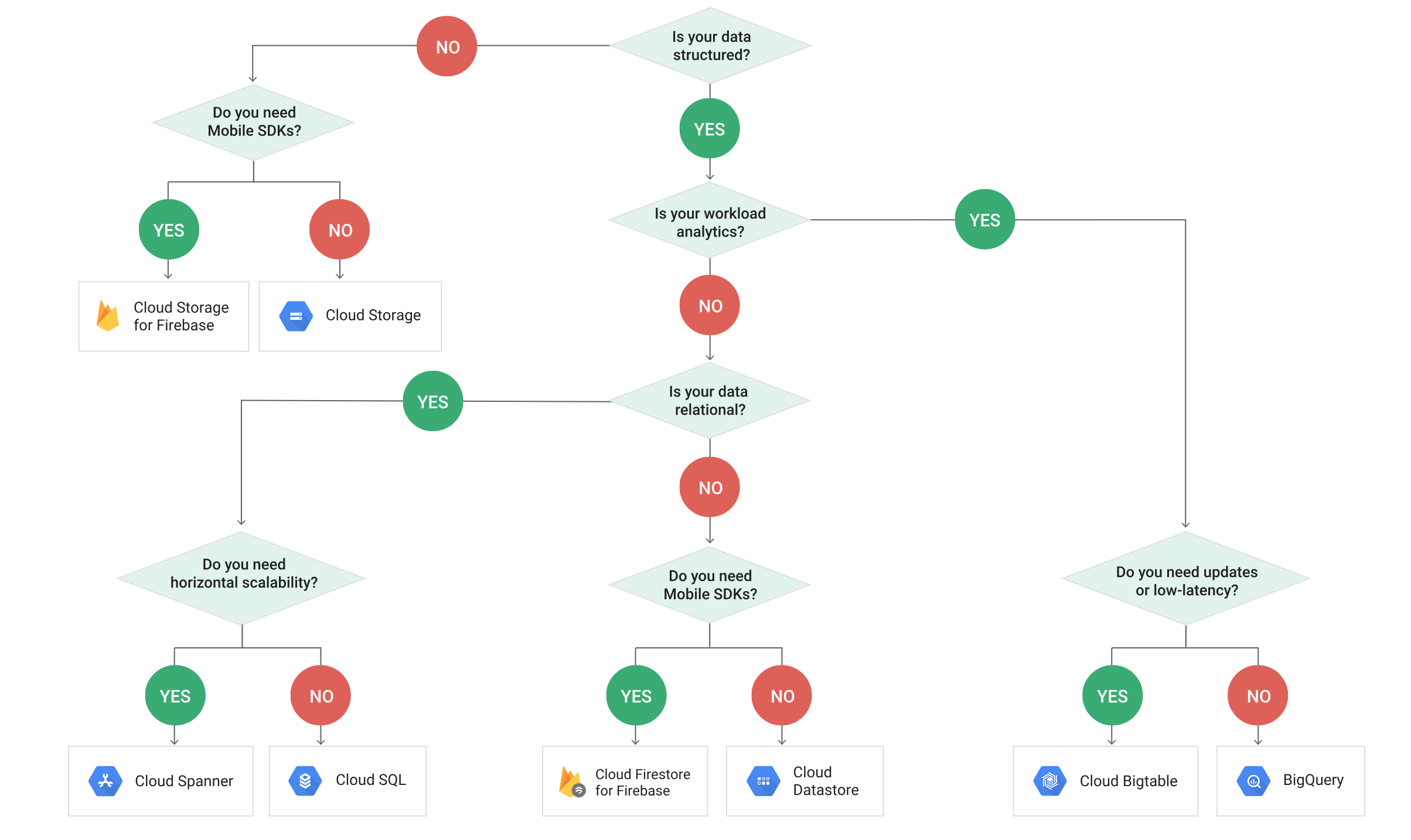
Google Cloud Storage Options
- Relational (SQL) – Cloud SQL, AlloyDB & Cloud Spanner
- Non-Relational (NoSQL) – Firestore & Bigtable
- Structured & Semi-structured – Cloud SQL, AlloyDB, Cloud Spanner, Firestore & Bigtable
- Unstructured – Cloud Storage
- Block Storage – Persistent Disk & Hyperdisk
- File Storage – Filestore
- In-Memory – Memorystore (Redis, Valkey)
- Transactional (OLTP) – Cloud SQL, AlloyDB & Cloud Spanner
- Analytical (OLAP) – Bigtable & BigQuery
- Fully Managed (Serverless) – Cloud Spanner, Firestore, BigQuery, AlloyDB
- Requires Provisioning – Cloud SQL, Bigtable
- Global – Cloud Spanner
- Regional – Cloud SQL, AlloyDB, Bigtable, Firestore
Google Cloud Storage – GCS
- provides service for storing unstructured data i.e. objects
- consists of bucket and objects where an object is an immutable piece of data consisting of a file of any format stored in containers called buckets.
- support different location types
- regional
- A region is a specific geographic place, such as London.
- helps optimize latency and network bandwidth for data consumers, such as analytics pipelines, that are grouped in the same region.
- dual-region
- is a specific pair of regions, such as Finland and the Netherlands.
- provides higher availability that comes with being geo-redundant.
- multi-region
- is a large geographic area, such as the United States, that contains two or more geographic places.
- allows serving content to data consumers that are outside of the Google network and distributed across large geographic areas
- provides higher availability that comes with being geo-redundant.
- Objects stored in a multi-region or dual-region are geo-redundant i.e. data is stored redundantly in at least two separate geographic places separated by at least 100 miles.
- regional
- Storage class affects the object’s availability and pricing model
- Standard Storage is best for data that is frequently accessed (hot data) and/or stored for only brief periods of time.
- Nearline Storage is a low-cost, highly durable storage service for storing infrequently accessed data (warm data)
- Coldline Storage provides a very-low-cost, highly durable storage service for storing infrequently accessed data (cold data)
- Archive Storage is the lowest-cost, highly durable storage service for data archiving, online backup, and disaster recovery. (coldest data)
- Autoclass automatically transitions objects to appropriate storage classes based on access patterns, removing the need to manually manage lifecycle rules for cost optimization. Supports transitioning between Standard, Nearline, Coldline, and Archive classes.
- Soft Delete (launched 2024) provides default bucket-level protection against accidental or malicious deletion by preserving recently deleted objects for a configurable retention period (7-90 days). Enabled by default with 7-day retention.
- Object Versioning prevents accidental overwrites and deletion. It retains a noncurrent object version when the live object version gets replaced, overwritten or deleted
- Object Lifecycle Management sets Time To Live (TTL) on an object and helps configure transition or expiration of the objects based on specified rules for e.g.
SetStorageClassto change the storage class,deleteto expire noncurrent or archived objects - Resumable uploads are the recommended method for uploading large files, because they don’t need to be restarted from the beginning if there is a network failure while the upload is underway.
- Parallel composite uploads divides a file into up to 32 chunks, which are uploaded in parallel to temporary objects, the final object is recreated using the temporary objects, and the temporary objects are deleted
- Requester Pays on the bucket that requires requester to include a billing project in their requests, thus billing the requester’s project.
- supports upload and storage of any MIME type of data up to 5 TB in size.
- Retention policy on a bucket ensures that all current and future objects in the bucket cannot be deleted or replaced until they reach the defined age
- Retention policy locks will lock a retention policy on a bucket and prevents the policy from ever being removed or the retention period from ever being reduced (although it can be increased). Locking a retention policy is irreversible
- Bucket Lock feature provides immutable storage on Cloud Storage
- Object holds, when set on individual objects, prevents the object from being deleted or replaced, however allows metadata to be edited.
- Signed URLs provide time-limited read or write access to an object through a generated URL.
- Signed policy documents helps specify what can be uploaded to a bucket.
- Cloud Storage supports encryption at rest and in transit as well
- Cloud Storage supports both
- Server-side encryption with support for Google managed, Customer managed and Customer supplied encryption keys
- Client-side encryption: encryption that occurs before data is sent to Cloud Storage, encrypted at client side.
- Cloud Storage operations are
- strongly consistent for read after writes or deletes and listing
- eventually consistent for granting access to or revoking access
- Cloud Storage allows setting CORS configuration at the bucket level only
Cloud Storage Rapid (New – 2025)
- Rapid Bucket (formerly Rapid Storage) is a high-performance zonal object storage offering designed for AI/ML and HPC workloads
- Provides sub-millisecond random read and write latency
- Up to 15 TB/s of aggregate throughput and 20 million QPS
- Collocates data with AI accelerators (TPUs/GPUs) in the same physical zone
- 5x faster checkpoint restores and 3.2x faster checkpoint writes
- Rapid Cache (formerly Anywhere Cache) accelerates reads on-demand for workloads in existing multi-region buckets, providing up to 20 Tbps throughput
- Storage Intelligence provides zero-configuration dashboards, aggregated activity views, and enhanced batch operations for streamlined data management
Cloud SQL
- provides relational MySQL, PostgreSQL and SQL Server databases as a service
- managed, however, needs to select and provision machines
- supports automatic replication, managed backups, vertical scaling for read and write, Horizontal scaling (using read replicas)
- provides High Availability configuration provides data redundancy and failover capability with minimal downtime, when a zone or instance becomes unavailable due to a zonal outage, or an instance corruption
- HA standby instance does not increase scalability and cannot be used for read queries.
- Read replicas help scale horizontally the use of data in a database without degrading performance
- is regional – although it now supports cross region read replicas
- supports data encryption at rest and in transit
- supports Point-In-Time recovery with binary logging and backups
- available in two editions (introduced 2023-2024):
- Cloud SQL Enterprise – provides all core capabilities, suitable for applications with less stringent availability and performance requirements
- Cloud SQL Enterprise Plus – provides enhanced performance (up to 3x faster reads, 2x better write latency), higher availability, advanced observability (Query Insights), and supports Performance-optimized and Memory-optimized machine families (up to 32 GiB RAM per vCPU)
- supports Private Service Connect (PSC) for automated endpoint creation in VPCs
- supports Managed Connection Pooling with IAM authentication
- supports PostgreSQL 18, MySQL 8.4, and SQL Server 2022
- Extended Support – starting Feb 2025, instances running EOL major versions are automatically enrolled in paid extended support
AlloyDB for PostgreSQL (New Service)
- fully managed, PostgreSQL-compatible database service designed for demanding enterprise workloads
- more than 4x faster for transactional workloads and up to 100x faster for analytical queries compared to standard PostgreSQL
- provides 99.99% availability SLA including maintenance
- 100% compatible with open-source PostgreSQL
- key features:
- Columnar Engine – built-in columnar engine for real-time analytical queries on transactional data
- AI/ML Integration – built-in vector search, Vertex AI integration for gen AI applications
- Adaptive Autovacuum and automatic memory management
- Index Advisor – recommends indexes to improve query performance
- AlloyDB Omni – downloadable version that can run anywhere (on-premises, other clouds, edge)
- supports PostgreSQL 14, 15, 16, 17, and 18
- is regional with cross-region replication for disaster recovery
Cloud Spanner
- fully managed, globally distributed, strongly consistent relational database service
- provides virtually unlimited horizontal scalability with 99.999% availability SLA
- supports SQL (GoogleSQL and PostgreSQL interface)
- now available in editions (introduced 2024):
- Standard Edition – core relational database capabilities
- Enterprise Edition – adds multi-model capabilities including Spanner Graph, full-text search, vector search, managed autoscaling, and incremental backups
- Enterprise Plus Edition – highest performance and availability
- Multi-model capabilities (2024-2025):
- Spanner Graph – native graph support using industry-standard GQL (Graph Query Language), interoperable with SQL for querying relational and connected data in a single operation
- Vector Search – built-in vector similarity search for gen AI applications (cosine, Euclidean, dot-product distance)
- Full-text Search – integrated text search capabilities
- Vertex AI Integration – direct integration for embedding generation and AI model invocation
- Tiered Storage (GA) – store data across SSDs or HDDs to optimize costs
- is Global – spans multiple regions with strong consistency
Firestore (formerly Datastore)
- Cloud Datastore has been superseded by Firestore and is now available in two modes:
- Firestore in Datastore mode – same data model as original Datastore but runs on the Firestore engine (built on Spanner); backward-compatible with existing Datastore applications
- Firestore in Native mode – new data model with real-time listeners, offline support, and richer querying
- serverless, fully managed NoSQL document database
- scales automatically with strong consistency
- Firestore in Datastore mode improvements:
- Queries in transactions are no longer required to be ancestor queries
- Transactions are no longer limited to 25 entity groups
- Firestore Enterprise Edition (2026) supports Text Search and Geospatial Search
- Query Engine with Pipelines (2025) – introduces 100+ new pipeline operations for complex queries directly within the database
- supports vector search for gen AI applications
BigQuery
- serverless, highly scalable enterprise data warehouse for analytics
- user- or project-level custom query quota
- supports dry-run which helps in pricing queries based on the amount of bytes read i.e.
--dry_runflag in thebqcommand-line tool ordryRunparameter when submitting a query job using the API - Pricing models:
- On-demand – pay per TiB of data processed (first 1 TiB/month free)
- Capacity (Editions) – replaced legacy flat-rate pricing (July 2023). Available in Standard, Enterprise, and Enterprise Plus editions with autoscaling slots
- Legacy flat-rate and Flex Slots are no longer available for new purchases; existing commitments migrate to Editions upon expiration
- BigQuery ML – build and run ML models using SQL, including:
- TimesFM – state-of-the-art pre-trained forecasting model from Google Research
- Gemini and open-source LLM model integration
- Row-wise inference functions for mixing gen AI with SQL
- Contribution Analysis for explaining changes in metrics
- AI/ML capabilities (2024-2025):
- AI functions for processing unstructured data
- MCP (Model Context Protocol) support for agent-building tools
- Over 100x scalability gains for LLM inference
- Structured data generation/extraction with LLMs
- BigQuery Studio – unified interface for data analytics with improved resource search and explorer
Bigtable
- fully managed, wide-column NoSQL database designed for large analytical and operational workloads
- handles massive scale with consistent low-latency (single-digit millisecond)
- ideal for time-series data, IoT, financial data, and ad-tech
- now available in editions (GA April 2026):
- Enterprise and Enterprise Plus editions with advanced analytics, performance, and resource management features
- GoogleSQL support – query Bigtable using standard SQL with features like:
- Window functions for advanced analytic operations (GA 2026)
- Distributed counting for real-time dashboards
- KNN similarity search
- Data Boost – serverless compute for running analytical queries without impacting operational workloads
- In-Memory Tier (2026) – supports up to 120,000 QPS on a single row with hotspot resistance
- supports replication across multiple regions for high availability
- is regional with multi-region replication options
Filestore
- fully managed, high-performance NFS file storage service
- provides shared file storage mountable by Compute Engine VMs, GKE nodes, and other Google Cloud compute
- supports NFSv3 and NFSv4.1 protocols
- available in multiple tiers:
- Basic (HDD/SSD) – for file sharing, software development, web hosting
- Zonal – high-performance tier with higher IOPS and throughput
- Enterprise – multi-zone with 99.99% availability SLA for business-critical apps
- supports integration with GKE via Filestore CSI driver
Memorystore
- fully managed in-memory data store service for Redis, Memcached, and Valkey
- Memorystore for Valkey (GA 2025) – open-source, Redis-compatible in-memory database
- 99.99% availability SLA
- Supports Valkey versions 7.2, 8.0, and 9.0
- Features: Private Service Connect, multi-VPC access, cross-region replication, persistence
- Zero-downtime scaling, instances up to 14.5 TB
- Valkey 9.0 includes SIMD optimizations for improved throughput and latency
- Memorystore for Redis – managed Redis with Basic and Standard tiers (Standard includes replication and automatic failover)
- Memorystore for Redis Cluster – high-throughput with clustering support
- Memorystore for Memcached – managed Memcached for caching
- supports vector search capabilities for gen AI applications
Google Persistent Disk & Hyperdisk
- Persistent Disk – durable block storage for Compute Engine VMs
- Standard (pd-standard) – HDD-backed, suitable for sequential read/write workloads
- Balanced (pd-balanced) – SSD-backed, balance of performance and cost
- SSD (pd-ssd) – SSD-backed, high random IOPS
- Available as zonal or regional (synchronous replication across 2 zones)
- Hyperdisk (newer generation, recommended) – higher performance block storage leveraging Google’s Titanium offload technology
- Hyperdisk Balanced – general-purpose with configurable IOPS and throughput
- Hyperdisk Extreme – highest IOPS for demanding databases
- Hyperdisk Throughput – high throughput for bandwidth-intensive workloads at cost similar to cold storage
- Hyperdisk ML – optimized for serving ML models with high throughput reads
- Hyperdisk Balanced High Availability – for GKE workloads requiring HA (GKE 1.33+)
- Hyperdisk Storage Pools (2024) – provision IOPS and throughput in aggregate; dynamically allocated across volumes for better utilization
- Backup Vaults (GA 2025) – support for standalone Persistent Disk and Hyperdisk backups with multi-region capability
Google Local SSD
- physically attached storage providing very high IOPS and low latency
- ephemeral – data does not persist beyond the life of the instance
- ideal for caches, scratch disks, and temporary processing
- Titanium Local SSD (2024-2025) – next-generation local storage available with newer machine series:
- C3 machine series with -lssd machine types (e.g., c3-standard-88-lssd)
- C4 machine series with Intel Xeon 6 – up to 35% lower access latency
- C4A with Google Axion processors – up to 72 vCPUs, 576 GB memory, 6 TB local storage
- Z3 storage-optimized – up to 3x disk throughput, 35% lower latency, 3-36 TiB per VM
- not available with shared-core machine types
- data may not be available during maintenance events on storage-optimized VMs
Cloud SQL now supports SQL server as one of the managed databases.
https://cloud.google.com/sql
Thanks Adarsh, updated the same.