Table of Contents
hide
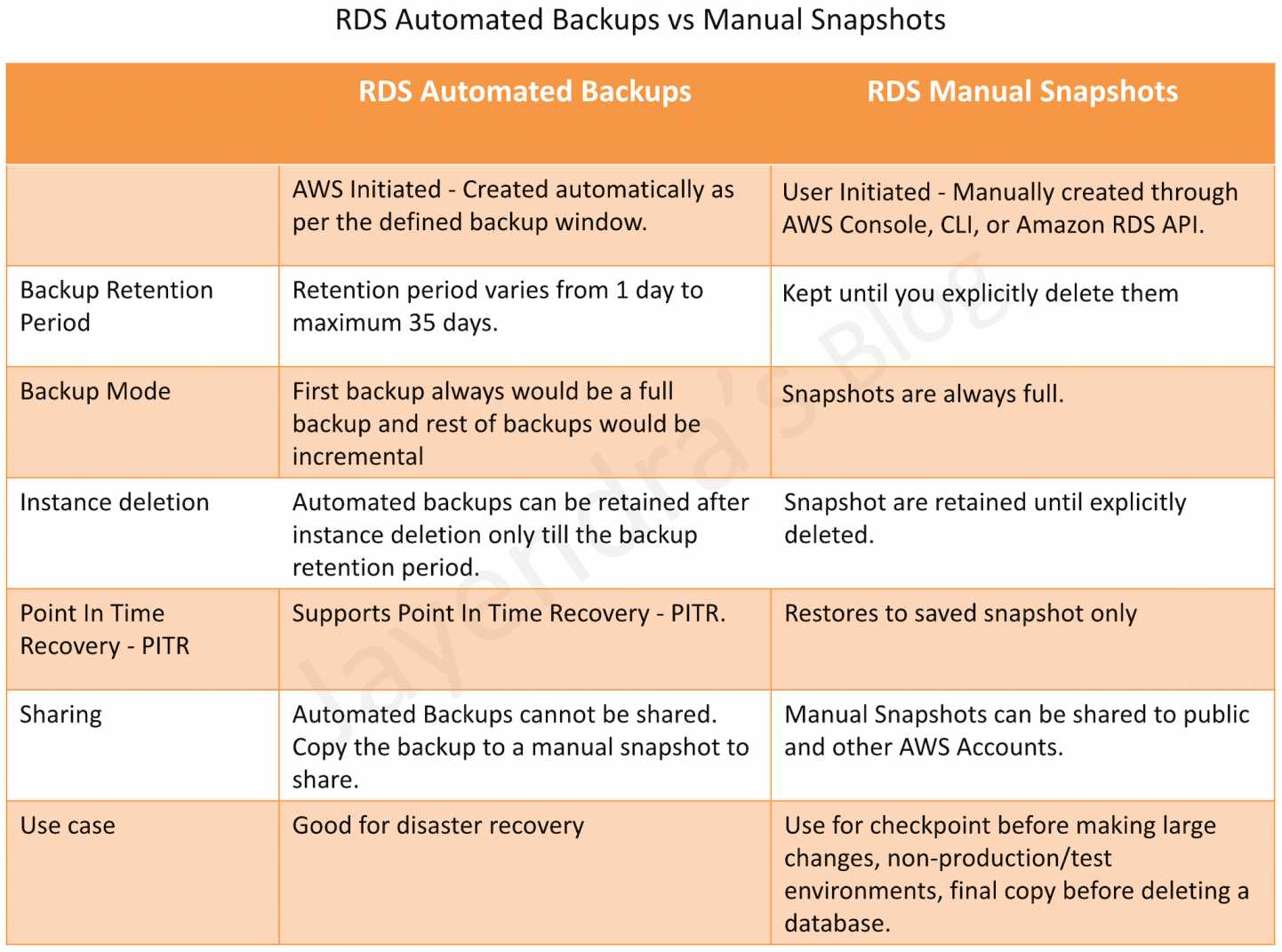
RDS Automated Backups vs Manual Snapshots
RDS automated backups vs manual snapshots — quick answer: Automated backups are AWS-initiated on a daily backup window, retain 0–35 days, keep transaction logs so they support Point-In-Time Recovery (PITR), and are deleted when the DB instance is deleted (unless you explicitly retain them). Manual snapshots are user-initiated, never expire (kept until you delete them), can be shared and copied across accounts/Regions, but restore only to the snapshot point — no PITR. Rule of thumb: rely on automated backups + PITR for day-to-day recovery; take a manual snapshot before risky changes or to keep a backup beyond 35 days / past instance deletion.
- Amazon RDS Automated Backups are AWS Initiated. Backups are created automatically as per the defined backup window. Backups are also created when a read replica is created.
- Amazon RDS DB snapshots are manual, user-initiated backups that enable a DB instance backup to be restored to that specific state at any time.
Instance Deletion & Backup Retention Period
- Amazon RDS Backups can be configured with a retention period varying from 0 to 35 days. Setting to 0 disables automated backups (not recommended for production).
- RDS Automated Backups are deleted when the DB instance is deleted. However, RDS can be configured to retain the automated backups on RDS instance deletion. These backups would be retained only till their retention window.
- RDS Snapshots don’t expire and RDS keeps all manual DB snapshots until explicitly deleted and aren’t subject to the backup retention period.
Backup Mode
- RDS Automated Backups are incremental. The first snapshot of a DB instance contains the data for the full database. Subsequent backups of the same database are incremental, meaning only the data that has changed after the most recent backup is saved.
- RDS Manual Snapshots are also incremental. Only the blocks on the device that have changed after the most recent snapshot are saved, reducing both the time to create the snapshot and storage costs by not duplicating data.
Point In Time Recovery – PITR
- RDS Automated Backups with transaction logs help support Point In Time Recovery – PITR. You can restore your DB instance to any second during the retention period, up to the LatestRestorableTime (typically within the last 5 minutes).
- RDS Snapshots restores to saved snapshot data only. It cannot be used for PITR.
Sharing
- RDS Automated Backups cannot be shared directly. You can copy the automated backup to a manual snapshot to share.
- RDS Manual Snapshots can be shared with the public and with up to 20 other AWS Accounts.
Cross-Region & Cross-Account Capabilities
- Cross-Region Automated Backup Replication – RDS can replicate automated backups (snapshots and transaction logs) to a chosen destination AWS Region, enabling PITR in a secondary Region for disaster recovery. You can replicate up to 20 backups to each destination Region per account.
- Cross-Region and Cross-Account Snapshot Copy (2025) – RDS now supports copying snapshots across Regions and accounts directly using a single copy action, eliminating the need for sequential copying steps.
- AWS Backup Single-Action Copy (Oct 2025) – AWS Backup supports copying RDS, Aurora, Neptune, and DocumentDB snapshots across Regions and accounts in a single action.
AWS Backup Integration
- AWS Backup provides centralized backup management for RDS with custom schedules, retention periods, and lifecycle policies beyond native RDS backup capabilities.
- AWS Backup Vault Lock – Provides WORM (Write Once Read Many) immutability for backups, preventing any user from deleting backups or changing lifecycle settings. Helps meet compliance requirements.
- Logically Air-Gapped Vault (GA Aug 2024) – A specialized vault type that stores immutable backup copies in service-owned accounts, encrypted with AWS-owned keys. Supports secure sharing across accounts and direct restore for faster recovery.
- Multi-AZ Cluster Support (March 2026) – AWS Backup expanded support for RDS Multi-AZ clusters to 17 Regions, including automated lifecycle management and immutable backups with Vault Lock.
Backup Configuration on Restore (Feb 2026)
- RDS and Aurora now allow you to view and modify the backup retention period and preferred backup window prior to and upon restoring database snapshots, providing visibility into backup configurations before initiating restore operations.
Use case
- RDS Automated Backups are good for disaster recovery and compliance requirements with PITR capability.
- Cross-Region Automated Backup Replication is ideal for cross-region disaster recovery with minimal RPO.
- RDS Snapshots can be used for checkpoint before making large changes, non-production/test environments, and final copy before deleting a database.
- AWS Backup with Vault Lock is recommended for ransomware protection and regulatory compliance requiring immutable backups.
AWS Certification Exam Practice Questions
- Questions are collected from Internet and the answers are marked as per my knowledge and understanding (which might differ with yours).
- AWS services are updated everyday and both the answers and questions might be outdated soon, so research accordingly.
- AWS exam questions are not updated to keep up the pace with AWS updates, so even if the underlying feature has changed the question might not be updated
- Open to further feedback, discussion and correction.
- You receive a frantic call from a new DBA who accidentally dropped a table containing all your customers. Which Amazon RDS feature will allow you to reliably restore your database within 5 minutes of when the mistake was made?
- Multi-AZ RDS
- RDS snapshots
- RDS read replicas
- RDS automated backup
- A company requires that their RDS database backups be protected from accidental or malicious deletion, including from administrators with root access. Which AWS solution provides immutable backup protection?
- RDS automated backups with 35-day retention
- RDS manual snapshots shared to another account
- AWS Backup with Vault Lock in compliance mode
- Cross-Region automated backup replication
- A company needs to restore their RDS database in a secondary AWS Region if the primary Region becomes unavailable, with a Recovery Point Objective (RPO) of minutes. Which feature should they use?
- Manual snapshot copy to another Region
- Cross-Region Automated Backup Replication
- RDS Read Replica in another Region
- AWS Backup with cross-account copy
One thought on “RDS Automated Backups vs Manual Snapshots”
Comments are closed.