Google Cloud – Mountkirk Games Case Study
Mountkirk Games makes online, session-based, multiplayer games for mobile platforms. They have recently started expanding to other platforms after successfully migrating their on-premises environments to Google Cloud. Their most recent endeavor is to create a retro-style first-person shooter (FPS) game that allows hundreds of simultaneous players to join a geo-specific digital arena from multiple platforms and locations. A real-time digital banner will display a global leaderboard of all the top players across every active arena.
Solution Concept
Mountkirk Games is building a new multiplayer game that they expect to be very popular. They plan to deploy the game’s backend on Google Kubernetes Engine so they can scale rapidly and use Google’s global load balancer to route players to the closest regional game arenas. In order to keep the global leader board in sync, they plan to use a multi-region Spanner cluster.
So the key here is the company wants to deploy the new game to Google Kubernetes Engine exposed globally using a Global Load Balancer and configured to scale rapidly and bring it closer to the users. Backend DB would be managed using a multi-region Cloud Spanner cluster.
Executive Statement
Our last game was the first time we used Google Cloud, and it was a tremendous success. We were able to analyze player behavior and game telemetry in ways that we never could before. This success allowed us to bet on a full migration to the cloud and to start building all-new games using cloud-native design principles. Our new game is our most ambitious to date and will open up doors for us to support more gaming platforms beyond mobile. Latency is our top priority, although cost management is the next most important challenge. As with our first cloud-based game, we have grown to expect the cloud to enable advanced analytics capabilities so we can rapidly iterate on our deployments of bug fixes and new functionality.
So the key points here are the company has moved to Google Cloud with great success and wants to build new games in the cloud. Key priorities are high performance, low latency, cost, advanced analytics, quick deployment, and time-to-market cycles.
Business Requirements
Support multiple gaming platforms.
Support multiple regions.
- Can be handled using a Global HTTP load balancer with GKE in each region.
- Can be handled using multi-region Cloud Spanner (Enterprise Plus edition for 99.999% availability with multi-region configurations)
- Other multi-regional services like Cloud Storage, Firestore, Cloud Pub/Sub, BigQuery can be used.
Support rapid iteration of game features.
- Can be handled using Terraform with Infrastructure Manager (IaC) to automate infrastructure provisioning
- Cloud Build + Cloud Deploy can be used for rapid continuous integration and deployment to GKE
Minimize latency
- can be reduced using a Global HTTP load balancer, which would route the user to the closest region
- using multi-regional resources like Cloud Spanner would also help reduce latency
- using Agones with GKE for dedicated game server hosting would optimize player-to-server latency
Optimize for dynamic scaling
- can be done using GKE Cluster Autoscaler and Horizontal Pod Autoscaling to dynamically scale the nodes and applications as per the demand
- GKE Autopilot can simplify cluster management with automatic node provisioning and scaling
- Cloud Spanner can be scaled dynamically with autoscaling (available since 2023)
- Agones Fleet Autoscaler can dynamically scale game server fleets based on player demand
Use managed services and pooled resources.
- Using GKE (Standard or Autopilot mode), with Global Load Balancer for computing and Cloud Spanner would help cover the application stack using managed services
- Agones on GKE Autopilot eliminates the need to manage Kubernetes node pools for game servers
Minimize costs.
- Using minimal resources and enabling auto-scaling as per the demand would help minimize costs
- GKE Autopilot with Agones helps minimize costs by automatically right-sizing resources
- Cloud Spanner Standard edition provides cost-effective option for development and testing environments
Existing Technical Environment
The existing environment was recently migrated to Google Cloud, and five games came across using lift-and-shift virtual machine migrations, with a few minor exceptions. Each new game exists in an isolated Google Cloud project nested below a folder that maintains most of the permissions and network policies. Legacy games with low traffic have been consolidated into a single project. There are also separate environments for development and testing.
Key points here are the resource hierarchy exists with a project for each new game under a folder to control access using Service Control Permissions. Also, some of the small games would be hosted in a single project. There are also different environments for development, testing, and production.
Technical Requirements
Dynamically scale based on game activity.
- can be done using GKE Cluster Autoscaler and Horizontal Pod Autoscaling to dynamically scale the nodes and applications as per the demand
- Agones Fleet Autoscaler can scale game server instances up and down based on active players and buffer capacity
Publish scoring data on a near-real-time global leaderboard.
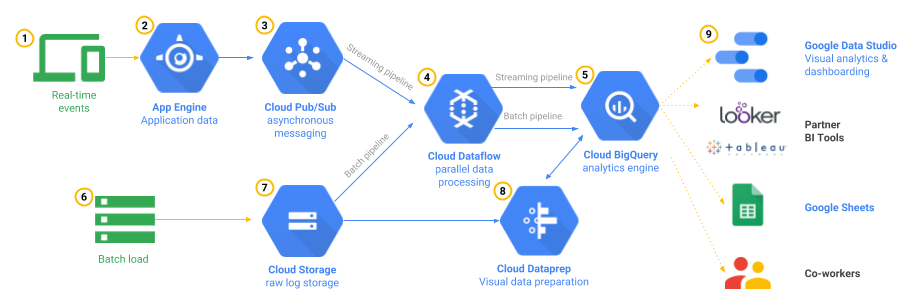
- can be handled using Pub/Sub for capturing data and Dataflow for processing the data on the fly i.e real time
- Cloud Spanner multi-region configuration provides strongly consistent reads for global leaderboard data
Store game activity logs in structured files for future analysis.
- can be handled using Cloud Storage to store logs for future analysis
- analysis can be handled using BigQuery either loading the data or using federated data source
- data can also be stored directly using BigQuery as it would provide a low-cost data storage (as compared to Bigtable) for analytics
- another advantage of BigQuery over Bigtable in this case its multi-regional, meeting the global footprint and latency requirements
Use GPU processing to render graphics server-side for multi-platform support.
- GKE supports GPU node pools (NVIDIA T4, L4, A100, H100) for server-side rendering workloads
- Support eventual migration of legacy games to this new platform.
Key Services & Architecture Patterns (Updated 2025)
Agones – Dedicated Game Server Hosting
Agones is an open-source platform (developed by Google and Ubisoft) built on Kubernetes that simplifies hosting, scaling, and managing dedicated game servers. It is the recommended approach for running multiplayer game servers on GKE.
- Fleet Management: Manages pools (Fleets) of ready game server instances
- Fleet Autoscaler: Automatically scales game server fleets based on demand
- Allocator: Assigns players to available game servers with low latency
- Multi-cluster: Supports game server allocation across multiple GKE clusters in different regions
- GKE Autopilot Support: Runs on GKE Autopilot for hands-off node management
For Mountkirk Games, Agones would be ideal for managing the FPS game server instances across multiple regions, handling player allocation to the nearest arena, and scaling based on game activity.
Cloud Spanner Editions (2024)
Cloud Spanner introduced tier-based editions in 2024 providing greater flexibility:
- Standard: Cost-effective for development, testing, and less demanding workloads
- Enterprise: Regional and multi-regional configurations with 99.99%+ availability
- Enterprise Plus: Designed for the most demanding workloads requiring 99.999% availability with multi-region configurations and geo-partitioning
For the global leaderboard requirement, Enterprise Plus edition with multi-region configuration is recommended to provide strongly consistent, low-latency reads globally.
Additional Spanner capabilities added in 2024-2025:
- Spanner Graph (2024): Native graph support with GQL for relationship queries (e.g., player social graphs, matchmaking)
- Vector Search: Built-in vector capabilities for similarity search
- Autoscaling: Automatic compute scaling based on workload demand
- Won 2025 ACM SIGMOD Systems Award for groundbreaking distributed database contributions
GKE Updates (2024-2026)
- GKE Autopilot: Fully managed mode with per-pod billing — recommended for game servers with Agones
- Fleets & Multi-cluster Management: Now included free with GKE Standard for managing game servers across regions
- Custom Compute Classes: Define specific compute requirements for game server pods
- Scale: Support for up to 130,000 nodes per cluster
- GKE Inference Gateway: For AI/ML workloads (player behavior prediction, anti-cheat)
Cloud Deploy for GKE
Cloud Deploy is a fully managed continuous delivery service for GKE and Cloud Run. It provides:
- Delivery pipelines with promotion across environments (dev → staging → production)
- Canary and blue/green deployment strategies
- Rollback capabilities
- Integration with Cloud Build for CI/CD
This replaces the need for self-managed tools like Spinnaker for continuous deployment to GKE.
⚠️ Deployment Manager Deprecated (EOL: March 31, 2026)
Google Cloud Deployment Manager reached end of support on March 31, 2026. For infrastructure as code, use:
- Infrastructure Manager (Infra Manager) — Google Cloud’s managed Terraform service
- Terraform — directly with Google Cloud provider for multi-cloud or hybrid IaC
Use the DM Convert tool to migrate existing Deployment Manager configurations to Terraform.
Reference Architecture

Refer to Best Practices for Mobile Game Online Architectures on Google Cloud
Practice Questions
Question 1: Mountkirk Games needs to deploy their FPS game backend to serve players globally with minimal latency. They want to use managed services and scale dynamically. Which combination of services should they use?
- Compute Engine MIGs with Global Load Balancer and Cloud SQL
- GKE with Agones, Global Load Balancer, and Cloud Spanner (Enterprise Plus, multi-region)
- Cloud Run with Cloud Spanner and Cloud CDN
- App Engine Flex with Firestore and Cloud Load Balancing
Show Answer
Answer: B. – GKE with Agones provides dedicated game server hosting with fleet autoscaling, the Global Load Balancer routes players to the nearest region, and Cloud Spanner Enterprise Plus with multi-region configuration provides 99.999% availability for the global leaderboard with strongly consistent reads.
Question 2: Mountkirk Games wants to implement rapid iteration of game features with automated deployments to their GKE clusters across multiple environments. Which approach aligns best with Google Cloud managed services?
- Deployment Manager with custom templates for each environment
- Jenkins on Compute Engine with custom deployment scripts
- Cloud Build for CI with Cloud Deploy pipelines for progressive delivery to GKE
- Spinnaker on GKE for multi-environment deployments
Show Answer
Answer: C. – Cloud Build provides continuous integration (building and testing), while Cloud Deploy provides fully managed continuous delivery with promotion pipelines across environments (dev → staging → production), canary deployments, and rollback capabilities. Note: Deployment Manager (Option A) reached end of support in March 2026.
Question 3: Mountkirk Games needs to publish scoring data on a near-real-time global leaderboard. Which architecture best meets this requirement?
- Write scores directly to Cloud Spanner from game servers
- Use Pub/Sub to ingest scoring events, Dataflow for real-time processing and aggregation, and write to Cloud Spanner multi-region for the leaderboard
- Store scores in Memorystore (Redis) with periodic batch writes to BigQuery
- Use Cloud Functions triggered by Firestore to update a global leaderboard document
Show Answer
Answer: B. – Pub/Sub provides reliable message ingestion at scale, Dataflow processes and aggregates scores in real-time (handling late-arriving data with windowing), and Cloud Spanner multi-region provides strongly consistent global reads for the leaderboard display.
Question 4: Mountkirk Games wants their game servers to dynamically scale based on player activity while minimizing operational overhead. Which approach is recommended?
- GKE Standard with manual node pool management and custom autoscaling scripts
- GKE Autopilot with Agones and Fleet Autoscaler
- Compute Engine Managed Instance Groups with custom game server images
- Cloud Run with WebSocket support for real-time game sessions
Show Answer
Answer: B. – GKE Autopilot eliminates node management overhead with per-pod billing, while Agones provides purpose-built game server lifecycle management. The Fleet Autoscaler automatically scales game server instances based on player demand and configurable buffer policies.
Question 5: Mountkirk Games needs to store game activity logs for future analysis. They need a cost-effective solution that supports structured queries. Which approach is most appropriate?
- Cloud Bigtable for real-time ingestion and ad-hoc analytics
- Cloud Storage (Standard) with BigQuery federated queries for analysis
- Ingest through Pub/Sub, process with Dataflow, store in BigQuery for analytics
- Firestore in Datastore mode with periodic exports to Cloud Storage
Show Answer
Answer: C. – Pub/Sub handles high-volume log ingestion, Dataflow transforms and enriches the data in streaming or batch mode, and BigQuery provides cost-effective, serverless, multi-regional analytics storage with powerful SQL querying capabilities for future analysis.
Mountkirk Games References
- Google Cloud – Mountkirk Games Case Study (PDF)
- Google Cloud – PCA Exam Guide with Case Studies
- Google Cloud – Best Practices for Mobile Game Architectures
- Agones – Dedicated Game Server Hosting on Kubernetes
- Google Cloud – Spanner Editions (2024)
- Google Cloud – Cloud Deploy – Continuous Delivery for GKE
- Google Cloud – Agones on GKE Autopilot for Game Servers
This needs to be re-visited. The use case now talks about using GKE in solution concept.
Mountkirk has been updated – working on the same.