AWS DDoS Resiliency – Best Practices
📋 Whitepaper Update Notice
The original AWS DDoS Best Practices whitepaper (June 2015) has been updated multiple times, with the latest revision dated August 9, 2023. AWS now marks it as “historical reference.” The current AWS DDoS protection guidance is integrated into the AWS WAF, Shield, and Firewall Manager Developer Guide.
This post has been updated to reflect the modern AWS DDoS protection services including AWS Shield, AWS WAF v2, AWS Firewall Manager, and the new Anti-DDoS Managed Rule Group (2026).
- Denial of Service (DoS) is an attack, carried out by a single attacker, which attempts to make a website or application unavailable to the end users.
- Distributed Denial of Service (DDoS) is an attack, carried out by multiple attackers either controlled or compromised by a group of collaborators, which generates a flood of requests to the application making it unavailable to the legitimate end users.
- DDoS attacks can be segregated by which layer of the OSI model they attack:
- Infrastructure layer attacks (Layer 3 and 4) — SYN/UDP floods, reflection attacks, amplification attacks
- Application layer attacks (Layer 6 and 7) — HTTP/S floods, DNS query floods, SSL/TLS abuse
AWS DDoS Protection Services
- AWS Shield Standard — Free, automatic protection for all AWS customers against common infrastructure DDoS attacks (Layer 3/4)
- AWS Shield Advanced — Paid managed DDoS protection with enhanced detection, always-on automatic mitigation, 24/7 access to Shield Response Team (SRT), cost protection, and application layer protections
- AWS WAF — Web application firewall for application layer (Layer 7) protection with managed rule groups, rate-based rules, and bot control
- AWS Firewall Manager — Centralized security policy management across multiple accounts and resources in AWS Organizations
- AWS Shield Network Security Director (Preview, 2025) — Analyzes network resources, identifies configuration issues, and provides remediation recommendations for comprehensive DDoS posture
Mitigation Techniques
Minimize the Attack Surface Area
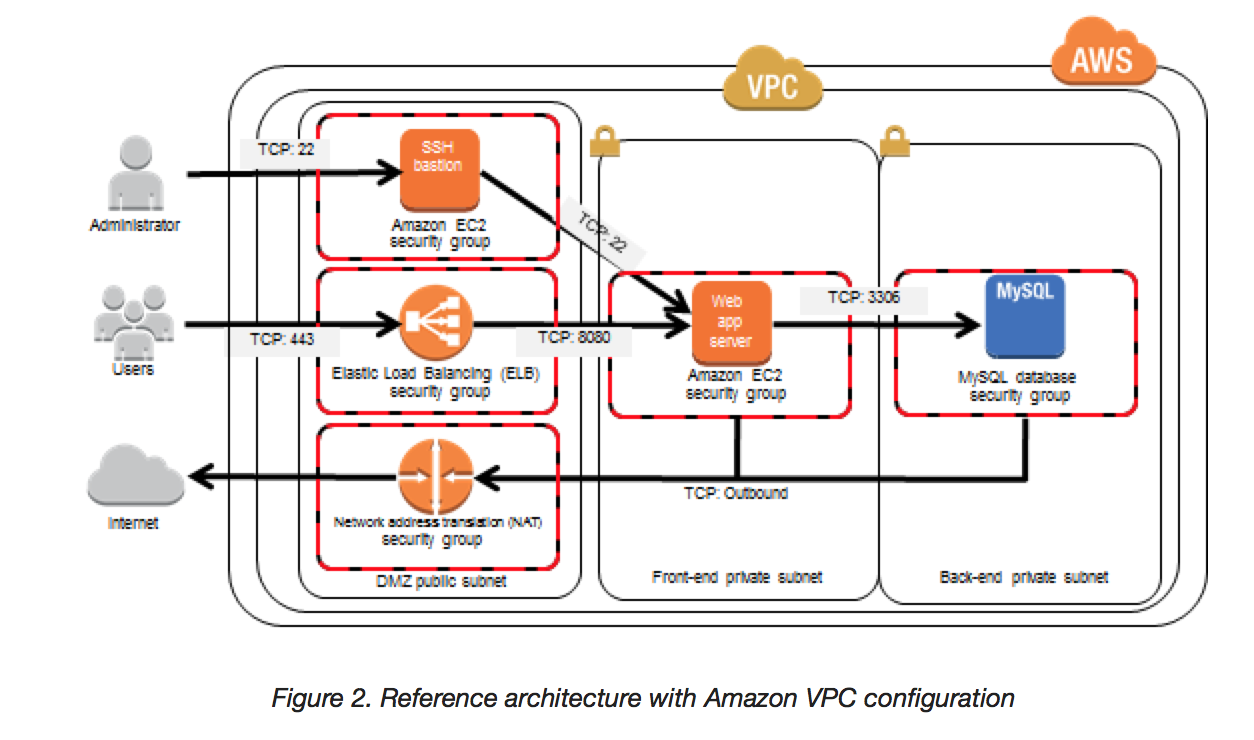
- Reduce the attack surface by minimizing the different Internet entry points that allow access to your application
- Strategy to minimize the Attack surface area:
- Reduce the number of necessary Internet entry points
- Don’t expose back-end servers
- Eliminate non-critical Internet entry points
- Separate end user traffic from management traffic
- Obfuscate necessary Internet entry points to the level that untrusted end users cannot access them
- Decouple Internet entry points to minimize the effects of attacks
- Benefits:
- Minimizes the effective attack vectors and targets
- Less to monitor and protect
- Strategy can be achieved using AWS Virtual Private Cloud (VPC):
- Defines a logically isolated virtual network within AWS
- Provides ability to create Public & Private Subnets to launch internet-facing and non-public-facing instances accordingly
- Provides NAT gateway allowing instances in private subnets to have internet access without Public IPs
- Allows creation of Bastion hosts (or use AWS Systems Manager Session Manager) for connecting to instances in private subnets
- Provides security groups for instances and NACLs for subnets to control and limit outbound and inbound traffic
- Supports VPC endpoints (Gateway and Interface) to access AWS services privately without traversing the internet
Be Ready to Scale to Absorb the Attack
- DDoS attacks mainly aim to overload systems beyond their capacity, rendering them unusable
- Scaling out Benefits:
- Helps build a resilient architecture
- Makes the attacker work harder
- Gives you time to think, analyze, and adapt
- AWS services for scaling:
- Auto Scaling & Elastic Load Balancing
- Horizontal scaling using Auto Scaling with ELB (ALB, NLB, or CLB)
- Auto Scaling allows instances to be added and removed as demand changes
- ELB distributes traffic across multiple EC2 instances while acting as a single point of contact
- Auto Scaling automatically registers and deregisters EC2 instances with the ELB during scale-out and scale-in events
- Application Load Balancer (ALB) integrates natively with AWS WAF for Layer 7 protection
- Network Load Balancer (NLB) handles millions of requests per second with ultra-low latency for Layer 4 traffic
- EC2 Instance
- Vertical scaling can be achieved by using appropriate EC2 instance types (e.g., EBS-optimized or ones with 25/100 Gbps network connectivity) to handle the load
- Enhanced Networking
- Use instances with Enhanced Networking capabilities (ENA) for high packet-per-second performance, low latency networking, and improved scalability
- Amazon CloudFront
- CloudFront is a CDN that acts as a proxy between end users and Origin servers, distributing content without sending all traffic to the Origin
- Has inherent ability to mitigate both infrastructure and application layer DDoS attacks by dispersing traffic across multiple edge locations globally
- AWS has multiple Internet connections for capacity and redundancy at each location, allowing isolation of attack traffic while serving legitimate end users
- CloudFront filters to ensure only valid TCP connections and HTTP requests are processed, dropping invalid requests (commonly used in UDP & SYN floods, and slow reads)
- CloudFront Security Dashboard (2023) provides unified CDN and security experience with one-click AWS WAF protection and built-in security monitoring
- Integrates natively with AWS WAF and AWS Shield Advanced
- Amazon Route 53
- DDoS attacks also target DNS — if DNS is unavailable, the application is effectively unavailable
- AWS Route 53 is a highly available and scalable DNS service with capabilities to withstand DDoS attacks:
- Shuffle Sharding — spreads DNS requests over numerous PoPs using independent sets of edge locations, providing multiple paths to your application
- Anycast Routing — advertises the same IP address from multiple PoPs, increasing redundancy; if one endpoint is overwhelmed, traffic routes to others
- AWS Global Accelerator
- Uses static anycast IP addresses as entry points to the AWS global network
- Integrates with AWS Shield for DDoS mitigation at the edge, including a stateless SYN proxy that challenges new connections and only serves legitimate end users
- Routes traffic over the AWS backbone network, away from the congested public internet
- Provides fault isolation and deterministic routing for improved DDoS resiliency
- Auto Scaling & Elastic Load Balancing
Safeguard Exposed & Hard-to-Scale Resources
- If entry points cannot be limited, additional measures to restrict access and protect those entry points without interrupting legitimate end user traffic
- AWS services for protection:
- CloudFront
- Restrict access using Geo Restriction and Origin Access Control (OAC)
- With Geo Restriction, access can be restricted to whitelisted countries or blocked from blacklisted countries
- Origin Access Control (OAC) replaces the legacy Origin Access Identity (OAI) — allows access to S3 origins only through CloudFront while denying direct access. OAC supports SSE-KMS, dynamic requests, and all S3 regions.
- Route 53
- Alias Record sets and Private DNS make it easier to scale infrastructure and respond to DDoS attacks
- Route 53 health checks enable automatic failover to healthy resources
- AWS WAF (Web Application Firewall)
- AWS WAF is a fully managed service (not EC2-based) that filters web traffic using customizable rules
- Integrates directly with CloudFront, ALB, API Gateway, AppSync, App Runner, Cognito, and Verified Access
- Key capabilities:
- Rate-based rules — automatically blocks IPs exceeding request thresholds
- Managed Rule Groups — pre-built rules for OWASP Top 10, known bad inputs, SQL injection, XSS
- Bot Control — managed bot detection and mitigation covering 650+ unique bots and AI agents
- Fraud Control — Account Takeover Prevention (ATP) and Account Creation Fraud Prevention (ACFP)
- Anti-DDoS Managed Rule Group (AWSManagedRulesAntiDDoSRuleSet) — launched March 2026 as the default L7 DDoS protection; establishes traffic baselines, detects anomalies within seconds, and mitigates HTTP floods automatically
- AI Bot Management — AI Activity Dashboard (Feb 2026) for visibility into AI scrapers, tools, and agents; supports AI traffic monetization
- Geo-match conditions, IP set rules, regex pattern sets
- Custom response bodies and headers
- No longer requires the “WAF sandwich” pattern — AWS WAF is now a native, managed Layer 7 service that does not require separate EC2 instances
- AWS Shield Advanced
- Provides managed DDoS protection for CloudFront, Route 53, Global Accelerator, ELB, and EC2 Elastic IPs
- Key features:
- Always-on detection and automatic mitigation with sub-second time-to-mitigate
- Application layer automatic mitigation — automatically deploys WAF rules during attacks
- Shield Response Team (SRT) — 24/7 expert support during active DDoS events
- Cost protection — credits for scaling charges incurred during DDoS attacks
- DDoS visibility — real-time metrics, attack notifications, and forensic reports
- Health-based detection — uses Route 53 health checks to improve detection accuracy and reduce false positives
- Network Security Director (Preview, June 2025) — discovers resources, visualizes network topology, identifies security misconfigurations, and provides remediation recommendations using Amazon Q Developer
- AWS Firewall Manager
- Centrally configure and manage AWS WAF rules, Shield Advanced protections, security groups, Network Firewall, and DNS Firewall policies across all accounts in AWS Organizations
- Automatically applies security policies to new resources as they are created
- Provides compliance monitoring and reporting
- CloudFront
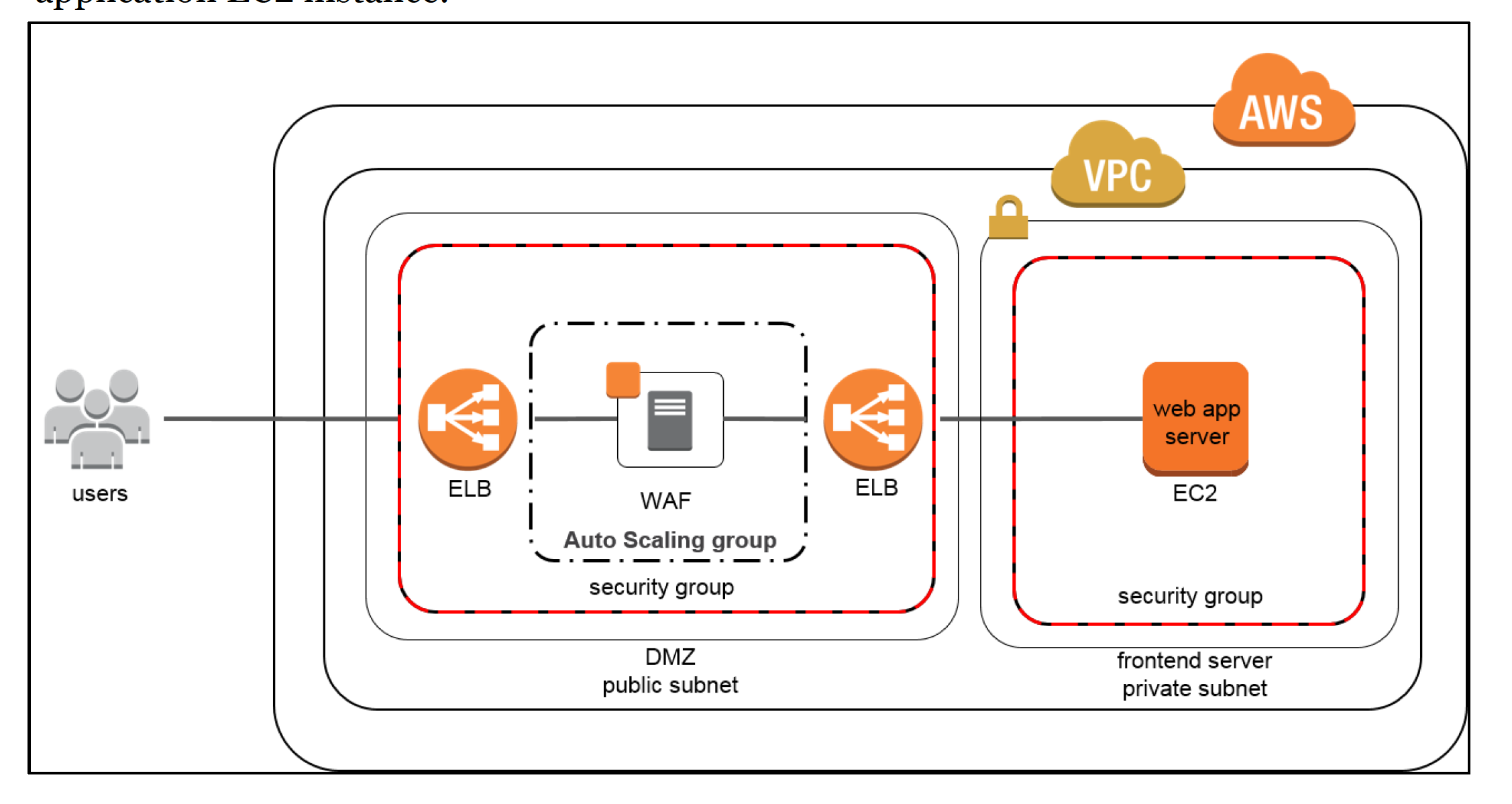
Note: The WAF Sandwich pattern shown above is a legacy architecture. AWS WAF is now a fully managed service that integrates natively with ALB, CloudFront, API Gateway, and other services — no separate EC2-based WAF instances are needed.
Learn Normal Behavior
- Understand the normal levels and patterns of traffic for your application and use that as a benchmark for identifying abnormal traffic or resource spikes
- Benefits:
- Allows one to spot abnormalities
- Configure alarms with accurate thresholds
- Assists with generating forensic data
- AWS services for tracking and detection:
- Amazon CloudWatch
- Monitor infrastructure and applications running on AWS
- Collect metrics, log files, and set alarms for when metrics pass predetermined thresholds
- Shield Advanced publishes DDoS metrics:
DDoSDetected,DDoSAttackBitsPerSecond,DDoSAttackPacketsPerSecond,DDoSAttackRequestsPerSecond
- VPC Flow Logs
- Capture traffic to instances in a VPC to understand traffic patterns and detect anomalies
- Can be published to CloudWatch Logs or S3 for analysis
- AWS WAF Logging & Metrics
- Full logging of all evaluated requests to S3, CloudWatch Logs, or Kinesis Data Firehose
- Real-time metrics in CloudWatch for blocked/allowed/counted requests
- Traffic Overview Dashboard (2025) — near-real-time summaries including total requests, blocked requests, bot categories, CAPTCHA solve rates, and top matched rules
- AWS CloudTrail
- Logs API calls for auditing configuration changes to WAF, Shield, and security groups
- Amazon CloudWatch
Create a Plan for Attacks
- Have a plan in place before an attack, which ensures that:
- Architecture has been validated and techniques selected work for the infrastructure
- Costs for increased resiliency have been evaluated and the goals of your defense are understood
- Contact points have been identified
- Runbooks exist for DDoS incident response
- AWS Shield Advanced SRT engagement — proactive or reactive engagement with DDoS experts
- AWS Support — Business or Enterprise Support plans provide access to 24/7 support during attacks
DDoS-Resilient Reference Architecture
AWS recommends using the following services at the edge for maximum DDoS resiliency:
- Edge Layer: Amazon CloudFront + AWS WAF + AWS Shield (Standard/Advanced) + Amazon Route 53
- Network Layer: AWS Global Accelerator + Elastic Load Balancing (ALB/NLB) + VPC with NACLs and Security Groups
- Application Layer: Auto Scaling groups + EC2 instances in multiple AZs
- Management Layer: AWS Firewall Manager for centralized policy management across accounts
Key principle: Push traffic as far from the origin as possible using CloudFront, Global Accelerator, and Route 53 to leverage AWS’s globally distributed DDoS mitigation capacity (terabits scale).
AWS Certification Exam Practice Questions
- Questions are collected from Internet and the answers are marked as per my knowledge and understanding (which might differ with yours).
- AWS services are updated everyday and both the answers and questions might be outdated soon, so research accordingly.
- AWS exam questions are not updated to keep up the pace with AWS updates, so even if the underlying feature has changed the question might not be updated
- Open to further feedback, discussion and correction.
- You are designing a social media site and are considering how to mitigate distributed denial-of-service (DDoS) attacks. Which of the below are viable mitigation techniques? (Choose 3 answers)
- Add multiple elastic network interfaces (ENIs) to each EC2 instance to increase the network bandwidth.
- Use dedicated instances to ensure that each instance has the maximum performance possible.
- Use an Amazon CloudFront distribution for both static and dynamic content.
- Use an Elastic Load Balancer with auto scaling groups at the web app and Amazon Relational Database Service (RDS) tiers
- Add alert Amazon CloudWatch to look for high Network in and CPU utilization.
- Create processes and capabilities to quickly add and remove rules to the instance OS firewall.
- You’ve been hired to enhance the overall security posture for a very large e-commerce site. They have a well architected multi-tier application running in a VPC that uses ELBs in front of both the web and the app tier with static assets served directly from S3. They are using a combination of RDS and DynamoDB for their dynamic data and then archiving nightly into S3 for further processing with EMR. They are concerned because they found questionable log entries and suspect someone is attempting to gain unauthorized access. Which approach provides a cost effective scalable mitigation to this kind of attack?
- Recommend that they lease space at a DirectConnect partner location and establish a 1G DirectConnect connection to their VPC they would then establish Internet connectivity into their space, filter the traffic in hardware Web Application Firewall (WAF). And then pass the traffic through the DirectConnect connection into their application running in their VPC. (Not cost effective)
- Add previously identified hostile source IPs as an explicit INBOUND DENY NACL to the web tier subnet. (does not protect against new source)
- Add a WAF tier by creating a new ELB and an AutoScaling group of EC2 Instances running a host-based WAF. They would redirect Route 53 to resolve to the new WAF tier ELB. The WAF tier would then pass the traffic to the current web tier. The web tier Security Groups would be updated to only allow traffic from the WAF tier Security Group (Note: This describes the legacy “WAF sandwich” pattern. In modern AWS, you would simply enable AWS WAF on the existing ALB — no separate EC2 WAF tier is needed.)
- Remove all but TLS 1.2 from the web tier ELB and enable Advanced Protocol Filtering This will enable the ELB itself to perform WAF functionality. (No advanced protocol filtering in ELB)
- A company wants to protect its web application from Layer 7 DDoS attacks and common web exploits. The application uses Amazon CloudFront with an Application Load Balancer origin. Which combination of AWS services provides the MOST effective protection? (Choose 2 answers)
- Enable AWS Shield Advanced on the CloudFront distribution and ALB with automatic application layer DDoS mitigation
- Deploy AWS Network Firewall in front of the ALB
- Associate an AWS WAF web ACL with rate-based rules and the Anti-DDoS Managed Rule Group on the CloudFront distribution
- Use Security Groups on the ALB to block malicious IPs
- Enable VPC Flow Logs and manually block attacking IPs
- A security team needs to protect multiple AWS accounts’ web applications from DDoS attacks with consistent security policies. Which approach provides centralized management with automatic enforcement?
- Manually configure AWS WAF rules on each account’s resources
- Use AWS Firewall Manager to define WAF and Shield Advanced policies across the AWS Organization
- Deploy third-party WAF appliances in each VPC
- Use AWS Config rules to audit WAF configurations
- Which AWS service provides automatic, always-on protection against common DDoS attacks at no additional cost for ALL AWS customers?
- AWS WAF
- AWS Shield Standard
- AWS Shield Advanced
- AWS Firewall Manager
- A company is experiencing an active DDoS attack on their application behind CloudFront. They have AWS Shield Advanced enabled. Which features are available to help mitigate the attack? (Choose 3 answers)
- 24/7 access to the AWS Shield Response Team (SRT)
- Automatic VPC security group rule updates
- Automatic application layer mitigation through managed WAF rules
- Cost protection credits for scaling charges incurred during the attack
- Automatic CloudFront distribution disablement
References
- AWS Best Practices for DDoS Resiliency Whitepaper (Aug 2023)
- AWS DDoS Resiliency Best Practices — Developer Guide
- AWS Shield
- AWS WAF
- AWS WAF Bot Control
- AWS WAF Application Layer DDoS Protection
- AWS Firewall Manager
- AWS DDoS Attack Protection
Hello,
Use an Elastic Load Balancer with auto scaling groups at the web, App and Amazon Relational Database Service (RDS) tiers
->RDS doesn’t have ELB and ASG. Should be CEF?
Hi Ruoen,
Elastic Load Balancing and Auto Scaling for Web Application is a key for ddos resiliency.
Here the ELB and ASG options doesn’t apply to RDS, but you can use RDS scale out features with Read Replicas, Multi AZ feature for failover to minimize the impact.
Option F is more of an after attack option and with high frequency ddos attacks from multiple sources, this can hardly work.
CDE is correct:
Services that are available within AWS Regions, like Elastic Load Balancing and
Amazon Elastic Compute Cloud (EC2), allow you to build DDoS resiliency and
scale to handle unexpected volumes of traffic within a given region.
Ref :https://d0.awsstatic.com/whitepapers/DDoS_White_Paper_June2015.pdf
Might be correct for the test, but the idea of mitigating an attack with option D means that the bad guys force me to spend more money with spinning up instances. Hardly seems wise. It’s like saying we need more drive through banking lanes so that when robbers clog up the ones you have you can open up additional ones for real customers. I do understand in general ELB provides better security against individual instances.
To prevent WAF from being a Single point of failure, a WAF sandwich pattern can be implemented where an autoscaled WAF sits between the Internet and Internal Load Balancer
Can you explain more about this WAF sandwich pattern, please?
How can we put WAF service between Internet and Internal Load balancer?
The approach is similar to having a web server between the Internet and Internal Load balancer.
So instead of Web Server you would have an auto scaled WAF instances.
Remember this approach was applicable when and AWS WAF was not available and these are 3rd party WAF images which can scale and help route the requests to the internal load balancer.
I think the sandwich architecture is obsoleted, WAF now can associate with ALB or API Gateway, these all are high available service, so we don’t need setup the auto scaling WAF by ourselves
Thats right Aaron, sandwich pattern was before the AWS WAF was introduced.