AWS Certified Developer – Associate DVA-C01 Exam Learning Path

AWS Certified Developer – Associate DVA-C01 Exam Learning Path

⚠️ EXAM RETIRED — DVA-C01 No Longer Available

The AWS Certified Developer – Associate DVA-C01 exam was retired on February 27, 2023.

It has been replaced by the DVA-C02 exam. This content is maintained for historical reference only.

👉 For the current exam, see: AWS Certified Developer – Associate DVA-C02 Exam Learning Path

Key DVA-C02 Changes vs DVA-C01:

  • Domain restructuring — 4 domains: Development with AWS Services (32%), Security (26%), Deployment (24%), Troubleshooting & Optimization (18%)
  • More hands-on focus — Emphasis on writing, testing, deploying, and debugging code
  • New services — Amazon Q Developer, EventBridge, Step Functions, AppSync, CDK
  • AI-assisted development — Amazon Q Developer added in December 2024 revision
  • Removed focus — Less emphasis on architecture design, more on CI/CD workflows

AWS Certified Developer – Associate DVA-C01 exam was the AWS exam version available from June 2018 to February 2023 and has been replaced by the DVA-C02 exam. It validated:

  • Demonstrate an understanding of core AWS services, uses, and basic AWS architecture best practices.
  • Demonstrate proficiency in developing, deploying, and debugging cloud-based applications using AWS.

Refer AWS Certified Developer – Associate (Released June 2018) Exam Blue Print
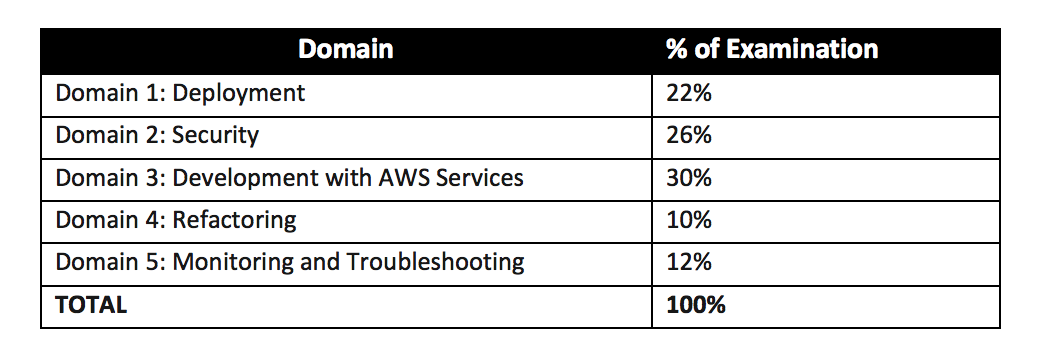
AWS Certified Developer - Associate June 2018 Domains

AWS Certified Developer – Associate DVA-C01 Summary

  • AWS Certified Developer – Associate DVA-C01 exam was quite different from the previous one with more focus on the hands-on development and deployment concepts rather than just the architectural concepts
  • AWS Certified Developer – Associate DVA-C01 exam covered a lot of AWS services like Lambda, X-Ray while focusing majorly on other services like DynamoDB, Elastic Beanstalk, S3, EC2
  • Note: DVA-C01 was retired on Feb 27, 2023. For current exam preparation, refer to the DVA-C02 Learning Path

AWS Developer – Associate Exam Resources (Updated for DVA-C02)

AWS Developer – Associate DVA-C01 Exam Topics

  • Be sure to cover the following topics
    • Compute
      • Understand what AWS services you can use to build a serverless architecture?
      • Make sure you know and understand Lambda and serverless architecture, its features and use cases.
      • Know Lambda limits for e.g. execution time, deployable zipped and unzipped package limit
      • Be sure to know how to deploy, package using Lambda.
      • Understand tracing of Lambda functions using X-Ray
      • Understand integration of Lambda with CloudWatch.
      • Understand how to handle multiple releases using Alias
      • Know AWS Step Functions to manage Lambda functions flow
      • Understand Lambda with API Gateway
      • Understand API Gateway stages, ability to cater to different environments for e.g. dev, test, prod
      • Understand EC2 as a whole
      • Understand EC2 Metadata & Userdata. Whats the use of each? How to look up instance data after it is launched.
      • Understand EC2 Security. How IAM Role work with EC2 instances.
      • Understand how does EC2 evaluates the order of credentials, when multiple are provided. Remember the order – Environment variables -> Java system properties -> Default credential profiles file -> ECS container credentials -> Instance Profile credentials
      • Know Elastic Beanstalk at a high level, what it provides and its ability to get an application running quickly
      • Understand Elastic Beanstalk configurations and deployment types with their advantages and disadvantages
    • Databases
      • Understand relational and NoSQLs data storage options which include RDS, DynamoDB and their use cases
      • Understand DynamoDB Secondary Indexes
      • Make sure you understand DynamoDB provisioned throughput for Read/Writes and its calculations
      • Make sure you understand DynamoDB Consistency Model – difference between Strongly Consistent and Eventual Consistency
      • Understand DynamoDB with its low latency performance, DAX
      • Know how to configure fine grained security for DynamoDB table, items, attributes
      • Understand DynamoDB Best Practices regarding
        • table design
        • provisioned throughput
        • Query vs Scan operations
        • improving Scan operation performance
      • Understand RDS features – Read Replicas for scalability, Multi-AZ for High Availability
      • Know ElastiCache use cases, mainly for caching performance
      • Understand ElastiCache Redis vs Memcached
    • Storage
      • Understand S3 storage option
      • Understand S3 Best Practices to improve performance for GET/PUT requests
      • Understand S3 features like different storage classes with lifecycle policies, static website hosting, versioning, Pre-Signed URLs for both upload and download, CORS
    • Security
      • Understand IAM as a whole
      • Focus on IAM role and its use case especially with EC2 instance
      • Know how to test and validate IAM policies
      • Understand IAM identity providers and federation and use cases
      • Understand how AWS Cognito works and what features it provides
      • Understand MFA and How would implement two factor authentication for your application
      • Understand KMS for key management and envelope encryption
      • Know what services support KMS
        • Remember SQS, Kinesis now provides SSE support
      • Focus on S3 with SSE, SSE-C, SSE-KMS. How they work and differ?
      • Know how can you enforce only buckets to only accept encrypted objects
      • Know various KMS encryption options encrypt, reencrypt, generateEncryptedDataKey etc
      • Know how KMS impacts the performance of the services
    • Management Tools
      • Understand CloudWatch monitoring to provide operational transparency
      • Know which EC2 metrics it can track.
      • Understand CloudWatch is extendable with custom metrics
      • Understand CloudTrail for Audit
    • Integration Tools
      • Understand SQS as message queuing service and SNS as pub/sub notification service
      • Understand SQS features like visibility, long poll vs short poll
      • Focus on SQS as a decoupling service
      • AWS has released SQS FIFO, make sure you know the differences between standard and FIFO
      • Know the different development and deployment tools like CodeCommit, CodeBuild, CodeDeploy, CodePipeline
    • Networking
      • Does not cover much on networking or designing of networks, but be sure you understand VPC, Subnets, Routes, Security Groups etc.

AWS Cloud Computing Whitepapers

AWS Certified Developer – Associate DVA-C01 Exam Contents

Note: These domains are specific to the retired DVA-C01 exam. The current DVA-C02 exam has different domain structure and weightings. See the DVA-C02 Learning Path for current exam domains.

Domain 1: Deployment

  1. Deploy written code in AWS using existing CI/CD pipelines, processes, and patterns.
  1. Deploy applications using Elastic Beanstalk.
  1. Prepare the application deployment package to be deployed to AWS.
  2. Deploy serverless applications.

Domain 2: Security

  1. Make authenticated calls to AWS services.
  1. Implement encryption using AWS services.
  2. Implement application authentication and authorization.

Domain 3: Development with AWS Services

  1. Write code for serverless applications.
  1. Translate functional requirements into application design.
  1. Implement application design into application code.
  2. Write code that interacts with AWS services by using APIs, SDKs, and AWS CLI.

Domain 4: Refactoring

  1. Optimize application to best use AWS services and features.
  2. Migrate existing application code to run on AWS.

Domain 5: Monitoring and Troubleshooting

  1. Write code that can be monitored.
  2. Perform root cause analysis on faults found in testing or production.

DVA-C01 vs DVA-C02 — Key Differences

If you studied for DVA-C01 and need to understand what changed for DVA-C02:

  • Domain restructuring: DVA-C01 had 5 domains; DVA-C02 has 4 domains with different weightings
  • Refactoring domain removed: Merged into Development and Troubleshooting domains
  • More Lambda focus: Lambda gets its own dedicated task in DVA-C02
  • CI/CD emphasis: Greater focus on CodePipeline, CodeBuild, CodeDeploy, and CDK
  • New services added: EventBridge, AppSync, Step Functions, CDK, Amazon Q Developer
  • Services de-emphasized: Less focus on Elastic Beanstalk, more on containers (ECS/EKS)
  • Security weight increased: Security is now 26% of the exam (was 12% in DVA-C01)
  • AI-assisted development: December 2024 revision added Amazon Q Developer skills

For full DVA-C02 preparation guidance, visit the AWS Certified Developer – Associate DVA-C02 Exam Learning Path.

AWS Certified Cloud Practitioner (CLF-C01) Exam Learning Path

AWS Certified Cloud Practitioner (CLF-C02) Exam Learning Path

📋 Exam Update: The AWS Certified Cloud Practitioner exam was updated to CLF-C02 on September 19, 2023. The previous version (CLF-C01) was retired on September 18, 2023. This guide has been fully updated for the CLF-C02 exam.

  • AWS Certified Cloud Practitioner (CLF-C02) is a foundational-level certification that validates overall knowledge of the AWS Cloud, independent of a specific job role.
  • AWS Certified Cloud Practitioner exam is ideal for starting your AWS certification journey and provides non-technical professionals foundational cloud literacy.
  • AWS Certified Cloud Practitioner Exam has 65 questions to be answered in 90 minutes.
  • A scaled score of 700 out of 1000 is required to pass. Approximately 50 questions are scored, while 15 are unscored pretest questions.
  • The exam can be taken at a Pearson VUE testing center or via online proctoring from any private space (home or office).
  • The exam costs $100 USD and is available in multiple languages including English, Japanese, Korean, and Simplified Chinese.

AWS Certified Cloud Practitioner exam validates the following:

  • Define what the AWS Cloud is and the basic global infrastructure
  • Describe the AWS Cloud value proposition and benefits of cloud migration
  • Describe key services on the AWS platform and their common use cases (compute, storage, networking, databases, AI/ML)
  • Describe basic security and compliance aspects of the AWS platform and the shared responsibility model
  • Define the billing, account management, and pricing models
  • Identify sources of documentation or technical assistance (e.g., white papers, support plans)
  • Describe basic/core characteristics of deploying and operating in the AWS Cloud
  • Identify cloud migration strategies and AWS migration services

Refer to the AWS Certified Cloud Practitioner (CLF-C02) Exam Guide

CLF-C02 Exam Domain Breakdown

Domain Weight
Domain 1: Cloud Concepts 24%
Domain 2: Security and Compliance 30%
Domain 3: Cloud Technology and Services 34%
Domain 4: Billing, Pricing, and Support 12%

Key Changes from CLF-C01 to CLF-C02:

  • Security and Compliance weight increased from 25% to 30%
  • Billing and Pricing weight decreased from 16% to 12%
  • New topics added: AI/ML services, cloud migration strategies, sustainability pillar
  • Greater emphasis on the AWS Well-Architected Framework (now 6 pillars)
  • Exam time reduced from 100 minutes to 90 minutes

AWS Certified Cloud Practitioner Exam Resources

AWS Cloud Computing Whitepapers

AWS Certified Cloud Practitioner (CLF-C02) Exam Contents

Domain 1: Cloud Concepts (24%)

  • 1.1 Define the benefits of the AWS Cloud
    • Agility – Speed, Experimentation, Innovation
    • Elasticity – Scale on demand, Eliminate wasted capacity
    • High Availability – Spread across multiple Availability Zones
    • Flexibility – Broad set of products, Low to no cost to entry
    • Security – Compliance certifications, Shared responsibility model
    • Global Reach – Deploy globally in minutes using Regions and Edge Locations
  • 1.2 Identify design principles of the AWS Cloud
    • Advantages of Cloud Computing
      • Trade upfront expense for variable expense
      • Benefit from massive economies of scale
      • Stop guessing about capacity
      • Increase speed and agility
      • Stop spending money running and maintaining data centers
      • Go global in minutes
    • AWS Well-Architected Framework (6 Pillars)
      • Operational Excellence – Run and monitor systems to deliver business value
      • Security – Protect information, systems, and assets
      • Reliability – Recover from failures and meet demand
      • Performance Efficiency – Use resources efficiently
      • Cost Optimization – Avoid unnecessary costs
      • Sustainability – Minimize environmental impact of cloud workloads (added 2021)
  • 1.3 Understand the benefits of and strategies for migration to the AWS Cloud
    • Cloud adoption strategies (AWS Cloud Adoption Framework – CAF)
    • Migration strategies: the 7 Rs (Rehost, Replatform, Repurchase, Refactor, Retire, Retain, Relocate)
    • AWS Cloud Architecting – Best Practices
  • 1.4 Understand concepts of cloud economics
    • Total Cost of Ownership (TCO) – Compare on-premises vs. cloud costs
    • Fixed costs vs. variable costs
    • Right-sizing and resource optimization
    • Managed services reduce operational overhead

Domain 2: Security and Compliance (30%)

  • 2.1 Define the AWS Shared Responsibility Model
    • AWS responsibility: Security OF the cloud (hardware, software, networking, facilities)
    • Customer responsibility: Security IN the cloud (data, identity, applications, OS, network config)
    • Shared controls: Patch management, configuration management, awareness & training
  • 2.2 Define AWS Cloud security and compliance concepts
    • AWS compliance programs (SOC, PCI DSS, HIPAA, FedRAMP)
    • Data protection and encryption (at rest and in transit)
    • AWS Artifact – on-demand access to AWS compliance reports
  • 2.3 Identify AWS access management capabilities
    • IAM – Users, Groups, Roles, Policies
    • Multi-Factor Authentication (MFA)
    • IAM Identity Center (formerly AWS SSO) – centralized access management
    • Root user vs. IAM user best practices
  • 2.4 Identify components and resources for security
    • CloudTrail – API call auditing and logging
    • AWS GuardDuty – intelligent threat detection
    • AWS Inspector – automated vulnerability assessment
    • AWS Security Hub – centralized security findings
    • AWS Shield – DDoS protection
    • WAF – Web Application Firewall
    • AWS KMS – Key Management Service for encryption
    • AWS Macie – sensitive data discovery using ML

Domain 3: Cloud Technology and Services (34%)

  • 3.1 Define methods of deploying and operating in the AWS Cloud
    • Deployment models: Cloud, Hybrid, On-premises (private cloud)
    • Connectivity options: VPN, Direct Connect, Public internet
    • AWS Management Console, CLI, SDKs, Infrastructure as Code
  • 3.2 Define the AWS global infrastructure
    • Regions, Availability Zones, Edge Locations, Local Zones, Wavelength Zones
    • Factors for choosing a Region (compliance, latency, service availability, cost)
  • 3.3 Identify AWS compute services
    • EC2 – Virtual servers, instance types, pricing models
    • Lambda – Serverless compute, event-driven
    • ECS & EKS – Container orchestration
    • AWS Fargate – Serverless containers
    • Elastic Beanstalk – Platform as a Service (PaaS)
    • AWS Lightsail – Simple virtual private servers
    • Auto Scaling – Scale based on demand
  • 3.4 Identify AWS storage services
    • S3 – Object storage, storage classes (Standard, IA, Glacier, Glacier Deep Archive)
    • EBS – Block storage for EC2
    • EFS – Shared file storage (NFS)
    • FSx – Managed file systems (Windows, Lustre, NetApp, OpenZFS)
    • AWS Storage Gateway – Hybrid cloud storage
    • S3 Glacier – Archival long-term storage
  • 3.5 Identify AWS networking services
    • VPC – Virtual private network, subnets, security groups, NACLs
    • CloudFront – Content delivery network (CDN)
    • Route 53 – DNS and domain registration, routing policies
    • ELB – Distribute traffic (ALB, NLB, GLB)
    • VPN & Direct Connect – On-premises connectivity
    • AWS Global Accelerator – Improve application availability and performance
    • AWS Transit Gateway – Connect VPCs and on-premises networks
  • 3.6 Identify AWS database services
    • RDS – Managed relational databases (MySQL, PostgreSQL, MariaDB, Oracle, SQL Server)
    • Aurora – High-performance MySQL/PostgreSQL compatible
    • DynamoDB – Managed NoSQL (key-value and document)
    • ElastiCache – In-memory caching (Redis, Memcached)
    • Amazon Redshift – Data warehouse
    • Amazon DocumentDB – MongoDB compatible
    • Amazon Neptune – Graph database
  • 3.7 Identify AWS AI/ML and analytics services
    • Amazon SageMaker – Build, train, and deploy ML models
    • Amazon Rekognition – Image and video analysis
    • Amazon Comprehend – Natural language processing
    • Amazon Lex – Conversational AI (chatbots)
    • Amazon Polly – Text-to-speech
    • Amazon Transcribe – Speech-to-text
    • Amazon Translate – Language translation
    • Amazon Bedrock – Generative AI with foundation models
    • Amazon Q – AI assistant for business and development
    • Amazon Athena – Serverless query service for S3
    • Amazon QuickSight – Business intelligence and dashboards
  • 3.8 Identify AWS management and governance services
  • 3.9 Identify AWS migration and transfer services
    • AWS Migration Hub – Track migrations
    • AWS Database Migration Service (DMS) – Database migration
    • AWS Snow Family (Snowcone, Snowball, Snowmobile) – Offline data transfer
    • AWS DataSync – Online data transfer
    • AWS Application Migration Service – Lift-and-shift migrations
  • 3.10 Identify messaging and integration services
    • SQS – Message queuing
    • SNS – Pub/sub notifications
    • Amazon EventBridge – Serverless event bus
    • AWS Step Functions – Workflow orchestration

Domain 4: Billing, Pricing, and Support (12%)

  • 4.1 Compare and contrast the various pricing models for AWS
    • includes AWS Pricing
      • Know EC2 pricing models: On-Demand, Reserved Instances, Savings Plans, Spot, Dedicated
      • Know Lambda pricing: based on number of requests and duration
      • Know S3 pricing: storage class, requests, data transfer
      • Understand Savings Plans (Compute and EC2 Instance) as flexible alternative to Reserved Instances
  • 4.2 Understand resources for billing, budget, and cost management
    • includes Billing and Cost Management
    • AWS Pricing Calculator – Estimate costs for AWS services and architectures
    • AWS Cost Explorer – Visualize, understand, and forecast spending
    • AWS Budgets – Set custom cost and usage budgets with alerts
    • AWS Cost and Usage Report – Most detailed billing data
    • AWS Free Tier – Explore services at no cost (Always Free, 12 Months Free, Trials)
  • 4.3 Identify AWS support resources

⚠️ AWS Support Plans Update (December 2025): AWS announced a restructuring of Support Plans at re:Invent 2025. The legacy Developer, Business, and Enterprise On-Ramp plans will be discontinued on January 1, 2027. The new structure is:

  • Business Support+ – AI-powered assistance with seamless transition to AWS experts
  • Enterprise Support – Designated TAM, 15-minute critical response, strategic guidance
  • Unified Operations – Most comprehensive, for large-scale enterprise operations

The CLF-C02 exam may still reference the current (legacy) support plan structure during the transition period.

Current AWS Support Plans (for CLF-C02 exam)

  • Basic (Free) – Account and billing support, AWS Health Dashboard, limited Trusted Advisor checks
  • Developer – Email support during business hours, 1 primary contact
  • Business – 24/7 phone/chat/email, full Trusted Advisor, AWS Support API, unlimited contacts
  • Enterprise On-Ramp – Pool of TAMs, concierge support, 30-minute critical response SLA
  • Enterprise – Dedicated TAM, Well-Architected Reviews, Concierge, <15 minute critical response SLA

Key exam points:

  • Business and above provide: 24/7 access to Cloud Support Engineers via phone/chat/email, Full Trusted Advisor checks
  • Enterprise only provides: Dedicated TAM, Well-Architected Reviews, Support Concierge, <15 min SLA

Deprecated Tool Note

The AWS TCO Calculator referenced in older study materials has been deprecated. Use the AWS Pricing Calculator instead for estimating costs and comparing on-premises vs. cloud economics.