AWS Data Transfer Services
📋 Last Updated: June 2026. Major changes include AWS Snowcone discontinuation (Nov 2024), AWS Snowmobile retirement (March 2024), Snowball Edge restricted to existing customers (Nov 2025), and the launch of AWS Data Transfer Terminal (Dec 2024).
- AWS provides a suite of data transfer services that includes many methods to migrate data more effectively.
- Data Transfer services work both Online and Offline and the usage depends on several factors like the amount of data, the time required, frequency, available bandwidth, and cost.
- Online data transfer and hybrid cloud storage
- A network link to the VPC, transfer data to AWS or use S3 for hybrid cloud storage with existing on-premises applications.
- Helps both to lift and shift large datasets once, as well as help integrate existing process flows like backup and recovery or continuous data streams directly with cloud storage.
- Offline/Physical data migration to S3.
- Use shippable, ruggedized devices or visit AWS Data Transfer Terminals for moving large archives, data lakes, or in situations where bandwidth and data volumes cannot pass over your networks within your desired time frame.
Online Data Transfer
VPN
- Connect securely between data centers and AWS
- Quick to set up and cost-efficient
- Ideal for small data transfers and connectivity
- Not reliable as still uses shared Internet connection
Direct Connect
- Provides a dedicated physical connection to accelerate network transfers between data centers and AWS
- Provides reliable data transfer with consistent low latency
- Ideal for regular large data transfer
- Needs time to setup
- Is not a cost-efficient solution for small workloads
- Can be secured using VPN over Direct Connect or MACsec encryption
- Supports dedicated connections at 1 Gbps, 10 Gbps, 100 Gbps, and 400 Gbps speeds
- Supports hosted connections from 50 Mbps up to 25 Gbps via AWS Direct Connect Partners
- MACsec (IEEE 802.1AE) – provides native, near line-rate, point-to-point Layer 2 encryption on 10 Gbps, 100 Gbps, and 400 Gbps dedicated connections at select locations
- SiteLink – enables sending data between Direct Connect locations over the AWS global backbone, bypassing AWS Regions, for private site-to-site network connectivity
AWS S3 Transfer Acceleration
- Makes public Internet transfers to S3 faster by up to 50-500% for long-distance transfers of larger objects.
- Helps maximize the available bandwidth regardless of distance or varying Internet weather, and there are no special clients or proprietary network protocols. Simply change the endpoint you use with your S3 bucket and acceleration is automatically applied.
- Uses globally distributed CloudFront edge locations (over 50 locations worldwide) for data transport.
- Ideal for recurring jobs that travel across the globe, such as media uploads, backups, and local data processing tasks that are regularly sent to a central location.
AWS DataSync
- Automates moving data between on-premises storage and Amazon S3, Amazon EFS, Amazon FSx, and other AWS storage services.
- Automatically handles many of the tasks related to data transfers that can slow down migrations, including encryption, managing scripts, network optimization, and data integrity validation.
- Helps transfer data at speeds up to 10 times faster than open-source tools.
- Uses AWS Direct Connect or internet links to AWS and is ideal for one-time data migrations, recurring data processing workflows, and automated replication for data protection and recovery.
- Enhanced Mode (2024-2025) – provides higher performance, scalability, and observability for transfers between S3 locations with virtually unlimited numbers of objects.
- Cross-Cloud Transfers (May 2025) – supports direct data transfers between other clouds (Google Cloud Storage, Microsoft Azure Blob Storage, Oracle Cloud Object Storage) and Amazon S3 without deploying DataSync agents.
- On-Premises Enhanced Mode (Dec 2025) – Enhanced mode now supports transfers between on-premises file servers and Amazon S3 with higher performance.
- Supports AWS Secrets Manager for credential management across all location types including HDFS, FSx for Windows, and FSx for NetApp ONTAP.
AWS Transfer Family
- Provides fully managed support for file transfers directly into and out of Amazon S3 and Amazon EFS using SFTP, FTPS, FTP, and AS2 protocols.
- Eliminates the need to manage file transfer infrastructure and helps migrate file transfer workflows to AWS seamlessly.
- SFTP Connectors – fully managed, low-code capability to copy files between remote SFTP servers and Amazon S3, supporting up to 150 GB files at 100 files/second throughput.
- VPC-Based Connectivity (2025) – SFTP connectors can connect to remote servers through your VPC for private transfers.
- Web Apps – browser-based interface for data transfers to/from S3, with VPC hosted endpoint support.
- Supports quantum-resistant ML-KEM key exchange for SFTP connections.
- Ideal for B2B file exchanges, data distribution, and supply chain management.
Physical/Offline Data Transfer
AWS Data Transfer Terminal
🆕 NEW (December 2024) – AWS recommends Data Transfer Terminal for new customers requiring physical data transfer.
- AWS Data Transfer Terminal provides secure, upload-ready, physical locations where you can bring your own storage devices and connect them to the AWS network for high-speed data transfer.
- Supports upload to any AWS endpoint including Amazon S3, Amazon EFS, and others using a high-throughput connection.
- Each Terminal includes at least two 100 Gigabit Ethernet (100 GbE) ports.
- You can reserve a date and time to visit, connect your storage device, initiate transfer, and validate completion.
- Available at multiple locations globally (including Los Angeles, New York, San Francisco Bay Area, Munich, and more).
- Pricing is based on port hours (number of 100 GbE ports actively used during your reservation).
- Ideal for media production teams, large-scale data migrations, and data center shutdowns where you bring your own storage devices.
AWS Snowball Edge
⚠️ Notice: Effective November 7, 2025, AWS Snowball Edge devices are only available to existing customers. New customers should use AWS DataSync for online transfers or AWS Data Transfer Terminal for physical transfers.
- AWS Snowball Edge is a data migration and edge computing device.
- Latest Generation Devices (available to existing customers only):
- Storage Optimized 210TB
- 210 terabytes of NVMe storage with up to 1.5 GB/s data transfer speed.
- Connectivity options: 10GBASE-T, SFP48, and QSFP28.
- Well-suited for petabyte-scale data migrations.
- Compute Optimized
- 104 vCPUs, 416 GB of memory, and 28 TB of dedicated NVMe SSD for compute instances.
- 42 TB of usable block or object storage plus 7.68 TB of dedicated NVMe SSD for instances.
- Well-suited for advanced machine learning, full-motion video analysis, and edge computing in disconnected environments.
- Storage Optimized 210TB
- Data is encrypted at rest and in transit for security during physical transport.
- Five to ten devices can be clustered for local compute jobs, data durability, and to grow/shrink storage on demand.
- Customers can use these for data collection, machine learning and processing, and storage in environments with intermittent connectivity (manufacturing, industrial, transportation) or extremely remote locations (military or maritime operations).
- Supports running Lambda functions and EC2 instances locally on the device.
- Managed using AWS OpsHub (graphical interface).
AWS Snowcone (Discontinued)
⚠️ DISCONTINUED – AWS Snowcone was discontinued effective November 12, 2024. Support for existing customers ended November 12, 2025. Use AWS DataSync for online transfers or AWS Data Transfer Terminal for physical transfers.
AWS Snowcone was a portable, rugged, and secure edge computing and data transfer device.Snowcone could collect, process, and move data to AWS, either offline by shipping the device or online with AWS DataSync.Snowcone devices were small and weighed 4.5 lbs. (2.1 kg) for IoT, vehicular, or drone use cases.
Previous Generation Snowball Devices (Discontinued)
⚠️ DISCONTINUED – Previous generation Snowball Edge devices (80TB Storage Optimized, 52 vCPU Compute Optimized, and Compute Optimized with GPU) were discontinued effective November 12, 2024. Support for existing customers ended November 12, 2025.
Snowball Edge Storage Optimized (previous gen) provided 40 vCPUs with 80 terabytes of usable block or S3-compatible object storage.Snowball Edge Compute Optimized (previous gen) provided 52 vCPUs, 42 terabytes of usable storage.
AWS Snowmobile (Retired)
⚠️ SERVICE RETIRED – AWS Snowmobile was retired in March 2024. The service is no longer available. For exabyte-scale migrations, AWS recommends using multiple Snowball Edge devices or AWS Data Transfer Terminal combined with AWS DataSync.
AWS Snowmobile moved up to 100 PB of data in a 45-foot long ruggedized shipping container for multi-petabyte or Exabyte-scale digital media migrations and data center shutdowns.A Snowmobile arrived at the customer site and appeared as a network-attached data store for high-speed data transfer.After data was transferred to Snowmobile, it was driven back to an AWS Region where the data was loaded into S3.
Data Transfer Decision Guide
| Scenario | Recommended Service | Notes |
|---|---|---|
| Regular ongoing transfers with reliable bandwidth | AWS Direct Connect + DataSync | Dedicated connection, consistent performance |
| One-time large migration (limited bandwidth) | AWS Data Transfer Terminal | Bring your own devices, 100 GbE speeds |
| Edge computing + data transfer (existing customer) | AWS Snowball Edge | Only available to existing customers |
| Cross-globe S3 uploads | S3 Transfer Acceleration | 50-500% faster for long-distance transfers |
| Multi-cloud data migration | AWS DataSync (Enhanced Mode) | Agentless cross-cloud transfers to S3 |
| B2B file transfers (SFTP/FTPS/AS2) | AWS Transfer Family | Managed file transfer protocols |
| Quick, low-cost secure connectivity | VPN | Uses shared internet, unpredictable performance |
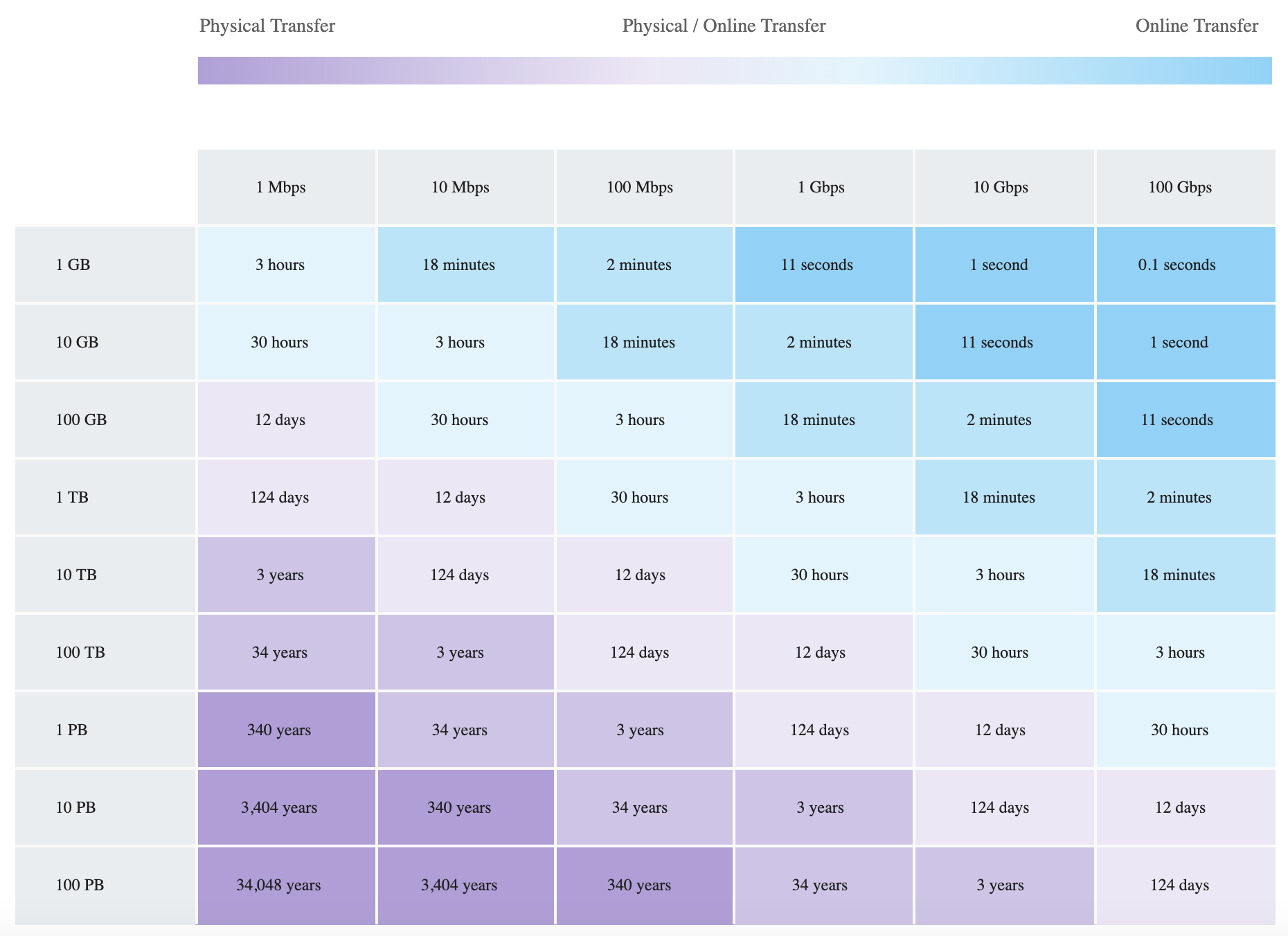
Data Transfer Chart – Bandwidth vs Time
AWS Certification Exam Practice Questions
- Questions are collected from Internet and the answers are marked as per my knowledge and understanding (which might differ with yours).
- AWS services are updated everyday and both the answers and questions might be outdated soon, so research accordingly.
- AWS exam questions are not updated to keep up the pace with AWS updates, so even if the underlying feature has changed the question might not be updated
- Open to further feedback, discussion and correction.
- An organization is moving non-business-critical applications to AWS while maintaining a mission critical application in an on-premises data center. An on-premises application must share limited confidential information with the applications in AWS. The Internet performance is unpredictable. Which configuration will ensure continued connectivity between sites MOST securely?
- VPN and a cached storage gateway
- AWS Snowball Edge
- VPN Gateway over AWS Direct Connect
- AWS Direct Connect
- A company wants to transfer petabyte-scale of data to AWS for their analytics, however are constrained on their internet connectivity? Which AWS service can help them transfer the data quickly?
- S3 enhanced uploader
- Snowmobile
- Snowball
- Direct Connect
- A company wants to transfer its video library data, which runs in exabytes, to AWS. Which AWS service can help the company transfer the data? [Note: Snowmobile was retired in March 2024. For current exabyte-scale migrations, multiple Snowball Edge devices or AWS Data Transfer Terminal would be recommended.]
- Snowmobile
- Snowball
- S3 upload
- S3 enhanced uploader
- You are working with a customer who has 100 TB of archival data that they want to migrate to Amazon Glacier. The customer has a 1-Gbps connection to the Internet. Which service or feature provides the fastest method of getting the data into Amazon Glacier?
- Amazon Glacier multipart upload
- AWS Storage Gateway
- VM Import/Export
- AWS Snowball
- A media company needs to transfer 500 TB of video content from their on-premises data center to Amazon S3. They have a 10 Gbps Direct Connect link but need the transfer completed within 1 week. Which approach is MOST appropriate?
- Use S3 Transfer Acceleration over the internet
- Use AWS DataSync over the Direct Connect link
- Use multiple AWS Snowball Edge devices
- Upload directly using the AWS CLI
- A company needs to regularly transfer files from a partner’s SFTP server to Amazon S3 for processing. Which AWS service provides a fully managed solution for this requirement?
- AWS DataSync
- Amazon S3 Transfer Acceleration
- AWS Transfer Family SFTP Connectors
- AWS Direct Connect
- A company is migrating data from Google Cloud Storage to Amazon S3. They want a managed solution that does not require deploying agents. Which AWS service and feature should they use?
- AWS DataSync Basic mode with an agent
- AWS S3 Batch Operations
- AWS DataSync Enhanced mode (cross-cloud transfers)
- AWS Transfer Family
- A film production company has 200 TB of raw footage on portable NAS devices after a remote shoot. They need to upload it to S3 as quickly as possible. They are near an AWS Data Transfer Terminal location. What is the FASTEST approach?
- Ship an AWS Snowball Edge device and transfer offline
- Use AWS DataSync over the internet
- Visit the AWS Data Transfer Terminal with their storage devices
- Use S3 Transfer Acceleration for parallel uploads
Thanks for your guidance this is very useful for me,anyone want to learn advance AWS tools