Using AWS in a Hybrid Environment
As the adoption of the public cloud grows, more and more organizations are adopting a hybrid cloud model. This adoption is driven by business requirements including data residency, latency sensitivity, regulatory compliance, and phased migration strategies. When you start to look closely at what makes a hybrid cloud, it’s clear why AWS has invested heavily in services designed specifically for hybrid architectures.
With a hybrid cloud model consisting of on-premises infrastructure, private cloud services, and public cloud offerings, organizations can orchestrate workloads across these environments based on specific requirements like performance, compliance, or cost optimization.
AWS Hybrid Cloud Services
AWS provides a comprehensive suite of services specifically designed for hybrid cloud architectures. These services span compute, networking, storage, and data transfer categories.
Hybrid Compute
- AWS Outposts – Fully managed service that extends AWS infrastructure, services, APIs, and tools to on-premises facilities. Available as Outposts Racks (full 42U rack) or Outposts Servers (1U/2U form factor). Second-generation Outposts Racks launched in April 2025 with up to 40% better performance (C7i, M7i, R7i instances) and accelerated networking for ultra-low latency workloads. EC2 C8i, M8i, and R8i instances added in February 2026.
- AWS Local Zones – Places AWS infrastructure in metro areas close to users for single-digit millisecond latency. Supports compute, storage, networking, databases, and AI/ML inference. Expanding continuously with new locations (Athens, Hanoi in 2026).
- AWS Dedicated Local Zones – Fully managed, single-tenant Local Zones for digital sovereignty and data residency requirements. Expanded services announced in 2025 for security-sensitive workloads.
- AWS Wavelength – Embeds AWS compute and storage at the edge of 5G networks for ultra-low latency mobile and connected device applications.
Hybrid Networking & Connectivity
- AWS Direct Connect – Dedicated private network connection from on-premises to AWS, bypassing the public internet. Supports 1 Gbps, 10 Gbps, and 100 Gbps connections. Can be combined with AWS Cloud WAN for simplified global hybrid connectivity (Direct Connect gateway attachments supported since late 2024).
- AWS Site-to-Site VPN – Encrypted IPSec tunnels between on-premises networks and AWS VPCs. Supports accelerated VPN using AWS Global Accelerator for improved performance. Provides high availability with two tunnels across multiple Availability Zones.
- AWS Transit Gateway – Central hub connecting VPCs and on-premises networks. Acts as a cloud router simplifying complex network topologies. Supports multicast, inter-region peering, and integration with Direct Connect.
- AWS Cloud WAN – Global wide area network service to build, manage, and monitor unified networks across AWS Regions and on-premises locations. Features centralized dashboard, network segmentation, and Routing Policy (launched November 2025) for fine-grained traffic control. Now available in AWS GovCloud (2026).
Hybrid Storage
- AWS Storage Gateway – Provides on-premises access to virtually unlimited cloud storage using standard protocols (iSCSI, SMB, NFS). Available as S3 File Gateway, Volume Gateway, and Tape Gateway. Note: FSx File Gateway is no longer available to new customers as of October 2024.
- AWS DataSync – Online data transfer service for moving data between on-premises storage, edge locations, other clouds, and AWS. Enhanced mode (2025) provides higher performance, scalability, and cross-cloud transfers without requiring an agent.
- AWS Snow Family – Physical devices for edge computing and data transfer. Note: As of November 2025, Snowball Edge devices are only available to existing customers. New customers should use AWS DataSync for online transfers or AWS Data Transfer Terminal for physical transfers.
Key Considerations for Hybrid Cloud Implementation
When implementing a hybrid cloud architecture with AWS, several key areas must be addressed:
- Networking & Connectivity – Choose between Direct Connect (dedicated, consistent performance) and Site-to-Site VPN (encrypted, quick setup). Use Transit Gateway or Cloud WAN for complex multi-VPC and multi-Region topologies.
- Identity & Access – Extend on-premises Active Directory to AWS using AWS Directory Service or federate identities using AWS IAM Identity Center (formerly AWS SSO).
- Security – Implement consistent security policies across environments. Use AWS Security Hub for centralized security posture management.
- Data Residency & Compliance – Use Outposts, Local Zones, or Dedicated Local Zones to keep data within specific geographic boundaries while leveraging AWS services.
- Monitoring & Operations – Use AWS Systems Manager for unified operations management across hybrid environments. CloudWatch provides monitoring for both cloud and on-premises resources with the CloudWatch agent.
Data Protection in Hybrid Environments
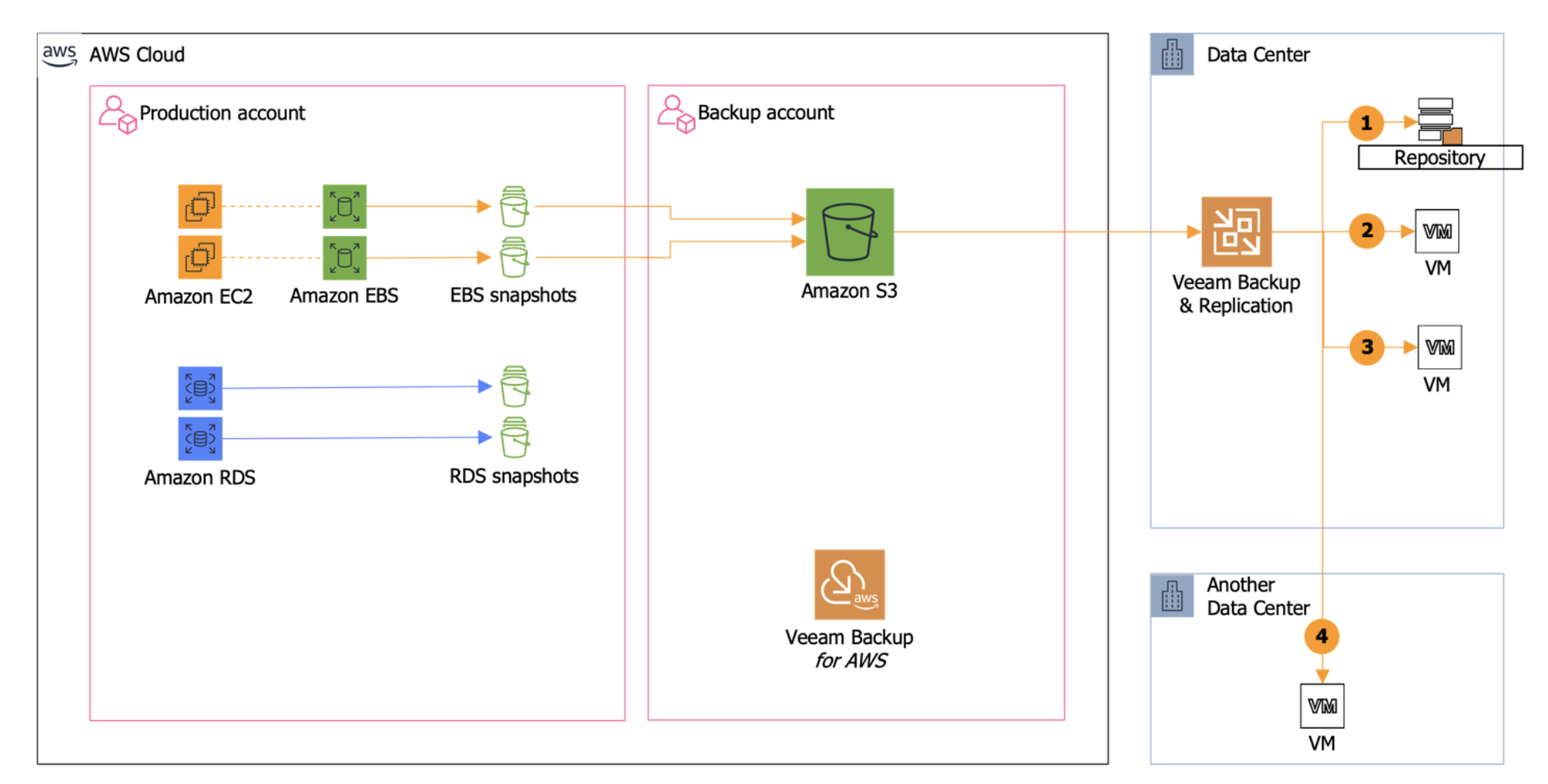
Protecting and migrating workloads across hybrid platforms is a critical consideration. AWS provides native services like AWS Backup for centralized backup management, and third-party solutions like Veeam provide comprehensive cross-platform data protection.
AWS Native Options:
- AWS Backup – Centralized backup service supporting EC2, EBS, RDS, DynamoDB, EFS, FSx, and Storage Gateway volumes.
- AWS Elastic Disaster Recovery (DRS) – Minimizes downtime and data loss with affordable storage and minimal compute, supporting on-premises to cloud recovery.
Third-Party Solutions:
Solutions like Veeam Backup for AWS (currently at v9) provide cross-platform workload protection and migration. Veeam supports backup of EC2, RDS, DynamoDB, Redshift, Redshift Serverless, EFS, and FSx, with the ability to move workloads between AWS, on-premises VMware/Hyper-V environments, and other clouds.
Summary
AWS provides a comprehensive set of services for hybrid cloud architectures, from extending full AWS infrastructure on-premises with Outposts to connecting environments via Direct Connect and Cloud WAN. Key decisions involve choosing the right connectivity option based on latency, bandwidth, and cost requirements, selecting appropriate compute placement (Region, Local Zone, Outposts, or Wavelength), and implementing consistent security and operations across all environments.
The hybrid cloud model continues to evolve with AWS investing in second-generation hardware (Outposts Racks 2025), simplified global networking (Cloud WAN Routing Policy), and AI/ML capabilities at the edge. Organizations should evaluate their specific requirements around latency, data residency, compliance, and workload characteristics to choose the optimal hybrid architecture pattern.
AWS Certification – Hybrid Cloud Topics
Hybrid cloud architecture is covered across multiple AWS certifications:
- Solutions Architect Associate (SAA-C03) – Direct Connect, Site-to-Site VPN, Storage Gateway, Outposts, Transit Gateway
- Solutions Architect Professional (SAP-C02) – Cloud WAN, complex hybrid networking, migration strategies
- Advanced Networking Specialty (ANS-C01) – Deep dive into Direct Connect, Transit Gateway, Cloud WAN, routing