AWS VPC NAT Gateway vs NAT Instance – Comparison

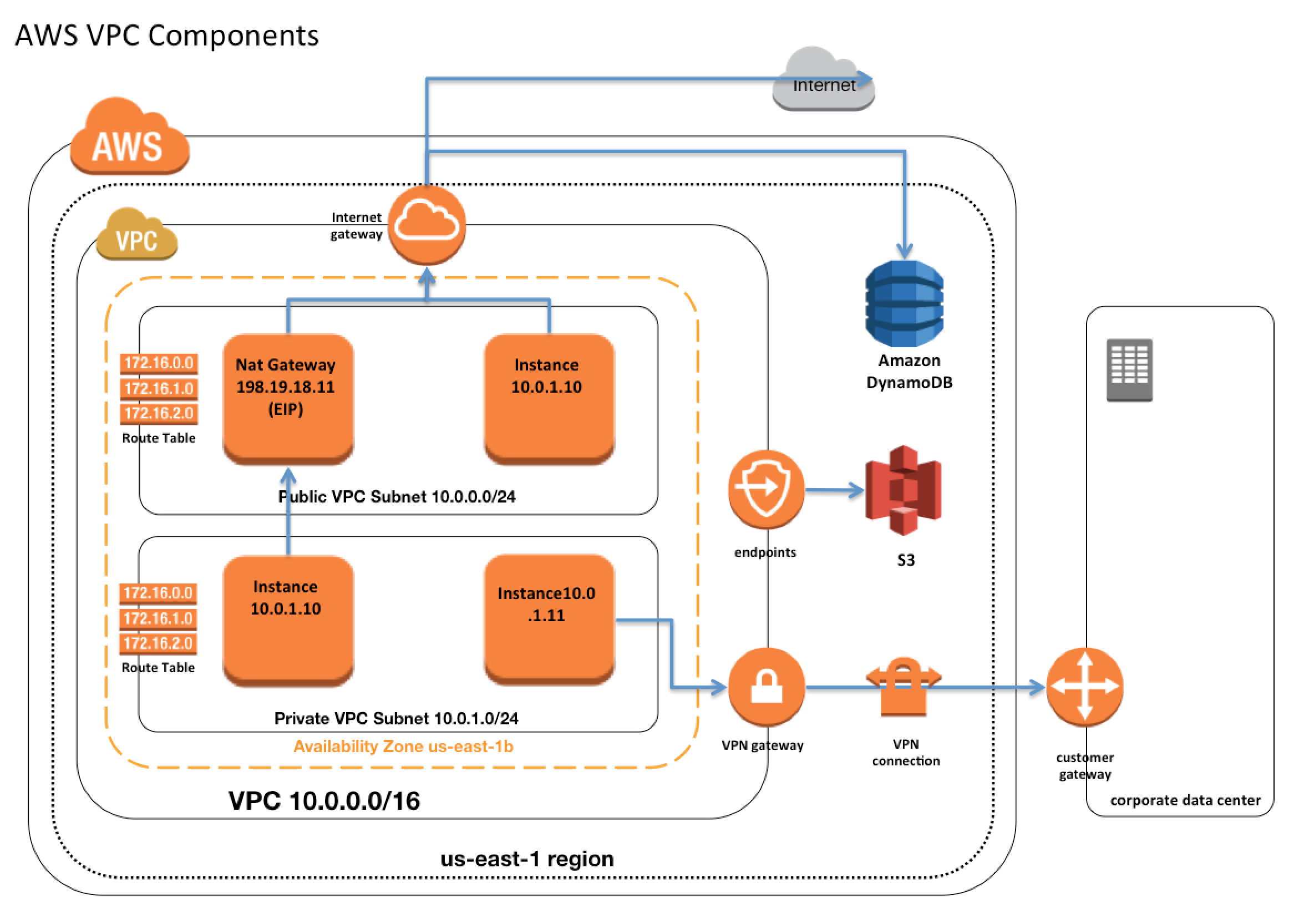
NAT Gateway High Availability

AWS NAT

  • AWS NAT – Network Address Translation devices, launched in the public subnet, enables instances in a private subnet to connect to the Internet but prevents the Internet from initiating connections with the instances.
  • Instances in private subnets would need an internet connection for performing software updates or trying to access external services.
  • NAT device performs the function of both address translation and port address translation (PAT)
  • NAT instance prevents instances to be directly exposed to the Internet and having to be launched in a Public subnet and assigning of the Elastic IP address to all, which are limited.
  • NAT device routes the traffic, from the private subnet to the Internet, by replacing the source IP address with its address and it translates the address back to the instances’ private IP addresses for the response traffic.
  • AWS allows NAT configuration in 2 ways
    • NAT Gateway, managed service by AWS (recommended)
    • NAT Instance (legacy, not recommended)

NAT Gateway

  • NAT gateway is an AWS managed NAT service that provides better availability, higher bandwidth, and requires less administrative effort.
  • A NAT gateway supports 5 Gbps of bandwidth and automatically scales up to 100 Gbps. For higher bursts requirements, the workload can be distributed by splitting the resources into multiple subnets and creating a NAT gateway in each subnet.
  • A NAT gateway can process one million packets per second and automatically scales up to ten million packets per second. Beyond this limit, a NAT gateway will drop packets.
  • Each NAT gateway is created in a specific Availability Zone and implemented with redundancy in that zone (for zonal NAT gateways).
  • A NAT gateway supports the TCP, UDP, and ICMP protocols.
  • NAT gateways are supported for IPv4 or IPv6 traffic. For IPv6 traffic, NAT gateway performs NAT64. By using this in conjunction with DNS64 (available on Route 53 Resolver), IPv6 workloads in a subnet can communicate with IPv4 resources.
  • NAT gateway cannot be associated with a security group. Security can be configured for the instances in the private subnets to control the traffic.
  • Network ACL can be used to control the traffic to and from the subnet. NACL applies to the NAT gateway’s traffic, which uses ports 1024-65535
  • NAT gateway when created receives an elastic network interface that’s automatically assigned a private IP address from the IP address range of the subnet. Attributes of this network interface cannot be modified.
  • NAT gateway cannot send traffic over VPC endpoints, VPN connections, AWS Direct Connect, or VPC peering connections. The private subnet’s route table should be modified to route the traffic directly to these devices.
  • NAT gateway can route traffic to Transit Gateways and virtual private gateways (for private NAT gateways) or through Transit Gateway for Site-to-Site VPN/Direct Connect traffic.
  • NAT gateway times out the connection if it is idle for 350 seconds or more. To prevent the connection from being dropped, initiate more traffic over the connection or enable TCP keepalive on the instance with a value of less than 350 seconds.
  • NAT gateways currently do not support the IPsec protocol.
  • NAT gateways support traffic with a maximum transmission unit (MTU) of 8500 bytes.
  • Each IPv4 address can support up to 55,000 simultaneous connections to each unique destination. You can increase this limit by associating up to 8 IPv4 addresses to your NAT gateways (1 primary IPv4 address and 7 secondary IPv4 addresses). By default, you can associate up to 2 Elastic IP addresses per public NAT gateway (quota increase available).

NAT Gateway Types

  • Public NAT Gateway
    • Enables instances in private subnets to connect to the internet
    • Requires an Elastic IP address
    • Must be created in a public subnet (for zonal mode)
    • Supports up to 8 IPv4 addresses (1 primary + 7 secondary)
  • Private NAT Gateway
    • Enables instances in private subnets to connect to other VPCs or on-premises networks via Transit Gateway or virtual private gateway
    • Does not require an Elastic IP address
    • Uses private IP address for source NAT
    • Cannot be used for internet connectivity
    • Useful for communication between VPCs with overlapping CIDR ranges

Regional NAT Gateway (Announced November 2025)

  • A regional NAT gateway automatically expands across Availability Zones based on workload presence, unlike standard zonal NAT gateways which operate in a single AZ.
  • Does not require a public subnet – creates its own route table with a pre-configured route to the internet gateway.
  • Provides automatic high availability without manual multi-AZ configuration.
  • Simplifies setup – no need to create/delete NAT Gateways or edit route tables when workloads expand to new AZs.
  • Supports up to 32 IP addresses per Availability Zone (compared to 8 for zonal NAT gateways).
  • May take up to 60 minutes to expand to a new AZ after a resource is launched there.
  • Supports two modes:
    • Automatic mode – AWS manages IP addresses and AZ expansion (recommended)
    • Manual mode – You manually manage IP addresses and control AZ expansion/contraction
  • Supports AWS Transit Gateway as a valid route in the regional NAT gateway route table.
  • Does not support private NAT connectivity (use zonal NAT gateways for private NAT use cases).
  • Available in all commercial AWS Regions (except AWS GovCloud and China Regions).

Regional NAT Gateway vs Zonal NAT Gateway

  • Zonal NAT Gateway (Traditional)
    • Created in a specific Availability Zone
    • Requires a public subnet in each AZ for high availability
    • Requires manual creation of NAT Gateway in each AZ
    • Requires route table updates for each AZ
    • Supports up to 8 IP addresses
    • Supports both public and private connectivity types
    • Best for: Predictable, static workloads; private NAT use cases
  • Regional NAT Gateway
    • Automatically spans all AZs based on workload presence
    • No public subnet required
    • Single NAT Gateway resource to manage
    • Automatic routing across AZs
    • Supports up to 32 IP addresses per AZ
    • Public connectivity only (no private NAT support)
    • Best for: Dynamic workloads that scale across AZs, simplified management, new deployments
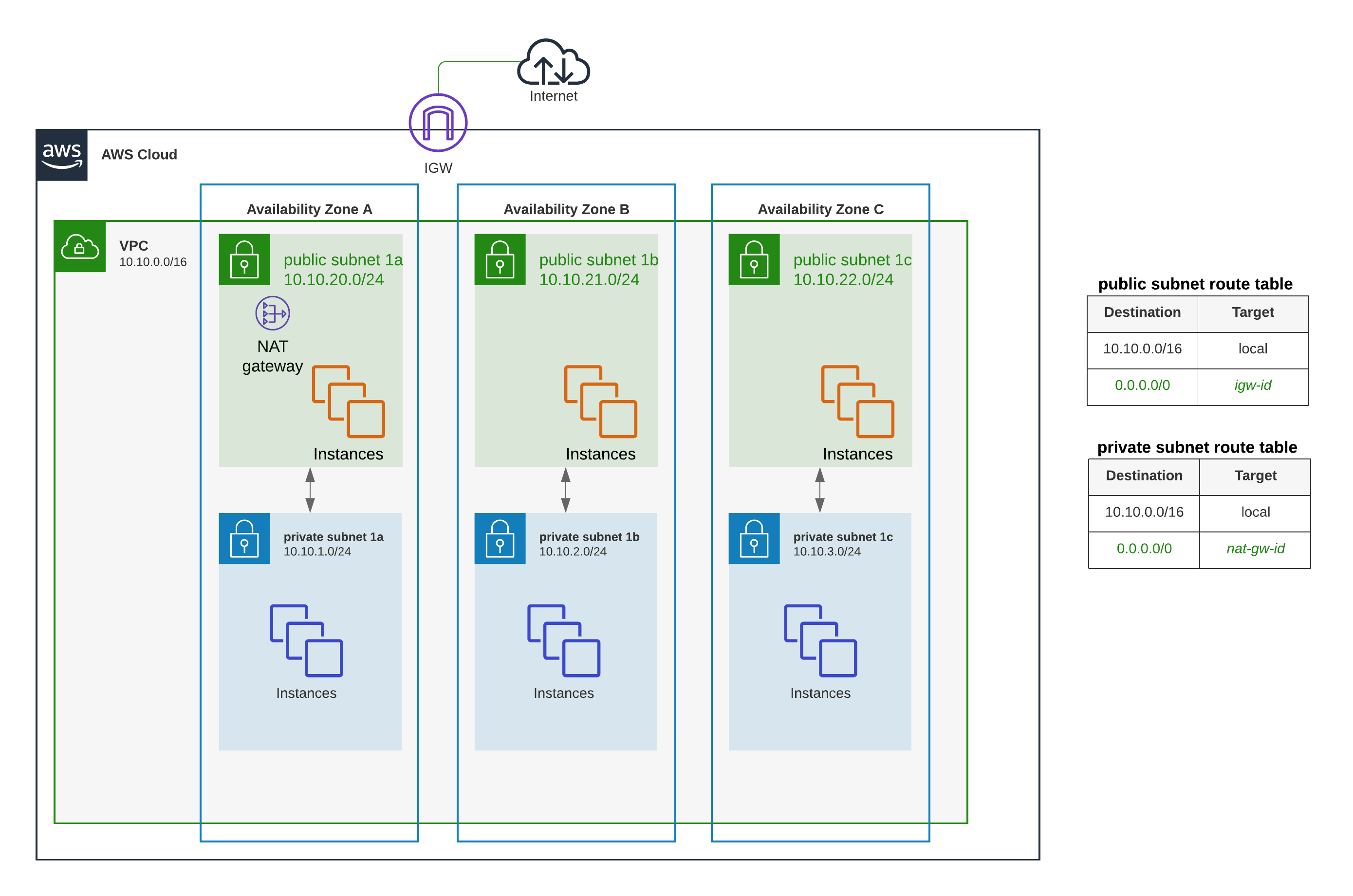
NAT Gateway High Availability

NAT Instance

⚠️ NAT Instance – Legacy (Not Recommended)

The NAT AMI is built on the last version of Amazon Linux AMI, 2018.03, which reached end of standard support on December 31, 2020 and end of maintenance support on December 31, 2023.

AWS recommends migrating to a NAT Gateway for better availability, higher bandwidth, and less administrative effort.

If NAT instances are required for your use case (e.g., cost optimization for non-production environments), you can create your own NAT AMI from a current version of Amazon Linux.

NAT Gateway vs NAT Instance
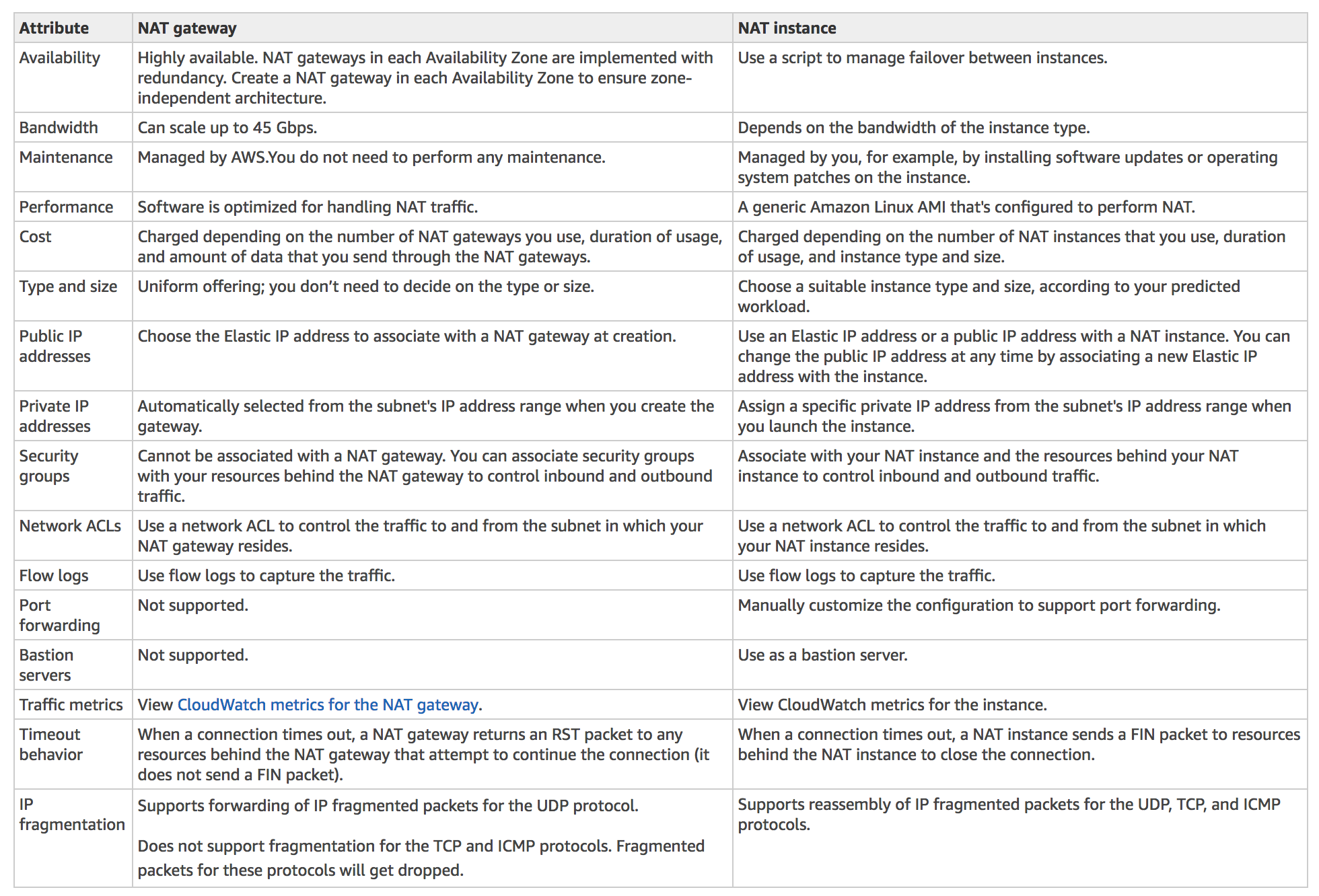
NAT Gateway vs NAT Instance

AWS Certification Exam Practice Questions

  • Questions are collected from Internet and the answers are marked as per my knowledge and understanding (which might differ with yours).
  • AWS services are updated everyday and both the answers and questions might be outdated soon, so research accordingly.
  • AWS exam questions are not updated to keep up the pace with AWS updates, so even if the underlying feature has changed the question might not be updated
  • Open to further feedback, discussion and correction.
  1. After launching an instance that you intend to serve as a NAT (Network Address Translation) device in a public subnet you modify your route tables to have the NAT device be the target of internet bound traffic of your private subnet. When you try and make an outbound connection to the Internet from an instance in the private subnet, you are not successful. Which of the following steps could resolve the issue?
    1. Attaching a second Elastic Network interface (ENI) to the NAT instance, and placing it in the private subnet
    2. Attaching an Elastic IP address to the instance in the private subnet
    3. Attaching a second Elastic Network Interface (ENI) to the instance in the private subnet, and placing it in the public subnet
    4. Disabling the Source/Destination Check attribute on the NAT instance
  2. You manually launch a NAT AMI in a public subnet. The network is properly configured. Security groups and network access control lists are property configured. Instances in a private subnet can access the NAT. The NAT can access the Internet. However, private instances cannot access the Internet. What additional step is required to allow access from the private instances?
    1. Enable Source/Destination Check on the private Instances.
    2. Enable Source/Destination Check on the NAT instance.
    3. Disable Source/Destination Check on the private instances
    4. Disable Source/Destination Check on the NAT instance
  3. A user has created a VPC with public and private subnets. The VPC has CIDR 20.0.0.0/16. The private subnet uses CIDR 20.0.1.0/24 and the public subnet uses CIDR 20.0.0.0/24. The user is planning to host a web server in the public subnet (port 80. and a DB server in the private subnet (port 3306.. The user is configuring a security group of the NAT instance. Which of the below mentioned entries is not required for the NAT security group?
    1. For Inbound allow Source: 20.0.1.0/24 on port 80
    2. For Outbound allow Destination: 0.0.0.0/0 on port 80
    3. For Inbound allow Source: 20.0.0.0/24 on port 80 (Refer NAT Instance Documentation)
    4. For Outbound allow Destination: 0.0.0.0/0 on port 443
  4. A web company is looking to implement an external payment service into their highly available application deployed in a VPC. Their application EC2 instances are behind a public facing ELB. Auto scaling is used to add additional instances as traffic increases. Under normal load the application runs 2 instances in the Auto Scaling group but at peak it can scale 3x in size. The application instances need to communicate with the payment service over the Internet, which requires whitelisting of all public IP addresses used to communicate with it. A maximum of 4 whitelisting IP addresses are allowed at a time and can be added through an API. How should they architect their solution?
    1. Route payment requests through two NAT instances setup for High Availability and whitelist the Elastic IP addresses attached to the NAT instances
    2. Whitelist the VPC Internet Gateway Public IP and route payment requests through the Internet Gateway. (Internet gateway is only to route traffic)
    3. Whitelist the ELB IP addresses and route payment requests from the Application servers through the ELB. (ELB does not have a fixed IP address)
    4. Automatically assign public IP addresses to the application instances in the Auto Scaling group and run a script on boot that adds each instances public IP address to the payment validation whitelist API. (would exceed the allowed 4 IP addresses)
  5. A company needs to provide internet access to instances in private subnets across multiple Availability Zones with automatic high availability and simplified management. Which NAT Gateway option should they use?
    1. Create a public NAT Gateway in each Availability Zone
    2. Create a Regional NAT Gateway that automatically spans all Availability Zones
    3. Create a private NAT Gateway in each Availability Zone
    4. Use NAT instances with Auto Scaling
  6. An organization has two VPCs with overlapping CIDR ranges that need to communicate with each other through a Transit Gateway. Which NAT Gateway type should be used to enable this communication?
    1. Public NAT Gateway with Elastic IP addresses
    2. Regional NAT Gateway in automatic mode
    3. Private NAT Gateway connected to a Transit Gateway
    4. NAT Instance with Source/Destination Check disabled
  7. A company’s NAT Gateway is experiencing port exhaustion when communicating with a popular third-party API endpoint. What is the most effective solution to increase the number of simultaneous connections?
    1. Create multiple NAT Gateways in the same subnet
    2. Associate secondary IPv4 addresses with the NAT Gateway to increase the connection limit
    3. Increase the NAT Gateway bandwidth allocation
    4. Replace the NAT Gateway with a NAT Instance using a larger instance type
Related Posts

References

AWS Direct Connect vs VPN – Hybrid Connectivity

AWS Direct Connect vs VPN

AWS Direct Connect vs VPN

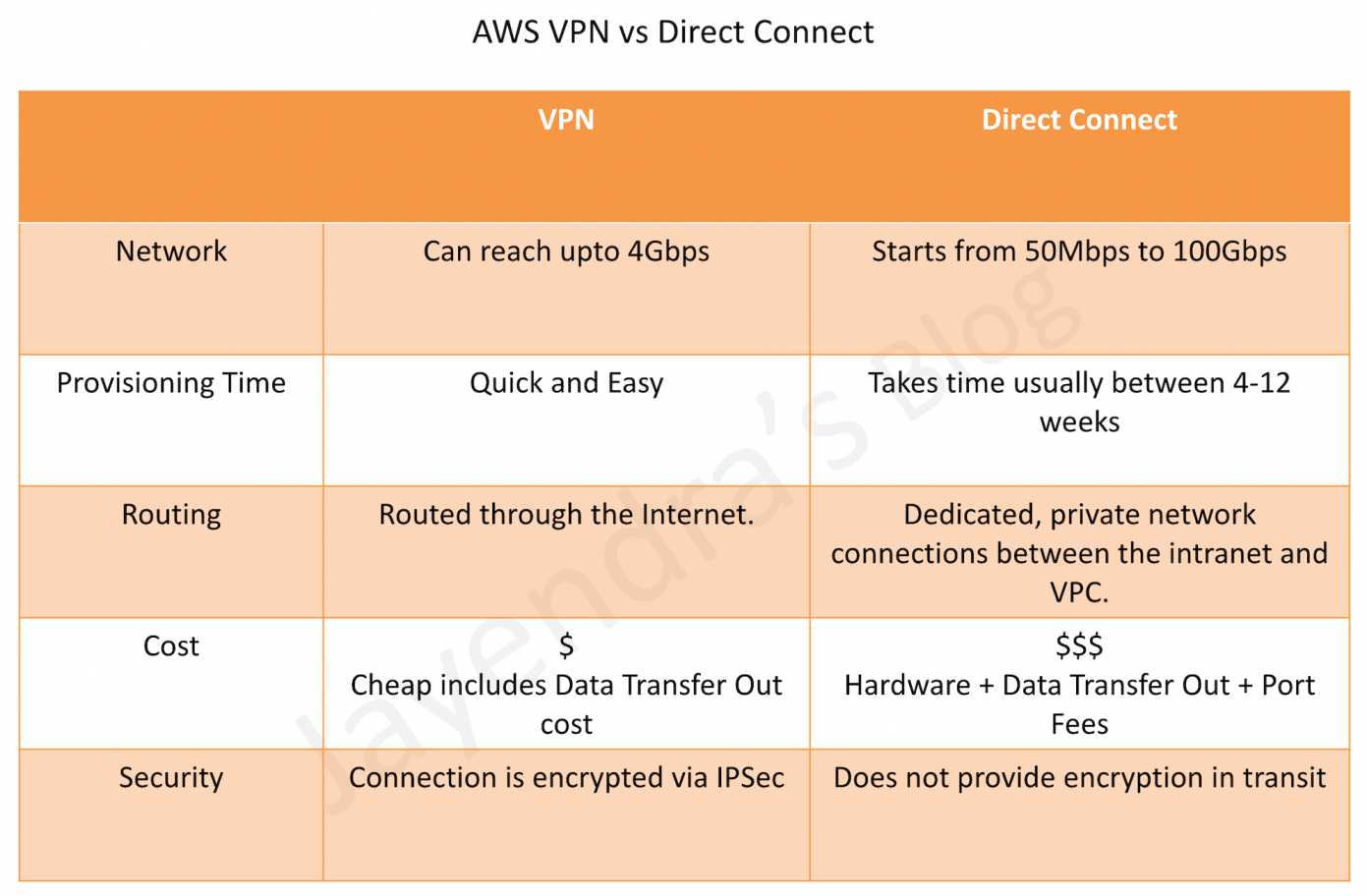
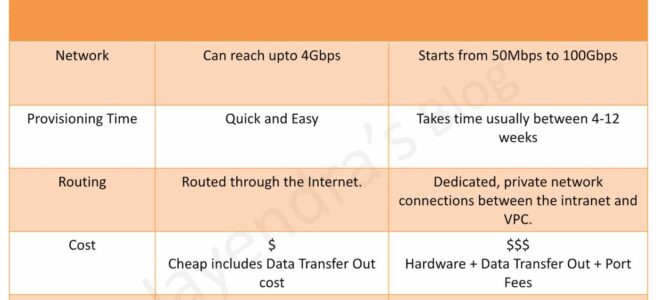
  • AWS VPN Connection utilizes IPSec to establish encrypted network connectivity between the intranet and VPC over the Internet.
  • AWS Direct Connect provides dedicated, private network connections between the intranet and VPC.
  • Setup time
    • VPN Connections can be configured in minutes and are a good solution for immediate needs, have low to modest bandwidth requirements, and can tolerate the inherent variability in Internet-based connectivity.
    • Direct Connect can take anywhere from 4 to 12 weeks
  • Routing
    • VPN traffic is still routed through the Internet.
    • Direct Connect does not involve the Internet; instead, it uses dedicated, private network connections between the intranet and VPC. The network traffic remains on the AWS global network and never touches the public internet. This reduces the chance of hitting bottlenecks or unexpected increases in latency
  • Bandwidth
    • VPN connections support up to 1.25 Gbps per tunnel (standard) or 5 Gbps per tunnel (large bandwidth tunnels, launched Nov 2025). With ECMP on Transit Gateway, multiple tunnels can be aggregated for higher throughput.
    • Direct Connect supports dedicated connections at 1 Gbps, 10 Gbps, 100 Gbps, or 400 Gbps (native 400 Gbps launched Jul 2024 at select locations). Hosted connections are available from 50 Mbps up to 25 Gbps via AWS Direct Connect Partners.
  • Cost
    • VPN connections are relatively inexpensive — standard 1.25 Gbps connections cost $0.05/hr (~$36/month) per connection. The 5 Gbps large bandwidth tunnels cost $0.60/hr (~$432/month). Additional charges apply for data transfer out and Transit Gateway attachments.
    • Direct Connect requires actual hardware and infrastructure — port-hour charges vary by speed (e.g., 1 Gbps, 10 Gbps, 100 Gbps, 400 Gbps) plus data transfer charges. Total costs can run into thousands per month depending on port speed and data volumes.
  • Encryption in Transit
    • VPN connections encrypt the data in transit using IPSec.
    • Direct Connect data transfer can be encrypted using:
      • MACsec (IEEE 802.1AE) — Layer 2 encryption on dedicated connections (1 Gbps, 10 Gbps, 100 Gbps, 400 Gbps) and supported partner interconnects (extended Jul 2025).
      • Private IP VPN — IPSec encryption over Direct Connect transit VIFs, providing end-to-end encryption without using public VIFs or public IP addresses.
  • Resiliency
    • VPN provides built-in high availability with two tunnels per connection across multiple Availability Zones. Accelerated VPN uses AWS Global Accelerator for optimized routing.
    • Direct Connect offers the Resiliency Toolkit with connection wizard supporting Maximum Resiliency, High Resiliency, and Development/Test models. SiteLink enables direct data transfer between Direct Connect locations bypassing AWS Regions.

Direct Connect vs VPN Comparison

AWS Direct Connect vs VPN

AWS VPN Connection Types (Updated 2025)

As of November 2025, AWS Site-to-Site VPN offers five distinct connection options:

  • Standard 1.25 Gbps VPN — Up to 1.25 Gbps per tunnel; terminates on Virtual Private Gateway (VGW) or Transit Gateway. Supports ECMP for higher aggregate bandwidth when used with Transit Gateway.
  • 5 Gbps Large Bandwidth VPN (Nov 2025) — Up to 5 Gbps per tunnel; terminates on Transit Gateway only. Ideal for bandwidth-intensive hybrid applications, big data migrations, and disaster recovery. Existing tunnels can be upgraded in-place (May 2026) without changing IP addresses or configuration.
  • Accelerated VPN — Uses AWS Global Accelerator to route traffic from on-premises to the nearest AWS edge location, reducing internet path variability. Available for both 1.25 Gbps connections.
  • VPN Concentrator (Nov 2025) — Simplifies multi-site connectivity for 25+ remote sites (each under 100 Mbps). Single Transit Gateway attachment for all sites with 5 Gbps aggregate bandwidth. Cost-effective for distributed enterprises (retail, hospitality, healthcare).
  • Private IP VPN — IPSec VPN over Direct Connect transit VIFs using private IP addresses. Provides encryption on dedicated connections without traversing the public internet.

AWS Direct Connect + VPN

AWS Direct Connect + VPN

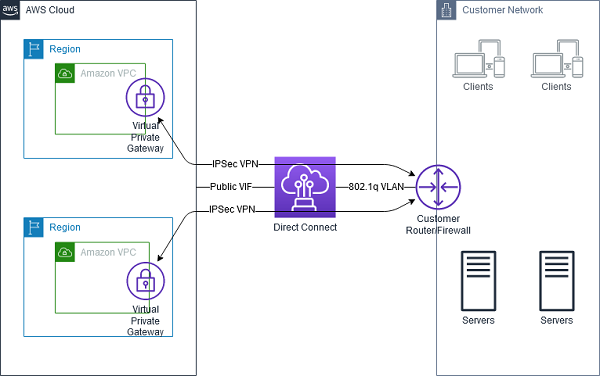
  • AWS Direct Connect + VPN combines the benefits of the end-to-end secure IPSec connection with low latency and increased bandwidth of the AWS Direct Connect to provide a more consistent network experience than internet-based VPN connections.
  • Two approaches are available:
    • Public VIF approach (legacy) — Direct Connect public VIF establishes a dedicated network connection between the on-premises network to public AWS resources, such as an Amazon virtual private gateway IPsec endpoint. A BGP connection is established on the public VIF, and another BGP session or static route is established on the IPSec VPN tunnel.
    • Private IP VPN (recommended) — Uses Direct Connect transit VIFs with private IP addresses to establish IPSec connections to Transit Gateway. This eliminates the need for public IP addresses and keeps all traffic private end-to-end.

Direct Connect + VPN as Backup

Direct Connect with VPN as Backup

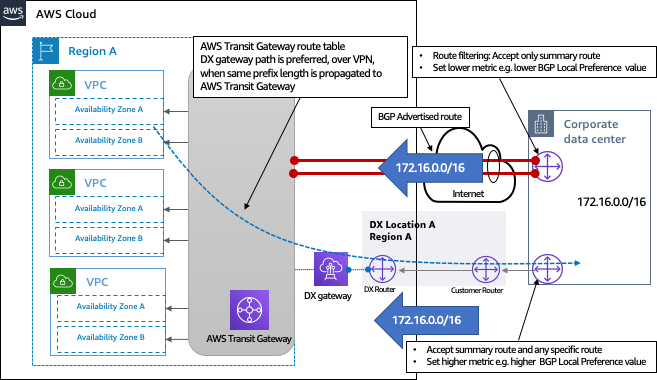
  • VPN can be selected to provide a quick and cost-effective, backup hybrid network connection to an AWS Direct Connect. However, it provides a lower level of reliability and indeterministic performance over the internet.
  • Be sure that you use the same virtual private gateway for both Direct Connect and the VPN connection to the VPC.
  • If you are configuring a Border Gateway Protocol (BGP) VPN, advertise the same prefix for Direct Connect and the VPN.
  • If you are configuring a static VPN, add the same static prefixes to the VPN connection that you are announcing with the Direct Connect virtual interface.
  • If you are advertising the same routes toward the AWS VPC, the Direct Connect path is always preferred, regardless of AS path prepending.
  • For Transit Gateway architectures, both Direct Connect (via Direct Connect Gateway) and VPN can attach to the same Transit Gateway with route table preferences configured appropriately.

AWS Direct Connect SiteLink

  • SiteLink enables sending data from one Direct Connect location to another, bypassing AWS Regions entirely.
  • Useful for building a private, low-latency global backbone between on-premises data centers using the AWS global network.
  • Traffic flows between Direct Connect locations over the shortest available path on the AWS backbone without being routed through any AWS Region.
  • Enabled per virtual interface — only SiteLink-enabled VIFs can communicate with each other.
  • Combined with MACsec encryption, provides a secure and private global WAN over AWS infrastructure.

AWS Certification Exam Practice Questions

  • Questions are collected from Internet and the answers are marked as per my knowledge and understanding (which might differ with yours).
  • AWS services are updated everyday and both the answers and questions might be outdated soon, so research accordingly.
  • AWS exam questions are not updated to keep up the pace with AWS updates, so even if the underlying feature has changed the question might not be updated
  • Open to further feedback, discussion and correction.
  1. You work as an AWS Architect for a company that has an on-premise data center. They want to connect their on-premise infra to the AWS Cloud. Note that this connection must have the maximum throughput and be dedicated to the company. How can this be achieved?
    1. Use AWS Express Route
    2. Use AWS Direct Connect
    3. Use AWS VPC Peering
    4. Use AWS VPN
  2. A company wants to set up a hybrid connection between their AWS VPC and their on-premise network. They need to have high bandwidth and less latency because they need to transfer their current database workloads to AWS. Which of the following would you use for this purpose?
    1. AWS Managed software VPN
    2. AWS Managed hardware VPN
    3. AWS Direct Connect
    4. AWS VPC Peering
  3. An organization has established an Internet-based VPN connection between their on-premises data center and AWS. They are considering migrating from VPN to AWS Direct Connect. Which operational concern should drive an organization to consider switching from an Internet-based VPN connection to AWS Direct Connect?
    1. AWS Direct Connect provides greater redundancy than an Internet-based VPN connection.
    2. AWS Direct Connect provides greater resiliency than an Internet-based VPN connection.
    3. AWS Direct Connect provides greater bandwidth than an Internet-based VPN connection.
    4. AWS Direct Connect provides greater control of network provider selection than an Internet-based VPN connection.
  4. A company needs to encrypt data in transit over their existing AWS Direct Connect connection. They want to use private IP addresses and avoid routing traffic over the public internet. Which solution should they implement?
    1. Configure MACsec encryption on the Direct Connect connection.
    2. Create a VPN connection over a Direct Connect public VIF.
    3. Create a Private IP VPN connection over a Direct Connect transit VIF.
    4. Use AWS CloudHSM to encrypt data before transmission.
  5. A retail company has 200 store locations across the country, each requiring under 50 Mbps bandwidth to access centralized applications in AWS. They want to minimize the number of Transit Gateway attachments and reduce costs. Which VPN solution is most appropriate?
    1. Create 200 individual Site-to-Site VPN connections to Transit Gateway.
    2. Use AWS Client VPN for each store location.
    3. Use AWS Site-to-Site VPN Concentrator to connect all sites through a single Transit Gateway attachment.
    4. Set up AWS Direct Connect for each store location.
  6. A company requires a single encrypted VPN connection with bandwidth exceeding 2 Gbps for disaster recovery replication to AWS. They want the simplest architecture with the fewest connections. Which solution meets these requirements?
    1. Create two standard 1.25 Gbps VPN connections with ECMP enabled.
    2. Use AWS Direct Connect with MACsec encryption.
    3. Create a 5 Gbps Site-to-Site VPN connection to Transit Gateway.
    4. Create four standard VPN connections with load balancing.
  7. A company uses AWS Direct Connect as their primary connection and Site-to-Site VPN as backup. Both connections advertise the same routes. Which path will AWS prefer for traffic from the VPC to on-premises?
    1. The path with the shortest AS path length.
    2. The VPN connection because it is encrypted.
    3. The Direct Connect path is always preferred, regardless of AS path prepending.
    4. Traffic is load balanced between both connections.

Network Firewall vs WAF vs Security Groups vs NACLs

AWS Network Firewall vs WAF vs Security Groups vs NACLs

📅 Updated June 2026: Added AWS WAF Classic EOL notice, Network Firewall Transit Gateway attachment, Web Category-based filtering, WAF AI Bot Control dashboard, Security Group VPC Associations, and AWS Shield Network Security Director.

⚠️ AWS WAF Classic Deprecated

AWS WAF Classic reached End of Life (EOL) on September 30, 2025.

All references to WAF in this post refer to the current AWS WAF (formerly “AWS WAFv2”). If you are still using WAF Classic, you must migrate immediately.

Migration: Use the AWS WAF Classic migration guide and the CreateWebACLMigrationStack API to migrate your web ACLs.

Overview

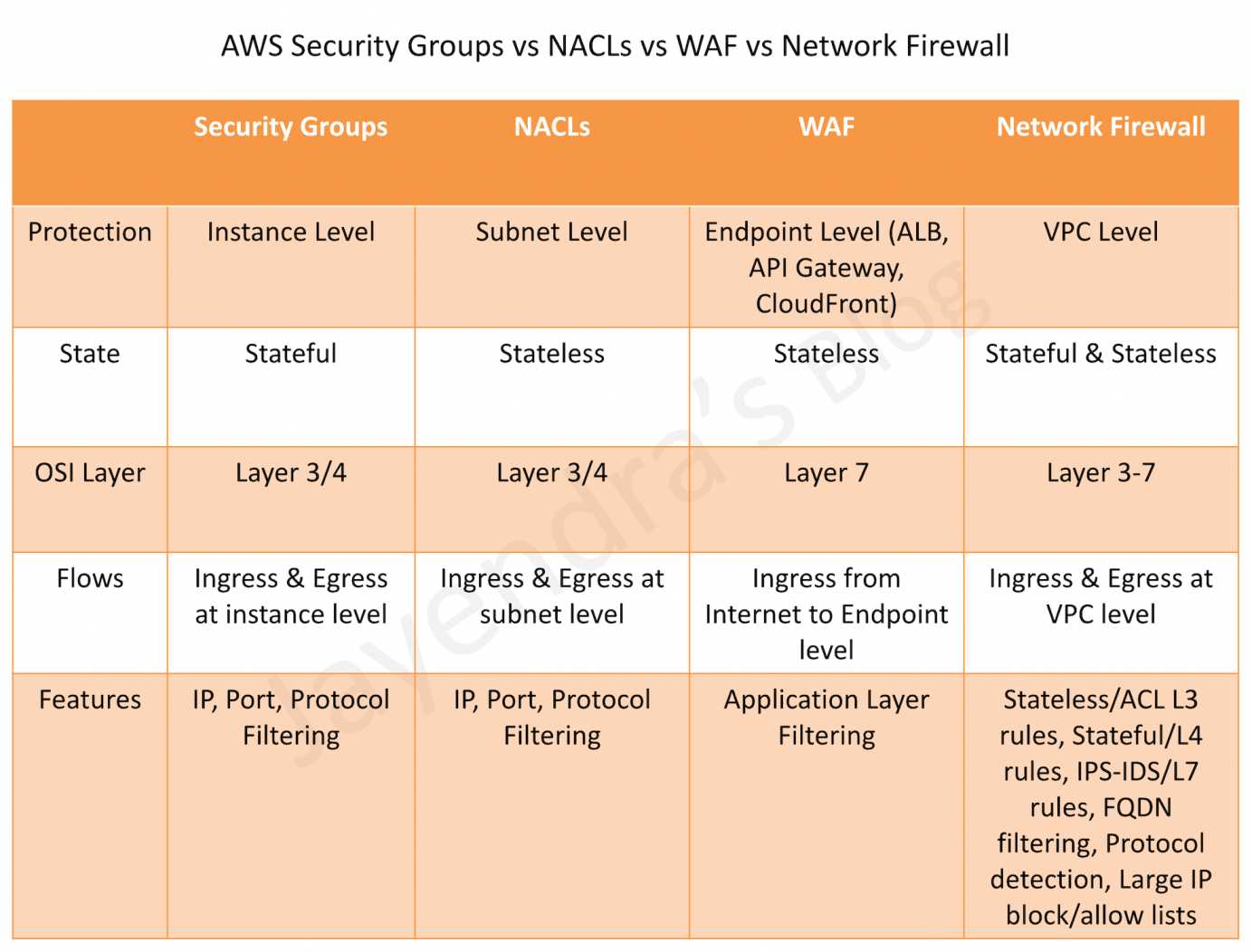
  • AWS Network Firewall is a stateful, fully managed network firewall and intrusion detection and prevention service (IDS/IPS) for VPCs.
  • AWS WAF is a web application firewall that helps protect web applications from attacks by allowing rules configuration that allow, block, or monitor (count) web requests based on defined conditions.
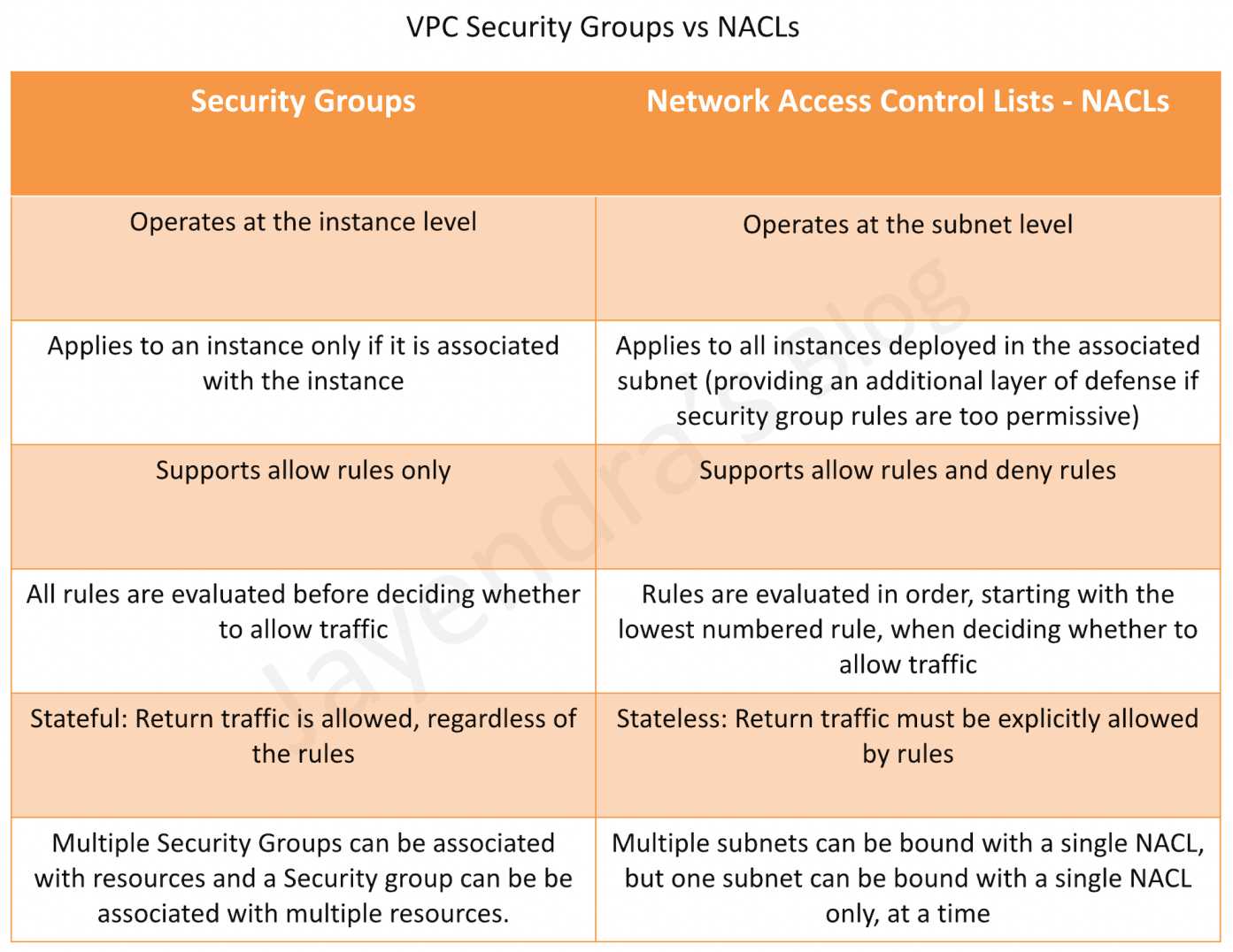
  • Security groups act as a virtual firewall for associated instances, controlling both inbound and outbound traffic at the instance level.
  • Network access control lists (NACLs) act as a firewall for associated subnets, controlling both inbound and outbound traffic at the subnet level.

AWS Security Groups vs NACLs vs WAF vs Network Firewall

Comparison Table

Feature Security Groups NACLs AWS WAF AWS Network Firewall
Scope Instance/ENI level Subnet level Application level (Layer 7) VPC level (Layers 3-7)
State Stateful Stateless Stateful Stateful & Stateless
Rules Allow rules only Allow and Deny rules Allow, Block, Count, CAPTCHA, Challenge Allow, Drop, Reject, Alert
Rule Processing All rules evaluated Rules processed in order (lowest number first) Rules processed by priority Rules processed by priority with strict/action order
Traffic Inspection IP, Port, Protocol IP, Port, Protocol HTTP/HTTPS headers, body, URI, query strings IP, Port, Protocol, Domain, HTTP/TLS, IDS/IPS signatures
IDS/IPS No No No (application-level only) Yes (Suricata-compatible)
TLS Inspection No No No (inspects after decryption at ALB/CloudFront) Yes (decrypts and re-encrypts HTTPS traffic)
Domain Filtering No No No Yes (FQDN, SNI, URL categories)
Bot Control No No Yes (650+ bots including AI crawlers) No (use WAF for bot control)
Cost Free Free Pay per web ACL, rule, and requests Pay per endpoint hour and data processed

Security Groups

  • Act as a virtual firewall at the instance/ENI level
  • Stateful – return traffic is automatically allowed regardless of rules
  • Support allow rules only – cannot create deny rules
  • All rules are evaluated before deciding whether to allow traffic
  • Can reference other security groups as sources/destinations (including cross-account)
  • Applied to ENIs – an instance can have multiple security groups
  • Default security group allows all outbound and denies all inbound (except from same group)

Security Group Updates (2024-2026)

  • Security Group VPC Associations (Oct 2024) – Associate a security group with multiple VPCs in the same account and Region, eliminating the need to duplicate security groups across VPCs
  • Shared Security Groups – In shared VPCs, security groups can now be shared with participant accounts using AWS RAM
  • Cross-VPC Security Group Referencing (AWS Cloud WAN) – Create inbound rules referencing security groups in other VPCs attached to AWS Cloud WAN within the same Region

Network Access Control Lists (NACLs)

  • Act as a firewall at the subnet level
  • Stateless – return traffic must be explicitly allowed by rules
  • Support both allow and deny rules
  • Rules are processed in number order (lowest first); processing stops at first match
  • Default NACL allows all inbound and outbound traffic
  • Custom NACLs deny all traffic by default until rules are added
  • Applied automatically to all instances in the associated subnet
  • Provide broad subnet-level protection as a first line of defense

AWS WAF (Web Application Firewall)

  • Operates at Layer 7 (Application Layer) – inspects HTTP/HTTPS requests
  • Protects against common web exploits: SQL injection, XSS, CSRF
  • Deployed on CloudFront, ALB, API Gateway, AppSync, Cognito, App Runner, and Verified Access
  • Rules based on IP addresses, HTTP headers, HTTP body, URI strings, query strings, and geo-location
  • Supports rate-based rules for DDoS mitigation at application layer
  • Managed rule groups from AWS and AWS Marketplace partners
  • Centrally managed using AWS Firewall Manager across accounts

AWS WAF Updates (2024-2026)

  • New Console Experience (June 2025) – Pre-configured protection packs for specific workloads (e-commerce, APIs, transaction processing), automated security recommendations, and a unified dashboard
  • AI Activity Dashboard (Feb 2026) – Bot Control detection catalog covers 650+ unique bots including AI search engine crawlers, AI data collectors, AI assistants, and LLM training crawlers
  • Dynamic Label Interpolation (May 2026) – Forward WAF classification signals to origin and embed context in responses with a single rule
  • Protection Packs – Pre-configured Web ACLs tailored to specific workload types with expert-curated rules that are continuously updated

AWS Network Firewall

  • Operates at Layers 3-7 – provides network-level and application-level filtering
  • Deployed within a VPC using firewall endpoints in dedicated firewall subnets
  • Supports both stateful and stateless rule groups
  • Intrusion Detection and Prevention (IDS/IPS) using Suricata-compatible rules
  • Domain name filtering – Allow/deny based on FQDN or SNI for encrypted traffic
  • TLS Inspection – Decrypts and re-encrypts HTTPS traffic for deep packet inspection
  • Supports AWS Managed Rule Groups for active threat defense (malware, botnets, C2 channels)
  • Auto-scales based on traffic load
  • Centrally managed using AWS Firewall Manager
  • Can be shared across accounts using AWS RAM

AWS Network Firewall Updates (2024-2026)

  • Transit Gateway Native Attachment (2026) – Attach Network Firewall directly to Transit Gateway, eliminating the need for a dedicated inspection VPC. Simplifies architecture and enables flexible cost allocation across accounts.
  • Web Category-based Filtering (Jan 2026) – Pre-defined URL categories to control access to GenAI services, social media, streaming sites, and other web categories directly in firewall rules
  • Enhanced Managed Rules from Marketplace Partners (Apr 2026) – Support for up to 10 million domain name indicators and 1 million IP addresses in managed rule groups
  • Price Reductions (Feb 2026) – Hourly and data processing discounts on NAT Gateways service-chained with Network Firewall secondary endpoints
  • Enhanced Console & Monitoring (Sep 2025) – Expanded monitoring insights, advanced TLS inspection features, PrivateLink endpoint analysis, and improved filtering
  • Application Layer Traffic Controls (Sep 2025) – Enhanced default rules for handling TLS client hellos and HTTP requests split across multiple packets

When to Use Each Service

Use Case Recommended Service
Control traffic to/from specific instances Security Groups
Block specific IPs at the subnet level NACLs
Protect web apps from SQL injection, XSS AWS WAF
Block/manage bot traffic and AI crawlers AWS WAF (Bot Control)
Rate limiting at application layer AWS WAF
IDS/IPS for VPC traffic AWS Network Firewall
Domain/FQDN-based egress filtering AWS Network Firewall
TLS traffic inspection (decrypt/re-encrypt) AWS Network Firewall
Block access to GenAI/social media categories AWS Network Firewall (Web Category Filtering)
Centralized inspection across multiple VPCs AWS Network Firewall + Transit Gateway
Centralized policy management across accounts AWS Firewall Manager
Identify misconfigured network security AWS Shield Network Security Director

AWS Shield Network Security Director (Preview)

  • Launched June 2025 as a capability of AWS Shield
  • Discovers compute, networking, and network security resources across your AWS accounts
  • Identifies missing or misconfigured network security services (WAF, Security Groups, NACLs)
  • Provides actionable remediation recommendations based on AWS best practices and threat intelligence
  • Supports multi-account analysis with AWS Organizations integration (Dec 2025)
  • Findings available in AWS Security Hub (Mar 2026)
  • Visualizes network topology and security configuration issues

AWS Firewall Manager

  • Centrally configure and manage firewall rules across multiple accounts and resources in an AWS Organization
  • Manages policies for AWS WAF, AWS Network Firewall, Security Groups, NACLs, and Shield Advanced
  • Automatically applies protections to new accounts and resources as they are added
  • Supports retrofitting – application teams can customize rules in Firewall Manager-managed Web ACLs using console or IaC tools
  • Requires AWS Organizations and a designated Firewall Manager administrator account

Defense in Depth Architecture

AWS recommends a layered security approach combining all four services:

  1. NACLs – First line of defense at subnet boundary; block known malicious IPs
  2. Security Groups – Instance-level access control; allow only required ports/protocols
  3. AWS Network Firewall – VPC-level IDS/IPS, domain filtering, and deep packet inspection
  4. AWS WAF – Application-level protection against web exploits and bot traffic

Use AWS Firewall Manager for centralized policy management and AWS Shield Network Security Director to identify gaps in your security posture.

AWS Certification Exam Practice Questions

Question 1:

A company needs to inspect all egress traffic from their VPC and block access to known malicious domains. They also need IDS/IPS capabilities. Which service should they use?

  1. AWS WAF
  2. Network ACLs
  3. AWS Network Firewall
  4. Security Groups

Answer: C – AWS Network Firewall provides domain-based filtering, IDS/IPS with Suricata-compatible rules, and can inspect all VPC egress traffic. WAF only inspects HTTP/HTTPS at the application layer and requires a load balancer or CloudFront.

Question 2:

A solutions architect needs to protect a web application from SQL injection and cross-site scripting attacks. The application is behind an Application Load Balancer. Which is the MOST appropriate service?

  1. AWS Network Firewall
  2. AWS WAF
  3. Network ACLs
  4. Security Groups

Answer: B – AWS WAF is specifically designed to protect web applications from common exploits like SQL injection and XSS. It integrates directly with ALB to inspect HTTP/HTTPS requests.

Question 3:

A company wants to block a specific IP address from accessing any resources in a subnet. Which service provides the ability to explicitly DENY traffic?

  1. Security Groups
  2. AWS WAF
  3. Network ACLs
  4. AWS Network Firewall

Answer: C – NACLs support both allow and deny rules at the subnet level. Security Groups only support allow rules. While WAF and Network Firewall can also block traffic, NACLs are the most appropriate for simple IP-based subnet-level blocking.

Question 4:

An organization needs to control access to generative AI services from their corporate VPC. They want to block employees from accessing specific AI platforms while allowing approved ones. Which feature should they use?

  1. AWS WAF Bot Control
  2. Security Group rules
  3. AWS Network Firewall with Web Category-based filtering
  4. NACLs with deny rules

Answer: C – AWS Network Firewall’s Web Category-based filtering (launched Jan 2026) enables controlling access to GenAI services using pre-defined URL categories without maintaining individual domain lists.

Question 5:

A company wants to detect and manage AI crawlers and LLM training bots accessing their web application. Which AWS service provides this capability?

  1. AWS Network Firewall
  2. AWS WAF with Bot Control
  3. Security Groups
  4. AWS Shield Advanced

Answer: B – AWS WAF Bot Control’s detection catalog covers 650+ unique bots including AI search engine crawlers, AI data collectors, AI assistants, and LLM training crawlers. The AI Activity Dashboard provides visibility into AI bot traffic patterns.

Question 6:

A company operates multiple VPCs connected via Transit Gateway and wants to centrally inspect all inter-VPC traffic. What is the SIMPLEST architecture using AWS Network Firewall?

  1. Deploy Network Firewall in each VPC
  2. Create a dedicated inspection VPC with firewall endpoints
  3. Attach Network Firewall directly to Transit Gateway
  4. Use Gateway Load Balancer with third-party appliances

Answer: C – AWS Network Firewall now supports native Transit Gateway attachment, eliminating the need for a dedicated inspection VPC. This simplifies architecture by directly attaching the firewall to the Transit Gateway.

Question 7:

Which statement correctly describes the difference between Security Groups and NACLs? (Select TWO)

  1. Security Groups are stateless; NACLs are stateful
  2. Security Groups operate at instance level; NACLs operate at subnet level
  3. Security Groups evaluate all rules; NACLs process rules in order
  4. NACLs support allow rules only; Security Groups support allow and deny
  5. Both Security Groups and NACLs can reference other security groups

Answer: B, C – Security Groups operate at the instance/ENI level and evaluate all rules before making a decision. NACLs operate at the subnet level and process rules in numerical order, stopping at the first match. Security Groups are stateful (not stateless), and NACLs support both allow and deny rules.

Question 8:

A security team needs to identify which AWS resources have misconfigured network security services across their multi-account environment. Which service should they use?

  1. AWS Config
  2. AWS Shield Network Security Director
  3. Amazon Inspector
  4. AWS Firewall Manager

Answer: B – AWS Shield Network Security Director discovers resources across accounts, identifies missing or misconfigured network security services (WAF, Security Groups, NACLs), and provides remediation recommendations. It integrates with AWS Organizations for multi-account analysis.

References

AWS Data Transfer Services

AWS Data Transfer Services

📋 Last Updated: June 2026. Major changes include AWS Snowcone discontinuation (Nov 2024), AWS Snowmobile retirement (March 2024), Snowball Edge restricted to existing customers (Nov 2025), and the launch of AWS Data Transfer Terminal (Dec 2024).
  • AWS provides a suite of data transfer services that includes many methods to migrate data more effectively.
  • Data Transfer services work both Online and Offline and the usage depends on several factors like the amount of data, the time required, frequency, available bandwidth, and cost.
  • Online data transfer and hybrid cloud storage
    • A network link to the VPC, transfer data to AWS or use S3 for hybrid cloud storage with existing on-premises applications.
    • Helps both to lift and shift large datasets once, as well as help integrate existing process flows like backup and recovery or continuous data streams directly with cloud storage.
  • Offline/Physical data migration to S3.
    • Use shippable, ruggedized devices or visit AWS Data Transfer Terminals for moving large archives, data lakes, or in situations where bandwidth and data volumes cannot pass over your networks within your desired time frame.

Online Data Transfer

VPN

  • Connect securely between data centers and AWS
  • Quick to set up and cost-efficient
  • Ideal for small data transfers and connectivity
  • Not reliable as still uses shared Internet connection

Direct Connect

  • Provides a dedicated physical connection to accelerate network transfers between data centers and AWS
  • Provides reliable data transfer with consistent low latency
  • Ideal for regular large data transfer
  • Needs time to setup
  • Is not a cost-efficient solution for small workloads
  • Can be secured using VPN over Direct Connect or MACsec encryption
  • Supports dedicated connections at 1 Gbps, 10 Gbps, 100 Gbps, and 400 Gbps speeds
  • Supports hosted connections from 50 Mbps up to 25 Gbps via AWS Direct Connect Partners
  • MACsec (IEEE 802.1AE) – provides native, near line-rate, point-to-point Layer 2 encryption on 10 Gbps, 100 Gbps, and 400 Gbps dedicated connections at select locations
  • SiteLink – enables sending data between Direct Connect locations over the AWS global backbone, bypassing AWS Regions, for private site-to-site network connectivity

AWS S3 Transfer Acceleration

  • Makes public Internet transfers to S3 faster by up to 50-500% for long-distance transfers of larger objects.
  • Helps maximize the available bandwidth regardless of distance or varying Internet weather, and there are no special clients or proprietary network protocols. Simply change the endpoint you use with your S3 bucket and acceleration is automatically applied.
  • Uses globally distributed CloudFront edge locations (over 50 locations worldwide) for data transport.
  • Ideal for recurring jobs that travel across the globe, such as media uploads, backups, and local data processing tasks that are regularly sent to a central location.

AWS DataSync

  • Automates moving data between on-premises storage and Amazon S3, Amazon EFS, Amazon FSx, and other AWS storage services.
  • Automatically handles many of the tasks related to data transfers that can slow down migrations, including encryption, managing scripts, network optimization, and data integrity validation.
  • Helps transfer data at speeds up to 10 times faster than open-source tools.
  • Uses AWS Direct Connect or internet links to AWS and is ideal for one-time data migrations, recurring data processing workflows, and automated replication for data protection and recovery.
  • Enhanced Mode (2024-2025) – provides higher performance, scalability, and observability for transfers between S3 locations with virtually unlimited numbers of objects.
  • Cross-Cloud Transfers (May 2025) – supports direct data transfers between other clouds (Google Cloud Storage, Microsoft Azure Blob Storage, Oracle Cloud Object Storage) and Amazon S3 without deploying DataSync agents.
  • On-Premises Enhanced Mode (Dec 2025) – Enhanced mode now supports transfers between on-premises file servers and Amazon S3 with higher performance.
  • Supports AWS Secrets Manager for credential management across all location types including HDFS, FSx for Windows, and FSx for NetApp ONTAP.

AWS Transfer Family

  • Provides fully managed support for file transfers directly into and out of Amazon S3 and Amazon EFS using SFTP, FTPS, FTP, and AS2 protocols.
  • Eliminates the need to manage file transfer infrastructure and helps migrate file transfer workflows to AWS seamlessly.
  • SFTP Connectors – fully managed, low-code capability to copy files between remote SFTP servers and Amazon S3, supporting up to 150 GB files at 100 files/second throughput.
  • VPC-Based Connectivity (2025) – SFTP connectors can connect to remote servers through your VPC for private transfers.
  • Web Apps – browser-based interface for data transfers to/from S3, with VPC hosted endpoint support.
  • Supports quantum-resistant ML-KEM key exchange for SFTP connections.
  • Ideal for B2B file exchanges, data distribution, and supply chain management.

Physical/Offline Data Transfer

AWS Data Transfer Terminal

🆕 NEW (December 2024) – AWS recommends Data Transfer Terminal for new customers requiring physical data transfer.
  • AWS Data Transfer Terminal provides secure, upload-ready, physical locations where you can bring your own storage devices and connect them to the AWS network for high-speed data transfer.
  • Supports upload to any AWS endpoint including Amazon S3, Amazon EFS, and others using a high-throughput connection.
  • Each Terminal includes at least two 100 Gigabit Ethernet (100 GbE) ports.
  • You can reserve a date and time to visit, connect your storage device, initiate transfer, and validate completion.
  • Available at multiple locations globally (including Los Angeles, New York, San Francisco Bay Area, Munich, and more).
  • Pricing is based on port hours (number of 100 GbE ports actively used during your reservation).
  • Ideal for media production teams, large-scale data migrations, and data center shutdowns where you bring your own storage devices.

AWS Snowball Edge

⚠️ Notice: Effective November 7, 2025, AWS Snowball Edge devices are only available to existing customers. New customers should use AWS DataSync for online transfers or AWS Data Transfer Terminal for physical transfers.
  • AWS Snowball Edge is a data migration and edge computing device.
  • Latest Generation Devices (available to existing customers only):
    • Storage Optimized 210TB
      • 210 terabytes of NVMe storage with up to 1.5 GB/s data transfer speed.
      • Connectivity options: 10GBASE-T, SFP48, and QSFP28.
      • Well-suited for petabyte-scale data migrations.
    • Compute Optimized
      • 104 vCPUs, 416 GB of memory, and 28 TB of dedicated NVMe SSD for compute instances.
      • 42 TB of usable block or object storage plus 7.68 TB of dedicated NVMe SSD for instances.
      • Well-suited for advanced machine learning, full-motion video analysis, and edge computing in disconnected environments.
  • Data is encrypted at rest and in transit for security during physical transport.
  • Five to ten devices can be clustered for local compute jobs, data durability, and to grow/shrink storage on demand.
  • Customers can use these for data collection, machine learning and processing, and storage in environments with intermittent connectivity (manufacturing, industrial, transportation) or extremely remote locations (military or maritime operations).
  • Supports running Lambda functions and EC2 instances locally on the device.
  • Managed using AWS OpsHub (graphical interface).

AWS Snowcone (Discontinued)

⚠️ DISCONTINUED – AWS Snowcone was discontinued effective November 12, 2024. Support for existing customers ended November 12, 2025. Use AWS DataSync for online transfers or AWS Data Transfer Terminal for physical transfers.
  • AWS Snowcone was a portable, rugged, and secure edge computing and data transfer device.
  • Snowcone could collect, process, and move data to AWS, either offline by shipping the device or online with AWS DataSync.
  • Snowcone devices were small and weighed 4.5 lbs. (2.1 kg) for IoT, vehicular, or drone use cases.

Previous Generation Snowball Devices (Discontinued)

⚠️ DISCONTINUED – Previous generation Snowball Edge devices (80TB Storage Optimized, 52 vCPU Compute Optimized, and Compute Optimized with GPU) were discontinued effective November 12, 2024. Support for existing customers ended November 12, 2025.
  • Snowball Edge Storage Optimized (previous gen) provided 40 vCPUs with 80 terabytes of usable block or S3-compatible object storage.
  • Snowball Edge Compute Optimized (previous gen) provided 52 vCPUs, 42 terabytes of usable storage.

AWS Snowmobile (Retired)

⚠️ SERVICE RETIRED – AWS Snowmobile was retired in March 2024. The service is no longer available. For exabyte-scale migrations, AWS recommends using multiple Snowball Edge devices or AWS Data Transfer Terminal combined with AWS DataSync.
  • AWS Snowmobile moved up to 100 PB of data in a 45-foot long ruggedized shipping container for multi-petabyte or Exabyte-scale digital media migrations and data center shutdowns.
  • A Snowmobile arrived at the customer site and appeared as a network-attached data store for high-speed data transfer.
  • After data was transferred to Snowmobile, it was driven back to an AWS Region where the data was loaded into S3.

Data Transfer Decision Guide

Scenario Recommended Service Notes
Regular ongoing transfers with reliable bandwidth AWS Direct Connect + DataSync Dedicated connection, consistent performance
One-time large migration (limited bandwidth) AWS Data Transfer Terminal Bring your own devices, 100 GbE speeds
Edge computing + data transfer (existing customer) AWS Snowball Edge Only available to existing customers
Cross-globe S3 uploads S3 Transfer Acceleration 50-500% faster for long-distance transfers
Multi-cloud data migration AWS DataSync (Enhanced Mode) Agentless cross-cloud transfers to S3
B2B file transfers (SFTP/FTPS/AS2) AWS Transfer Family Managed file transfer protocols
Quick, low-cost secure connectivity VPN Uses shared internet, unpredictable performance

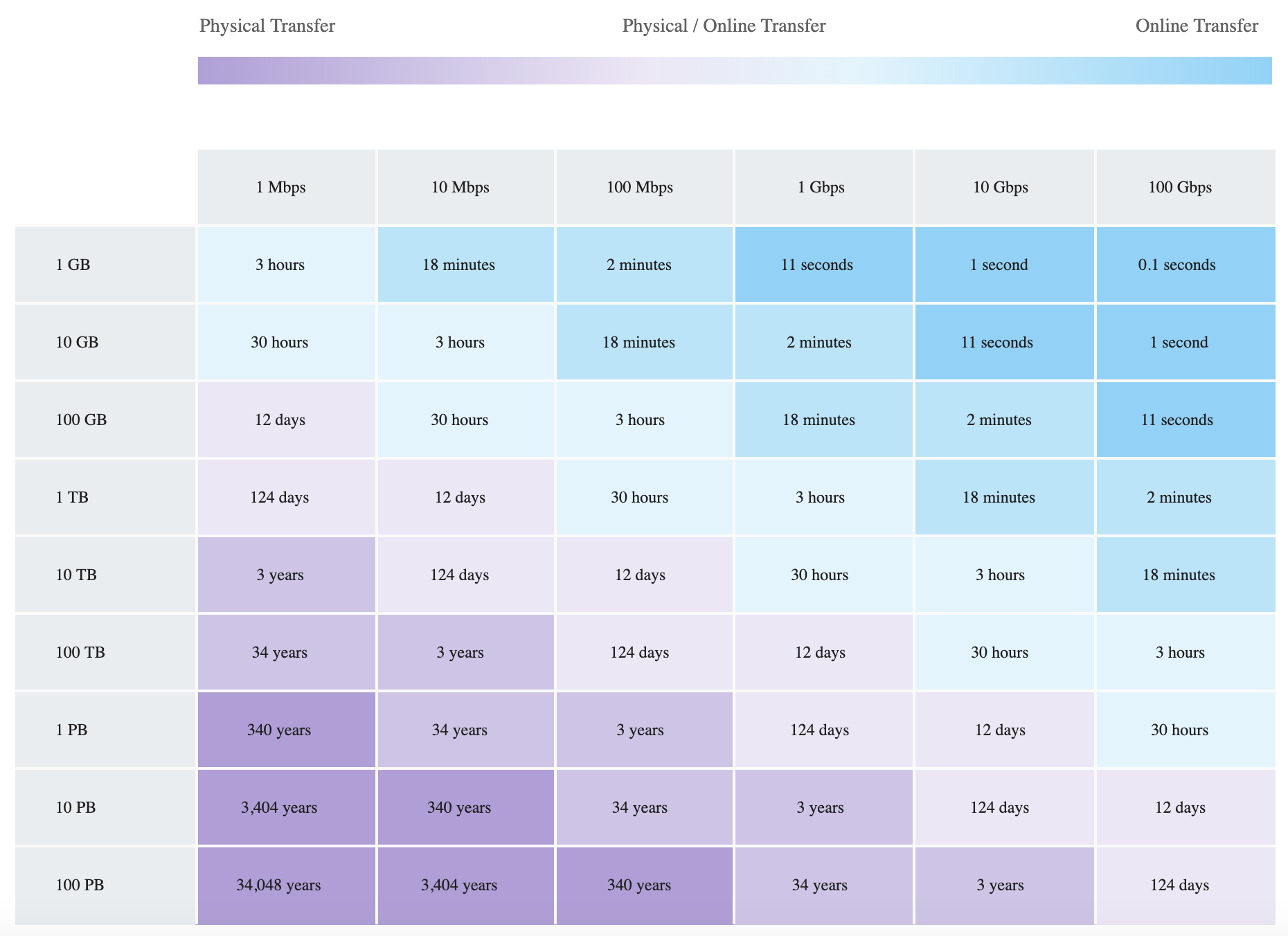
Data Transfer Chart – Bandwidth vs Time

Data Migration Speeds

AWS Certification Exam Practice Questions

  • Questions are collected from Internet and the answers are marked as per my knowledge and understanding (which might differ with yours).
  • AWS services are updated everyday and both the answers and questions might be outdated soon, so research accordingly.
  • AWS exam questions are not updated to keep up the pace with AWS updates, so even if the underlying feature has changed the question might not be updated
  • Open to further feedback, discussion and correction.
  1. An organization is moving non-business-critical applications to AWS while maintaining a mission critical application in an on-premises data center. An on-premises application must share limited confidential information with the applications in AWS. The Internet performance is unpredictable. Which configuration will ensure continued connectivity between sites MOST securely?
    1. VPN and a cached storage gateway
    2. AWS Snowball Edge
    3. VPN Gateway over AWS Direct Connect
    4. AWS Direct Connect
  2. A company wants to transfer petabyte-scale of data to AWS for their analytics, however are constrained on their internet connectivity? Which AWS service can help them transfer the data quickly?
    1. S3 enhanced uploader
    2. Snowmobile
    3. Snowball
    4. Direct Connect
  3. A company wants to transfer its video library data, which runs in exabytes, to AWS. Which AWS service can help the company transfer the data? [Note: Snowmobile was retired in March 2024. For current exabyte-scale migrations, multiple Snowball Edge devices or AWS Data Transfer Terminal would be recommended.]
    1. Snowmobile
    2. Snowball
    3. S3 upload
    4. S3 enhanced uploader
  4. You are working with a customer who has 100 TB of archival data that they want to migrate to Amazon Glacier. The customer has a 1-Gbps connection to the Internet. Which service or feature provides the fastest method of getting the data into Amazon Glacier?
    1. Amazon Glacier multipart upload
    2. AWS Storage Gateway
    3. VM Import/Export
    4. AWS Snowball
  5. A media company needs to transfer 500 TB of video content from their on-premises data center to Amazon S3. They have a 10 Gbps Direct Connect link but need the transfer completed within 1 week. Which approach is MOST appropriate?
    1. Use S3 Transfer Acceleration over the internet
    2. Use AWS DataSync over the Direct Connect link
    3. Use multiple AWS Snowball Edge devices
    4. Upload directly using the AWS CLI
  6. A company needs to regularly transfer files from a partner’s SFTP server to Amazon S3 for processing. Which AWS service provides a fully managed solution for this requirement?
    1. AWS DataSync
    2. Amazon S3 Transfer Acceleration
    3. AWS Transfer Family SFTP Connectors
    4. AWS Direct Connect
  7. A company is migrating data from Google Cloud Storage to Amazon S3. They want a managed solution that does not require deploying agents. Which AWS service and feature should they use?
    1. AWS DataSync Basic mode with an agent
    2. AWS S3 Batch Operations
    3. AWS DataSync Enhanced mode (cross-cloud transfers)
    4. AWS Transfer Family
  8. A film production company has 200 TB of raw footage on portable NAS devices after a remote shoot. They need to upload it to S3 as quickly as possible. They are near an AWS Data Transfer Terminal location. What is the FASTEST approach?
    1. Ship an AWS Snowball Edge device and transfer offline
    2. Use AWS DataSync over the internet
    3. Visit the AWS Data Transfer Terminal with their storage devices
    4. Use S3 Transfer Acceleration for parallel uploads

References

AWS Networking & Content Delivery Cheat Sheet

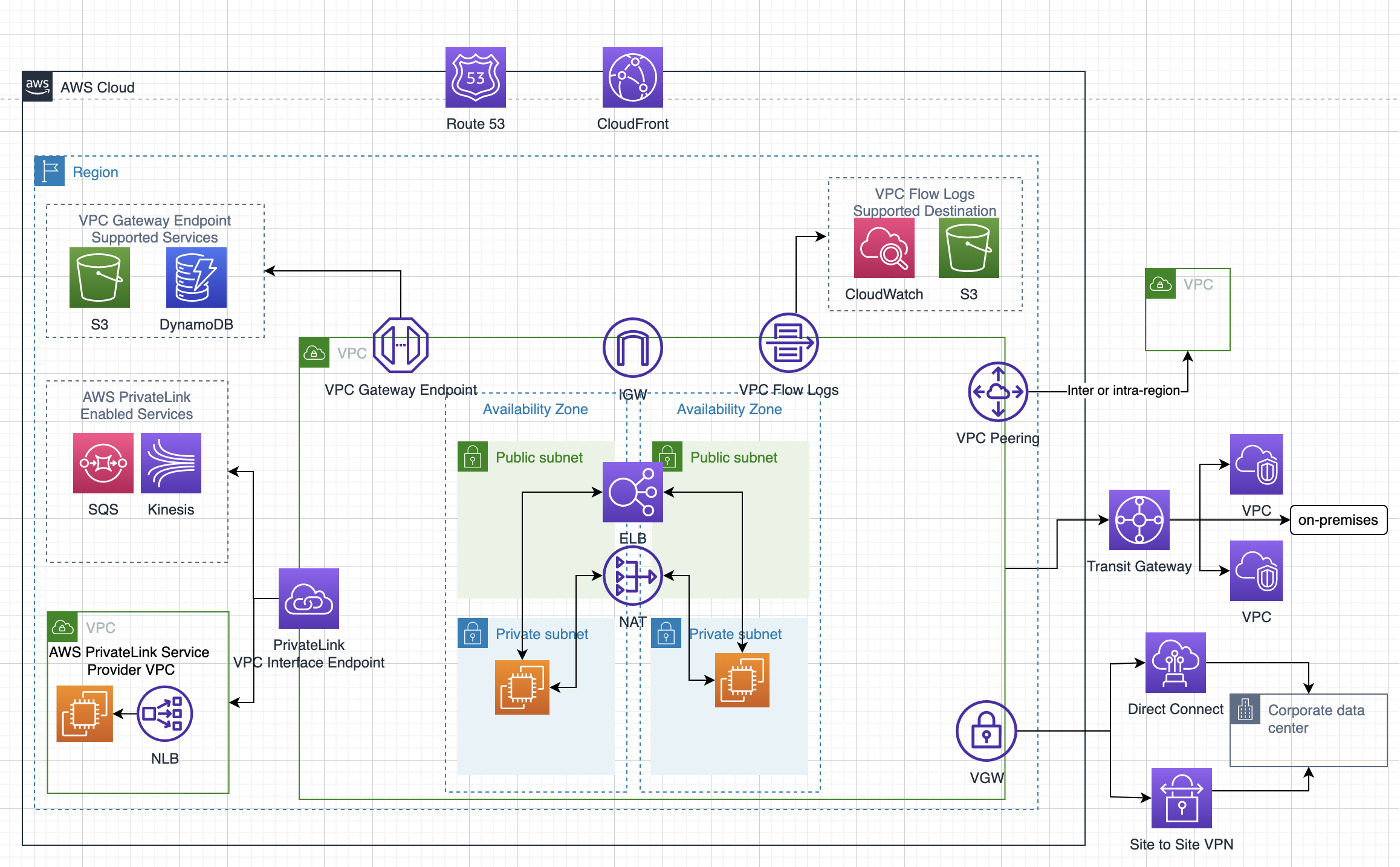
AWS Networking & Content Delivery Services

AWS Networking & Content Delivery Services Cheat Sheet

AWS Networking & Content Delivery Services

Virtual Private Cloud – VPC

  • helps define a logically isolated dedicated virtual network within the AWS
  • provides control of IP addressing using CIDR block from a minimum of /28 to a maximum of /16 block size
  • supports IPv4 and IPv6 addressing
  • cannot be extended once created
  • can be extended by associating secondary IPv4 CIDR blocks to VPC
  • Components
    • Internet gateway (IGW) provides access to the Internet
    • Virtual gateway (VGW) provides access to the on-premises data center through VPN and Direct Connect connections
    • VPC can have only one IGW and VGW
    • Route tables determine network traffic routing from the subnet
    • Ability to create a subnet with VPC CIDR block
    • A Network Address Translation (NAT) server provides outbound Internet access for EC2 instances in private subnets
    • Elastic IP addresses are static, persistent public IP addresses
    • Instances launched in the VPC will have a Private IP address and can have a Public or an Elastic IP address associated with it
    • Security Groups and NACLs help define security
    • Flow logs – Capture information about the IP traffic going to and from network interfaces in your VPC
  • Tenancy option for instances
    • shared, by default, allows instances to be launched on shared tenancy
    • dedicated allows instances to be launched on a dedicated hardware
  • Route Tables
    • defines rules, termed as routes, which determine where network traffic from the subnet would be routed
    • Each VPC has a Main Route table and can have multiple custom route tables created
    • Every route table contains a local route that enables communication within a VPC which cannot be modified or deleted
    • Route priority is decided by matching the most specific route in the route table that matches the traffic
  • Subnets
    • map to AZs and do not span across AZs
    • have a CIDR range that is a portion of the whole VPC.
    • CIDR ranges cannot overlap between subnets within the VPC.
    • AWS reserves 5 IP addresses in each subnet – first 4 and last one
    • Each subnet is associated with a route table which define its behavior
      • Public subnets – inbound/outbound Internet connectivity via IGW
      • Private subnets – outbound Internet connectivity via an NAT or VGW
      • Protected subnets – no outbound connectivity and used for regulated workloads
  • Elastic Network Interface (ENI)
    • a default ENI, eth0, is attached to an instance which cannot be detached with one or more secondary detachable ENIs (eth1-ethn)
    • has primary private, one or more secondary private, public, Elastic IP address, security groups, MAC address and source/destination check flag attributes associated
    • AN ENI in one subnet can be attached to an instance in the same or another subnet, in the same AZ and the same VPC
    • Security group membership of an ENI can be changed
    • with pre-allocated Mac Address can be used for applications with special licensing requirements
  • Security Groups vs NACLs – Network Access Control Lists
    • Stateful vs Stateless
    • At instance level vs At subnet level
    • Only allows Allow rule vs Allows both Allow and Deny rules
    • Evaluated as a Whole vs Evaluated in defined Order
  • Elastic IP
    • is a static IP address designed for dynamic cloud computing.
    • is associated with an AWS account, and not a particular instance
    • can be remapped from one instance to another instance
    • is charged for non-usage, if not linked for any instance or instance associated is in a stopped state
  • NAT
    • allows internet access to instances in the private subnets.
    • performs the function of both address translation and port address translation (PAT)
    • needs source/destination check flag to be disabled as it is not the actual destination of the traffic for NAT Instance.
    • NAT gateway is an AWS managed NAT service that provides better availability, higher bandwidth, and requires less administrative effort
    • are not supported for IPv6 traffic
    • NAT Gateway supports private NAT with fixed private IPs.
    • Regional NAT Gateway (announced Nov 2025) automatically expands across Availability Zones based on workload footprint, providing simplified setup, enhanced security, and automatic high availability without manual multi-AZ configuration.
  • Egress-Only Internet Gateways
    • outbound communication over IPv6 from instances in the VPC to the Internet, and prevents the Internet from initiating an IPv6 connection with your instances
    • supports IPv6 traffic only
  • Shared VPCs
    • allows multiple AWS accounts to create their application resources, such as EC2 instances, RDS databases, Redshift clusters, and AWS Lambda functions, into shared, centrally-managed VPCs
  • VPC Encryption Controls (announced Nov 2025)
    • allows enforcing encryption in transit for network traffic within the VPC
    • provides centralized encryption policy enforcement and monitoring capabilities
    • supports monitor and enforce modes to audit and enforce encryption compliance
    • transitioned to paid feature starting March 2026

VPC Peering

  • allows routing of traffic between the peer VPCs using private IP addresses with no IGW or VGW required.
  • No single point of failure and bandwidth bottlenecks
  • supports inter-region VPC peering
  • Limitations
    • IP space or CIDR blocks cannot overlap
    • cannot be transitive
    • supports a one-to-one relationship between two VPCs and has to be explicitly peered.
    • does not support edge-to-edge routing.
    • supports only one connection between any two VPCs
  • Private DNS values cannot be resolved
  • Security groups from peered VPC can now be referred to, however, the VPC should be in the same region.

VPC Endpoints

  • enables private connectivity from VPC to supported AWS services and VPC endpoint services powered by PrivateLink
  • does not require a public IP address, access over the Internet, NAT device, a VPN connection, or Direct Connect
  • traffic between VPC & AWS service does not leave the Amazon network
  • are virtual devices.
  • are horizontally scaled, redundant, and highly available VPC components that allow communication between instances in the VPC and services without imposing availability risks or bandwidth constraints on the network traffic.
  • Gateway Endpoints
    • is a gateway that is a target for a specified route in the route table, used for traffic destined to a supported AWS service.
    • only S3 and DynamoDB are currently supported
  • Interface Endpoints OR Private Links
    • is an elastic network interface with a private IP address that serves as an entry point for traffic destined to a supported service
    • supports services include AWS services, services hosted by other AWS customers and partners in their own VPCs (referred to as endpoint services), and supported AWS Marketplace partner services.
    • Private Links
      • provide fine-grained access control
      • provides a point-to-point integration.
      • supports overlapping CIDR blocks.
      • supports transitive routing
    • Access to VPC Resources over PrivateLink (announced Dec 2024) – allows sharing any VPC resource using AWS RAM and accessing them privately using VPC endpoints, without requiring the resource to sit behind a NLB.

CloudFront

  • provides low latency and high data transfer speeds for the distribution of static, dynamic web, or streaming content to web users.
  • delivers the content through a worldwide network of data centers called Edge Locations or Point of Presence (PoPs)
  • keeps persistent connections with the origin servers so that the files can be fetched from the origin servers as quickly as possible.
  • dramatically reduces the number of network hops that users’ requests must pass through
  • supports multiple origin server options, like AWS hosted service for e.g. S3, EC2, ELB, or an on-premise server, which stores the original, definitive version of the objects
  • single distribution can have multiple origins and Path pattern in a cache behavior determines which requests are routed to the origin
  • Web distribution supports static, dynamic web content, on-demand using progressive download & HLS, and live streaming video content
  • RTMP distributions were deprecated and removed on December 31, 2020. Use Web distributions with HTTP-based streaming protocols (HLS, DASH) instead.
  • supports HTTPS using either
    • dedicated IP address, which is expensive as a dedicated IP address is assigned to each CloudFront edge location
    • Server Name Indication (SNI), which is free but supported by modern browsers only with the domain name available in the request header
  • For E2E HTTPS connection,
    • Viewers -> CloudFront needs either a certificate issued by CA or ACM
    • CloudFront -> Origin needs a certificate issued by ACM for ELB and by CA for other origins
  • Security
    • Origin Access Control (OAC) is the recommended method to restrict content from S3 origin to be accessible from CloudFront only. OAC supports SSE-KMS, all HTTP methods, and all AWS Regions.
      • Origin Access Identity (OAI) is the legacy method. OAI creation was deprecated in 2024 and new distributions (as of March 2026) can only use OAC. Existing OAI configurations continue to work but migration to OAC is recommended.
    • supports Geo restriction (Geo-Blocking) to whitelist or blacklist countries that can access the content
    • Signed URLs
      • to restrict access to individual files, for e.g., an installation download for your application.
      • users using a client, for e.g. a custom HTTP client, that doesn’t support cookies
    • Signed Cookies
      • provide access to multiple restricted files, for e.g., video part files in HLS format or all of the files in the subscribers’ area of a website.
      • don’t want to change the current URLs
    • integrates with AWS WAF, a web application firewall that helps protect web applications from attacks by allowing rules configured based on IP addresses, HTTP headers, and custom URI strings
  • supports GET, HEAD, OPTIONS, PUT, POST, PATCH, DELETE to get object & object headers, add, update, and delete objects
    • only caches responses to GET and HEAD requests and, optionally, OPTIONS requests
    • does not cache responses to PUT, POST, PATCH, DELETE request methods and these requests are proxied back to the origin
  • object removal from the cache
    • would be removed upon expiry (TTL) from the cache, by default 24 hrs
    • can be invalidated explicitly, but has a cost associated, however, might continue to see the old version until it expires from those caches
    • objects can be invalidated only for Web distribution
    • use versioning or change object name, to serve a different version
    • Tag-based cache invalidation (announced May 2026) – allows tagging cached objects via origin response headers or S3 metadata and invalidating them by tag directly through the CloudFront API.
  • supports adding or modifying custom headers before the request is sent to origin which can be used to
    • validate if a user is accessing the content from CDN
    • identifying CDN from which the request was forwarded, in case of multiple CloudFront distributions
    • for viewers not supporting CORS to return the Access-Control-Allow-Origin header for every request
  • supports Partial GET requests using range header to download objects in smaller units improving the efficiency of partial downloads and recovery from partially failed transfers
  • supports compression to compress and serve compressed files when viewer requests include Accept-Encoding: gzip in the request header
  • supports different price classes to include all regions, or only the least expensive regions and other regions without the most expensive regions
  • supports access logs which contain detailed information about every user request for both web distribution
  • Edge Compute
    • CloudFront Functions – lightweight JavaScript functions for simple request/response transformations (URL rewrites, header manipulation, redirects) executed at viewer request/response events with sub-millisecond latency
    • Lambda@Edge – more powerful compute for complex processing at origin request/response and viewer request/response events
    • CloudFront KeyValueStore (launched 2023) – a globally distributed, low-latency data store that CloudFront Functions can read at runtime for dynamic routing, A/B testing, feature flags, and geo-routing without redeploying function code
  • CloudFront Flat-Rate Pricing Plans – combine CDN, AWS WAF, DDoS protection, bot management, Route 53 DNS, CloudWatch Logs ingestion, serverless edge compute, and S3 storage credits into a single monthly price

AWS VPN

  • AWS Site-to-Site VPN provides secure IPSec connections from on-premise computers or services to AWS over the Internet
  • is cheap, and quick to set up however it depends on the Internet speed
  • delivers high availability by using two tunnels across multiple Availability Zones within the AWS global network
  • VPN requires a Virtual Gateway – VGW and Customer Gateway – CGW for communication
  • VPN connection is terminated on VGW on AWS
  • Only one VGW can be attached to a VPC at a time
  • VGW supports both static and dynamic routing using Border Gateway Protocol (BGP)
  • VGW supports AWS-256 and SHA-2 for data encryption and integrity
  • AWS Client VPN is a managed client-based VPN service that enables secure access to AWS resources and resources in the on-premises network.
  • AWS VPN does not allow accessing the Internet through IGW or NAT Gateway, peered VPC resources, or VPC Gateway Endpoints from on-premises.
  • AWS VPN allows access accessing the Internet through NAT Instance and VPC Interface Endpoints from on-premises.

Direct Connect

  • is a network service that uses a private dedicated network connection to connect to AWS services.
  • helps reduce costs (long term), increases bandwidth, and provides a more consistent network experience than internet-based connections.
  • supports Dedicated and Hosted connections
    • Dedicated connection is made through a 1 Gbps, 10 Gbps, or 100 Gbps Ethernet port dedicated to a single customer.
    • Hosted connections are sourced from an AWS Direct Connect Partner that has a network link between themselves and AWS.
  • provides Virtual Interfaces
    • Private VIF to access instances within a VPC via VGW
    • Public VIF to access non VPC services
    • Transit VIF to access one or more Amazon VPC Transit Gateways associated with Direct Connect gateways, enabling connectivity to multiple VPCs through a single VIF
  • requires time to setup probably months, and should not be considered as an option if the turnaround time is less
  • does not provide redundancy, use either second direct connection or IPSec VPN connection
  • Virtual Private Gateway is on the AWS side and Customer Gateway is on the Customer side
  • route propagation is enabled on VGW and not on CGW
  • A link aggregation group (LAG) is a logical interface that uses the link aggregation control protocol (LACP) to aggregate multiple dedicated connections at a single AWS Direct Connect endpoint and treat them as a single, managed connection
  • VIF Rate Limiters (announced June 2026) on dedicated connections help prevent network congestion caused by unexpected traffic spikes on a VIF that could consume all available bandwidth impacting other VIFs on the same connection.
  • Direct Connect vs VPN IPSec
    • Expensive to Setup and Takes time vs Cheap & Immediate
    • Dedicated private connections vs Internet
    • Reduced data transfer rate vs Internet data transfer cost
    • Consistent performance vs Internet inherent variability
    • Do not provide Redundancy vs Provides Redundancy

Route 53

  • provides highly available and scalable DNS, Domain Registration Service, and health-checking web services
  • Reliable and cost-effective way to route end users to Internet applications
  • Supports multi-region and backup architectures for High availability. ELB is limited to region and does not support multi-region HA architecture.
  • supports private Intranet facing DNS service
  • internal resource record sets only work for requests originating from within the VPC and currently cannot extend to on-premise
  • Global propagation of any changes made to the DN records within ~ 1min
  • supports Alias resource record set is a Route 53 extension to DNS.
    • It’s similar to a CNAME resource record set, but supports both for root domain – zone apex e.g. example.com, and for subdomains for e.g. www.example.com.
    • supports ELB load balancers, CloudFront distributions, Elastic Beanstalk environments, API Gateways, VPC interface endpoints, and S3 buckets that are configured as websites.
  • CNAME resource record sets can be created only for subdomains and cannot be mapped to the zone apex record
  • supports Private DNS to provide an authoritative DNS within the VPCs without exposing the DNS records (including the name of the resource and its IP address(es) to the Internet.
  • Split-view (Split-horizon) DNS enables mapping the same domain publicly and privately. Requests are routed as per the origin.
  • Routing policy
    • Simple routing – simple round-robin policy
    • Weighted routing – assign weights to resource records sets to specify the proportion for e.g. 80%:20%
    • Latency based routing – helps improve global applications as requests are sent to the server from the location with minimal latency, is based on the latency and cannot guarantee users from the same geography will be served from the same location for any compliance reasons
    • Geolocation routing – Specify geographic locations by continent, country, the state limited to the US, is based on IP accuracy
    • Geoproximity routing policy – Use to route traffic based on the location of the resources and, optionally, shift traffic from resources in one location to resources in another.
    • Multivalue answer routing policy – Use to respond to DNS queries with up to eight healthy records selected at random.
    • Failover routing – failover to a backup site if the primary site fails and becomes unreachable
    • IP-based routing – route traffic based on the IP address of the client making the DNS query
  • Weighted, Latency and Geolocation can be used for Active-Active while Failover routing can be used for Active-Passive multi-region architecture
  • Traffic Flow is an easy-to-use and cost-effective global traffic management service. Traffic Flow supports versioning and helps create policies that route traffic based on the constraints they care most about, including latency, endpoint health, load, geoproximity, and geography.
  • Route 53 Resolver is a regional DNS service that helps with hybrid DNS
    • Inbound Endpoints are used to resolve DNS queries from an on-premises network to AWS
    • Outbound Endpoints are used to resolve DNS queries from AWS to an on-premises network
    • Resolver endpoints now support DNS delegation for private hosted zones (June 2025)
  • Route 53 Profiles – enables sharing DNS configurations (private hosted zone associations, Resolver rules, and Resolver DNS Firewall rule group associations) across VPCs and accounts using AWS RAM
  • Accelerated Recovery (announced Nov 2025) – provides a 60-minute recovery time objective (RTO) for regaining the ability to make DNS changes to public hosted zones during regional disruptions in US East (N. Virginia)
  • PrivateLink Support (announced Nov 2025) – allows making changes to DNS infrastructure (hosted zones, records, health checks) without using the public internet

AWS Global Accelerator

  • is a networking service that helps you improve the availability and performance of the applications to global users.
  • utilizes the Amazon global backbone network, improving the performance of the applications by lowering first-byte latency, and jitter, and increasing throughput as compared to the public internet.
  • provides two static IP addresses serviced by independent network zones that provide a fixed entry point to the applications and eliminate the complexity of managing specific IP addresses for different AWS Regions and AZs.
  • always routes user traffic to the optimal endpoint based on performance, reacting instantly to changes in application health, the user’s location, and configured policies
  • improves performance for a wide range of applications over TCP or UDP by proxying packets at the edge to applications running in one or more AWS Regions.
  • is a good fit for non-HTTP use cases, such as gaming (UDP), IoT (MQTT), or Voice over IP, as well as for HTTP use cases that specifically require static IP addresses or deterministic, fast regional failover.
  • integrates with AWS Shield for DDoS protection
  • uses a global network of 130+ Points of Presence in 95+ cities across 53+ countries
  • supports dual-stack Network Load Balancers as endpoints
  • supports endpoints in 33 AWS Regions (as of 2025)
  • integrates with AWS Load Balancer Controller for Kubernetes (announced 2025)

Transit Gateway – TGW

  • is a highly available and scalable service to consolidate the AWS VPC routing configuration for a region with a hub-and-spoke architecture.
  • acts as a Regional virtual router and is a network transit hub that can be used to interconnect VPCs and on-premises networks.
  • traffic always stays on the global AWS backbone, data is automatically encrypted, and never traverses the public internet, thereby reducing threat vectors, such as common exploits and DDoS attacks.
  • is a Regional resource and can connect VPCs within the same AWS Region.
  • TGWs across the same or different regions can peer with each other.
  • provides simpler VPC-to-VPC communication management over VPC Peering with a large number of VPCs.
  • scales elastically based on the volume of network traffic.
  • supports security group referencing (announced Sept 2024) – allows creating inbound security rules that reference security groups defined in other VPCs attached to the same Transit Gateway within the same Region.
  • supports per-AZ metrics delivered to CloudWatch and Path MTU Discovery (PMTUD) for both IPv4 and IPv6 (announced Nov 2024).
  • supports Transit Gateway Flow Logs for monitoring and logging network traffic between transit gateways.
  • supports Flexible Cost Allocation (announced Nov 2025) – provides versatile cost allocation options through a central metering policy beyond the default sender-pay model.

Amazon VPC Lattice

  • is a fully managed application networking service that connects, monitors, and secures communications between services and resources across VPCs and accounts.
  • simplifies service-to-service connectivity without requiring VPC peering, Transit Gateway, or PrivateLink NLBs.
  • automatically manages network connectivity and application-layer routing between services across different VPCs and AWS accounts.
  • supports connectivity to TCP resources, such as databases, domain names, and IP addresses across VPCs and accounts.
  • integrates with AWS IAM for service-to-service authentication and authorization using Auth policies.
  • removes the NLB requirement that PrivateLink imposes on providers and supports cross-VPC/cross-account connectivity without CIDR coordination.
  • terminates TLS at the data plane so callers do not need to manage certificates.
  • provides built-in observability with access logs, connection logs, and traffic metrics.
  • Key concepts:
    • Service Network – a logical boundary for a collection of services that can communicate with each other
    • Service – represents an application unit that is independently deployable
    • Target Groups – collection of resources (instances, IPs, Lambda, ALB) for routing
    • Resource Configurations – define TCP resources (databases, IPs, domain names) accessible through VPC Lattice
  • Use cases:
    • Microservices connectivity across multiple VPCs/accounts
    • Secure service-to-service communication with zero trust
    • Alternative to VPC Peering and Transit Gateway for application-layer connectivity
    • Replacement for AWS App Mesh (which reached EOL on September 30, 2026)

Amazon VPC IP Address Manager (IPAM)

  • is a VPC feature that allows you to plan, track, and monitor IP addresses for AWS workloads.
  • organizes IP addresses by routing and security requirements while automating allocation to VPCs, replacing manual spreadsheet-based tracking.
  • tracks AWS accounts and VPCs, eliminating IP bookkeeping overhead.
  • supports management at both VPC and subnet CIDR levels.
  • integrates with AWS Organizations for cross-account IP address management.
  • supports provisioning Amazon-provided contiguous IPv4 blocks into publicly scoped regional pools for use with EIPs, NLBs, and NAT Gateways.
  • Public IP Insights – free feature that simplifies monitoring, analysis, and auditing of public IPv4 addresses.
  • IPAM Policies – define public IPv4 allocation strategies and automate prefix lists.
  • integrates with ALB for predictable IP address blocks for internet-facing ALBs (March 2025).
  • IPAM Advanced Tier – includes Infoblox integration (Nov 2025) for managing AWS IP addresses through existing Infoblox workflows.

AWS Network Firewall

  • is a managed, stateful network firewall and intrusion detection and prevention service for all Amazon VPCs.
  • scales automatically with network traffic, requiring no infrastructure management.
  • provides Layer 7 firewall capabilities with deep packet inspection.
  • supports flexible rules engine for fine-grained control of VPC network traffic.
  • provides active threat defense using AWS managed rules to block evasive C2 channels, malicious URLs, and other threat vectors.
  • supports Suricata-compatible IPS rules for known bad signatures and traffic patterns.
  • includes Network Firewall Proxy for granular security controls to inspect and filter VPC outbound connections, preventing data exfiltration and malware intrusion.
  • integrates with AWS Firewall Manager for centralized policy management across accounts.
  • can be combined with VPC Lattice for comprehensive security (VPC Lattice for HTTP/S with identity-based controls, Network Firewall for other traffic types).

AWS Cloud WAN

  • is a managed WAN service that provides a central dashboard to connect and manage branch offices, data centers, VPN connections, SD-WAN, VPCs, and Transit Gateways.
  • uses network policies to create a global network spanning multiple locations and networks, removing the need for different technologies.
  • provides a single console and set of APIs to manage networks across AWS Regions.
  • supports direct Direct Connect gateway attachments without requiring an intermediate Transit Gateway (announced Nov 2024).
  • supports Routing Policy for advanced traffic control (announced Nov 2025) – enables controlled routing environments, minimizing route reachability blast radius.
  • supports Service Insertion for inspection and security appliance integration.
  • supports PMTUD for both IPv4 and IPv6 (announced Nov 2024).
  • supports AWS PrivateLink and IPv6 for management endpoint connectivity (announced March 2025).
  • available in AWS GovCloud (US) Regions.

AWS Verified Access

  • provides secure access to corporate applications and resources without requiring a VPN.
  • implements zero trust principles by evaluating each access request based on user identity and device security posture rather than network location.
  • uses the Cedar policy language for defining fine-grained access policies.
  • supports secure access to resources over non-HTTP(S) protocols (announced Feb 2025) – enables VPN-less access to TCP-based resources like SSH, RDP, and databases.
  • continuously monitors active connections and terminates connections when security requirements aren’t met.
  • integrates with third-party identity providers and device management solutions.
  • can be used with PrivateLink-backed services to provide authorized internet-based access while maintaining security boundaries.

AWS VPC – Subnets, Route Tables, Gateways, Security Groups

AWS VPC Components

AWS VPC – Virtual Private Cloud

  • AWS VPC – Virtual Private Cloud is a virtual network dedicated to the AWS account. It is logically isolated from other virtual networks in the AWS cloud.
  • VPC allows the users complete control over their virtual networking environment, including the selection of their own IP address range, creation of subnets, and configuration of route tables and network gateways.
  • VPC allows you to use both IPv4 and IPv6 in your VPC for secure and easy access to resources and applications.
  • VPC is a regional service and it spans all of the AZs in the Region. Availability zones (AZ) are multiple, isolated locations within each Region.

  • VPC Sizing
    • VPC needs a set of IP addresses in the form of a Classless Inter-Domain Routing (CIDR) block for e.g, 10.0.0.0/16, which allows 2^16 (65536) IP address to be available 
    • Allowed CIDR block size is between
      • /28 netmask (minimum with 2^4 – 16 available IP address) and
      • /16 netmask (maximum with 2^16 – 65536 IP address)
    • CIDR block from private (non-publicly routable) IP address can be assigned
      • 10.0.0.0 – 10.255.255.255 (10/8 prefix)
      • 172.16.0.0 – 172.31.255.255 (172.16/12 prefix)
      • 192.168.0.0 – 192.168.255.255 (192.168/16 prefix)
    • It’s possible to specify a range of publicly routable IP addresses; however, direct access to the Internet is not currently supported from publicly routable CIDR blocks in a VPC
    • CIDR block once assigned to the VPC cannot be modified.  NOTE – You can now resize VPC. Read AWS blog post.
    • Each VPC is separate from any other VPC created with the same CIDR block even if it resides within the same AWS account
  • Connection between your VPC and corporate or home network can be established, however, the CIDR blocks should be not be overlapping for e.g. VPC with CIDR 10.0.0.0/16 can communicate with 10.1.0.0/16 corporate network but the connections would be dropped if it tries to connect to 10.0.37.0/16 corporate network cause of overlapping IP addresses.
  • VPC allows you to set tenancy options for the Instances launched in it. By default, the tenancy option is shared. If the dedicated option is selected, all the instances within it are launched on dedicated hardware overriding the individual instance tenancy setting.
  • Deletion of the VPC is possible only after terminating all instances within the VPC and deleting all the components with the VPC e.g. subnets, security groups, network ACLs, route tables, Internet gateways, VPC peering connections, and DHCP options
  • VPC Peering provides a networking connection between two VPCs (same or different account and region) that enables routing of traffic between them using private IPv4 addresses or IPv6 addresses.
  • NAT Gateway enables instances in a private subnet to connect to the Internet but prevents the Internet from initiating connections with the instances.
  • VPC endpoints enable the creation of a private connection between VPC to supported AWS services and VPC endpoint services powered by PrivateLink using its private IP address.
AWS VPC Components

Subnets

  • Subnet spans a single Availability Zone, distinct locations engineered to be isolated from failures in other AZs, and cannot span across AZs
  • Subnet can be configured with an Internet gateway to enable communication over the Internet, or virtual private gateway (VPN) connection to enable communication with your corporate network
  • Subnet can be Public or Private and it depends on whether it has Internet connectivity i.e. is able to route traffic to the Internet through the IGW
  • Instances within the Public Subnet should be assigned a Public IP or Elastic IP address to be able to communicate with the Internet
  • For Subnets not connected to the Internet, but has traffic routed through Virtual Private Gateway only is termed as VPN-only subnet
  • Subnets can be configured to Enable assignment of the Public IP address to all the Instances launched within the Subnet by default, which can be overridden during the creation of the Instance
  • Subnet Sizing
    • CIDR block assigned to the Subnet can be the same as the VPC CIDR, in this case you can launch only one subnet within your VPC
    • CIDR block assigned to the Subnet can be a subset of the VPC CIDR, which allows you to launch multiple subnets within the VPC
    • CIDR block assigned to the subnet should not be overlapping
    • CIDR block size allowed is between
      • /28 netmask (minimum with 2^4 – 16 available IP address) and
      • /16 netmask (maximum with 2^16 – 65536 IP address)
    • AWS reserves 5 IPs address (first 4 and last 1 IP address) in each Subnet which are not available for use and cannot be assigned to an instance. for e.g. for a Subnet with a CIDR block 10.0.0.0/24 the following five IPs are reserved
      • 10.0.0.0: Network address
      • 10.0.0.1: Reserved by AWS for the VPC router
      • 10.0.0.2: Reserved by AWS for mapping to Amazon-provided DNS
      • 10.0.0.3: Reserved by AWS for future use
      • 10.0.0.255: Network broadcast address. AWS does not support broadcast in a VPC, therefore the address is reserved.
  • Subnet Routing
    • Each Subnet is associated with a route table that controls the traffic.
  • Subnet Security
    • Subnet security can be configured using Security groups and NACLs
    • Security groups work at the instance level, and NACLs work at the subnet level

VPC & Subnet Sizing

  • VPC supports IPv4 and IPv6 addressing and has different CIDR block size limits for each
  • IPv6 CIDR block can be optionally associated with the VPC
  • VPC IPv4 CIDR block cannot be modified once created i.e. cannot increase or decrease the size of an existing CIDR block.
  • However, secondary CIDR blocks can be associated with the VPC to extend the VPC
  • Limitations
    • allowed block size is between a /28 netmask and /16 netmask.
    • CIDR block must not overlap with any existing CIDR block that’s associated with the VPC.
    • CIDR block must not be the same or larger than the CIDR range of a route in any of the VPC route tables for e.g. for a CIDR block 10.0.0.0/24, can only associate smaller CIDR blocks like 10.0.0.0/25

Secondary VPC Limitations

IP Addresses

Instances launched in the VPC can have Private, Public, and Elastic IP addresses assigned to them and are properties of ENI (Network Interfaces)

  • Private IP Addresses
    • Private IP addresses are not reachable over the Internet, and can be used for communication only between the instances within the VPC
    • All instances are assigned a private IP address, within the IP address range of the subnet, to the default network interface
    • Primary IP address is associated with the network interface for its lifetime, even when the instance is stopped and restarted and is released only when the instance is terminated
    • Additional Private IP addresses, known as secondary private IP address, can be assigned to the instances and these can be reassigned from one network interface to another
  • Public IP address
    • Public IP addresses are reachable over the Internet, and can be used for communication between instances and the Internet, or with other AWS services that have public endpoints
    • Public IP address assignment to the Instance depends if the Public IP Addressing is enabled for the Subnet.
    • Public IP address can also be assigned to the Instance by enabling the Public IP addressing during the creation of the instance, which overrides the subnet’s public IP addressing attribute
    • Public IP address is assigned from AWS pool of IP addresses and it is not associated with the AWS account and hence is released when the instance is stopped and restarted or terminated.
  • Elastic IP address
    • Elastic IP addresses are static, persistent public IP addresses that can be associated and disassociated with the instance, as required
    • Elastic IP address is allocated to the VPC and owned by the account unless released.
    • A Network Interface can be assigned either a Public IP or an Elastic IP. If you assign an instance, that already has a Public IP, an Elastic IP, the public IP is released
    • Elastic IP addresses can be moved from one instance to another, which can be within the same or different VPC within the same account
    • Elastic IPs are charged for non-usage i.e. if it is not associated or associated with a stopped instance or an unattached Network Interface

Elastic Network Interface (ENI)

  • Each Instance is attached to a default elastic network interface (Primary Network Interface eth0) and cannot be detached from the instance
  • ENI can include the following attributes
    • Primary private IP address
    • One or more secondary private IP addresses
    • One Elastic IP address per private IP address
    • One public IP address, which can be auto-assigned to the network interface for eth0 when you launch an instance, but only when you create a network interface for eth0 instead of using an existing ENI
    • One or more security groups
    • A MAC address
    • A source/destination check flag
    • A description
  • ENI’s attributes follow the ENI as it is attached or detached from an instance and reattached to another instance. When an ENI is moved from one instance to another, network traffic is redirected to the new instance.
  • Multiple ENIs can be attached to an instance and is useful for use cases:
    • Create a management network.
    • Use network and security appliances in your VPC.
    • Create dual-homed instances with workloads/roles on distinct subnets.
    • Create a low-budget, high-availability solution.

Route Tables

  • Route table defines rules, termed as routes, which determine where network traffic from the subnet would be routed
  • Each VPC has an implicit router to route network traffic
  • Each VPC has a Main Route table and can have multiple custom route tables created
  • Each Subnet within a VPC must be associated with a single route table at a time, while a route table can have multiple subnets associated with it
  • Subnet, if not explicitly associated to a route table, is implicitly associated with the main route table
  • Every route table contains a local route that enables communication within a VPC which cannot be modified or deleted
  • Route priority is decided by matching the most specific route in the route table that matches the traffic
  • Route tables need to be updated to define routes for Internet gateways, Virtual Private gateways, VPC Peering, VPC Endpoints, NAT Devices, etc.

VPC Route Server

  • Amazon VPC Route Server enables dynamic routing within a VPC using Border Gateway Protocol (BGP), simplifying routing between virtual appliances and cloud workloads.
  • VPC Route Server was announced GA in April 2025 and expanded to additional regions in January 2026.
  • Key Capabilities
    • Deploy Route Server endpoints in VPC and peer with virtual appliances using BGP
    • Dynamically updates VPC and internet gateway route tables with preferred IPv4 or IPv6 routes
    • Achieves routing fault tolerance for workloads running in subnets
    • Automatically reroutes traffic within a VPC for active/standby failover without static routes or manual intervention
    • Standard BGP attributes used for route filtering and selection
  • Use Cases
    • Network appliance high availability (automatic failover via BGP)
    • Centralized inspection with Transit Gateway for active/standby architectures
    • Third-party firewall and SD-WAN appliance integration
    • Replacing custom Lambda-based route failover scripts
  • VPC Route Server eliminates the need for complex scripting or third-party solutions to handle dynamic routing and failover scenarios within a VPC.

Internet Gateways – IGW

  • An Internet gateway is a horizontally scaled, redundant, and highly available VPC component that allows communication between instances in the VPC and the Internet.
  • IGW imposes no availability risks or bandwidth constraints on the network traffic.
  • An Internet gateway serves two purposes:
    • To provide a target in the VPC route tables for Internet-routable traffic,
    • To perform network address translation (NAT) for instances that have been NOT been assigned public IP addresses.
  • Enabling Internet access to an Instance requires
    • Attaching Internet gateway to the VPC
    • Subnet should have route tables associated with the route pointing to the Internet gateway
    • Instances should have a Public IP or Elastic IP address assigned
    • Security groups and NACLs associated with the Instance should allow relevant traffic

NAT

  • NAT device enables instances in a private subnet to connect to the Internet or other AWS services, but prevents the Internet from initiating connections with the instances.
  • NAT devices do not support IPv6 traffic, use an egress-only Internet gateway instead. 

Refer to My Blog Post about VPC NAT

Egress-only Internet gateway

  • Egress-only Internet gateway works as a NAT gateway, but for IPv6 traffic
  • Egress-only Internet gateway is a horizontally scaled, redundant, and highly available VPC component that allows outbound communication over IPv6 from instances in the VPC to the Internet, and prevents the Internet from initiating an IPv6 connection with the instances.
  • An egress-only Internet gateway is for use with IPv6 traffic only. To enable outbound-only Internet communication over IPv4, use a NAT gateway instead.

Shared VPCs

  • VPC sharing allows multiple AWS accounts to create their application resources, such as EC2 instances, RDS databases, Redshift clusters, and AWS Lambda functions, into shared, centrally-managed VPCs.
  • In this model, the account that owns the VPC (owner) shares one or more subnets with other accounts (participants) that belong to the same organization from AWS Organizations.
  • After a subnet is shared, the participants can view, create, modify, and delete their application resources in the subnets shared with them. Participants cannot view, modify, or delete resources that belong to other participants or the VPC owner.

VPC Endpoints

  • VPC endpoint enables the creation of a private connection between VPC to supported AWS services and VPC endpoint services powered by PrivateLink using its private IP address
  • Endpoints do not require a public IP address, access over the Internet, NAT device, a VPN connection, or AWS Direct Connect.
  • Traffic between VPC and AWS service does not leave the Amazon network
  • Endpoints are virtual devices, that are horizontally scaled, redundant, and highly available VPC components that allow communication between instances in the VPC and AWS services without imposing availability risks or bandwidth constraints on your network traffic.
  • Endpoints currently do not support cross-region requests, ensure that the endpoint is created in the same region as the S3 bucket
  • AWS currently supports the following types of Endpoints

Refer to My Blog Post about VPC Endpoint

VPC Peering

  • A VPC peering connection is a networking connection between two VPCs that enables the routing of traffic between them using private IPv4 addresses or IPv6 addresses.
  • VPC peering connection is a one-to-one relationship between two VPCs and can be established between your own VPCs, or with a VPC in another AWS account in the same or different region.
  • VPC peering helps instances in either VPC can communicate with each other as if they are within the same network using AWS’s existing infrastructure of a VPC to create a peering connection; it is neither a gateway nor a VPN connection and does not rely on a separate piece of physical hardware.
  • VPC peering does not have any separate charges. However, there are data transfer charges.

Refer to My Blog Post about VPC Peering

VPC VPN Connections

Refer to My Blog Post about AWS VPC VPN Connections

VPC Security

  • In a VPC, both Security Groups and Network ACLs (NACLS) together help to build a layered network defense.
  • Security groups – Act as a virtual firewall for associated instances, controlling both inbound and outbound traffic at the instance level
  • Network access control lists (NACLs) – Act as a firewall for associated subnets, controlling both inbound and outbound traffic at the subnet level

Security Groups & NACLs

Security Groups vs NACLs

Refer to My Blog Post about AWS Security Group vs NACLs

VPC Flow logs

  • VPC Flow Logs help capture information about the IP traffic going to and from network interfaces in the VPC and can help in monitoring the traffic or troubleshooting any connectivity issues.
  • Flow log data can be published to CloudWatch Logs, S3, and Kinesis Data Firehose.
  • Flow log can be created for the entire VPC, subnets, or each network interface. If enabled, for the entire VPC or subnet all the network interfaces within that resource are monitored.
  • Flow log can be configured to capture the type of traffic (accepted traffic, rejected traffic, or all traffic).
  • Flow logs do not capture real-time log streams for network interfaces.
  • Flow log data is collected outside of the path of the network traffic, and therefore does not affect network throughput or latency.
  • Flow logs can be created for network interfaces that are created by other AWS services; for e.g., ELB, RDS, ElastiCache, Redshift, and WorkSpaces.
  • Flow logs do not capture the following traffic
    • Traffic generated by instances when they contact the Amazon DNS server.
    • Traffic generated by a Windows instance for Amazon Windows license activation.
    • Traffic to and from 169.254.169.254 for instance metadata
    • Traffic to and from 169.254.169.123 for the Amazon Time Sync Service.
    • DHCP traffic.
    • Mirrored traffic.
    • Traffic to the reserved IP address for the default VPC router.
    • Traffic between an endpoint network interface and a Network Load Balancer network interface.
  • Troubleshooting traffic flow
    • If ACCEPT followed by REJECT, inbound was accepted by Security Groups and ACLs. However, rejected by NACLs outbound
    • If REJECT, inbound was either rejected by Security Groups OR NACLs.

VPC Block Public Access (BPA)

  • Amazon VPC Block Public Access (BPA) is a simple, declarative control that authoritatively blocks incoming (ingress) and outgoing (egress) VPC traffic through AWS-provided internet paths (launched November 2024).
  • VPC BPA supersedes any existing VPC settings (route tables, security groups, NACLs) to drop all traffic that would otherwise be exposed to the internet through Internet Gateways (IGW) or Egress-Only Internet Gateways (EIGW).
  • Key Features
    • Single declarative control to block internet access to/from VPCs and subnets
    • Can be set to bidirectional block (blocks all ingress and egress) or ingress-only block
    • Prevents accidental public exposure regardless of routing and security configuration
    • Supports subnet-level exclusions for DMZ architectures
    • Centralized enforcement across an AWS Organization
  • Deployment
    • Can be deployed across AWS Organizations using AWS CloudFormation or CLI
    • Supports IPv4 and IPv6 traffic blocking
    • Available in all commercial AWS regions and AWS China Regions (May 2025)
  • BPA is useful for accounts that should have no internet access (data processing, backend services) while allowing exceptions for specific subnets that require internet connectivity.

VPC Encryption Controls

  • VPC Encryption Controls is a security and compliance feature that provides centralized control to monitor and enforce encryption in transit for all traffic flows within and across VPCs in a region (GA 2025, paid feature from March 1, 2026).
  • VPC Encryption Controls uses both application-layer encryption and built-in encryption in transit capability of AWS Nitro System hardware to ensure encryption enforcement.
  • Operational Modes
    • Monitor mode – Audit the encryption status of traffic flows and identify resources allowing cleartext traffic
    • Enforce mode – Prevents creation or use of resources that allow unencrypted traffic; all traffic must be encrypted at hardware layer (Nitro) or application layer (TLS/SSL)
  • Key Capabilities
    • Centralized encryption policy enforcement across VPCs
    • Generates audit logs for compliance and reporting
    • Identifies resources that allow plaintext traffic
    • Works with Transit Gateway for inter-VPC encryption
    • Available in AWS GovCloud (US) Regions as of March 2026
  • Pricing
    • Fixed hourly rate for every non-empty VPC (with network interfaces) that has Encryption Controls enabled in either monitor or enforce mode
  • VPC Encryption Controls helps security teams demonstrate encryption compliance without relying on individual application teams to implement TLS correctly.

AWS VPC IP Address Manager (IPAM)

  • Amazon VPC IP Address Manager (IPAM) is a fully managed service that simplifies IP address management across AWS environments.
  • IPAM provides centralized visibility and control over IP address allocations across multiple AWS Regions and accounts within an AWS Organization.
  • Key benefits of IPAM:
    • Eliminates manual IP address tracking via spreadsheets or disparate systems
    • Automated IP address allocation and tracking
    • Prevents IP address conflicts and overlaps
    • Provides holistic view of IP address utilization
    • Supports both IPv4 and IPv6 address management
  • IPAM Features
    • Hierarchical pool structure for organizing IP address space
    • Automated CIDR allocation for VPCs and subnets
    • Cross-region and cross-account IP address visibility
    • Integration with AWS Organizations for centralized management
    • Compliance monitoring and reporting
    • IP address history and audit trails
  • IPAM Advanced Tier (launched 2025)
    • Infoblox infrastructure integration for hybrid cloud IP management
    • Manage AWS IP addresses through existing Infoblox workflows
    • Available for private scopes
    • Enhanced enterprise-grade capabilities
  • IPAM Integrations
    • Application Load Balancer (ALB) integration for predictable IP address blocks (March 2025)
    • IPAM Policies support for RDS and Application Load Balancers (January 2026)
    • Amazon CloudFront BYOIP for IPv6 through VPC IPAM integration (March 2026)
    • VPC CIDR allocation automation
    • AWS Resource Access Manager (RAM) for sharing IP pools
    • CloudWatch for monitoring and alerting
  • IPAM Pool Allocation Tags (May 2026)
    • Supports tags on IPAM pool allocations for organizing, governing, and controlling access to individual IP address allocations
    • Uses same tagging workflows as other AWS resources
    • Enables fine-grained access control via IAM policies based on allocation tags
  • IPAM helps network administrators organize, assign, monitor, and audit IP addresses at scale, reducing management burden and eliminating manual errors.
  • IPAM is available across all AWS commercial regions, including Asia Pacific (Taipei) as of June 2025.

Amazon VPC Lattice

  • Amazon VPC Lattice is an application networking service that simplifies service-to-service communication across VPCs and AWS accounts.
  • VPC Lattice operates at Layer 4 (TCP) and Layer 7 (HTTP/HTTPS) to provide intelligent application-layer routing.
  • VPC Lattice eliminates the need for complex networking configurations, Transit Gateways, or sidecar-based service meshes.
  • Key Capabilities
    • Service-to-service connectivity across VPCs and accounts without IP address management
    • Built-in service discovery and routing
    • Application-layer authentication and authorization
    • Centralized observability and monitoring
    • Zero-trust security model with fine-grained access controls
  • Service Networks
    • Logical container for grouping related services
    • Provides consistent security policies across services
    • Can be shared across AWS accounts using AWS Resource Access Manager (RAM)
    • Enables cross-account connectivity at scale
    • VPC can have only one service network association
  • VPC Lattice vs Traditional Networking
    • Simpler than Transit Gateway for service-to-service communication
    • No need for VPC Peering connections between every VPC pair
    • Application-aware routing based on headers, paths, and methods
    • Automatic service discovery without DNS management
    • Built-in security without managing security groups across VPCs
  • Migration from AWS App Mesh
    • AWS App Mesh is being discontinued effective September 30, 2026
    • VPC Lattice is the recommended replacement for App Mesh workloads
    • VPC Lattice provides similar service mesh capabilities without sidecar proxies
    • Simplified architecture with centralized management
  • VPC Lattice integrates with Amazon ECS, EKS, EC2, Lambda, and other compute services.
  • Resource Configurations (Enhanced 2025-2026)
    • Defines private endpoints (IP address or DNS name) within a VPC for cross-account access
    • Supports custom domain names for resource configurations (November 2025)
    • Supports private domain-name targets for secure cross-account access to privately-hosted resources (May 2026)
    • Attached to resource gateways and shared via AWS RAM
  • Use cases include microservices architectures, multi-account applications, and hybrid cloud connectivity.

AWS Network Firewall

  • AWS Network Firewall is a fully managed network security service that protects VPCs from network threats.
  • Network Firewall provides enterprise-grade perimeter defense with deep packet inspection and intrusion prevention.
  • Key Features
    • Stateful and stateless firewall rules
    • Deep packet inspection (DPI) for Layer 7 traffic analysis
    • Intrusion detection and prevention system (IDS/IPS)
    • Domain name filtering and URL filtering
    • Protocol detection and blocking
    • Geographic IP filtering
  • Flexible Rules Engine
    • Supports thousands of custom firewall rules
    • Rules based on domain, port, protocol, IP addresses, and pattern matching
    • Suricata-compatible IPS rules for threat detection
    • AWS Managed Threat Signatures for known threats
    • Active threat defense against command-and-control channels and malicious URLs
  • Traffic Filtering Capabilities
    • Inbound and outbound web filtering for HTTP/HTTPS traffic
    • Server Name Indication (SNI) filtering for encrypted traffic
    • Application protocol detection and enforcement
    • Malware and botnet protection
    • DDoS attack mitigation
  • Deployment and Scalability
    • Deployed at VPC subnet boundaries
    • Automatically scales based on traffic load
    • High availability with 99.99% SLA
    • Multi-AZ deployment for redundancy
    • No capacity planning required
  • Logging and Monitoring
    • Detailed flow logs for all inspected traffic
    • Alert logs for detected threats
    • Integration with CloudWatch, S3, and Kinesis Data Firehose
    • Real-time visibility into network traffic patterns
    • Compliance reporting and audit trails
  • Network Firewall integrates with AWS Firewall Manager for centralized policy management across multiple accounts and VPCs.
  • Default Stateful Action Update (June 2026)
    • New default stateful action for firewall policies changed to “Application drop established (server-directed only)” replacing “Application drop established (bidirectional)”
    • Improves connection reliability for legitimate traffic
    • Applies to all newly created firewall policies
  • Common use cases include perimeter security, egress filtering, threat prevention, and compliance enforcement.

AWS Certification Exam Practice Questions

  • Questions are collected from Internet and the answers are marked as per my knowledge and understanding (which might differ with yours).
  • AWS services are updated everyday and both the answers and questions might be outdated soon, so research accordingly.
  • AWS exam questions are not updated to keep up the pace with AWS updates, so even if the underlying feature has changed the question might not be updated
  • Open to further feedback, discussion and correction.
  1. You have a business-to-business web application running in a VPC consisting of an Elastic Load Balancer (ELB), web servers, application servers and a database. Your web application should only accept traffic from predefined customer IP addresses. Which two options meet this security requirement? Choose 2 answers
    1. Configure web server VPC security groups to allow traffic from your customers’ IPs (Web server is behind the ELB and customer IPs will never reach web servers)
    2. Configure your web servers to filter traffic based on the ELB’s “X-forwarded-for” header (get the customer IPs and create a custom filter to restrict access. Refer link)
    3. Configure ELB security groups to allow traffic from your customers’ IPs and deny all outbound traffic (ELB will see the customer IPs so can restrict access, deny all is basically have no rules in outbound traffic, implicit, and its stateful so would work)
    4. Configure a VPC NACL to allow web traffic from your customers’ IPs and deny all outbound traffic (NACL is stateless, deny all will not work)
  2. A user has created a VPC with public and private subnets using the VPC Wizard. The VPC has CIDR 20.0.0.0/16. The private subnet uses CIDR 20.0.0.0/24. Which of the below mentioned entries are required in the main route table to allow the instances in VPC to communicate with each other?
    1. Destination : 20.0.0.0/24 and Target : VPC
    2. Destination : 20.0.0.0/16 and Target : ALL
    3. Destination : 20.0.0.0/0 and Target : ALL
    4. Destination : 20.0.0.0/16 and Target : Local
  3. A user has created a VPC with two subnets: one public and one private. The user is planning to run the patch update for the instances in the private subnet. How can the instances in the private subnet connect to the internet?
    1. Use the internet gateway with a private IP
    2. Allow outbound traffic in the security group for port 80 to allow internet updates
    3. The private subnet can never connect to the internet
    4. Use NAT with an elastic IP
  4. A user has launched an EC2 instance and installed a website with the Apache webserver. The webserver is running but the user is not able to access the website from the Internet. What can be the possible reason for this failure?
    1. The security group of the instance is not configured properly.
    2. The instance is not configured with the proper key-pairs.
    3. The Apache website cannot be accessed from the Internet.
    4. Instance is not configured with an elastic IP.
  5. A user has created a VPC with public and private subnets using the VPC wizard. Which of the below mentioned statements is true in this scenario?
    1. AWS VPC will automatically create a NAT instance with the micro size
    2. VPC bounds the main route table with a private subnet and a custom route table with a public subnet
    3. User has to manually create a NAT instance
    4. VPC bounds the main route table with a public subnet and a custom route table with a private subnet
  6. A user has created a VPC with public and private subnets. The VPC has CIDR 20.0.0.0/16. The private subnet uses CIDR 20.0.1.0/24 and the public subnet uses CIDR 20.0.0.0/24. The user is planning to host a web server in the public subnet (port 80) and a DB server in the private subnet (port 3306). The user is configuring a security group of the NAT instance. Which of the below mentioned entries is not required for the NAT security group?
    1. For Inbound allow Source: 20.0.1.0/24 on port 80
    2. For Outbound allow Destination: 0.0.0.0/0 on port 80
    3. For Inbound allow Source: 20.0.0.0/24 on port 80
    4. For Outbound allow Destination: 0.0.0.0/0 on port 443
  7. A user has created a VPC with CIDR 20.0.0.0/24. The user has used all the IPs of CIDR and wants to increase the size of the VPC. The user has two subnets: public (20.0.0.0/25) and private (20.0.0.128/25). How can the user change the size of the VPC?
    1. The user can delete all the instances of the subnet. Change the size of the subnets to 20.0.0.0/32 and 20.0.1.0/32, respectively. Then the user can increase the size of the VPC using CLI
    2. It is not possible to change the size of the VPC once it has been created (NOTE – You can now increase the VPC size. Read Post)
    3. User can add a subnet with a higher range so that it will automatically increase the size of the VPC
    4. User can delete the subnets first and then modify the size of the VPC
  8. A user has created a VPC with the public and private subnets using the VPC wizard. The VPC has CIDR 20.0.0.0/16. The public subnet uses CIDR 20.0.1.0/24. The user is planning to host a web server in the public subnet (port 80) and a DB server in the private subnet (port 3306). The user is configuring a security group for the public subnet (WebSecGrp) and the private subnet (DBSecGrp). Which of the below mentioned entries is required in the web server security group (WebSecGrp)?
    1. Configure Destination as DB Security group ID (DbSecGrp) for port 3306 Outbound
    2. Configure port 80 for Destination 0.0.0.0/0 Outbound
    3. Configure port 3306 for source 20.0.0.0/24 InBound
    4. Configure port 80 InBound for source 20.0.0.0/16
  9. A user has created a VPC with CIDR 20.0.0.0/16. The user has created one subnet with CIDR 20.0.0.0/16 by mistake. The user is trying to create another subnet of CIDR 20.0.0.1/24. How can the user create the second subnet?
    1. There is no need to update the subnet as VPC automatically adjusts the CIDR of the first subnet based on the second subnet’s CIDR
    2. The user can modify the first subnet CIDR from the console
    3. It is not possible to create a second subnet as one subnet with the same CIDR as the VPC has been created
    4. The user can modify the first subnet CIDR with AWS CLI
  10. A user has setup a VPC with CIDR 20.0.0.0/16. The VPC has a private subnet (20.0.1.0/24) and a public subnet (20.0.0.0/24). The user’s data centre has CIDR of 20.0.54.0/24 and 20.1.0.0/24. If the private subnet wants to communicate with the data centre, what will happen?
    1. It will allow traffic communication on both the CIDRs of the data centre
    2. It will not allow traffic with data centre on CIDR 20.1.0.0/24 but allows traffic communication on 20.0.54.0/24
    3. It will not allow traffic communication on any of the data centre CIDRs
    4. It will allow traffic with data centre on CIDR 20.1.0.0/24 but does not allow on 20.0.54.0/24 (as the CIDR block would be overlapping)
  11. A user has created a VPC with public and private subnets using the VPC wizard. The VPC has CIDR 20.0.0.0/16. The private subnet uses CIDR 20.0.0.0/24 . The NAT instance ID is i-a12345. Which of the below mentioned entries are required in the main route table attached with the private subnet to allow instances to connect with the internet?
    1. Destination: 0.0.0.0/0 and Target: i-a12345
    2. Destination: 20.0.0.0/0 and Target: 80
    3. Destination: 20.0.0.0/0 and Target: i-a12345
    4. Destination: 20.0.0.0/24 and Target: i-a12345
  12. A user has created a VPC with CIDR 20.0.0.0/16 using the wizard. The user has created a public subnet CIDR (20.0.0.0/24) and VPN only subnets CIDR (20.0.1.0/24) along with the VPN gateway (vgw-12345) to connect to the user’s data centre. The user’s data centre has CIDR 172.28.0.0/12. The user has also setup a NAT instance (i-123456) to allow traffic to the internet from the VPN subnet. Which of the below mentioned options is not a valid entry for the main route table in this scenario?
    1. Destination: 20.0.1.0/24 and Target: i-12345
    2. Destination: 0.0.0.0/0 and Target: i-12345
    3. Destination: 172.28.0.0/12 and Target: vgw-12345
    4. Destination: 20.0.0.0/16 and Target: local
  13. A user has created a VPC with CIDR 20.0.0.0/16. The user has created one subnet with CIDR 20.0.0.0/16 in this VPC. The user is trying to create another subnet with the same VPC for CIDR 20.0.0.1/24. What will happen in this scenario?
    1. The VPC will modify the first subnet CIDR automatically to allow the second subnet IP range
    2. It is not possible to create a subnet with the same CIDR as VPC
    3. The second subnet will be created
    4. It will throw a CIDR overlaps error
  14. A user has created a VPC with CIDR 20.0.0.0/16 using the wizard. The user has created both Public and VPN-Only subnets along with hardware VPN access to connect to the user’s data centre. The user has not yet launched any instance as well as modified or deleted any setup. He wants to delete this VPC from the console. Will the console allow the user to delete the VPC?
    1. Yes, the console will delete all the setups and also delete the virtual private gateway
    2. No, the console will ask the user to manually detach the virtual private gateway first and then allow deleting the VPC
    3. Yes, the console will delete all the setups and detach the virtual private gateway
    4. No, since the NAT instance is running
  15. A user has created a VPC with the public and private subnets using the VPC wizard. The VPC has CIDR 20.0.0.0/16. The public subnet uses CIDR 20.0.1.0/24. The user is planning to host a web server in the public subnet (port 80) and a DB server in the private subnet (port 3306). The user is configuring a security group for the public subnet (WebSecGrp) and the private subnet (DBSecGrp). Which of the below mentioned entries is required in the private subnet database security group (DBSecGrp)?
    1. Allow Inbound on port 3306 for Source Web Server Security Group (WebSecGrp)
    2. Allow Inbound on port 3306 from source 20.0.0.0/16
    3. Allow Outbound on port 3306 for Destination Web Server Security Group (WebSecGrp.
    4. Allow Outbound on port 80 for Destination NAT Instance IP
  16. A user has created a VPC with a subnet and a security group. The user has launched an instance in that subnet and attached a public IP. The user is still unable to connect to the instance. The internet gateway has also been created. What can be the reason for the error?
    1. The internet gateway is not configured with the route table
    2. The private IP is not present
    3. The outbound traffic on the security group is disabled
    4. The internet gateway is not configured with the security group
  17. A user has created a subnet in VPC and launched an EC2 instance within it. The user has not selected the option to assign the IP address while launching the instance. Which of the below mentioned statements is true with respect to the Instance requiring access to the Internet?
    1. The instance will always have a public DNS attached to the instance by default
    2. The user can directly attach an elastic IP to the instance
    3. The instance will never launch if the public IP is not assigned
    4. The user would need to create an internet gateway and then attach an elastic IP to the instance to connect from internet
  18. A user has created a VPC with public and private subnets using the VPC wizard. Which of the below mentioned statements is not true in this scenario?
    1. VPC will create a routing instance and attach it with a public subnet
    2. VPC will create two subnets
    3. VPC will create one internet gateway and attach it to VPC
    4. VPC will launch one NAT instance with an elastic IP
  19. A user has created a VPC with the public subnet. The user has created a security group for that VPC. Which of the below mentioned statements is true when a security group is created?
    1. It can connect to the AWS services, such as S3 and RDS by default
    2. It will have all the inbound traffic by default
    3. It will have all the outbound traffic by default
    4. It will by default allow traffic to the internet gateway
  20. A user has created a VPC with CIDR 20.0.0.0/16 using VPC Wizard. The user has created a public CIDR (20.0.0.0/24) and a VPN only subnet CIDR (20.0.1.0/24) along with the hardware VPN access to connect to the user’s data centre. Which of the below mentioned components is not present when the VPC is setup with the wizard?
    1. Main route table attached with a VPN only subnet
    2. A NAT instance configured to allow the VPN subnet instances to connect with the internet
    3. Custom route table attached with a public subnet
    4. An internet gateway for a public subnet
  21. A user has created a VPC with public and private subnets using the VPC wizard. The user has not launched any instance manually and is trying to delete the VPC. What will happen in this scenario?
    1. It will not allow to delete the VPC as it has subnets with route tables
    2. It will not allow to delete the VPC since it has a running route instance
    3. It will terminate the VPC along with all the instances launched by the wizard
    4. It will not allow to delete the VPC since it has a running NAT instance
  22. A user has created a public subnet with VPC and launched an EC2 instance within it. The user is trying to delete the subnet. What will happen in this scenario?
    1. It will delete the subnet and make the EC2 instance as a part of the default subnet
    2. It will not allow the user to delete the subnet until the instances are terminated
    3. It will delete the subnet as well as terminate the instances
    4. Subnet can never be deleted independently, but the user has to delete the VPC first
  23. A user has created a VPC with CIDR 20.0.0.0/24. The user has created a public subnet with CIDR 20.0.0.0/25 and a private subnet with CIDR 20.0.0.128/25. The user has launched one instance each in the private and public subnets. Which of the below mentioned options cannot be the correct IP address (private IP) assigned to an instance in the public or private subnet?
    1. 20.0.0.255
    2. 20.0.0.132
    3. 20.0.0.122
    4. 20.0.0.55
  24. A user has created a VPC with CIDR 20.0.0.0/16. The user has created public and VPN only subnets along with hardware VPN access to connect to the user’s datacenter. The user wants to make so that all traffic coming to the public subnet follows the organization’s proxy policy. How can the user make this happen?
    1. Setting up a NAT with the proxy protocol and configure that the public subnet receives traffic from NAT
    2. Setting up a proxy policy in the internet gateway connected with the public subnet
    3. It is not possible to setup the proxy policy for a public subnet
    4. Setting the route table and security group of the public subnet which receives traffic from a virtual private gateway
  25. A user has created a VPC with CIDR 20.0.0.0/16 using the wizard. The user has created a public subnet CIDR (20.0.0.0/24) and VPN only subnets CIDR (20.0.1.0/24) along with the VPN gateway (vgw-12345) to connect to the user’s data centre. Which of the below mentioned options is a valid entry for the main route table in this scenario?
    1. Destination: 20.0.0.0/24 and Target: vgw-12345
    2. Destination: 20.0.0.0/16 and Target: ALL
    3. Destination: 20.0.1.0/16 and Target: vgw-12345
    4. Destination: 0.0.0.0/0 and Target: vgw-12345
  26. Which two components provide connectivity with external networks? When attached to an Amazon VPC which two components provide connectivity with external networks? Choose 2 answers
    1. Elastic IPs (EIP) (Does not provide connectivity, public IP address will do as well)
    2. NAT Gateway (NAT) (Not Attached to VPC and still needs IGW)
    3. Internet Gateway (IGW)
    4. Virtual Private Gateway (VGW)
  27. You are attempting to connect to an instance in Amazon VPC without success You have already verified that the VPC has an Internet Gateway (IGW) the instance has an associated Elastic IP (EIP) and correct security group rules are in place. Which VPC component should you evaluate next?
    1. The configuration of a NAT instance
    2. The configuration of the Routing Table
    3. The configuration of the internet Gateway (IGW)
    4. The configuration of SRC/DST checking
  28. If you want to launch Amazon Elastic Compute Cloud (EC2) Instances and assign each Instance a predetermined private IP address you should:
    1. Assign a group or sequential Elastic IP address to the instances
    2. Launch the instances in a Placement Group
    3. Launch the instances in the Amazon virtual Private Cloud (VPC)
    4. Use standard EC2 instances since each instance gets a private Domain Name Service (DNS) already
    5. Launch the Instance from a private Amazon Machine image (AMI)
  29. A user has recently started using EC2. The user launched one EC2 instance in the default subnet in EC2-VPC Which of the below mentioned options is not attached or available with the EC2 instance when it is launched?
    1. Public IP address
    2. Internet gateway
    3. Elastic IP
    4. Private IP address
  30. A user has created a VPC with CIDR 20.0.0.0/24. The user has created a public subnet with CIDR 20.0.0.0/25. The user is trying to create the private subnet with CIDR 20.0.0.128/25. Which of the below mentioned statements is true in this scenario?
    1. It will not allow the user to create the private subnet due to a CIDR overlap
    2. It will allow the user to create a private subnet with CIDR as 20.0.0.128/25
    3. This statement is wrong as AWS does not allow CIDR 20.0.0.0/25
    4. It will not allow the user to create a private subnet due to a wrong CIDR range
  31. A user has created a VPC with CIDR 20.0.0.0/16 with only a private subnet and VPN connection using the VPC wizard. The user wants to connect to the instance in a private subnet over SSH. How should the user define the security rule for SSH?
    1. Allow Inbound traffic on port 22 from the user’s network
    2. The user has to create an instance in EC2 Classic with an elastic IP and configure the security group of a private subnet to allow SSH from that elastic IP
    3. The user can connect to a instance in a private subnet using the NAT instance
    4. Allow Inbound traffic on port 80 and 22 to allow the user to connect to a private subnet over the Internet
  32. A company wants to implement their website in a virtual private cloud (VPC). The web tier will use an Auto Scaling group across multiple Availability Zones (AZs). The database will use Multi-AZ RDS MySQL and should not be publicly accessible. What is the minimum number of subnets that need to be configured in the VPC?
    1. 1
    2. 2
    3. 3
    4. 4 (2 public subnets for web instances in multiple AZs and 2 private subnets for RDS Multi-AZ)
  33. Which of the following are characteristics of Amazon VPC subnets? Choose 2 answers
    1. Each subnet maps to a single Availability Zone
    2. A CIDR block mask of /25 is the smallest range supported
    3. Instances in a private subnet can communicate with the Internet only if they have an Elastic IP.
    4. By default, all subnets can route between each other, whether they are private or public
    5. Each subnet spans at least 2 Availability zones to provide a high-availability environment
  34. You need to design a VPC for a web-application consisting of an Elastic Load Balancer (ELB). a fleet of web/application servers, and an RDS database The entire Infrastructure must be distributed over 2 availability zones. Which VPC configuration works while assuring the database is not available from the Internet?
    1. One public subnet for ELB one public subnet for the web-servers, and one private subnet for the database
    2. One public subnet for ELB two private subnets for the web-servers, two private subnets for RDS
    3. Two public subnets for ELB two private subnets for the web-servers and two private subnets for RDS
    4. Two public subnets for ELB two public subnets for the web-servers, and two public subnets for RDS
  35. You have deployed a three-tier web application in a VPC with a CIDR block of 10.0.0.0/28. You initially deploy two web servers, two application servers, two database servers and one NAT instance tor a total of seven EC2 instances. The web, application and database servers are deployed across two availability zones (AZs). You also deploy an ELB in front of the two web servers, and use Route53 for DNS Web traffic gradually increases in the first few days following the deployment, so you attempt to double the number of instances in each tier of the application to handle the new load unfortunately some of these new instances fail to launch. Which of the following could the root caused? (Choose 2 answers) [PROFESSIONAL]
    1. The Internet Gateway (IGW) of your VPC has scaled-up adding more instances to handle the traffic spike, reducing the number of available private IP addresses for new instance launches.
    2. AWS reserves one IP address in each subnet’s CIDR block for Route53 so you do not have enough addresses left to launch all of the new EC2 instances.
    3. AWS reserves the first and the last private IP address in each subnet’s CIDR block so you do not have enough addresses left to launch all of the new EC2 instances.
    4. The ELB has scaled-up. Adding more instances to handle the traffic reducing the number of available private IP addresses for new instance launches
    5. AWS reserves the first four and the last IP address in each subnet’s CIDR block so you do not have enough addresses left to launch all of the new EC2 instances.
  36. A user wants to access RDS from an EC2 instance using IP addresses. Both RDS and EC2 are in the same region, but different AZs. Which of the below mentioned options help configure that the instance is accessed faster?
    1. Configure the Private IP of the Instance in RDS security group (Recommended as the data is transferred within the the Amazon network and not through internet – Refer link)
    2. Security group of EC2 allowed in the RDS security group
    3. Configuring the elastic IP of the instance in RDS security group
    4. Configure the Public IP of the instance in RDS security group
  37. In regards to VPC, select the correct statement:
    1. You can associate multiple subnets with the same Route Table.
    2. You can associate multiple subnets with the same Route Table, but you can’t associate a subnet with only one Route Table.
    3. You can’t associate multiple subnets with the same Route Table.
    4. None of these.
  38. You need to design a VPC for a web-application consisting of an ELB a fleet of web application servers, and an RDS DB. The entire infrastructure must be distributed over 2 AZ. Which VPC configuration works while assuring the DB is not available from the Internet?
    1. One Public Subnet for ELB, one Public Subnet for the web-servers, and one private subnet for the DB
    2. One Public Subnet for ELB, two Private Subnets for the web-servers, and two private subnets for the RDS
    3. Two Public Subnets for ELB, two private Subnet for the web-servers, and two private subnet for the RDS
    4. Two Public Subnets for ELB, two Public Subnet for the web-servers, and two public subnets for the RDS
  39. You have an Amazon VPC with one private subnet and one public subnet with a Network Address Translator (NAT) server. You are creating a group of Amazon Elastic Cloud Compute (EC2) instances that configure themselves at startup via downloading a bootstrapping script from Amazon Simple Storage Service (S3) that deploys an application via GIT. Which setup provides the highest level of security?
    1. Amazon EC2 instances in private subnet, no EIPs, route outgoing traffic via the NAT
    2. Amazon EC2 instances in public subnet, no EIPs, route outgoing traffic via the Internet Gateway (IGW)
    3. Amazon EC2 instances in private subnet, assign EIPs, route outgoing traffic via the Internet Gateway (IGW)
    4. Amazon EC2 instances in public subnet, assign EIPs, route outgoing traffic via the NAT
  40. You have launched an Amazon Elastic Compute Cloud (EC2) instance into a public subnet with a primary private IP address assigned, an internet gateway is attached to the VPC, and the public route table is configured to send all Internet-based traffic to the Internet gateway. The instance security group is set to allow all outbound traffic but cannot access the Internet. Why is the Internet unreachable from this instance?
    1. The instance does not have a public IP address
    2. The Internet gateway security group must allow all outbound traffic.
    3. The instance security group must allow all inbound traffic.
    4. The instance “Source/Destination check” property must be enabled.
  41. You have an environment that consists of a public subnet using Amazon VPC and 3 instances that are running in this subnet. These three instances can successfully communicate with other hosts on the Internet. You launch a fourth instance in the same subnet, using the same AMI and security group configuration you used for the others, but find that this instance cannot be accessed from the internet. What should you do to enable Internet access?
    1. Deploy a NAT instance into the public subnet.
    2. Assign an Elastic IP address to the fourth instance
    3. Configure a publically routable IP Address in the host OS of the fourth instance.
    4. Modify the routing table for the public subnet.
  42. You have a load balancer configured for VPC, and all back-end Amazon EC2 instances are in service. However, your web browser times out when connecting to the load balancer’s DNS name. Which options are probable causes of this behavior? Choose 2 answers
    1. The load balancer was not configured to use a public subnet with an Internet gateway configured
    2. The Amazon EC2 instances do not have a dynamically allocated private IP address
    3. The security groups or network ACLs are not property configured for web traffic.
    4. The load balancer is not configured in a private subnet with a NAT instance.
    5. The VPC does not have a VGW configured.
  43. When will you incur costs with an Elastic IP address (EIP)?
    1. When an EIP is allocated.
    2. When it is allocated and associated with a running instance.
    3. When it is allocated and associated with a stopped instance.
    4. Costs are incurred regardless of whether the EIP is associated with a running instance.
  44. A company currently has a VPC with EC2 Instances. A new instance being launched, which will host an application that works on IPv6. You need to ensure that this instance can initiate outgoing traffic to the Internet. At the same time, you need to ensure that no incoming connection can be initiated from the Internet on to the instance. Which of the following would you add to the VPC for this requirement?
    1. A NAT Instance
    2. A NAT Gateway
    3. An Internet Gateway
    4. An egress-only Internet gateway
  45. A company is deploying a multi-account AWS environment and needs centralized IP address management across all accounts and regions. Which AWS service should they use?
    1. AWS Config
    2. AWS Systems Manager
    3. Amazon VPC IP Address Manager (IPAM)
    4. AWS Resource Access Manager
  46. An organization wants to enable service-to-service communication across multiple VPCs and AWS accounts without managing complex networking configurations or Transit Gateways. Which service provides this capability?
    1. AWS PrivateLink
    2. VPC Peering
    3. Amazon VPC Lattice
    4. AWS Direct Connect
  47. A security team needs to implement deep packet inspection and intrusion prevention for all traffic entering and leaving their VPC. Which AWS service should they deploy?
    1. AWS WAF
    2. AWS Shield
    3. AWS Network Firewall
    4. Security Groups
  48. Your company is currently using AWS App Mesh for service mesh capabilities. What is the recommended migration path given AWS’s service roadmap?
    1. Migrate to AWS Cloud Map
    2. Migrate to Amazon VPC Lattice (App Mesh EOL September 30, 2026)
    3. Continue using App Mesh indefinitely
    4. Migrate to Elastic Load Balancing
  49. Which of the following features are provided by Amazon VPC Lattice? Choose 3 answers
    1. Built-in service discovery
    2. VPN connectivity
    3. Cross-account service connectivity
    4. Direct Connect integration
    5. Application-layer authentication
  50. A network administrator needs to prevent IP address conflicts across 50 AWS accounts in their organization. They want automated CIDR allocation for new VPCs. Which service feature addresses this requirement?
    1. VPC Flow Logs
    2. AWS VPC IPAM with automated allocation
    3. AWS Config Rules
    4. VPC CIDR block associations
  51. AWS Network Firewall supports which of the following capabilities? Choose 3 answers
    1. Deep packet inspection (DPI)
    2. DDoS protection at Layer 3/4 (use AWS Shield)
    3. Intrusion detection and prevention (IDS/IPS)
    4. Web application firewall rules (use AWS WAF)
    5. Domain name and URL filtering
  52. Your organization needs to integrate AWS IP address management with existing Infoblox infrastructure. Which IPAM tier is required?
    1. IPAM Basic Tier
    2. IPAM Advanced Tier
    3. IPAM Standard Tier
    4. IPAM Enterprise Tier
  53. A company wants to route HTTP traffic between microservices based on request headers and paths across multiple VPCs. Which service provides this capability?
    1. Application Load Balancer
    2. AWS Transit Gateway
    3. Amazon VPC Lattice (Layer 7 routing)
    4. VPC Peering
  54. Which AWS service provides a 99.99% SLA for managed network security with automatic scaling?
    1. Security Groups
    2. Network ACLs
    3. AWS Network Firewall
    4. AWS WAF
  55. A company needs to implement dynamic routing between their network virtual appliances and VPC route tables using BGP, with automatic failover when an appliance becomes unavailable. Which service should they use?
    1. AWS Transit Gateway
    2. Amazon VPC Route Server
    3. AWS Direct Connect
    4. VPC Peering
  56. An organization wants to ensure no resources in specific VPCs can access or be accessed from the Internet, regardless of security group or route table configurations. Which feature provides this declarative control?
    1. Network ACLs with deny rules
    2. Security Group restrictions
    3. VPC Block Public Access (BPA)
    4. AWS WAF IP restrictions
  57. A security team needs to centrally monitor and enforce that all network traffic within their VPCs is encrypted in transit, with audit logs for compliance. Which feature should they enable?
    1. AWS CloudTrail
    2. VPC Flow Logs
    3. VPC Encryption Controls
    4. AWS Config Rules
  58. Which of the following statements about VPC Encryption Controls are correct? Choose 2 answers
    1. It uses Nitro System hardware encryption and application-layer encryption (TLS/SSL)
    2. It encrypts data at rest in EBS volumes
    3. It provides monitor mode to audit encryption status and enforce mode to prevent unencrypted traffic
    4. It requires VPN connections for all traffic
  59. A company needs to tag individual IP address allocations within their IPAM pools to control access via IAM policies. Which IPAM feature supports this?
    1. IPAM hierarchical pools
    2. IPAM compliance monitoring
    3. IPAM pool allocation tags (May 2026)
    4. IPAM Advanced Tier

References

AWS_VPC_User_Guide

AWS VPC IPAM Documentation

Amazon VPC Lattice User Guide

AWS Network Firewall Developer Guide

Amazon VPC Route Server Documentation

VPC Block Public Access Documentation

VPC Encryption Controls Documentation

AWS Security Groups vs NACLs – Stateful vs Stateless

Security Groups vs NACLs

AWS VPC Security Group vs NACLs

  • In a VPC, both Security Groups and Network ACLs (NACLS) together help to build a layered network defence.
  • Security groups – Act as a virtual firewall for associated instances, controlling both inbound and outbound traffic at the instance level
  • Network access control lists (NACLs) – Act as a firewall for associated subnets, controlling both inbound and outbound traffic at the subnet level

Security Groups vs NACLs

Security Groups

  • Acts at an Instance level and not at the subnet level.
  • Each instance within a subnet can be assigned a different set of Security groups
  • An instance can be assigned up to 5 security groups (default, can be increased up to 16) with each security group having up to 60 rules (inbound and outbound separately).
  • allows separate rules for inbound and outbound traffic.
  • allows adding or removing rules (authorizing or revoking access) for both Inbound (ingress) and Outbound (egress) traffic to the instance
    • Default Security group allows no external inbound traffic but allows inbound traffic from instances with the same security group
    • Default Security group allows all outbound traffic
    • New Security groups start with only an outbound rule that allows all traffic to leave the instances.
  • can specify only Allow rules, but not deny rules
  • can grant access to a specific IP, CIDR range, or to another security group in the VPC or in a peer VPC (requires a VPC peering connection)
  • are evaluated as a Whole or Cumulative bunch of rules with the most permissive rule taking precedence for e.g. if you have a rule that allows access to TCP port 22 (SSH) from IP address 203.0.113.1 and another rule that allows access to TCP port 22 from everyone, everyone has access to TCP port 22.
  • are Stateful – responses to allowed inbound traffic are allowed to flow outbound regardless of outbound rules, and vice versa. Hence an Outbound rule for the response is not needed
  • Instances associated with a security group can’t talk to each other unless rules allowing the traffic are added.
  • are associated with ENI (network interfaces).
  • are associated with the instance and can be changed, which changes the security groups associated with the primary network interface (eth0) and the changes would be applicable immediately to all the instances associated with the Security Group.

Security Group Quotas

  • VPC security groups per Region: 2,500 (adjustable)
  • Inbound or outbound rules per security group: 60 (adjustable, enforced separately for IPv4 and IPv6)
  • Security groups per network interface: 5 (default, adjustable up to 16)
  • Total rules per network interface: Maximum of 1,000 rules across all attached security groups (hard limit)
  • The quota for rules per security group multiplied by security groups per network interface cannot exceed 1,000

Security Group VPC Associations and Sharing (New – 2024)

  • Security Group VPC Associations allow associating a security group with multiple VPCs in the same account and Region, enabling consistent security rules across workloads in different VPCs without duplicating security groups.
  • Shared Security Groups allow the VPC owner to share security groups with participant accounts in a shared VPC using AWS Resource Access Manager (RAM).
    • Participant accounts can use the shared security groups but cannot modify them.
    • Shared security groups can only be used with resources in shared subnets of the owner’s VPC.
  • Cannot be used with default security groups or default VPCs.
  • These features complement security group referencing across VPC peering and Transit Gateway.
  • Can be managed centrally using AWS Firewall Manager security group policies.

Security Group Referencing (Cross-VPC)

  • VPC Peering: Can reference security groups in a peer VPC within the same Region.
  • Transit Gateway (Sep 2024): Can reference security groups from other VPCs attached to the same Transit Gateway within the same Region, eliminating the need to hard-code IP address ranges.
  • Cloud WAN (Jun 2025): Can reference security groups defined in other VPCs within the same Region attached to the same Cloud WAN core network.
  • Security group referencing allows rules to dynamically adapt as instances scale up/down without updating IP-based rules.

Connection Tracking

  • Security groups are Stateful as they use Connection tracking to track information about traffic to and from the instance.
  • Responses to inbound traffic are allowed to flow out of the instance regardless of outbound security group rules, and vice versa.
  • Connection Tracking is maintained only if there is no explicit Outbound rule for an Inbound request (and vice versa)
  • However, if there is an explicit Outbound rule for an Inbound request, the response traffic is allowed on the basis of the Outbound rule and not on the Tracking information
  • Tracking flow e.g.
    • If an instance (host A) initiates traffic to host B and uses a protocol other than TCP, UDP, or ICMP, the instance’s firewall only tracks the IP address & protocol number for the purpose of allowing response traffic from host B.
    • If host B initiates traffic to the instance in a separate request within 600 seconds of the original request or response, the instance accepts it regardless of inbound security group rules, because it’s regarded as response traffic.
  • This can be controlled by modifying the security group’s outbound rules to permit only certain types of outbound traffic. Alternatively, Network ACLs (NACLs) can be used for the subnet, network ACLs are stateless and therefore do not automatically allow response traffic.

Connection Tracking Idle Timeouts (Configurable)

  • Connection tracking idle timeouts are configurable per Elastic Network Interface (ENI) since Nov 2023.
  • TCP Established timeout:
    • Default: 432,000 seconds (5 days) for most instance types
    • Default: 350 seconds for Nitro V6 instance types (since Jun 2025)
    • Recommended: Less than 432,000 seconds to prevent connection tracking table exhaustion
  • UDP Stream timeout (bidirectional traffic): Min 60s, Max 180s, Default 180s
  • UDP Unidirectional timeout: Min 30s, Max 60s, Default 30s
  • Configurable timeouts help prevent connection tracking exhaustion for high-throughput workloads, DNS-heavy UDP workloads, and long-lived idle connections.

Network Access Control Lists – NACLs

  • A Network ACLs (NACLs) is an optional layer of security for the VPC that acts as a firewall for controlling traffic in and out of one or more subnets.
  • are not for granular control and are assigned at a Subnet level and are applicable to all the instances in that Subnet
  • has separate inbound and outbound rules, and each rule can either allow or deny traffic
    • Default ACL allows all inbound and outbound traffic.
    • The newly created ACL denies all inbound and outbound traffic.
  • A Subnet can be assigned only 1 NACL and if not associated explicitly would be associated implicitly with the default NACL
  • can associate a network ACL with multiple subnets
  • is a numbered list of rules that are evaluated in order starting with the lowest numbered rule, to determine whether traffic is allowed in or out of any subnet associated with the network ACL e.g. if you have a Rule No. 100 with Allow All and 110 with Deny All, the Allow All would take precedence and all the traffic will be allowed.
  • are Stateless; responses to allowed inbound traffic are subject to the rules for outbound traffic (and vice versa) for e.g. if you enable Inbound SSH on port 22 from the specific IP address, you would need to add an Outbound rule for the response as well.

Network ACL Quotas

  • Network ACLs per VPC: 200 (adjustable)
  • Rules per network ACL: 20 (adjustable up to 40 inbound and 40 outbound, total 80 rules)
  • Note: Increasing rules beyond 40 per direction may impact network performance

Security Group vs NACLs

Security Groups vs NACLs

AWS Certification Exam Practice Questions

  • Questions are collected from Internet and the answers are marked as per my knowledge and understanding (which might differ with yours).
  • AWS services are updated everyday and both the answers and questions might be outdated soon, so research accordingly.
  • AWS exam questions are not updated to keep up the pace with AWS updates, so even if the underlying feature has changed the question might not be updated
  • Open to further feedback, discussion and correction.
  1. Instance A and instance B are running in two different subnets A and B of a VPC. Instance A is not able to ping instance B. What are two possible reasons for this? (Pick 2 correct answers)
    1. The routing table of subnet A has no target route to subnet B
    2. The security group attached to instance B does not allow inbound ICMP traffic
    3. The policy linked to the IAM role on instance A is not configured correctly
    4. The NACL on subnet B does not allow outbound ICMP traffic
  2. An instance is launched into a VPC subnet with the network ACL configured to allow all inbound traffic and deny all outbound traffic. The instance’s security group is configured to allow SSH from any IP address and deny all outbound traffic. What changes need to be made to allow SSH access to the instance?
    1. The outbound security group needs to be modified to allow outbound traffic.
    2. The outbound network ACL needs to be modified to allow outbound traffic.
    3. Nothing, it can be accessed from any IP address using SSH.
    4. Both the outbound security group and outbound network ACL need to be modified to allow outbound traffic.
  3. From what services I can block incoming/outgoing IPs?
    1. Security Groups
    2. DNS
    3. ELB
    4. VPC subnet
    5. IGW
    6. NACL
  4. What is the difference between a security group in VPC and a network ACL in VPC (chose 3 correct answers)
    1. Security group restricts access to a Subnet while ACL restricts traffic to EC2
    2. Security group restricts access to EC2 while ACL restricts traffic to a subnet
    3. Security group can work outside the VPC also while ACL only works within a VPC
    4. Network ACL performs stateless filtering and Security group provides stateful filtering
    5. Security group can only set Allow rule, while ACL can set Deny rule also
  5. You are currently hosting multiple applications in a VPC and have logged numerous port scans coming in from a specific IP address block. Your security team has requested that all access from the offending IP address block be denied for the next 24 hours. Which of the following is the best method to quickly and temporarily deny access from the specified IP address block?
    1. Create an AD policy to modify Windows Firewall settings on all hosts in the VPC to deny access from the IP address block
    2. Modify the Network ACLs associated with all public subnets in the VPC to deny access from the IP address block
    3. Add a rule to all of the VPC 5 Security Groups to deny access from the IP address block
    4. Modify the Windows Firewall settings on all Amazon Machine Images (AMIs) that your organization uses in that VPC to deny access from the IP address block
  6. You have two Elastic Compute Cloud (EC2) instances inside a Virtual Private Cloud (VPC) in the same Availability Zone (AZ) but in different subnets. One instance is running a database and the other instance an application that will interface with the database. You want to confirm that they can talk to each other for your application to work properly. Which two things do we need to confirm in the VPC settings so that these EC2 instances can communicate inside the VPC? Choose 2 answers
    1. A network ACL that allows communication between the two subnets.
    2. Both instances are the same instance class and using the same Key-pair.
    3. That the default route is set to a NAT instance or Internet Gateway (IGW) for them to communicate.
    4. Security groups are set to allow the application host to talk to the database on the right port/protocol
  7. A benefits enrollment company is hosting a 3-tier web application running in a VPC on AWS, which includes a NAT (Network Address Translation) instance in the public Web tier. There is enough provisioned capacity for the expected workload tor the new fiscal year benefit enrollment period plus some extra overhead Enrollment proceeds nicely for two days and then the web tier becomes unresponsive, upon investigation using CloudWatch and other monitoring tools it is discovered that there is an extremely large and unanticipated amount of inbound traffic coming from a set of 15 specific IP addresses over port 80 from a country where the benefits company has no customers. The web tier instances are so overloaded that benefit enrollment administrators cannot even SSH into them. Which activity would be useful in defending against this attack?
    1. Create a custom route table associated with the web tier and block the attacking IP addresses from the IGW (internet Gateway)
    2. Change the EIP (Elastic IP Address) of the NAT instance in the web tier subnet and update the Main Route Table with the new EIP
    3. Create 15 Security Group rules to block the attacking IP addresses over port 80
    4. Create an inbound NACL (Network Access control list) associated with the web tier subnet with deny rules to block the attacking IP addresses
  8. Which of the following statements describes network ACLs? (Choose 2 answers)
    1. Responses to allowed inbound traffic are allowed to flow outbound regardless of outbound rules, and vice versa (are stateless)
    2. Using network ACLs, you can deny access from a specific IP range
    3. Keep network ACL rules simple and use a security group to restrict application level access
    4. NACLs are associated with a single Availability Zone (associated with Subnet)
  9. You are designing security inside your VPC. You are considering the options for establishing separate security zones and enforcing network traffic rules across different zone to limit Instances can communications. How would you accomplish these requirements? Choose 2 answers
    1. Configure a security group for every zone. Configure a default allow all rule. Configure explicit deny rules for the zones that shouldn’t be able to communicate with one another (Security group does not allow deny rules)
    2. Configure you instances to use pre-set IP addresses with an IP address range every security zone. Configure NACL to explicitly allow or deny communication between the different IP address ranges, as required for interzone communication
    3. Configure a security group for every zone. Configure allow rules only between zone that need to be able to communicate with one another. Use implicit deny all rule to block any other traffic
    4. Configure multiple subnets in your VPC, one for each zone. Configure routing within your VPC in such a way that each subnet only has routes to other subnets with which it needs to communicate, and doesn’t have routes to subnets with which it shouldn’t be able to communicate. (default routes are unmodifiable)
  10. Your entire AWS infrastructure lives inside of one Amazon VPC. You have an Infrastructure monitoring application running on an Amazon instance in Availability Zone (AZ) A of the region, and another application instance running in AZ B. The monitoring application needs to make use of ICMP ping to confirm network reachability of the instance hosting the application. Can you configure the security groups for these instances to only allow the ICMP ping to pass from the monitoring instance to the application instance and nothing else” If so how?
    1. No Two instances in two different AZ’s can’t talk directly to each other via ICMP ping as that protocol is not allowed across subnet (i.e. broadcast) boundaries (Can communicate)
    2. Yes Both the monitoring instance and the application instance have to be a part of the same security group, and that security group needs to allow inbound ICMP (Need not have to be part of same security group)
    3. Yes, The security group for the monitoring instance needs to allow outbound ICMP and the application instance’s security group needs to allow Inbound ICMP (is stateful, so just allow outbound ICMP from monitoring and inbound ICMP on monitored instance)
    4. Yes, Both the monitoring instance’s security group and the application instance’s security group need to allow both inbound and outbound ICMP ping packets since ICMP is not a connection-oriented protocol (Security groups are stateful)
  11. A user has configured a VPC with a new subnet. The user has created a security group. The user wants to configure that instances of the same subnet communicate with each other. How can the user configure this with the security group?
    1. There is no need for a security group modification as all the instances can communicate with each other inside the same subnet
    2. Configure the subnet as the source in the security group and allow traffic on all the protocols and ports
    3. Configure the security group itself as the source and allow traffic on all the protocols and ports
    4. The user has to use VPC peering to configure this
  12. You are designing a data leak prevention solution for your VPC environment. You want your VPC Instances to be able to access software depots and distributions on the Internet for product updates. The depots and distributions are accessible via third party CDNs by their URLs. You want to explicitly deny any other outbound connections from your VPC instances to hosts on the Internet. Which of the following options would you consider?
    1. Configure a web proxy server in your VPC and enforce URL-based rules for outbound access Remove default routes. (Security group and NACL cannot have URLs in the rules nor does the route)
    2. Implement security groups and configure outbound rules to only permit traffic to software depots.
    3. Move all your instances into private VPC subnets remove default routes from all routing tables and add specific routes to the software depots and distributions only.
    4. Implement network access control lists to all specific destinations, with an Implicit deny as a rule.
  13. You have an EC2 Security Group with several running EC2 instances. You change the Security Group rules to allow inbound traffic on a new port and protocol, and launch several new instances in the same Security Group. The new rules apply:
    1. Immediately to all instances in the security group.
    2. Immediately to the new instances only.
    3. Immediately to the new instances, but old instances must be stopped and restarted before the new rules apply.
    4. To all instances, but it may take several minutes for old instances to see the changes.
  14. A company has multiple VPCs in the same AWS account and Region. They want to apply the same security group rules consistently across all VPCs without duplicating security groups. Which feature should they use?
    1. VPC Peering with security group referencing
    2. Security Group VPC Associations
    3. AWS Transit Gateway security group referencing
    4. AWS Firewall Manager common security group policy
  15. An organization uses VPC sharing with multiple participant accounts. The VPC owner wants to enforce consistent security group rules on all participant workloads while preventing participants from modifying the rules. Which approach meets this requirement?
    1. Create security groups in each participant account and use AWS Config rules for compliance
    2. Use AWS Firewall Manager to create audit security group policies
    3. Share security groups from the VPC owner account to participant accounts using AWS RAM
    4. Create identical security groups in each participant account using CloudFormation StackSets
  16. An application running on Nitro V6 instances is experiencing dropped connections after being idle for about 6 minutes. The security groups allow all required traffic. What is the most likely cause?
    1. The NACL outbound rules are blocking the return traffic
    2. The security group inbound rules need to be updated
    3. The TCP established idle timeout on Nitro V6 instances defaults to 350 seconds, and the connection is being dropped by connection tracking
    4. The VPC flow logs are consuming network resources

References