AWS SNS vs SQS vs EventBridge – When to Use Each (Comparison Guide)

SNS vs SQS vs EventBridge — Overview AWS offers three core messaging/eventing services that are often confused. Each serves a distinct purpose: SQS for queuing (point-to-point buffering), SNS for pub/sub (fan-out notifications), and EventBridge for event routing (content-based filtering from many sources). Choosing the right one — or combining them — is a frequent SAP-C02 […]

AWS Event-Driven Serverless Architecture – EventBridge, SQS, SNS & Step Functions

AWS Event-Driven Serverless Architecture — Overview Event-driven architecture (EDA) decouples services by communicating through events rather than direct calls. Combined with serverless compute, it provides automatic scaling, zero idle cost, and fault-tolerant loose coupling. This is a core pattern for SAP-C02 (architectural decisions) and DOP-C02 (automation and failure handling). Event-Driven Serverless Architecture on AWS ── […]

AWS SQS vs SNS vs EventBridge

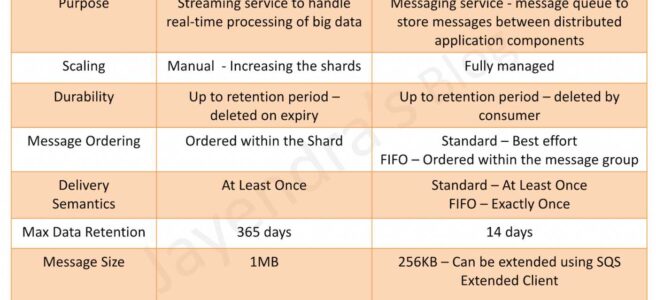
AWS SQS vs SNS vs EventBridge AWS provides multiple messaging and event-driven services for decoupling application components. SQS is a message queue for point-to-point communication, SNS is a pub/sub notification service, and EventBridge is a serverless event bus for event-driven architectures. These services are often used together but serve different purposes. SQS vs SNS vs […]

AWS SQS Standard Queue

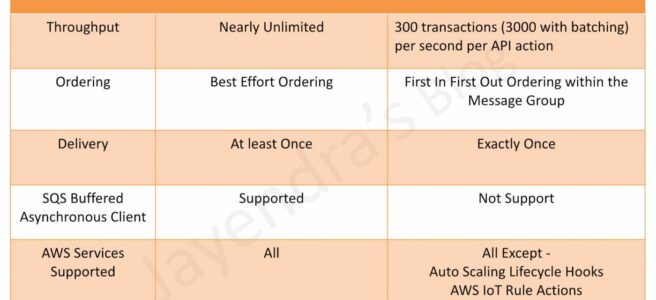
AWS SQS Standard Queue SQS offers standard as the default queue type. Standard queues support at-least-once message delivery. However, occasionally (because of the highly distributed architecture that allows nearly unlimited throughput), more than one copy of a message might be delivered out of order. Standard queues support a nearly unlimited number of API calls per […]

Amazon SQS Features – Visibility, DLQ & Batching

Amazon SQS Features Visibility timeout defines the period where SQS blocks the visibility of the message and prevents other consuming components from receiving and processing that message. Dead-letter queues – DLQ helps source queues (Standard and FIFO) target messages that can’t be processed (consumed) successfully. DLQ Redrive policy specifies the source queue, the dead-letter queue, […]