AWS Certified AI Practitioner AIF-C01 Exam Learning Path
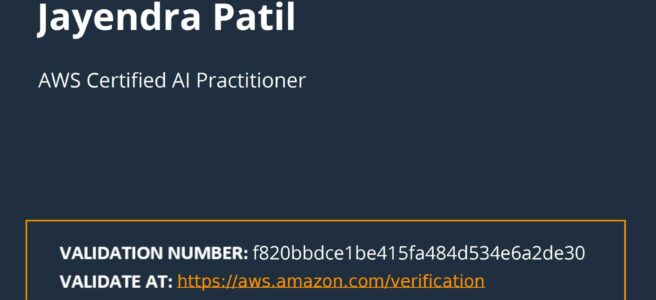
- Started the AI journey by clearing the AWS Certified AI Practitioner AIF-C01 exam with a perfect score.
- AWS Certified AI Practitioner AIF-C01 exam is the latest AWS exam released on October 8, 2024, following its beta period.
- AI Practitioner exam validates knowledge of AI/ML, generative AI technologies, and associated AWS services and tools, independent of a specific job role.
- The AIF-C01 exam has been refreshed in 2026 to reflect changes in AWS services, including the addition of Amazon Bedrock AgentCore.
-
Exam also validates a candidate’s ability to complete the following tasks:
- Understand AI, ML, and generative AI concepts, methods, and strategies in general and on AWS.
- Understand the appropriate use of AI/ML and generative AI technologies to ask relevant questions within the candidate’s organization.
- Determine the correct types of AI/ML technologies to apply to specific use cases.
- Use AI, ML, and generative AI technologies responsibly
🎯 AWS AI/ML Certification Path Update (2026)
- AWS Certified Machine Learning – Specialty retired on March 31, 2026. Certification holders retain active status through their original expiration date.
- AWS Certified Generative AI Developer – Professional (AIP-C01) is now generally available (beta ended March 31, 2026). It validates advanced skills in building production-ready AI solutions using Bedrock, RAG architectures, and agentic AI.
- AWS Agentic AI Demonstrated microcredential — a free, hands-on credential for implementing AI solutions in a provisioned AWS environment.
- Current AI/ML certification path:
- Foundational: AWS Certified AI Practitioner (AIF-C01)
- Associate: AWS Certified Machine Learning Engineer – Associate (MLA-C01)
- Professional: AWS Certified Generative AI Developer – Professional (AIP-C01)
Refer AWS Certified AI Practitioner AIF-C01 Exam Guide
See also: AWS AI & Generative AI Services – Cheat Sheet
AWS Certified AI Practitioner AIF-C01 Exam Summary
- AIF-C01 exam consists of 65 questions (50 scored and 15 unscored) in 90 minutes, and the time is more than sufficient if you are well-prepared.
- In addition to the usual types of multiple-choice and multiple-response questions, the AIF exams have introduced the following new types
- Ordering: Has a list of 3-5 responses which you need to select and place in the correct order to complete a specified task.
- Matching: Has a list of responses to match with a list of 3-7 prompts. You must match all the pairs correctly to receive credit for the question.
- Case study: A case study presents a single scenario with multiple questions. Each question is evaluated independently, and credit is given for each correct answer.
- AIF-C01 has a scaled score between 100 and 1,000. The scaled score needed to pass the exam is 700.
- Associate exams currently cost $ 100 + tax.
- You can get an additional 30 minutes if English is your second language by requesting Exam Accommodations. It might not be needed for Associate exams but is helpful for Professional and Specialty ones.
- AWS exams can be taken either remotely or online, I prefer to take them online as it provides a lot of flexibility. Just make sure you have a proper place to take the exam with no disturbance and nothing around you.
- Also, if you are taking the AWS Online exam for the first time try to join at least 30 minutes before the actual time as I have had issues with both PSI and Pearson with long wait times.
📖 Deep Dive Guides: Bedrock vs SageMaker | RAG Architecture | Prompt Engineering | Responsible AI | AI Services Decision Guide
AWS Certified AI Practitioner AIF-C01 Exam Resources
- Online Courses
- Practice tests
- Read the FAQs at least for the important topics, as they cover important points and are good for quick review
AWS Certified AI Practitioner AIF-C01 Exam Topics
AIF-C01 Exam covers the AI and ML aspects in terms of AI & ML fundamentals, ML lifecycle, Generative AI, AI use cases and applications and building secure, responsible AI.
Machine Learning Concepts
- Exploratory Data Analysis
- Feature selection and Engineering
- remove features that are not related to training
- remove features that have the same values, very low correlation, very little variance, or a lot of missing values
- Apply techniques like Principal Component Analysis (PCA) for dimensionality reduction i.e. reduce the number of features.
- Apply techniques such as One-hot encoding and label encoding to help convert strings to numeric values, which are easier to process.
- Apply Normalization i.e. values between 0 and 1 to handle data with large variance.
- Apply feature engineering for feature reduction e.g. using a single height/weight feature instead of both features.
- Handle Missing data
- remove the feature or rows with missing data
- impute using Mean/Median values – valid only for Numeric values and not categorical features also does not factor correlation between features
- impute using k-NN, Multivariate Imputation by Chained Equation (MICE), Deep Learning – more accurate and helps factors correlation between features
- Handle unbalanced data
- Source more data
- Oversample minority or Undersample majority
- Data augmentation using techniques like Synthetic Minority Oversampling Technique (SMOTE).
- Feature selection and Engineering
- Modeling
- Transfer learning (TL) is a machine learning (ML) technique where a model pre-trained on one task is fine-tuned for a new, related task.
- Know about Algorithms – Supervised, Unsupervised and Reinforcement and which algorithm is best suitable based on the available data either labelled or unlabelled.
- Supervised learning trains on labeled data e.g. Linear regression. Logistic regression, Decision trees, Random Forests
- Unsupervised learning trains on unlabelled data e.g. PCA, SVD, K-means
- Reinforcement learning trained based on actions and rewards e.g. Q-Learning
- Hyperparameters
- are parameters exposed by machine learning algorithms that control how the underlying algorithm operates and their values affect the quality of the trained models
- some of the common hyperparameters are learning rate, batch, epoch (hint: If the learning rate is too large, the minimum slope might be missed and the graph would oscillate If the learning rate is too small, it requires too many steps which would take the process longer and is less efficient)
- Evaluation
- Know difference in evaluating model accuracy
- Use Area Under the (Receiver Operating Characteristic) Curve (AUC) for Binary classification
- Use root mean square error (RMSE) metric for regression
- Understand Confusion matrix
- A true positive is an outcome where the model correctly predicts the positive class. Similarly, a true negative is an outcome where the model correctly predicts the negative class.
- A false positive is an outcome where the model incorrectly predicts the positive class. A false negative is an outcome where the model incorrectly predicts the negative class.
- Recall or Sensitivity or TPR (True Positive Rate): Number of items correctly identified as positive out of total true positives- TP/(TP+FN) (hint: use this for cases like fraud detection, cost of marking non fraud as frauds is lower than marking fraud as non-frauds)
- Specificity or TNR (True Negative Rate): Number of items correctly identified as negative out of total negatives- TN/(TN+FP) (hint: use this for cases like videos for kids, the cost of dropping few valid videos is lower than showing few bad ones)
- Training Problems
- Overfitting occurs when the machine learning model gives accurate predictions for training data but not for new data.
- Underfitting occurs when the model cannot determine a meaningful relationship between the input and output data. You get underfit models if they have not trained for the appropriate length of time on a large number of data points.
- Underfit models experience high bias—they give inaccurate results for both the training data and test set. On the other hand, overfit models experience high variance—they give accurate results for the training set but not for the test set. More model training results in less bias but variance can increase. Data scientists aim to find the sweet spot between underfitting and overfitting when fitting a model. A well-fitted model can quickly establish the dominant trend for seen and unseen data sets.
- Handle Overfitting problems
- Simplify the model, by reducing the number of layers
- Early Stopping – form of regularization while training a model with an iterative method, such as gradient descent
- Data Augmentation
- Regularization – technique to reduce the complexity of the model
- Dropout is a regularization technique that prevents overfitting
- Never train on test data
- Know difference in evaluating model accuracy
Generative AI
- Foundation Models:
- Large, pre-trained models built on diverse data that can be fine-tuned for specific tasks like text, image, and speech generation. for e.g. GPT, BERT, and DALL·E.
- Large Language Models (LLMs):
- A subset of foundation models designed to understand and generate human-like text. Capable of answering questions, summarizing, translating, and more.
- LLM Components
- Tokens:
- Basic units of text (words, subwords, or characters) that LLMs process.
- Vectors
- Numerical representations of tokens in high-dimensional space, enabling the model to perform mathematical operations on text.
- Each token is converted into a vector for processing in the neural network.
- Embeddings:
- Pre-trained numerical vector representations of tokens that capture their semantic meaning.
- Tokens:
- Prompt Engineering:
- Crafting effective input instructions to guide generative AI toward desired outputs. Key for improving performance without fine-tuning the model.
- Techniques
- Zero-Shot Prompting: Instructs the model to perform a task without providing examples.
- Few-Shot Prompting: Provides a few examples of the task in the prompt to guide the model’s output.
- Chain-of-Thought Prompting: Encourages the model to explain its reasoning step-by-step before giving the final answer.
- Instruction Prompting: Provides explicit instructions to guide the model’s behavior.
- Contextual Prompting: Includes additional context or background information in the prompt for better responses.
- Iterative Refinement: Refines the prompt in multiple iterations based on model responses to improve accuracy.
- Role-based Prompting: Assigns a role to the model to influence its tone or expertise.
- Agentic AI:
- AI systems that can autonomously plan, reason, and execute multi-step tasks with minimal human intervention.
- Agents use tools, make decisions, and adapt based on intermediate results.
- Key patterns include ReAct (Reasoning + Acting), tool use, and multi-agent orchestration.
- AWS provides Amazon Bedrock AgentCore for building and deploying production-grade agents.
- Retrieval-Augmented Generation (RAG):
- Combines LLMs with external knowledge bases to retrieve accurate and up-to-date information during text generation. Useful for chatbots and domain-specific tasks.
- Fine-Tuning:
- Adjusting pre-trained models using domain-specific data to optimize performance for specific applications.
- Reinforcement Fine-Tuning (RFT): Uses reward signals to align model outputs with desired behaviors, now supported on Amazon Bedrock for open-weight models.
- Responsible AI Features:
- Incorporates fairness, transparency, and bias mitigation techniques to ensure ethical AI outputs.
- Multi-Modal Capabilities:
- Models that process and generate outputs across multiple data types, such as text, images, and audio.
- Vector database
- provides the ability to store and retrieve vectors as high-dimensional points.
- add additional capabilities for efficient and fast lookup of nearest-neighbors in the N-dimensional space.
- Amazon natively supports vector search through OpenSearch, Aurora PostgreSQL with pgvector and Partner solutions like Pinecone, Weaviate, and Milvus.
- Controls
- Temperature: Adjusts randomness in the output; lower values (e.g., 0.2) produce focused and deterministic results, while higher values (e.g., 1.0 or above) generate creative and diverse outputs.
- Top P (Nucleus Sampling): Determines the probability threshold for token selection. With Top P = 0.9, the model considers only the smallest set of tokens whose cumulative probability is 90%.
- Top K: Limits the token selection to the top K most probable tokens. With Top K = 10, the model randomly chooses from the 10 most likely options.
- Token Length (Max Tokens): Sets the maximum number of tokens the model can generate in a response.
- Model Evaluation Metrics:
- Techniques like BLEU, ROUGE, perplexity, and embeddings measure generative AI performance across different use cases.
- ROUGE (Recall-Oriented Understudy for Gisting Evaluation): Commonly used for text summarization; compares overlap between generated and reference text.
- BERTScore: Evaluates text generation by comparing contextual embeddings, capturing semantic similarity beyond n-gram overlap.
- Perplexity: Used for language models to evaluate prediction quality. Lower perplexity indicates a better model.
- BLEU (Bilingual Evaluation Understudy): Evaluates machine translation by comparing generated text against reference translations.
- Limitations
- Security: can be exploited to create malicious content, phishing attacks, or deepfakes.
- Cost: Training and deploying large models require substantial computational resources.
- Explainability: Decision-making process is often a “black box,” making models hard to interpret.
- Hallucination: Models may confidently generate false or nonsensical outputs that appear accurate.
- Toxicity: Without proper safeguards, AI can produce harmful, biased, or offensive content.
- Creativity: AI-generated content often lacks true originality and may rely on existing patterns.
- Data Dependency: Quality of outputs depends heavily on training data quality and diversity.
- Regulation: Legal and ethical concerns surrounding misuse and intellectual property.
- Latency: Real-time applications may experience delays due to high computational demands.
AI Services
Amazon Bedrock
- is a fully managed service that offers a choice of industry leading foundation models (FMs) along with a broad set of capabilities needed to build generative AI applications, simplifying development with security, privacy, and responsible AI without the need to manage underlying infrastructure.
- supports foundation models from Amazon (Nova), Anthropic (Claude), OpenAI (GPT-5.5, GPT-5.4), Meta (Llama), Mistral AI, Cohere, Stability AI, and others.
- supports custom fine-tuning of FMs using tagged data or by using continued pre-train feature to customize the model using non-tagged data.
- supports Reinforcement Fine-Tuning (RFT) for open-weight models using OpenAI-compatible APIs (February 2026).
- supports Retrieval Augmented Generation (RAG) to enhance model responses with real-time, context-specific data retrieval from external knowledge bases.
- Knowledge Bases
- Integrate custom datasets to tailor models for specific use cases and improve accuracy.
- provides access to additional data that helps the model generate more relevant, context-specific, and accurate responses without continually retraining the FM.
- Managed Knowledge Base (GA June 2026) — a fully managed RAG service that abstracts storage, retrieval, embeddings, re-ranking, and FM selection into a single managed primitive. Includes six native data source connectors (S3, SharePoint, Confluence, Google Drive, OneDrive, Web Crawler), Smart Parsing for automatic multi-format data preparation, and an Agentic Retriever for complex multi-step queries.
- Supports multimodal retrieval across text, images, audio, and video content.
- Agents
- are fully managed capabilities that can help build and deploy intelligent agents to automate workflows and enhance user interactions.
- can complete complex tasks for a wide range of use cases and deliver up-to-date answers based on proprietary knowledge sources.
- Amazon Bedrock AgentCore (GA June 2026)
- Enterprise-grade infrastructure and operations layer for deploying and managing AI agents at scale.
- Provides a managed harness — orchestration loop, tool execution, context window management, state persistence, failure recovery, and session isolation — all with just two API calls (CreateHarness and InvokeHarness).
- Works with any framework: LangGraph, LlamaIndex, CrewAI, Strands Agents, and more.
- Includes AgentCore Gateway for connecting agents to tools, other agents, and models.
- Supports optimization capabilities that turn production traces into continuous improvement.
- Integrates with Bedrock Guardrails for real-time evaluation of agent actions and tool calls.
- Note: AgentCore is now included in the refreshed AIF-C01 exam content.
- Guardrails
- help implement safeguards for generative AI applications based on use cases and responsible AI policies.
- Provides six safeguard types:
- Content Filters — filter undesirable and harmful content
- Denied Topics — block conversations on specified topics
- Word Filters — block specific words and phrases
- Sensitive Information Filters (PII Redaction) — redacts PII using predefined types or custom regex patterns, masking with placeholders (e.g., {NAME}, {EMAIL})
- Contextual Grounding Checks — validates responses are grounded in provided context
- Automated Reasoning Checks (GA August 2025) — uses formal verification methods (mathematical logic) to validate AI outputs against rules and constraints. Provides provably correct, auditable assessment for every request. Delivers up to 99% verification accuracy for hallucination prevention.
- Prompt Attack Detection — detects prompt injection and jailbreak attempts.
- InvokeGuardrailChecks API (June 2026) — a new resourceless API that lets you apply individual safeguards at any point in agentic AI applications without creating guardrail resources. Operates in detect-only mode and returns numeric scores.
- Supports cross-account safeguards with centralized control via AWS Organizations.
- Model Evaluation
- Test and evaluate foundation models for performance and accuracy (GA April 2024).
- Automatic evaluation with predefined metrics (accuracy, robustness, toxicity).
- Human evaluation workflows for subjective quality assessment.
- LLM-as-a-judge capability for scalable, human-like evaluation.
- RAG evaluation capabilities.
- Compare multiple foundation models side by side.
- Pricing modes
- On-Demand Throughput Mode: Automatically scales based on request traffic. Ideal for variable workloads.
- Provisioned Throughput Mode: Pre-allocate capacity for consistent high-volume workloads. Required for customized fine-tuned models.
- Responsible AI Support: Tools and guidance to monitor, mitigate, and reduce biases while ensuring fairness and ethical AI use.
- Security
- S3 allows storing and managing data securely with fine-grained access controls and encryption.
- VPC PrivateLink allows operating Bedrock entirely within the VPC, ensuring secure communication without an internet gateway, NAT device, VPN connection, or AWS Direct Connect connection.
- Scalability and Cost Efficiency: Automatically scales to meet workload demands with a pay-as-you-go pricing model.
- Model Invocation Logging
- helps collect invocation logs, model input data, and model output data for all invocations.
- includes full request data, response data, and metadata associated with all calls.
- supported destinations include CloudWatch Logs and S3.
- Redesigned Console (June 2026) — browse the full model catalog (Claude, GPT, open-weight models), compare side by side on capabilities, modality, context window, and quotas in a single view.
Amazon SageMaker
- SageMaker Unified Studio (GA March 2025)
- Next-generation unified development environment for data engineers, data scientists, ML developers, and analysts.
- Breaks down silos by providing a single experience to discover data and AI assets, build analytics and AI artifacts, and collaborate in projects.
- Includes serverless notebooks with a built-in AI agent and one-click onboarding.
- Supports notebook scheduling, parameterization, and orchestration directly from the interface.
- supports Model tracking capability to manage up to thousands of machine learning model experiments
- supports automatic scaling for production variants dynamically adjusting instances in response to workload changes
- provides pre-built Docker images for its built-in algorithms and the supported deep learning frameworks used for training & inference
- SageMaker Inference options:
- Real-time inference is ideal for online inferences with low latency or high throughput requirements.
- Serverless Inference is ideal for intermittent or unpredictable traffic patterns.
- Batch Transform is suitable for offline processing when large amounts of data are available upfront.
- Asynchronous Inference is ideal for large payloads with long processing times.
- SageMaker Model deployment allows deploying multiple variants of a model to the same endpoint to test new models.
- SageMaker Managed Spot training can use spot instances to save cost; Checkpointing saves the state of ML models during training.
- SageMaker Feature Store — centralized store for features and associated metadata for easy discovery and reuse.
- SageMaker Debugger provides tools to debug training jobs and resolve problems such as overfitting, saturated activation functions, and vanishing gradients.
- SageMaker Model Monitor monitors model quality in production and alerts when there are deviations.
- SageMaker Automatic Model Tuning helps find optimal hyperparameters for an algorithm.
- SageMaker Data Wrangler reduces time to aggregate and prepare tabular and image data for ML from weeks to minutes.
- SageMaker Clarify helps detect potential bias and explain model predictions using SHAP analysis.
- SageMaker Model Governance provides systematic visibility into ML model development, validation, and usage.
- SageMaker Model Cards — document critical details about ML models for streamlined governance and reporting.
- SageMaker Autopilot automates the end-to-end process of building, training, tuning, and deploying ML models.
- SageMaker Neo enables ML models to train once and run anywhere in the cloud and at the edge.
- SageMaker JumpStart — pre-trained foundation models hub with one-click deployment, fine-tuning, and support for both proprietary and open-source models.
- SageMaker supports VPC interface endpoints powered by AWS PrivateLink for secure private connectivity.
- provides automated data labeling using machine learning
- helps build highly accurate training datasets quickly using Amazon Mechanical Turk
- provides annotation consolidation to improve the accuracy of data labels by combining multiple workers’ results.
- automated data labeling uses machine learning to label portions of the data automatically without sending them to human workers
AI Managed Services
- Amazon Q Business
- is a fully managed, generative-AI powered assistant that can answer questions, provide summaries, generate content, and complete tasks based on enterprise data.
- connects to enterprise data sources with existing security and access controls.
- AWS PartyRock
- Amazon Bedrock Playground for learning generative AI.
- No-code app building interface for hands-on experimentation with foundation models.
- Build apps in minutes with natural language prompts.
- Free to use for learning and prompt engineering practice.
- Comprehend — natural language processing (NLP) service to find insights and relationships in text. Identifies language, extracts key phrases, people, brands, events; understands sentiment; organizes text by topic.
- Lex — provides conversational interfaces using voice and text for building chatbots.
- Polly — text-to-speech; supports SSML tags and pronunciation lexicons.
- Rekognition — analyze images and video; identifies objects, people, text, scenes, activities, and inappropriate content.
- Translate — natural and fluent language translation.
- Transcribe — automatic speech recognition (ASR) speech-to-text.
- Kendra — intelligent search service using NLP and ML to return specific answers from your data.
- Panorama — brings computer vision to on-premises camera networks.
- Augmented AI (Amazon A2I) — builds workflows for human review of ML predictions.
- Forecast — highly accurate time-series forecasts.
Security, Identity & Compliance
- AWS Artifact is a self-service portal for on-demand access to AWS compliance documentation and agreements.
- SageMaker can read data from KMS-encrypted S3. Make sure KMS key policies include the role attached to SageMaker.
- AWS Identity and Access Management (IAM) helps securely control access to AWS resources.
- Amazon Inspector — vulnerability management service that continuously scans workloads for software vulnerabilities and unintended network exposure.
Management & Governance Tools
- Understand AWS CloudWatch for Logs and Metrics. (hint: SageMaker & Bedrock are integrated with CloudWatch for logs and metrics)
- CloudTrail records API events, the user who made the call, and the time of the call for monitoring and logging.
Whitepapers and articles
- AWS Machine Learning Services Cheat Sheet
- AWS Analytics Services Cheat Sheet
- Machine Learning Concepts Cheat Sheet
- AWS Machine Learning & AI Learning Hub
On the Exam Day
- Make sure you are relaxed and get some good night’s sleep. The exam is not tough if you are well-prepared.
- If you are taking the AWS Online exam
- Try to join at least 30 minutes before the actual time as I have had issues with both PSI and Pearson with long wait times.
- The online verification process does take some time and usually, there are glitches.
- Remember, you would not be allowed to take the exam if you are late by more than 30 minutes.
- Make sure you have your desk clear, no hand-watches, or external monitors, keep your phones away, and nobody can enter the room.
AWS AI Architecture & Deep Dives for AIF-C01
- GenAI Application Architecture – Bedrock, RAG, Agents & Guardrails
- RAG Architecture – Bedrock Knowledge Bases Complete Guide
- Prompt Engineering – Techniques & Best Practices
- Responsible AI – Guardrails, Governance & Ethics
- AI Services Decision Guide – Which Service for Which Use Case
- Bedrock vs SageMaker – When to Use Each
Practice Questions
- A company needs to deploy AI agents that can autonomously plan multi-step workflows, execute tools, and recover from failures at production scale. Which AWS service provides the infrastructure layer for this?
- Amazon Bedrock Agents
- Amazon Bedrock AgentCore
- Amazon SageMaker Unified Studio
- AWS Step Functions
Show Answer
Answer: B – Amazon Bedrock AgentCore provides enterprise-grade infrastructure for deploying and managing AI agents at scale, including orchestration, state persistence, and failure recovery.
- A financial services company needs mathematically verifiable accuracy for AI-generated compliance reports to prevent hallucinations. Which Amazon Bedrock Guardrails capability should they use?
- Content Filters
- Contextual Grounding Checks
- Automated Reasoning Checks
- Sensitive Information Filters
Show Answer
Answer: C – Automated Reasoning Checks use formal verification methods (mathematical logic) to validate AI outputs, delivering provably correct and auditable assessments with up to 99% verification accuracy.
- An organization wants to apply Bedrock Guardrails safety checks at individual steps in their agentic AI workflow without creating dedicated guardrail resources. Which API should they use?
- ApplyGuardrail
- InvokeGuardrailChecks
- CreateGuardrail
- InvokeModel
Show Answer
Answer: B – InvokeGuardrailChecks is a resourceless API (June 2026) that lets you apply individual safeguards at any point in agentic AI applications without creating guardrail resources.
- A development team wants to build a RAG application with enterprise data from SharePoint, Confluence, and S3 without managing vector storage or retrieval infrastructure. Which service should they use?
- Amazon OpenSearch with custom embeddings
- Amazon Bedrock Knowledge Bases with custom vector store
- Amazon Bedrock Managed Knowledge Base
- Amazon Kendra
Show Answer
Answer: C – Amazon Bedrock Managed Knowledge Base (GA June 2026) is a fully managed RAG service with native data connectors, managed vector storage, Smart Parsing, and an Agentic Retriever.
- Which of the following certifications has AWS retired as of March 31, 2026?
- AWS Certified AI Practitioner
- AWS Certified Machine Learning Engineer – Associate
- AWS Certified Machine Learning – Specialty
- AWS Certified Generative AI Developer – Professional
Show Answer
Answer: C – AWS Certified Machine Learning – Specialty was retired on March 31, 2026. It has been replaced by the expanded AI/ML certification portfolio including the Generative AI Developer – Professional.
- A beginner wants to learn generative AI through hands-on experimentation without writing code or managing infrastructure. Which AWS service should they use?
- SageMaker Unified Studio
- SageMaker Canvas
- AWS PartyRock
- Bedrock Console Playground
Show Answer
Answer: C – AWS PartyRock is a free, no-code platform for learning generative AI through hands-on experimentation with foundation models and prompt engineering.
Finally, All the Best 🙂