Table of Contents
hide
AWS Migration Hub
⚠️ AWS Migration Hub – No Longer Accepting New Customers
AWS Migration Hub stopped accepting new customers as of November 7, 2025. Existing customers can continue using the service to complete ongoing migration projects.
Replacement: AWS Transform (launched May 2025) provides equivalent capabilities with enhanced AI-driven automation for migration and modernization.
Related services also closed to new customers (Nov 7, 2025):
- AWS Application Discovery Service → Use AWS Transform
- Migration Hub Orchestrator → Use AWS Transform
- Migration Hub Refactor Spaces → Use AWS Transform
- Migration Hub Strategy Recommendations → Use AWS Transform
This content is maintained for historical reference, certification exam preparation, and existing customers.
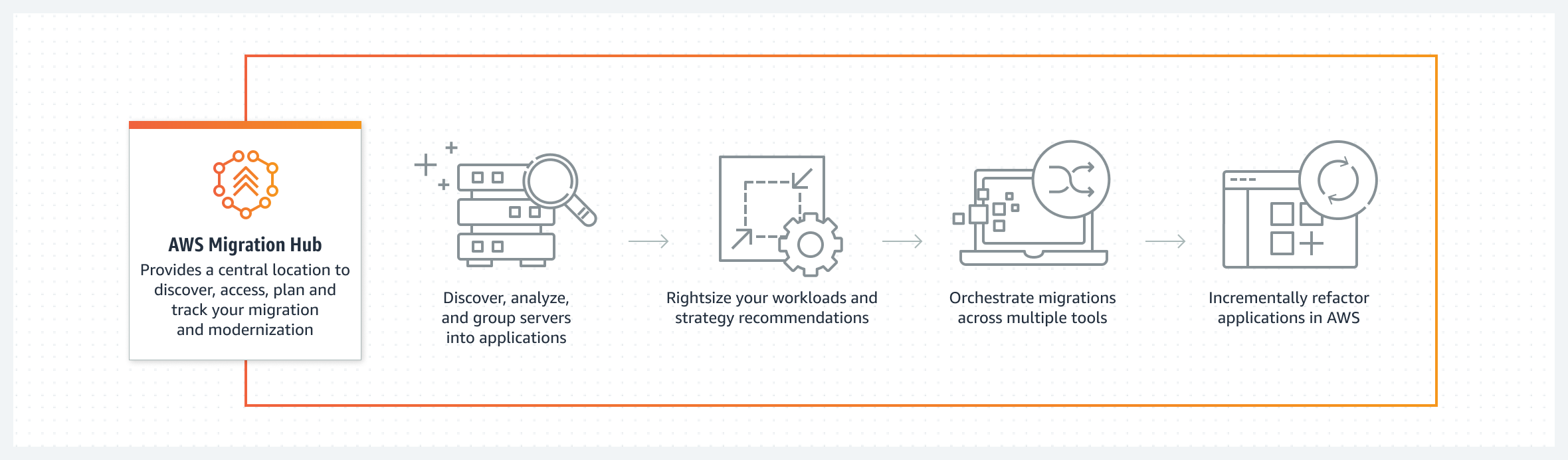
- AWS Migration Hub provides a centralized, single place to discover the existing servers, plan migrations, and track the status of each application migration.
- provides visibility into the application portfolio and streamlines planning and tracking.
- helps visualize the connections and the status of the migrating servers and databases, regardless of which migration tool is used.
- stores all the data in the selected Home Region and provides a single repository of discovery and migration planning information for the entire portfolio and a single view of migrations into multiple AWS Regions.
- helps track the status of the migrations in all AWS Regions, provided the migration tools are available in that Region.
- helps understand the environment by letting you explore information collected by AWS discovery tools and stored in the AWS Application Discovery Service’s repository.
- supports migration status updates from the following tools:
- AWS Application Migration Service (now AWS Transform MGN)
AWS Server Migration Service(Discontinued March 2022 — replaced by AWS Application Migration Service)- AWS Database Migration Service – DMS
- migration tools send migration status to the selected Home Region
- supports EC2 instance recommendations, that provide you with the ability to estimate the cost of running the existing servers in AWS.
- supports Strategy Recommendations, that help easily build a migration and modernization strategy for the applications running on-premises or in AWS.
Migration Hub Journeys
- Migration Hub Journeys (launched 2024) provides a guided migration experience with pre-defined journey templates that templatize migration projects and orchestrate tasks between project contributors.
- provides a hierarchy for all tasks per migration phase and converts them to subtasks for easy execution.
- furnishes step-by-step runbooks for each subtask, reducing the time needed for project planning.
- supports collaboration across partners, practitioners, and customers with pre-defined roles (administrator, contributor).
- enables inviting other users (including partners and AWS personnel) to collaborate on migration journeys.
Migration Hub Automation
- Migration Hub Automation (launched Dec 2024) enables customers to automate common migration tasks, significantly reducing manual effort and potential for errors.
- integrates with Migration Hub Journeys to streamline migration processes.
- helps achieve more efficient, cost-effective, and scalable cloud migrations.
Migration Hub Orchestrator
- Migration Hub Orchestrator provides customizable workflow templates to automate and orchestrate end-to-end migration processes.
- reduces migration costs and time by removing many of the manual tasks involved in migrating large-scale enterprise applications.
- manages dependencies between different tools and provides visibility into migration progress.
- supports pre-built workflow templates for common migration patterns including SAP, SQL Server, and rehost migrations.
- Note: No longer accepting new customers as of November 7, 2025. Use AWS Transform for similar capabilities.
Migration Hub’s Strategy Recommendations
- AWS Migration Hub’s Strategy Recommendations help easily build a migration and modernization strategy for the applications running on-premises or in AWS.
- Strategy Recommendations provides guidance on the strategy and tools that help you migrate and modernize at scale.
- Strategy Recommendations supports analysis for potential rehost (EC2) and replatform (managed environments such as RDS and Elastic BeanStalk, Containers, and OS upgrades) options for applications running on Windows Server 2003 or above or a wide variety of Linux distributions, including Ubuntu, RedHat, Oracle Linux, Debian, and Fedora.
- Strategy Recommendations offers additional refactor analysis for custom applications written in C# and Java, and licensed databases (such as Microsoft SQL Server and Oracle).
- Note: No longer accepting new customers as of November 7, 2025. Use AWS Transform for AI-driven assessment and strategy recommendations.
Migration Hub Refactor Spaces
- Migration Hub Refactor Spaces helps incrementally refactor applications by providing a managed environment for the strangler fig pattern.
- creates the infrastructure needed to route traffic between legacy and refactored services.
- provides a managed multi-account environment that facilitates application refactoring.
- Note: No longer accepting new customers as of November 7, 2025. Use AWS Transform for similar capabilities.
EC2 Instance Recommendations
- EC2 instance recommendations help analyze the data collected from each on-premises server, including server specification, CPU, and memory utilization, to recommend the most cost-effective, least expensive EC2 instance required to run the on-premises workload.
- EC2 instance recommendations can be fine-tuned by specifying preferences for AWS purchasing options, AWS Region, EC2 instance type exclusions, and CPU/RAM utilization metric (average, peak, or percentile).
AWS Transform (Successor Service)
- AWS Transform, launched May 2025, is the next-generation replacement for AWS Migration Hub using agentic AI to accelerate enterprise migration and modernization.
- uses specialized AI agents to automate complex migration and modernization tasks, delivering transformation projects up to 4x faster.
- provides a collaborative enterprise IT transformation workbench powered by expert agents.
- Key capabilities include:
- AWS Transform for VMware — automates application discovery, dependency mapping, migration planning, network conversion, and EC2 instance optimization. Reduces network configuration from weeks to hours.
- AWS Transform for .NET — modernizes Windows-based .NET Framework applications to Linux, reducing operating costs by up to 40%.
- AWS Transform for Mainframe — accelerates mainframe modernization by automating tasks from initial assessment to deployment, converting COBOL/JCL to Java/Postgres.
- AWS Transform MGN (formerly AWS Application Migration Service) — the proven replication engine for lift-and-shift migrations (rebranded June 2026).
- Migration Assessment — analyzes IT environments with intelligent, data-driven insights and actionable recommendations.
- uses Graph Neural Networks for dependency mapping and migration wave planning.
- provides a chat interface as a knowledgeable transformation assistant for specifying objectives, reviewing plans, and approving changes.
- supports human-in-the-loop controls at critical gates for reviewing and approving artifacts.
AWS Certification Exam Practice Questions
- Questions are collected from Internet and the answers are marked as per my knowledge and understanding (which might differ with yours).
- AWS services are updated everyday and both the answers and questions might be outdated soon, so research accordingly.
- AWS exam questions are not updated to keep up the pace with AWS updates, so even if the underlying feature has changed the question might not be updated
- Open to further feedback, discussion and correction.
- A company wants to migrate its on-premises data center to the AWS Cloud. This includes thousands of virtualized Linux and Microsoft Windows servers, SAN storage, Java and PHP applications with MYSQL, and Oracle databases. There are many department services hosted either in the same data center or externally.
The technical documentation is incomplete and outdated. A solutions architect needs to understand the current environment and estimate the cloud resource costs after the migration.
Which tools or services should be used to plan the cloud migration (Choose TWO.)- AWS Application Discovery Service
- AWS SMS
- AWS X-Ray
- Amazon Inspector
- AWS Migration Hub
- A company is planning a large-scale migration of 500+ servers from on-premises VMware to AWS. They want to automate dependency mapping, generate optimized migration wave plans, and convert their on-premises network configurations to AWS equivalents. Which service should they use?
- AWS Migration Hub
- AWS Application Migration Service
- AWS Transform
- AWS Server Migration Service
- A company needs to track the progress of its ongoing migration that uses both AWS Application Migration Service and AWS Database Migration Service. They signed up for Migration Hub before November 2025. Which AWS service provides a centralized view of migration status across multiple tools?
- AWS CloudTrail
- AWS Migration Hub
- AWS Config
- AWS Systems Manager
- An enterprise wants to modernize its .NET Framework applications running on Windows Server to reduce licensing costs. They want an AI-driven service that can analyze dependencies, develop modernization plans, and autonomously transform code. Which service should they use?
- AWS Migration Hub Strategy Recommendations
- AWS App2Container
- AWS Transform
- AWS Elastic Beanstalk