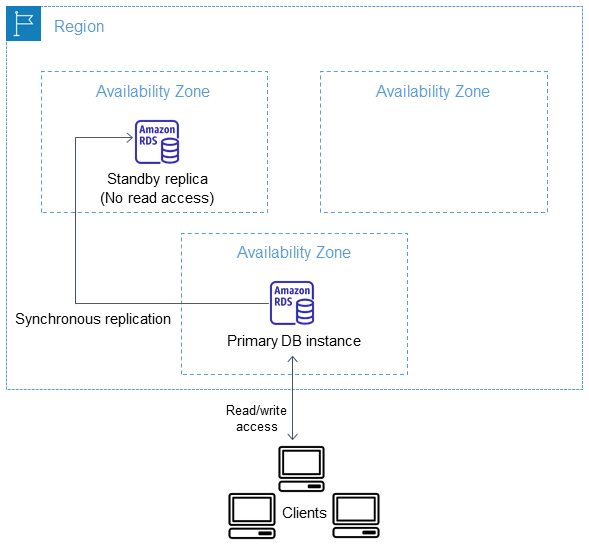
RDS automatically creates a primary DB Instance and synchronously replicates the data to a standby instance in a different AZ.
RDS performs an automatic failover to the standby, so that database operations can be resumed as soon as the failover is complete.
RDS Multi-AZ deployment maintains the same endpoint for the DB Instance after a failover, so the application can resume database operation without the need for manual administrative intervention.
Multi-AZ is a High Availability feature and NOT a scaling solution for read-only scenarios; a standby replica can’t be used to serve read traffic. To service read-only traffic, use a Read Replica or consider Multi-AZ DB Cluster deployment which provides readable standbys.
Multi-AZ deployments for MariaDB, MySQL, Oracle, PostgreSQL, and RDS Custom for SQL Server DB instances use Amazon failover technology. SQL Server DB instances use SQL Server Database Mirroring (DBM) or Always On Availability Groups (AGs). SQL Server 2022 Web Edition supports Multi-AZ through block-level replication.
In a Multi-AZ deployment,
RDS automatically provisions and maintains a synchronous standby replica in a different Availability Zone.
Copies of data are stored in different AZs for greater levels of data durability.
Primary DB instance is synchronously replicated across Availability Zones to a standby replica to provide
data redundancy,
eliminate I/O freezes during snapshots and backups
and minimize latency spikes during system backups.
DB instances may have increased write and commit latency compared to a Single AZ deployment, due to the synchronous data replication
Transaction success is returned only if the commit is successful both on the primary and the standby DB
There might be a change in latency if the deployment fails over to the standby replica, although AWS is engineered with low-latency network connectivity between Availability Zones.
When using the BYOL licensing model, a license for both the primary instance and the standby replica is required
For production workloads, it is recommended to use Multi-AZ deployment with Provisioned IOPS and DB instance classes optimized for Provisioned IOPS (e.g., current-generation M5, M6g, M6i, R5, R6g, R6i, or newer Graviton-based instances) for fast, consistent performance.
When Single-AZ deployment is modified to a Multi-AZ deployment (for engines other than SQL Server or Amazon Aurora)
RDS takes a snapshot of the primary DB instance from the deployment and restores the snapshot into another Availability Zone.
RDS then sets up synchronous replication between the primary DB instance and the new instance.
This avoids downtime during conversion from Single AZ to Multi-AZ.
An existing Single AZ instance can be converted into a Multi-AZ instance by modifying the DB instance without any downtime.
ENA Express for Multi-AZ Replication (2026)
As of May 2026, Amazon RDS Multi-AZ instances use ENA Express for replication traffic between Availability Zones.
ENA Express uses AWS’s Scalable Reliable Datagram (SRD) protocol to optimize network performance.
Delivers up to 25 Gbps single-flow bandwidth for cross-AZ replication traffic with advanced congestion control and multi-pathing capabilities.
Reduces latency variability for Multi-AZ deployments and delivers increased write throughput and lower write latencies for write-intensive workloads.
SRD improves replication by dynamically distributing traffic across multiple network paths and adapting to congestion in real time.
Available at no additional charge for RDS for MariaDB, MySQL, PostgreSQL, Db2, and Oracle.
To enable on existing instances, perform a start-stop or scale compute action.
RDS Multi-AZ Failover Process
In the event of a planned or unplanned outage of the DB instance,
RDS automatically switches to a standby replica in another AZ, if enabled for Multi-AZ.
The time taken for the failover to complete depends on the database activity and other conditions at the time the primary DB instance became unavailable.
Failover times are typically 60-120 secs. However, large transactions or a lengthy recovery process can increase failover time.
Failover mechanism automatically changes the DNS record of the DB instance to point to the standby DB instance.
DNS propagation can take up to 35 seconds to complete during failover.
Multi-AZ switch is seamless to the applications as there is no change in the endpoint URLs but just needs to re-establish any existing connections to the DB instance.
RDS handles failover automatically so that database operations can be resumed as quickly as possible without administrative intervention.
Primary DB instance switches over automatically to the standby replica if any of the following conditions occur:
Primary Availability Zone outage
Loss of network connectivity to primary
Primary DB instance fails
DB instance’s server type is changed
Operating system of the DB instance is undergoing software patching
Compute unit failure on the primary
Storage failure on the primary
A manual failover of the DB instance was initiated using Reboot with failover (also referred to as Forced Failover)
If the Multi-AZ DB instance has failed over, can be determined by
DB event subscriptions can be set up to notify you via email or SMS that a failover has been initiated.
DB events can be viewed via the Amazon RDS console or APIs.
The current state of the Multi-AZ deployment can be viewed via the RDS console and APIs.
RDS Proxy for Faster Failover
Amazon RDS Proxy can significantly reduce failover downtime for Multi-AZ DB instance deployments.
RDS Proxy eliminates the 35-second DNS propagation delay by continuously monitoring both primary and standby instances, allowing it to bypass DNS propagation entirely.
As of Dec 2024, AWS has optimized the planned failover process with RDS Proxy:
Modify instance class — downtime reduced by up to 4.9x (MariaDB), 4.3x (MySQL), 3.3x (PostgreSQL)
OS upgrades — downtime reduced by up to 4.8x (MySQL), 4x (MariaDB), 3.4x (PostgreSQL)
Reboot with force failover — downtime reduced by up to 3x (MariaDB), 2.5x (MySQL), 1.5x (PostgreSQL)
During maintenance operations, RDS performs maintenance on the standby first, then does a planned failover, then completes maintenance on the old primary — minimizing overall downtime.
These improvements are available for RDS for MySQL, MariaDB, and PostgreSQL with no changes needed to workloads.
Multi-AZ DB Instance vs Multi-AZ DB Cluster
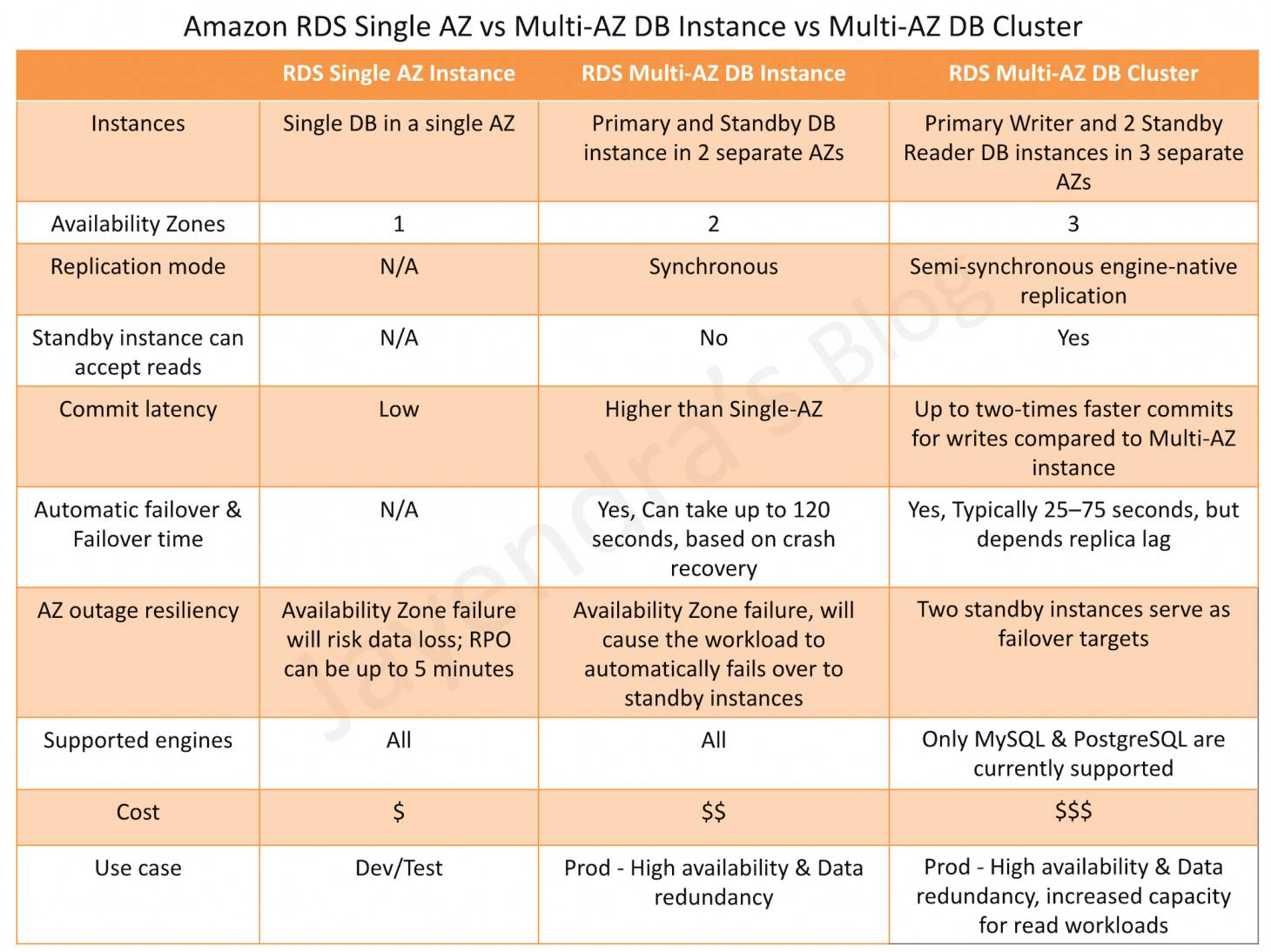
Multi-AZ DB Instance: One primary + one standby (standby NOT readable). Failover typically 60-120 seconds.
Multi-AZ DB Cluster: One writer + two reader instances in three AZs. Readers can serve read traffic. Failover typically under 35 seconds. Supports MySQL and PostgreSQL only.
Multi-AZ DB Cluster provides improved commit latency, faster failover, readable standby instances, and lower write latency compared to Multi-AZ DB Instance deployment.
Choose Multi-AZ DB Cluster when you need both read scaling and fast failover in a single managed deployment.
AWS Certification Exam Practice Questions
Questions are collected from Internet and the answers are marked as per my knowledge and understanding (which might differ with yours).
AWS services are updated everyday and both the answers and questions might be outdated soon, so research accordingly.
AWS exam questions are not updated to keep up the pace with AWS updates, so even if the underlying feature has changed the question might not be updated
Open to further feedback, discussion and correction.