CloudFront Functions vs Lambda@Edge
CloudFront Functions
- is a CloudFront native feature (code is managed entirely within CloudFront) and visible only on the CloudFront dashboard.
- supports lightweight functions written only in JavaScript language
- supports two JavaScript runtimes:
- Runtime 1.0 – ECMAScript 5.1 compliant with some ES 6-9 features
- Runtime 2.0 – Adds async/await, Promises, ES modules, WebCrypto, Buffer module, and ES 6-12 features. Required for KeyValueStore and origin modification.
- runs in 700+ Edge Locations (closer to viewers than Lambda@Edge)
- has process-based isolation
- supports Viewer Request, Viewer Response trigger events only
- Viewer Request: after CloudFront receives the request from the Viewer
- Viewer Response: before CloudFront forwards the response to the Viewer
- supports sub-millisecond execution time
- maximum function code size: 10 KB
- maximum function memory: 2 MB
- scales to millions of requests/second
- pricing: $0.10 per million invocations (1/6th the cost of Lambda@Edge)
- as they are built to be more scalable, performant, and cost-effective, they have the following limitations
- no network access
- no file system access
- no access to environment variables (use KeyValueStore instead)
- no dynamic code evaluation (eval() not supported)
- no timers (setTimeout, setImmediate not supported)
- cannot access the request body
- supports Amazon CloudFront KeyValueStore for low-latency data lookups at the edge without network calls (requires Runtime 2.0)
- supports origin modification (Nov 2024) – dynamically change or update origin servers on each request from the viewer request event, previously only possible via Lambda@Edge
- supports access to geolocation and device data headers
- can be built and tested entirely within CloudFront console
- ideal use cases:
- Cache-key manipulations and normalization
- URL rewrites and redirects
- HTTP header manipulation
- Request authorization (JWT validation via hashed tokens)
- Dynamic origin selection and modification
- A/B testing and feature flags (using KeyValueStore)
CloudFront Functions – Origin Modification (Nov 2024)
- allows conditionally changing or updating origin servers on each request from the viewer request event.
- previously, origin modification was only possible using Lambda@Edge on the origin request event.
- supports updating all existing origin capabilities such as setting custom headers, adjusting timeouts, setting Origin Shield, or changing the primary origin in origin groups.
- uses helper methods:
updateRequestOrigin(),selectRequestOriginById(), andcreateRequestOriginGroup(). - VPC Origin modification support added in April 2025, enabling routing to private VPC origins.
- requires JavaScript runtime 2.0.
CloudFront Functions – New Capabilities (Nov 2025)
- Edge Location Metadata – Access the three-letter airport code of the serving edge location and expected Regional Edge Cache (REC). Enables geo-specific content routing or compliance requirements.
- Raw Query String Retrieval – Access the complete, unprocessed query string as received from the viewer, preserving special characters and encoding.
- Advanced Origin Overrides – Customize SSL/TLS handshake parameters including Server Name Indication (SNI), useful for multi-tenant setups. Parameters include
hostHeader,sni,allowedCertificateNames, andoriginOverrides.
Lambda@Edge
- are Lambda functions and visible on the Lambda dashboard.
- supports Node.js and Python languages (currently supports Node.js 18, 20, 22, 24 and Python 3.9-3.13)
- runs in Regional Edge Caches (13 locations globally)
- has VM-based isolation
- supports Viewer Request, Viewer Response, Origin Request, and Origin Response trigger events.
- Viewer Request: after CloudFront receives the request from the Viewer
- Viewer Response: before CloudFront forwards the response to the Viewer
- Origin Request: before CloudFront forwards the request to the Origin
- Origin Response: after CloudFront receives the response from the Origin
- supports longer execution time, 5 seconds for viewer triggers and 30 seconds for origin triggers
- maximum memory: 128 MB for viewer triggers, 10,240 MB (10 GB) for origin triggers
- maximum function code size: 50 MB (including libraries)
- scales to 10,000 requests/second per Region
- pricing: $0.60 per million invocations + duration charges (no free tier)
- has network and file system access
- can access the request body
- does NOT support CloudFront KeyValueStore (use CloudFront Functions instead)
- geolocation and device data available only on origin request/response triggers (not viewer triggers)
- ideal use cases:
- Functions that take several milliseconds or more to complete
- Functions that require adjustable CPU or memory
- Functions that depend on third-party libraries (including the AWS SDK)
- Functions that require network access to use external services for processing
- Functions that require file system access or access to the body of HTTP requests
- Complex authentication and authorization (OAuth, SAML)
- Dynamic content generation and image transformation
- Limitations
- must use a numbered version of the Lambda function, not
$LATESTor aliases - Lambda function must be in the US East (N. Virginia) Region
- no free tier – Lambda@Edge requests are not covered by the standard Lambda free tier
- does not support Lambda layers, VPC access, provisioned concurrency, environment variables, or X-Ray tracing
- must use a numbered version of the Lambda function, not
Lambda@Edge – Advanced Logging Controls (Apr 2025)
- JSON Structured Logs – Function logs can now be output in structured JSON format, making it easier to search, filter, and analyze log entries without custom logging libraries.
- Log Level Granularity – Switch log levels (ERROR, DEBUG, INFO) instantly without code changes.
- Custom CloudWatch Log Group Selection – Choose which CloudWatch log group Lambda@Edge sends logs to, simplifying log aggregation and management at scale.
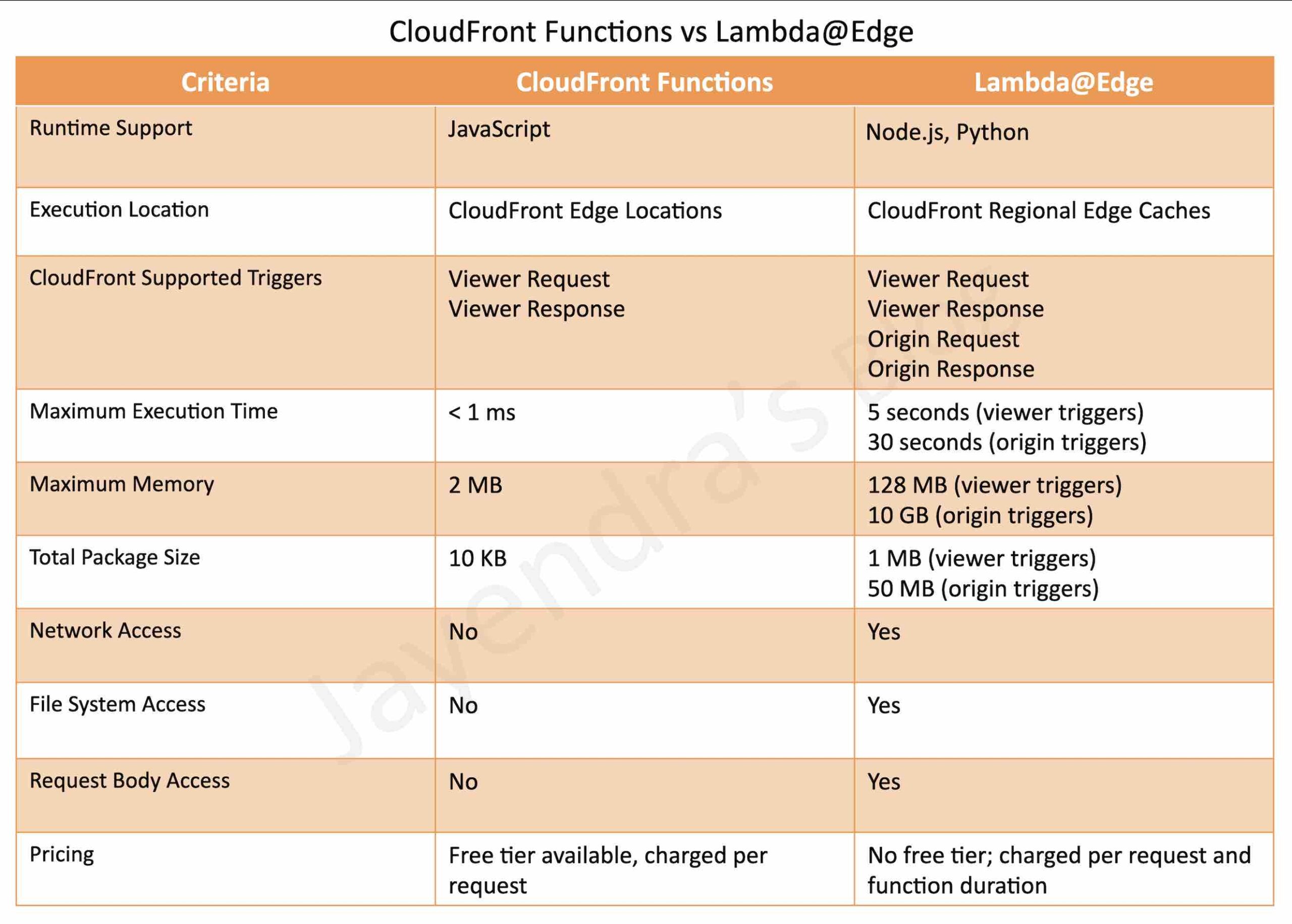
CloudFront Functions vs Lambda@Edge – Comparison
| Feature | CloudFront Functions | Lambda@Edge |
|---|---|---|
| Programming Language | JavaScript (ECMAScript 5.1+) | Node.js and Python |
| Event Triggers | Viewer Request, Viewer Response | Viewer Request, Viewer Response, Origin Request, Origin Response |
| Execution Location | 700+ Edge Locations | 13 Regional Edge Caches |
| Execution Duration | Sub-millisecond | 5 sec (viewer) / 30 sec (origin) |
| Memory | 2 MB | 128 MB (viewer) / 10 GB (origin) |
| Code Size | 10 KB | 50 MB |
| Scale | Millions of requests/sec | 10,000 requests/sec per Region |
| Network Access | No | Yes |
| File System Access | No | Yes |
| Request Body Access | No | Yes |
| KeyValueStore Support | Yes (Runtime 2.0) | No |
| Origin Modification | Yes (Nov 2024, viewer request) | Yes (origin request) |
| Geolocation/Device Data | Yes | Origin triggers only |
| Build & Test in CloudFront | Yes | No |
| Pricing | $0.10 per 1M invocations | $0.60 per 1M invocations + duration |
| Isolation Model | Process-based | VM-based (microVM) |
When to Use Which
- Start with CloudFront Functions when:
- Tasks are lightweight (header manipulation, URL rewrites, cache key normalization)
- Sub-millisecond latency is required
- High scale (millions of req/sec) is needed
- Origin selection can be done based on headers/query strings (no body access needed)
- Cost optimization is a priority
- Use Lambda@Edge when:
- You need access to the request body
- Functions require network calls (external APIs, databases)
- Third-party libraries or AWS SDK are needed
- Complex logic requiring more than sub-millisecond execution
- Origin request/response event manipulation is needed (and CloudFront Functions origin modification doesn’t suffice)
AWS Certification Exam Practice Questions
- Questions are collected from Internet and the answers are marked as per my knowledge and understanding (which might differ with yours).
- AWS services are updated everyday and both the answers and questions might be outdated soon, so research accordingly.
- AWS exam questions are not updated to keep up the pace with AWS updates, so even if the underlying feature has changed the question might not be updated
- Open to further feedback, discussion and correction.
- You’ve been given the requirement to customize the content which is distributed to users via a CloudFront Distribution. The content origin is an S3 bucket and the customization attribute exists in the request body. How could you achieve this?
- Add an event to the S3 bucket. Make the event invoke a Lambda function to customize the content before rendering
- Use CloudFront Functions
- Use Lambda@Edge
- Use a separate application on an EC2 Instance for this purpose.
- A company uses CloudFront to serve a multi-region application. They need to route users to the nearest origin based on the viewer’s geographic location with sub-millisecond latency impact. Which approach should they use?
- Use Lambda@Edge with origin request trigger
- Use CloudFront Functions with origin modification helper methods
- Use Route 53 latency-based routing
- Use CloudFront geographic restrictions
- A SaaS company wants to dynamically route tenant requests to different backend servers based on a tenant ID in the request header. The routing table changes frequently. Which solution provides the lowest latency?
- Use Lambda@Edge to query DynamoDB for the routing table
- Use CloudFront Functions with hard-coded routing logic
- Use CloudFront Functions with KeyValueStore to look up the tenant routing
- Use an Application Load Balancer with path-based routing
- An application requires JWT token validation at the edge and, if valid, needs to call an external authorization service to check permissions before serving content. Which combination should be used?
- Use CloudFront Functions for both JWT validation and the external call
- Use Lambda@Edge for both JWT validation and the external call
- Use CloudFront Functions for JWT validation on viewer request, and Lambda@Edge on origin request for the external authorization call
- Use API Gateway with a Lambda authorizer
- Which of the following is NOT a limitation of CloudFront Functions compared to Lambda@Edge? (Select TWO)
- Cannot access the request body
- Cannot modify the origin
- Cannot make network calls
- Cannot access geolocation data
- Cannot use KeyValueStore
Show Answer
Answer: B and E are NOT limitations (they are incorrect statements). CloudFront Functions CAN modify origins (since Nov 2024) and CAN use KeyValueStore –