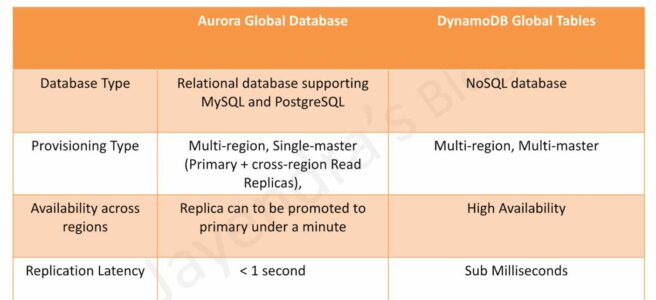
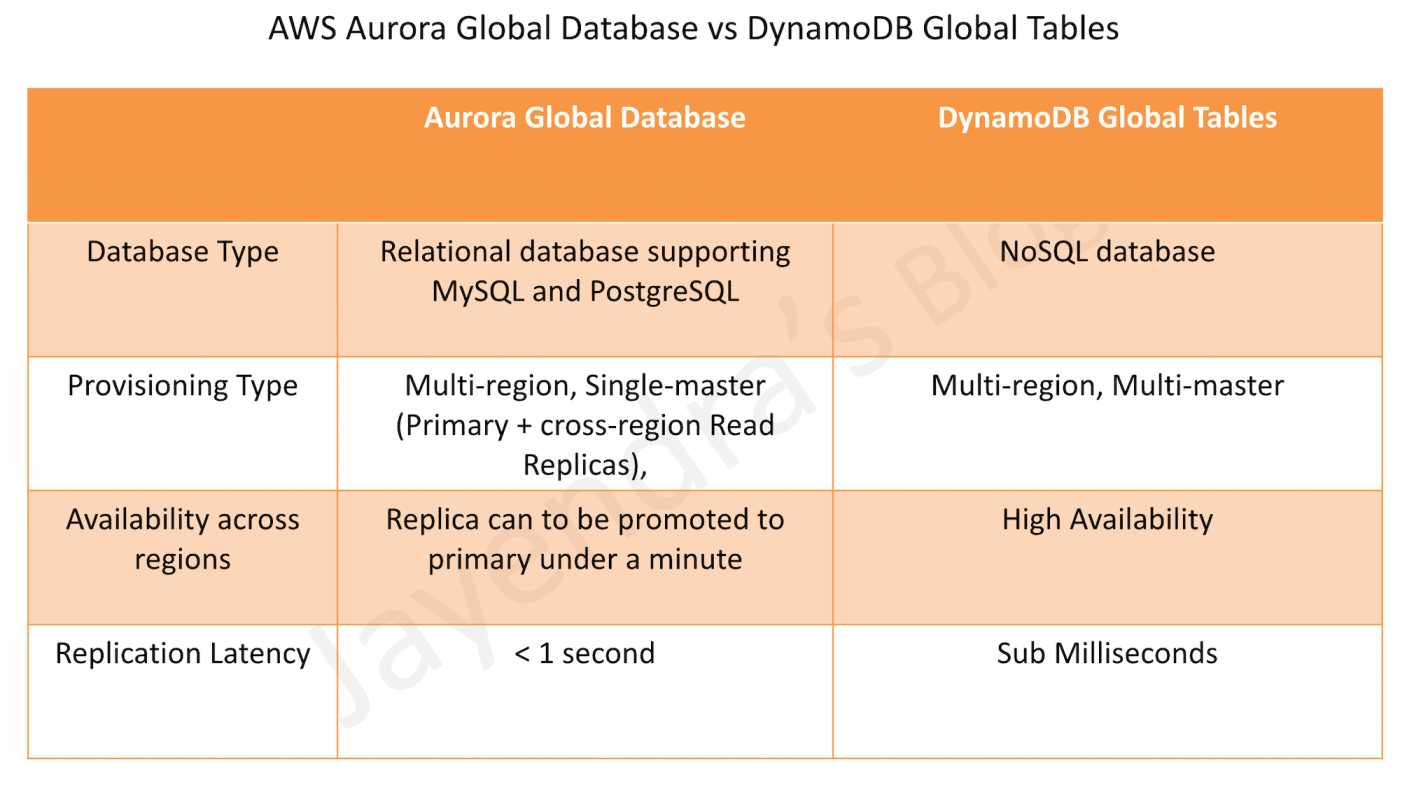
AWS Aurora Global Database vs. DynamoDB Global Tables vs. Aurora DSQL
Aurora Global Database
- Aurora Global Database provides a relational database supporting MySQL and PostgreSQL.
- Aurora Global Database consists of one primary AWS Region where the data is mastered, and up to five read-only, secondary AWS Regions.
- Aurora cluster in the primary AWS Region performs both read and write operations. The clusters in the secondary Regions enable low-latency reads.
- Aurora replicates data to the secondary AWS Regions with a typical latency of under a second.
- Secondary clusters can be scaled independently by adding one or more DB instances (Aurora Replicas) to serve read-only workloads.
- Aurora Global Database uses dedicated infrastructure to replicate the data, leaving database resources available entirely to serve applications.
- Applications with a worldwide footprint can use reader instances in the secondary AWS Regions for low-latency reads.
- Typical cross-region replication takes less than 1 second.
- In case of a disaster or an outage, one of the clusters in a secondary AWS Region can be promoted to take full read/write workloads in under a minute.
- However, the process is not automatic. If the primary region becomes unavailable, you must manually remove a secondary region from an Aurora Global Database and promote it to take full reads and writes. You will also need to point the application to the newly promoted region.
- Architecture: Single-master, multi-reader (one primary region for writes, multiple secondary regions for reads).
- Consistency: Eventual consistency for cross-region reads.
- ARC Integration (June 2026): Amazon Application Recovery Controller (ARC) Region switch now supports Aurora serverless scaling and provisioned scaling execution blocks, automating database scaling during multi-Region failover orchestration.
DynamoDB Global Tables
- DynamoDB Global tables provide NoSQL database.
- DynamoDB Global tables provide a fully managed, multi-Region, and multi-active database that delivers fast, local, read and write performance for massively scaled, global applications.
- Global tables replicate the DynamoDB tables automatically across the choice of AWS Regions and enable reads and writes on all instances.
- DynamoDB global table consists of multiple replica tables (one per AWS Region). Every replica has the same table name and the same primary key schema. When an application writes data to a replica table in one Region, DynamoDB propagates the write to the other replica tables in the other AWS Regions automatically.
- Global tables enable the read and write of data locally providing single-digit-millisecond latency for the globally distributed application at any scale.
- DynamoDB Global tables are designed for 99.999% availability.
- DynamoDB Global tables enable the applications to stay highly available even in the unlikely event of isolation or degradation of an entire Region. Applications can redirect to a different Region and perform reads and writes against a different replica table.
- Cross-Account Replication (February 2026): DynamoDB Global Tables now support replication across multiple AWS accounts, providing account-level isolation for stronger governance, security, and blast-radius control. Currently supported for MREC tables only.
DynamoDB Global Tables Consistency Modes
- DynamoDB Global Tables support two consistency modes:
Multi-Region Eventual Consistency (MREC) – Default
- Provides asynchronous replication with approximately 1-second replication latency for tables between two or more Regions.
- Multi-active: All replicas accept reads and writes.
- Conflict Resolution: Last Write Wins based on internal timestamp.
- RPO: Approximately 1 second (replication delay).
- Best for applications that can tolerate eventual consistency.
- Supports multi-account global tables for account-level isolation (February 2026).
Multi-Region Strong Consistency (MRSC) – January 2025
- Announced at AWS re:Invent 2024 and generally available in January 2025.
- Provides synchronous replication across Regions.
- Strongly consistent reads always return the latest version of an item, irrespective of the Region.
- Zero RPO: Enables Recovery Point Objective of zero.
- Item changes are synchronously replicated to at least one other Region before write returns success.
- Deployment: Must be deployed in exactly three Regions (3 replicas OR 2 replicas + 1 witness).
- Regional Availability: Three Region sets (US, EU, AP) – cannot span Region sets.
- Trade-off: Higher write latency compared to MREC due to synchronous replication.
- Best for applications requiring global strong consistency and zero data loss.
- AWS FIS Integration (January 2026): MRSC global tables now support application resiliency testing with AWS Fault Injection Service (FIS), enabling controlled fault injection experiments to validate failover behavior and regional resilience.
- Does not support multi-account model (cross-account replication is MREC only).
Amazon Aurora DSQL (GA May 2025)
- Amazon Aurora DSQL is a serverless distributed SQL database with active-active high availability, announced at re:Invent 2024 and generally available since May 27, 2025.
- Provides PostgreSQL-compatible (based on PostgreSQL 16) distributed SQL with multi-Region strong consistency.
- Active-active architecture: All database resources are peers capable of handling both read and write traffic, within a Region and across Regions. No leader, no failover lag.
- Strong consistency: All reads and writes to any Regional endpoint are strongly consistent and durable — not eventually consistent.
- Zero RPO: Synchronous data replication with automated zero data loss failover.
- Serverless: No servers to provision, patch, or manage. Scales to zero when idle. Provisions in under 60 seconds.
- Designed for 99.99% single-Region and 99.999% multi-Region availability.
- Multi-Region deployment: Supports linked multi-Region clusters (currently two Regions).
- Automatic failover: No manual intervention required. Applications use DNS-based routing (Route 53) for automatic Region redirection.
- Independently scales reads, writes, compute, and storage with no manual intervention.
- Supports SQL including secondary indexes, joins, and transactions — unlike DynamoDB’s NoSQL model.
- Limitations: Based on PostgreSQL 16 but does not support all PostgreSQL features. Subset of commonly used queries and features supported.
- Fills the gap between DynamoDB’s serverless economics and Aurora PostgreSQL’s SQL power with global consistency.
Comparison Table
| Feature | Aurora Global Database | DynamoDB Global Tables (MREC) | DynamoDB Global Tables (MRSC) | Aurora DSQL |
|---|---|---|---|---|
| Database Type | Relational (MySQL, PostgreSQL) | NoSQL (Key-Value, Document) | NoSQL (Key-Value, Document) | Relational (PostgreSQL-compatible) |
| Architecture | Single-master, multi-reader | Multi-active (all replicas read/write) | Multi-active (all replicas read/write) | Active-active (all peers read/write) |
| Max Regions | 1 primary + 5 secondary (6 total) | Unlimited (any Region with DynamoDB) | Exactly 3 Regions | 2 linked Regions (multi-Region cluster) |
| Replication Type | Asynchronous | Asynchronous | Synchronous | Synchronous |
| Replication Latency | < 1 second | ~1 second | Synchronous (no delay) | Synchronous (no delay) |
| Cross-Region Writes | No (primary region only) | Yes (all replicas) | Yes (all replicas) | Yes (all peers) |
| Consistency | Eventual (cross-region reads) | Eventual (cross-region reads) | Strong (all reads) | Strong (all reads and writes) |
| RPO | ~1 second | ~1 second | Zero (0) | Zero (0) |
| RTO | < 1 minute (manual failover) | Seconds (automatic) | Seconds (automatic) | Automatic (no manual intervention) |
| Failover | Manual promotion required | Automatic (redirect to another replica) | Automatic (redirect to another replica) | Automatic (DNS-based routing) |
| Availability SLA | 99.99% | 99.999% | 99.999% | 99.999% (multi-Region) |
| Serverless | No (instance-based, Serverless v2 option) | Yes (on-demand or provisioned) | Yes (on-demand or provisioned) | Yes (fully serverless, scales to zero) |
| SQL Support | Full SQL (MySQL/PostgreSQL) | NoSQL API only | NoSQL API only | PostgreSQL-compatible SQL (subset) |
| Cross-Account | No | Yes (February 2026) | No | No |
| Use Cases | Complex queries, joins, transactions, relational data | High-scale, low-latency, eventual consistency acceptable | Global strong consistency, zero data loss, financial apps | Global SQL transactions, serverless, strong consistency |
When to Choose Aurora Global Database
- Relational Data Model: Need full SQL, complex queries, joins, and transactions.
- MySQL/PostgreSQL Compatibility: Existing applications using these databases with full feature support.
- Single-Master Writes: Write operations centralized in one region is acceptable.
- Read-Heavy Workloads: Global read replicas for low-latency reads worldwide.
- Complex Analytics: Need advanced SQL features and reporting.
- More Than 2 Regions: Need up to 6 regions (vs. Aurora DSQL’s 2-region limit).
- Disaster Recovery: Can tolerate manual failover process (under 1 minute).
When to Choose DynamoDB Global Tables (MREC)
- NoSQL Data Model: Key-value or document data structure.
- Multi-Active Writes: Need to write to multiple regions simultaneously.
- Massive Scale: Require unlimited scalability with single-digit millisecond latency.
- High Availability: Need 99.999% availability with automatic failover.
- Eventual Consistency Acceptable: Can tolerate ~1 second replication delay.
- Cross-Account Isolation: Need multi-account replication for governance and security.
- Unlimited Regions: Need replication across many regions globally.
When to Choose DynamoDB Global Tables (MRSC)
- Zero RPO Required: Cannot tolerate any data loss.
- Global Strong Consistency: Need latest data across all regions immediately.
- NoSQL Data Model: Key-value/document data with strong consistency needs.
- Financial Applications: Banking, payments, trading systems.
- Inventory Management: Global inventory with strict consistency.
- Compliance Requirements: Regulations requiring zero data loss.
- Three-Region Deployment: Can deploy in exactly three regions within same region set (US, EU, or AP).
When to Choose Aurora DSQL
- Global SQL with Strong Consistency: Need SQL (joins, indexes, transactions) with multi-region strong consistency.
- Active-Active SQL Writes: Need both regions to accept writes — unlike Aurora Global Database’s single-master.
- Serverless with Scale-to-Zero: Want to avoid instance management entirely with pay-per-use pricing.
- Zero RPO + SQL: Need zero data loss with relational database capabilities.
- Financial Transactions: Global-scale financial apps requiring strong consistency and SQL.
- Automatic Failover: Need automated zero-intervention failover (unlike Aurora Global Database’s manual process).
- Two-Region Deployment: Workload fits within a two-region active-active topology.
- Note: Does not support full PostgreSQL feature set — evaluate supported features for your use case.
AWS Certification Exam Practice Questions
- Questions are collected from Internet and the answers are marked as per my knowledge and understanding (which might differ with yours).
- AWS services are updated everyday and both the answers and questions might be outdated soon, so research accordingly.
- AWS exam questions are not updated to keep up the pace with AWS updates, so even if the underlying feature has changed the question might not be updated
- Open to further feedback, discussion and correction.
- A company needs to implement a relational database with a multi-region disaster recovery Recovery Point Objective (RPO) of 1 second and a Recovery Time Objective (RTO) of 1 minute. Which AWS solution can achieve this?
- Amazon Aurora Global Database
- Amazon DynamoDB global tables
- Amazon RDS for MySQL with Multi-AZ enabled
- Amazon RDS for MySQL with a cross-Region snapshot copy
- A financial services company requires a globally distributed database with zero data loss (RPO = 0) and strong consistency across all regions. Which solution should they choose?
- Amazon Aurora Global Database
- Amazon DynamoDB Global Tables with MREC
- Amazon DynamoDB Global Tables with MRSC
- Amazon RDS with cross-region read replicas
- A company needs a multi-region database that supports writes in all regions simultaneously with automatic failover. Which solution provides this capability?
- Amazon Aurora Global Database
- Amazon DynamoDB Global Tables
- Amazon RDS Multi-AZ
- Amazon Aurora with read replicas
- What is the primary difference between Aurora Global Database and DynamoDB Global Tables in terms of write operations?
- Aurora supports writes in all regions, DynamoDB only in primary region
- Aurora supports writes only in primary region, DynamoDB supports writes in all regions
- Both support writes in all regions
- Both support writes only in primary region
- A company needs to deploy a DynamoDB Global Table with MRSC. How many regions must they deploy in?
- Minimum 2 regions
- Exactly 3 regions
- Up to 5 regions
- Unlimited regions
- Which of the following statements about Aurora Global Database and DynamoDB Global Tables are correct? (Select TWO)
- Aurora Global Database requires manual failover, DynamoDB Global Tables support automatic failover
- Aurora Global Database supports NoSQL, DynamoDB supports SQL
- DynamoDB Global Tables offer 99.999% availability, Aurora offers 99.99%
- Aurora Global Database supports multi-active writes
- DynamoDB MRSC has higher replication latency than Aurora
- A company needs a globally distributed relational database with active-active writes, serverless operations, and strong consistency. They require SQL support including joins and transactions. Which AWS service best meets these requirements?
- Amazon Aurora Global Database
- Amazon DynamoDB Global Tables with MRSC
- Amazon Aurora DSQL
- Amazon RDS with read replicas
- A company operates DynamoDB Global Tables and needs to replicate data across multiple AWS accounts for security isolation and governance. Which consistency mode supports this?
- Multi-Region Eventual Consistency (MREC)
- Multi-Region Strong Consistency (MRSC)
- Both MREC and MRSC
- Neither — cross-account replication is not supported
- Which of the following AWS database solutions provides BOTH zero RPO and active-active multi-region writes with SQL support? (Select TWO)
- Amazon Aurora Global Database
- Amazon DynamoDB Global Tables with MRSC
- Amazon Aurora DSQL
- Amazon RDS Multi-AZ
- Amazon ElastiCache Global Datastore
References
- AWS Aurora Global Database
- AWS DynamoDB Global Tables
- Multi-Region strong consistency for DynamoDB
- Build the highest resilience apps with multi-Region strong consistency
- Amazon Aurora DSQL
- Aurora DSQL Features
- Aurora DSQL for global-scale financial transactions
- DynamoDB Global Tables cross-account replication
- DynamoDB MRSC with AWS FIS resiliency testing
- ARC Region Switch for Aurora scaling