Table of Contents
hide
Amazon EventBridge
- Amazon EventBridge is a serverless event bus service that makes it easy to connect applications with data from a variety of sources.
- EventBridge enables building loosely coupled and distributed event-driven architectures.
- EventBridge provides a simple and consistent way to ingest, filter, transform, and deliver events so you can build new applications quickly.
- EventBridge delivers a stream of real-time data from applications, SaaS applications, and AWS services, and routes that data to targets such as AWS Lambda.
- EventBridge supports routing rules to determine where to send the data to build application architectures that react in real-time to all of the data sources.
- EventBridge supports event buses for many-to-many routing of events between event-driven services.
- EventBridge provides Pipes for point-to-point integrations between sources and targets, with support for advanced transformations and enrichment.
- EventBridge provides Scheduler for creating, running, and managing scheduled tasks at scale.
- EventBridge provides schemas, which define the structure of events, for all events that are generated by AWS services.
- EventBridge extends its predecessor, Amazon CloudWatch Events, and provides a near real-time stream of system events that describe changes to AWS resources.
- EventBridge is directly integrated with over 200 event sources and over 20 targets.
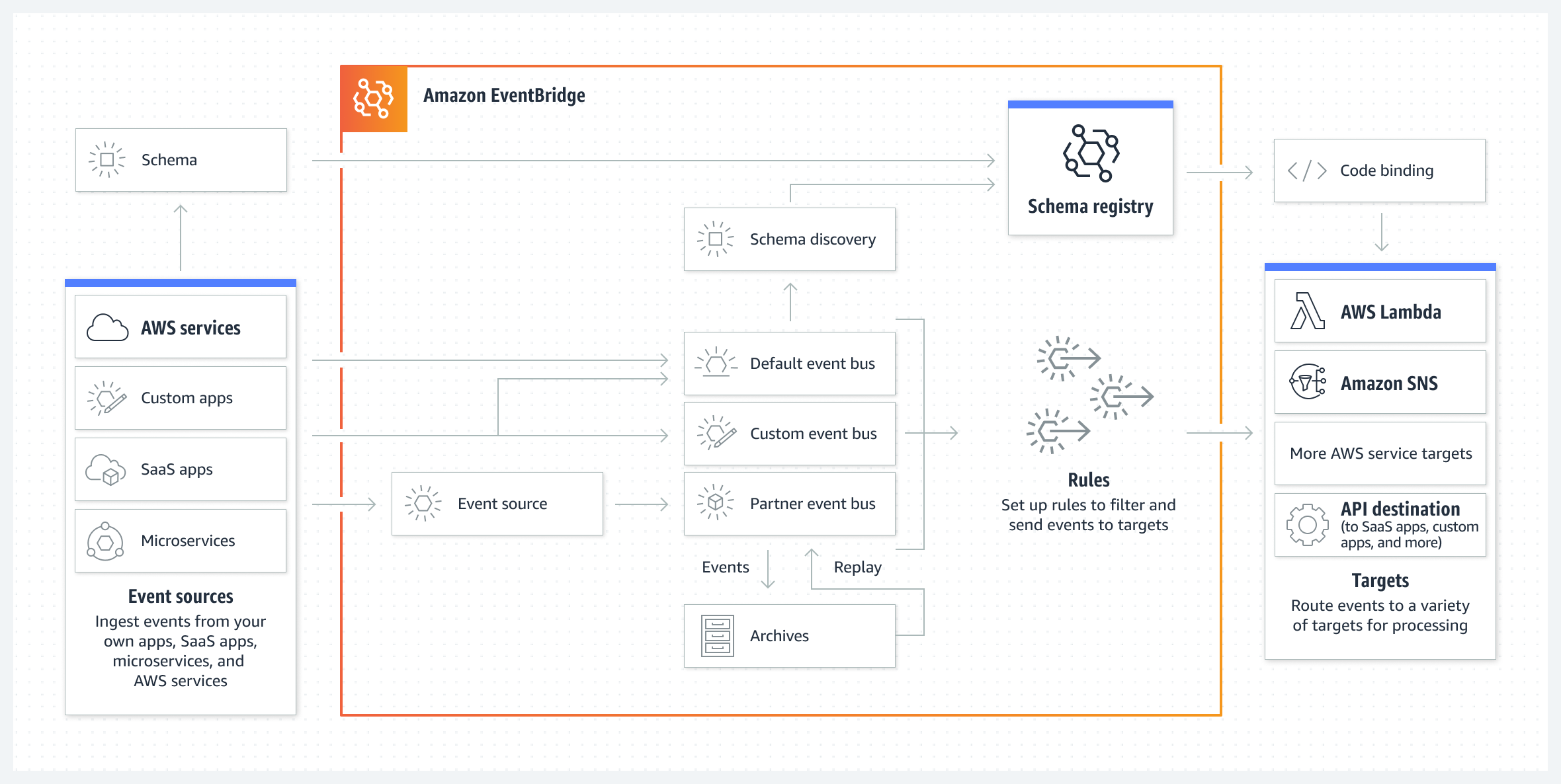
EventBridge Components
- EventBridge receives an event on an event bus and applies a rule to route the event to a target.
- Event sources
- An event source is used to ingest events from AWS Services, applications, or SaaS partners.
- EventBridge is natively integrated with SaaS applications including Shopify, BuildKite, Datadog, OneLogin, PagerDuty, Saviynt, Segment, Stripe, Zendesk, and many others.
- Events
- An event is a real-time indicator of a change in the environment such as an AWS environment, a SaaS partner service or application, or one of your applications or services.
- All events are associated with an event bus.
- Events are represented as JSON objects and they all have a similar structure and the same top-level fields.
- Contents of the detail top-level field are different depending on which service generated the event and what the event is.
- An event pattern defines the event structure and the fields that a rule matches.
- Event buses
- Event bus is a pipeline that receives events.
- Each account has a default event bus that receives events from AWS services. Custom event buses can be created to send or receive events from a different account or Region.
- Partner event buses can be created to receive events from SaaS partner applications.
- Rules
- Rules associated with the event bus evaluate events as they arrive.
- Rules match incoming events to targets based either on the structure of the event, called an event pattern, or on a schedule.
- Each rule checks whether an event matches the rule’s criteria.
- A single rule can send an event to multiple targets, which then run in parallel.
- Up to five targets can be defined for each rule.
- Rules that are based on a schedule perform an action at regular intervals.
- Targets
- A target is a resource or endpoint that EventBridge sends an event to when the event matches the event pattern defined for a rule.
- The rule processes the event data and sends the relevant information to the target.
- EventBridge needs permission to access the target resource to be able to deliver event data to the target.
- Supported targets include AWS Lambda, Amazon SQS, Amazon SNS, AWS Step Functions, Amazon Kinesis Data Streams, Amazon Kinesis Data Firehose, and more.
- EventBridge also supports API Destinations as targets for sending events to any HTTPS endpoint.
- EventBridge allows events to be archived and replayed later.
EventBridge Pipes
- EventBridge Pipes is a serverless integration resource for building point-to-point integrations between event producers and consumers.
- Pipes provide a simpler and consistent way to integrate sources with targets without writing additional code.
- Pipes support four sequential stages: Source → Filter → Enrichment → Target.
- Supported sources include Amazon DynamoDB Streams, Amazon Kinesis Data Streams, Amazon MQ, Amazon MSK, Apache Kafka, Amazon SQS.
- Supported targets include over 14 AWS services including Lambda, Step Functions, SQS, SNS, Kinesis Data Streams, Kinesis Data Firehose, EventBridge event buses, and API destinations.
- Filtering enables processing only a targeted subset of events using event patterns.
- Enrichment allows enhancing data by calling Lambda, Step Functions, API Gateway, or API destinations before sending to the target.
- Pipes support logging to Amazon CloudWatch Logs, Amazon S3, and Amazon Kinesis Data Firehose for improved observability.
- Pricing is based on events processed at $0.40 per million events.
EventBridge Scheduler
- Amazon EventBridge Scheduler is a serverless scheduler that allows creating, running, and managing scheduled tasks at scale.
- EventBridge Scheduler can schedule one-time or recurring tens of millions of tasks across many AWS services without provisioning or managing underlying infrastructure.
- Scheduler is highly customizable and offers improved scalability over EventBridge scheduled rules, with a wider set of target API operations and AWS services.
- Supports three schedule types:
- Rate-based schedules – run at regular intervals (e.g., every 5 minutes).
- Cron-based schedules – run at specific times using cron expressions.
- One-time schedules – run once at a specific date and time.
- Can invoke over 200 AWS services as targets using the universal target (any AWS API).
- Supports flexible time windows for delivery, retry limits, and maximum retention time for failed API invocations.
- Supports schedule groups for organizing and managing related schedules.
- Supports automatic deletion – EventBridge Scheduler automatically deletes the schedule after its last target invocation.
- Scheduler provides independent functionality from event buses and rules.
EventBridge Global Endpoints
- Global endpoints provide an easier and reliable way to improve the availability of event-driven applications.
- Global endpoints automatically fail over event ingestion to a secondary Region during service disruptions without manual intervention.
- Event replication (optional) is built-in to send all custom events to event buses in both primary and secondary Regions using managed rules.
- Uses Amazon Route 53 health checks (backed by CloudWatch Alarms) to determine when to fail over and when to route events back to the primary Region.
- Minimizes data loss during service disruptions.
- Reduces operational burden with automatic failover and recovery capability.
EventBridge Schema Registry
- Schema Registry stores event schemas in a shared central location that developers can easily search and access.
- Schemas for AWS services are automatically available in the registry.
- Schema Discovery can be enabled on an event bus to automatically detect and add schemas for all events flowing through the bus.
- Supports cross-account event discovery.
- Schema Registry can generate code bindings for Java, Python, and TypeScript, allowing events to be used as objects in code.
- Schemas are stored in OpenAPI or JSONSchema formats.
- Schema Discovery does not support events larger than 1000 KiB.
EventBridge API Destinations
- API Destinations enable sending events to any web-based application with an HTTPS endpoint without writing custom code.
- Supports routing events to on-premises, SaaS, and third-party applications.
- Provides built-in authentication support (Basic, OAuth, API Key).
- Supports rate limiting to control throughput to the destination.
- Uses connections to define authorization methods, credentials, and network connectivity.
- Supports integration with private APIs powered by AWS PrivateLink and Amazon VPC Lattice (announced December 2024), enabling secure connectivity to private resources across VPCs, accounts, and on-premises environments.
- Supports input transformations to map event format to the receiving service format.
Event Archive and Replay
- EventBridge allows events to be archived for later replay.
- Event Replay enables reprocessing past events back to an event bus or a specific rule.
- Useful for debugging applications, hydrating targets with historic events, and recovering from errors.
- Events can be stored for compliance requirements.
EventBridge Enhanced Logging
- Enhanced logging (launched July 2025) enables monitoring and debugging event-driven applications with comprehensive logs.
- Supports logging to Amazon CloudWatch Logs, Amazon S3, and Amazon Kinesis Data Firehose.
- Logs results from rule matching, errors, and target invocations for event buses.
- Helps track event lifecycles and gain deeper insights into event processing.
EventBridge Data Plane CloudTrail Logging
- EventBridge supports logging data plane APIs using AWS CloudTrail (announced May 2026).
- Enables greater visibility into event bus activity, including PutEvents API calls.
- The feature is opt-in and provides enhanced security auditing and operational troubleshooting capabilities.
- Additional charges apply for CloudTrail data events.
EventBridge Enhanced Visual Rule Builder
- EventBridge introduced an enhanced visual rule builder (November 2025) with a drag-and-drop console-based interface.
- Includes a comprehensive event catalog for discovering and subscribing to events from custom applications and over 200 AWS services.
- Simplifies the process of creating rules by providing a visual canvas for building rules and targets.
EventBridge Security and Compliance
- Integrates with AWS IAM for controlling access to resources.
- Supports VPC endpoints via AWS PrivateLink.
- Encryption in transit using TLS 1.2.
- GDPR, SOC, ISO, DoD CC SRG, and FedRAMP compliant.
- HIPAA eligible.
EventBridge Key Features Summary
- Provides at-least-once event delivery to targets, with retry and exponential backoff for up to 24 hours.
- Events are stored durably across multiple Availability Zones (AZs).
- 99.99% availability SLA.
- Pay-per-use pricing model – pay only for events published to the event bus.
- All state change events published by AWS services are free.
- Supports cross-account and cross-region event routing.
AWS Certification Exam Practice Questions
- Questions are collected from Internet and the answers are marked as per my knowledge and understanding (which might differ with yours).
- AWS services are updated everyday and both the answers and questions might be outdated soon, so research accordingly.
- AWS exam questions are not updated to keep up the pace with AWS updates, so even if the underlying feature has changed the question might not be updated
- Open to further feedback, discussion and correction.
- A company wants to be alerted through email when IAM CreateUser API calls are made within its AWS account. Which combination of actions should a SysOps administrator take to meet this requirement? (Choose two.)
- Create an Amazon EventBridge rule with AWS CloudTrail as the event source and IAM CreateUser as the specific API call for the event pattern.
- Create an Amazon EventBridge rule with Amazon CloudSearch as the event source and IAM CreateUser as the specific API call for the event pattern.
- Create an Amazon EventBridge rule with AWS IAM Access Analyzer as the event source and IAM CreateUser as the specific API call for the event pattern.
- Use an Amazon Simple Notification Service (Amazon SNS) topic as an event target with an email subscription.
- Use an Amazon Simple Email Service (Amazon SES) notification as an event target with an email subscription.
- A company needs to schedule millions of one-time notifications to be sent to mobile devices at specific times. The scheduled times vary for each notification. Which AWS service should the solutions architect recommend?
- Amazon EventBridge scheduled rules
- Amazon EventBridge Scheduler
- AWS Lambda with Amazon CloudWatch Events
- Amazon SQS with delay queues
- A development team wants to create a point-to-point integration that processes events from an Amazon SQS queue, filters specific events, enriches them with data from a Lambda function, and delivers them to an Amazon Kinesis Data Stream. Which EventBridge feature should they use?
- EventBridge Rules with multiple targets
- EventBridge API Destinations
- EventBridge Pipes
- EventBridge Schema Registry
- A company wants to build a highly available event-driven application that automatically fails over to a secondary Region during service disruptions. Which EventBridge feature should they implement?
- EventBridge cross-Region event routing with rules
- EventBridge Archive and Replay
- EventBridge Global Endpoints
- EventBridge Pipes with multi-region targets
- A solutions architect needs to send events from an EventBridge event bus to a third-party SaaS application’s REST API endpoint. The endpoint requires OAuth authentication and rate limiting. Which feature should be used?
- EventBridge Pipes with an HTTP enrichment
- EventBridge rule targeting AWS Lambda
- EventBridge API Destinations
- EventBridge Partner Event Source
- A company wants to invoke a private API hosted in their VPC directly from EventBridge without traversing the public internet. Which combination of services enables this? (Choose two.)
- Amazon VPC Lattice resource configuration
- Amazon API Gateway public endpoint with VPC link
- AWS Direct Connect with EventBridge
- EventBridge API Destinations with private API connection
- EventBridge Pipes with VPC target