⚠️ PARTIAL DEPRECATION NOTICE
AWS OpsWorks (all variants) reached End of Life (EOL) in 2024.
- AWS OpsWorks for Puppet Enterprise – EOL March 31, 2024
- AWS OpsWorks for Chef Automate – EOL May 5, 2024
- AWS OpsWorks Stacks – EOL May 26, 2024
The OpsWorks services have been disabled for both new and existing customers. The comparison sections involving OpsWorks are maintained for historical reference.
Current Deployment & Management Options:
- AWS CloudFormation – Infrastructure as Code (still actively supported and enhanced)
- AWS Elastic Beanstalk – Simplified application deployment (still actively supported)
- AWS CDK – Programmatic infrastructure definition using familiar languages
- AWS Systems Manager – Configuration management and automation (OpsWorks replacement)
- AWS CodeDeploy – Application deployment automation
- AWS App Runner – Fully managed container application service
For OpsWorks migration guidance, refer to: AWS OpsWorks EOL Documentation
AWS Elastic Beanstalk vs CloudFormation vs CDK – Deployment & Management Services Comparison
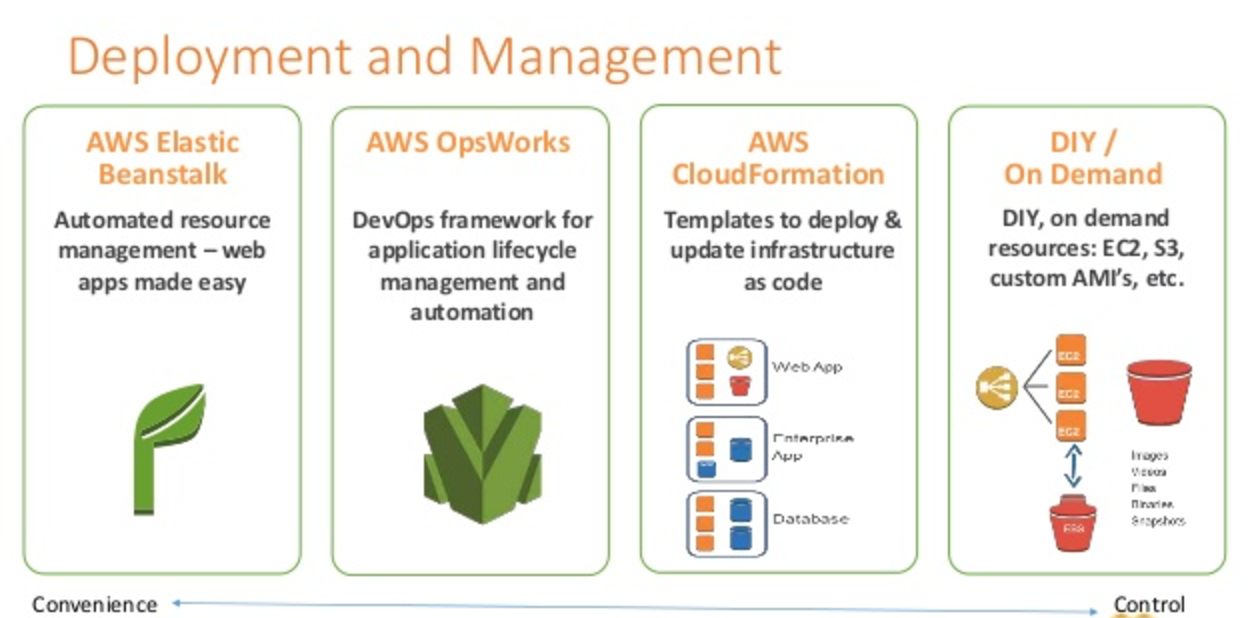
AWS offers multiple options for provisioning IT infrastructure and application deployment and management, varying from convenience & ease of setup to low-level granular control.
AWS Elastic Beanstalk
- AWS Elastic Beanstalk is a higher-level service which allows you to quickly deploy with minimum management effort a web or worker-based environment using EC2, Docker using ECS, Elastic Load Balancing, Auto Scaling, RDS, CloudWatch, etc.
- Elastic Beanstalk is the fastest and simplest way to get an application up and running on AWS, perfect for developers who want to deploy code and not worry about underlying infrastructure.
- Elastic Beanstalk provides an environment to easily deploy and run applications in the cloud. It is integrated with developer tools and provides a one-stop experience for application lifecycle management.
- Elastic Beanstalk requires minimal configuration and will help deploy, monitor, and handle the elasticity/scalability of the application.
- A user doesn’t need to do much more than write application code and configure some settings on Elastic Beanstalk.
- Supports platforms including Java, .NET, PHP, Node.js, Python, Ruby, Go, and Docker on Amazon Linux 2 and Amazon Linux 2023.
- AI-Powered Environment Analysis (2026) – Elastic Beanstalk now offers AI-powered analysis that automatically diagnoses environment health issues, identifies root causes, and provides recommended solutions when health status is Warning, Degraded, or Severe.
- Dual-Stack IPv6 Support (2025) – Supports dual-stack configuration for Application Load Balancers and Network Load Balancers, allowing environments to serve both IPv4 and IPv6 traffic.
AWS OpsWorks (Deprecated – EOL 2024)
⚠️ All AWS OpsWorks services reached End of Life in 2024 and have been disabled for all customers.
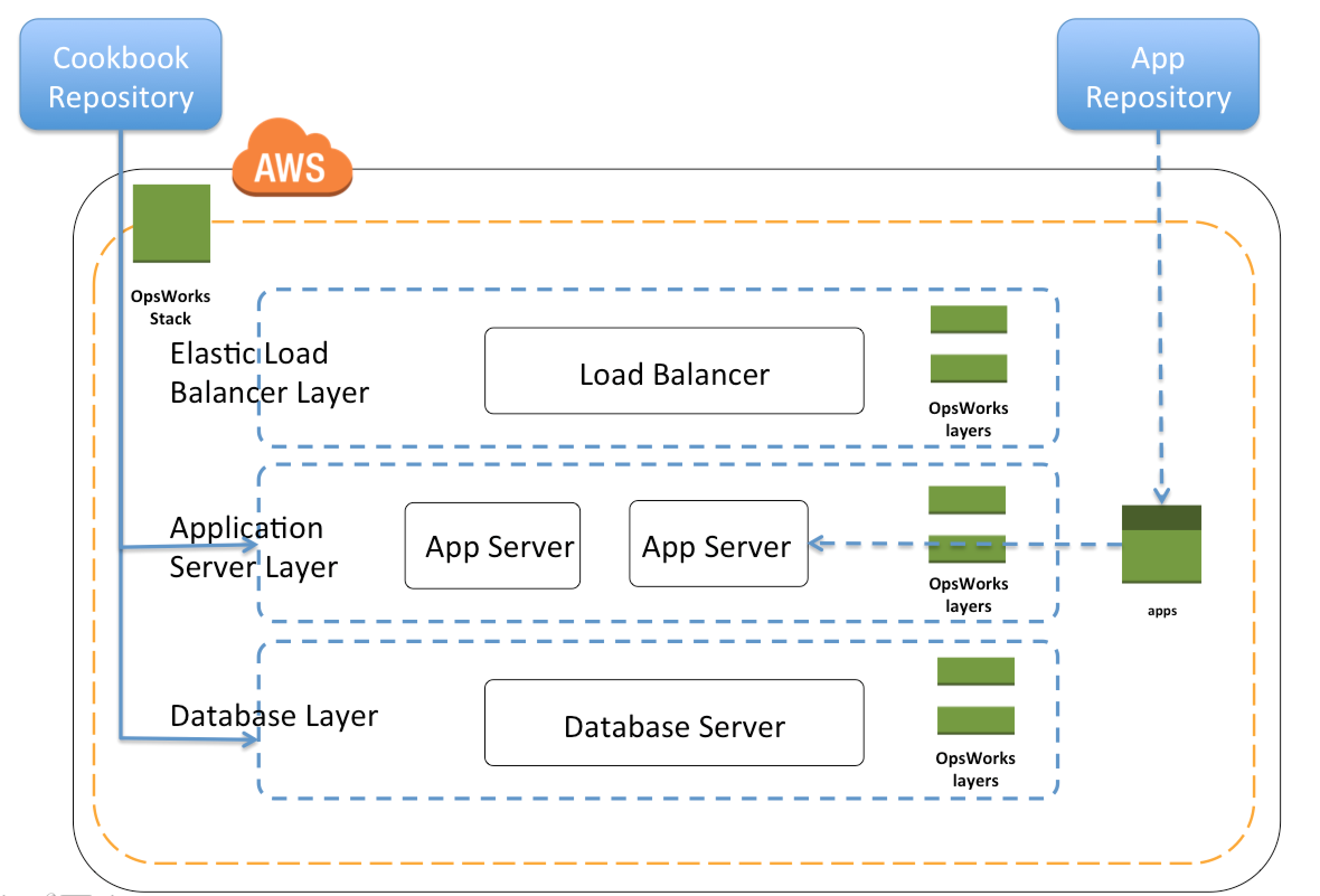
- AWS OpsWorks was an application management service that simplified software configuration, application deployment, scaling, and monitoring using Chef or Puppet.
- OpsWorks was recommended for managing infrastructure with a configuration management system such as Chef.
- OpsWorks enabled writing custom Chef recipes, utilized self-healing, and worked with layers.
- Although OpsWorks was a deployment management service that helped deploy applications with Chef recipes, it was not primarily meant to manage scaling out of the box and needed to be handled explicitly.
- Migration Paths:
- AWS Systems Manager – For configuration management and automation (recommended by AWS)
- Chef SaaS – For customers who want to continue using Chef recipes
- Puppet Enterprise – Self-hosted Puppet for existing Puppet users
- AWS CodeDeploy – For application deployment workflows
- Amazon ECS/EKS – For containerized workloads
AWS CloudFormation
- AWS CloudFormation enables modeling, provisioning, and version-controlling of a wide range of AWS resources ranging from a single EC2 instance to a complex multi-tier, multi-region application.
- CloudFormation is a low-level service and provides granular control to provision and manage stacks of AWS resources based on templates (JSON or YAML).
- CloudFormation templates enable version control of the infrastructure and make deployment of environments easy and repeatable.
- CloudFormation supports infrastructure needs of many different types of applications such as existing enterprise applications, legacy applications, applications built using a variety of AWS resources, and container-based solutions (including those built using AWS Elastic Beanstalk).
- CloudFormation is not just an application deployment tool but can provision any kind of AWS resource.
- CloudFormation is designed to complement Elastic Beanstalk and other AWS services.
- CloudFormation with Elastic Beanstalk
- CloudFormation supports Elastic Beanstalk application environments as one of the AWS resource types.
- This allows you, for example, to create and manage an AWS Elastic Beanstalk–hosted application along with an RDS database to store the application data. In addition to RDS instances, any other supported AWS resource can be added to the group as well.
- Key Updates (2024-2025):
- Stack Refactoring (2025) – Move resources between stacks, rename logical IDs, and decompose monolithic templates into focused components without disrupting running infrastructure.
- 40% Faster Deployments (2024) – Optimistic stabilization with CONFIGURATION_COMPLETE event enables parallel creation of dependent resources.
- IaC Generator – Generate CloudFormation templates from existing AWS resources (reverse-engineer existing infrastructure into IaC).
- Configuration Drift Management – Improved drift detection and remediation capabilities.
- AI Integration – IaC context integrated with AI-powered development tools.
AWS Cloud Development Kit (AWS CDK)
- AWS CDK is an open-source software development framework that allows you to define cloud infrastructure using familiar programming languages (TypeScript, JavaScript, Python, Java, C#/.NET, Go).
- CDK synthesizes into CloudFormation templates, providing the reliability of CloudFormation with the expressiveness of general-purpose programming languages.
- CDK provides high-level constructs (L2/L3) that encapsulate AWS best practices and reduce the amount of boilerplate code needed.
- CDK is ideal for teams who prefer imperative programming over declarative YAML/JSON templates.
- Same infrastructure that takes 500+ lines of CloudFormation YAML can be expressed in ~15 lines of CDK TypeScript.
- CDK Refactoring (2025) – Refactor CDK code (rename constructs, move resources between stacks) while preserving deployed resources.
- CDK Mixins (2026) – Add composable, reusable abstractions to any construct (L1, L2, or custom) without rebuilding existing infrastructure code.
- CDK Aspects – Apply organization-wide policies (security rules, tagging standards, compliance requirements) across entire infrastructure.
AWS Serverless Application Model (AWS SAM)
- AWS SAM is an open-source framework specifically designed for building serverless applications using infrastructure as code.
- SAM extends CloudFormation with shorthand syntax to express Lambda functions, APIs, databases, and event source mappings with fewer lines of code.
- During deployment, SAM transforms the SAM syntax into CloudFormation syntax, then CloudFormation provisions the resources.
- SAM CLI provides local testing, debugging, packaging, and deployment capabilities.
- SAM Accelerate – Speeds up local development and cloud testing.
- WebSocket API Support (2026) – Define complete WebSocket APIs for API Gateway with minimal configuration.
- SAM CLI integrates with AWS CDK and Terraform.
AWS App Runner
- AWS App Runner is a fully managed container application service that lets you build, deploy, and run containerized web applications and API services without prior infrastructure or container experience.
- App Runner connects directly to your code or image repository and provides an automatic CI/CD pipeline with fully managed operations, high performance, scalability, and security.
- App Runner automatically handles load balancing, auto-scaling (including scale to zero), encryption, and health monitoring.
- Ideal for web applications and APIs that need to deploy quickly from source code or container images without managing infrastructure.
- Supports deployment from GitHub, Bitbucket, or Amazon ECR.
AWS Proton (Deprecated – EOL October 7, 2026)
⚠️ AWS Proton will reach End of Life on October 7, 2026. Plan migration accordingly.
- AWS Proton was a fully managed deployment service that standardized how organizations deploy microservices and infrastructure from approved templates.
- Proton sat on top of CloudFormation (or Terraform) and added self-service deployment, versioning, parameter validation, and standardization.
- Designed for platform teams to provide standardized templates while giving developers self-service deployment speed.
- After EOL, the Proton console, API, and pipeline management will be permanently unavailable, though deployed infrastructure will remain intact.
Comparison Summary
| Service | Level | Best For | Status |
|---|---|---|---|
| Elastic Beanstalk | High-level PaaS | Developers who want to deploy code without managing infrastructure | ✅ Active |
| CloudFormation | Low-level IaC | Granular control over all AWS resources via declarative templates | ✅ Active |
| AWS CDK | High-level IaC | Teams who prefer defining infrastructure in programming languages | ✅ Active |
| AWS SAM | Serverless IaC | Serverless applications (Lambda, API Gateway, DynamoDB) | ✅ Active |
| App Runner | Fully Managed | Container web apps/APIs without any infrastructure management | ✅ Active |
| OpsWorks | Configuration Mgmt | Chef/Puppet based configuration management | ❌ EOL (2024) |
| AWS Proton | Template Orchestration | Standardized microservice deployment templates | ⚠️ EOL Oct 2026 |
AWS Certification Exam Practice Questions
- Questions are collected from Internet and the answers are marked as per my knowledge and understanding (which might differ with yours).
- AWS services are updated everyday and both the answers and questions might be outdated soon, so research accordingly.
- AWS exam questions are not updated to keep up the pace with AWS updates, so even if the underlying feature has changed the question might not be updated
- Open to further feedback, discussion and correction.
- Your team is excited about the use of AWS because now they have access to programmable infrastructure. You have been asked to manage your AWS infrastructure in a manner similar to the way you might manage application code. You want to be able to deploy exact copies of different versions of your infrastructure, stage changes into different environments, revert back to previous versions, and identify what versions are running at any particular time (development, test, QA, production). Which approach addresses this requirement?
- Use cost allocation reports and AWS OpsWorks to deploy and manage your infrastructure.
- Use AWS CloudWatch metrics and alerts along with resource tagging to deploy and manage your infrastructure.
- Use AWS Elastic Beanstalk and a version control system like GIT to deploy and manage your infrastructure.
- Use AWS CloudFormation and a version control system like GIT to deploy and manage your infrastructure.
- An organization is planning to use AWS for their production roll out. The organization wants to implement automation for deployment such that it will automatically create a LAMP stack, download the latest PHP installable from S3 and setup the ELB. Which of the below mentioned AWS services meets the requirement for making an orderly deployment of the software?
- AWS Elastic Beanstalk
- AWS CloudFront
- AWS CloudFormation
- AWS DevOps
- You are working with a customer who is using Chef configuration management in their data center. Which service is designed to let the customer leverage existing Chef recipes in AWS?
Note: AWS OpsWorks reached EOL in 2024. For Chef-based configuration management on AWS, customers should now use Chef SaaS or AWS Systems Manager with Chef recipes via Application Manager.
- Amazon Simple Workflow Service
- AWS Elastic Beanstalk
- AWS CloudFormation
- AWS OpsWorks (Historical answer – service now deprecated)
- A company wants to define their infrastructure using a programming language like TypeScript instead of writing YAML templates. They want the same reliability as CloudFormation but with less boilerplate code. Which AWS service should they use?
- AWS Elastic Beanstalk
- AWS Cloud Development Kit (CDK)
- AWS SAM
- AWS App Runner
- A startup wants to deploy a containerized web application with minimal infrastructure management. They want automatic scaling, load balancing, and a CI/CD pipeline connected to their GitHub repository. Which AWS service provides the simplest solution?
- Amazon ECS with Fargate
- AWS Elastic Beanstalk
- AWS App Runner
- AWS CloudFormation
- A team is building a serverless application using Lambda functions, API Gateway, and DynamoDB. They want to define their infrastructure using a simplified template syntax with built-in local testing capabilities. Which tool is most appropriate?
- AWS CloudFormation
- AWS CDK
- AWS SAM
- AWS Elastic Beanstalk
- An organization has a large monolithic CloudFormation stack that they want to split into smaller, focused stacks without recreating their existing infrastructure. Which CloudFormation feature enables this?
- CloudFormation StackSets
- CloudFormation Change Sets
- CloudFormation Stack Refactoring
- CloudFormation Nested Stacks