AWS Network Connectivity Options
Internet Gateway
- provides Internet connectivity to VPC
- is a horizontally scaled, redundant, and highly available component that allows communication between instances in your VPC and the internet.
- imposes no availability risks or bandwidth constraints on your network traffic.
- serves two purposes: to provide a target in the VPC route tables for internet-routable traffic and to perform NAT for instances that have not been assigned public IPv4 addresses.
- supports IPv4 and IPv6 traffic.
NAT Gateway
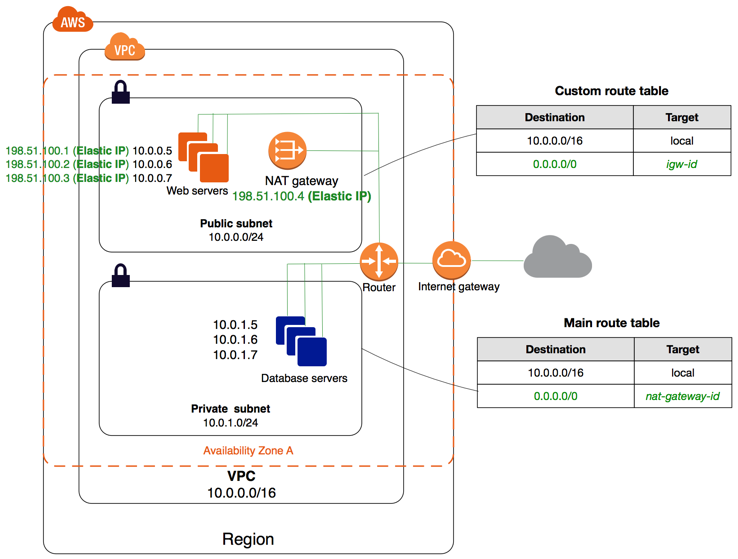
- enables instances in a private subnet to connect to the internet or other AWS services, but prevents the Internet from initiating connections with the instances.
- Public NAT gateway allows instances in private subnets to connect to the internet through the NAT gateway’s Elastic IP address.
- Private NAT gateway allows instances in private subnets to connect to other VPCs or the on-premises network using its private IP address for source NAT.
- Regional NAT Gateway (New – Nov 2025) – automatically expands across Availability Zones based on workload presence. Unlike standard (zonal) NAT gateways which operate in a single AZ, regional NAT gateways follow workloads to provide automatic high availability without requiring a public subnet to host the gateway.
Egress Only Internet Gateway
- NAT devices are not supported for IPv6 traffic, use an Egress-only Internet gateway instead
- Egress-only Internet gateway is a horizontally scaled, redundant, and highly available VPC component
- Egress-only Internet gateway allows outbound communication over IPv6 from instances in the VPC to the Internet and prevents the Internet from initiating an IPv6 connection with your instances.
VPC Endpoints
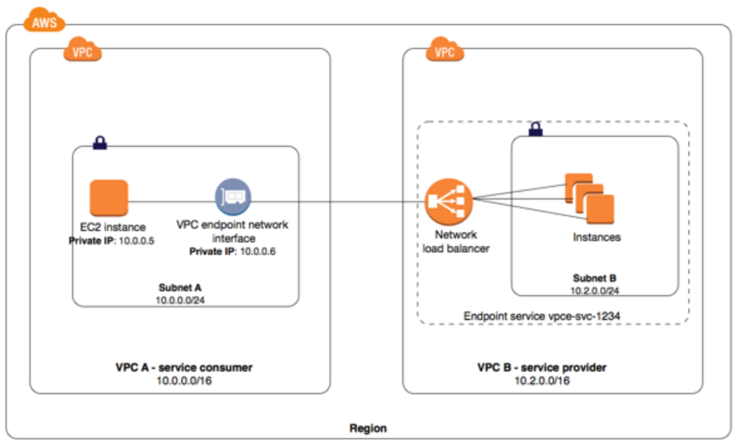
- VPC endpoint provides a private connection from VPC to supported AWS services and VPC endpoint services powered by PrivateLink without requiring an internet gateway, NAT device, VPN connection, or AWS Direct Connect connection.
- Instances in the VPC do not require public IP addresses to communicate with resources in the service. Traffic between the VPC and the other service does not leave the Amazon network.
- VPC Endpoints are virtual devices and are horizontally scaled, redundant, and highly available VPC components that allow communication between instances in the VPC and services without imposing availability risks or bandwidth constraints on the network traffic.
- VPC Endpoints are of three types
- Interface Endpoints – is an elastic network interface with a private IP address that serves as an entry point for traffic destined to supported services.
- Gateway Endpoints – is a gateway that is a target for a specified route in your route table, used for traffic destined to a supported AWS service. Currently only Amazon S3 and DynamoDB.
- Resource Endpoints (New – Dec 2024) – enables private access to a specific resource (e.g., RDS database, IP address, or domain name) in another VPC or on-premises environment shared via AWS RAM, without requiring an NLB.
- Cross-Region PrivateLink (Nov 2025) – Interface VPC endpoints now support cross-region connectivity, breaking the previous limitation that endpoints were regional-only. This enables connecting to VPC endpoint services hosted in other AWS Regions within the same partition.
VPC Private Links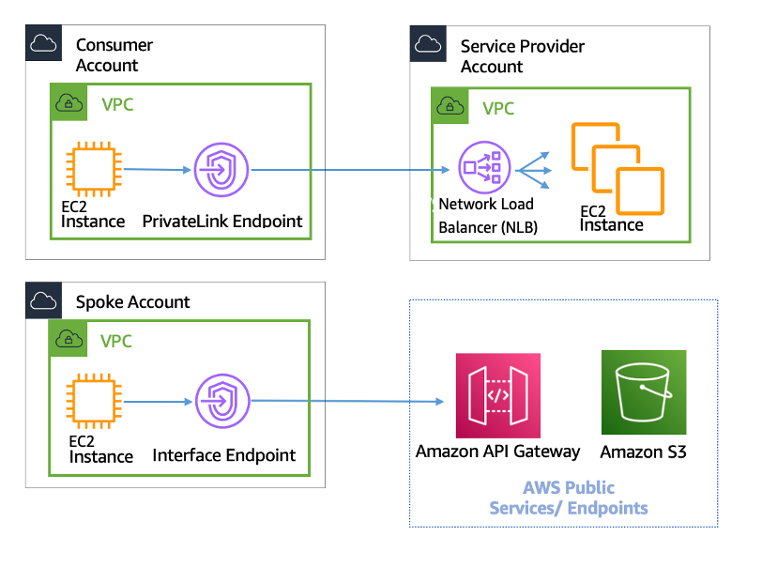
- provides private connectivity between VPCs, AWS services, and your on-premises networks without exposing your traffic to the public internet.
- helps privately expose a service/application residing in one VPC (service provider) to other VPCs (consumer) within an AWS Region in a way that only consumer VPCs initiate connections to the service provider VPC.
- With ALB as a target of NLB, ALB’s advanced routing capabilities can be combined with AWS PrivateLink.
- VPC Resource Gateway (Dec 2024) – allows sharing any VPC resource (RDS databases, domain names, IP addresses) via AWS RAM. Consumers access these resources privately using VPC endpoints without needing an NLB, simplifying hybrid networking.
- Cross-Region Connectivity (Nov 2025) – PrivateLink now supports native cross-region access for both AWS services and customer endpoint services, enabling global private connectivity from a single Region deployment.
VPC Peering
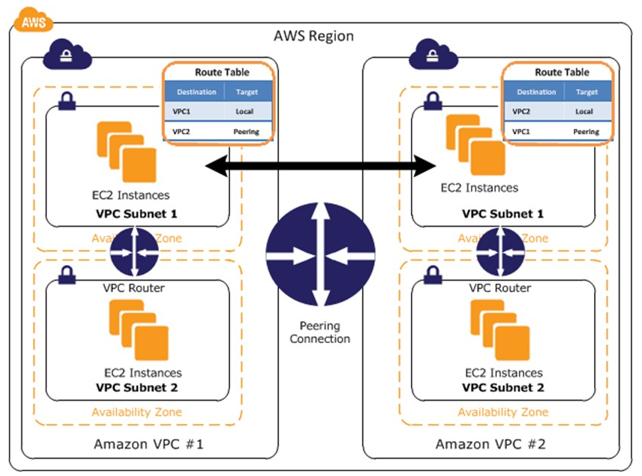
- enables networking connection between two VPCs to route traffic between them using private IPv4 addresses or IPv6 addresses
- connections can be created between your own VPCs, or with a VPC in another AWS account.
- enables full bidirectional connectivity between the VPCs
- supports inter-region VPC peering connection
- Inter-region peering now supports jumbo frames (up to 8500 bytes MTU) and full instance bandwidth (Mar 2025)
- uses existing underlying AWS infrastructure
- does not have a single point of failure for communication or a bandwidth bottleneck.
- VPC Peering connections have limitations
- cannot be used with Overlapping CIDR blocks
- does not provide Transitive peering
- does not support Edge to Edge routing through Gateway or private connection
- is best used when resources in one VPC must communicate with resources in another VPC, the environment of both VPCs is controlled and secured, and the number of VPCs to be connected is less than 10
- supports a limit of 125 active peering connections per VPC
- Simplified Billing (Apr 2025) – AWS simplified VPC Peering billing; no changes to data transfer pricing but billing structure is streamlined.
VPN CloudHub
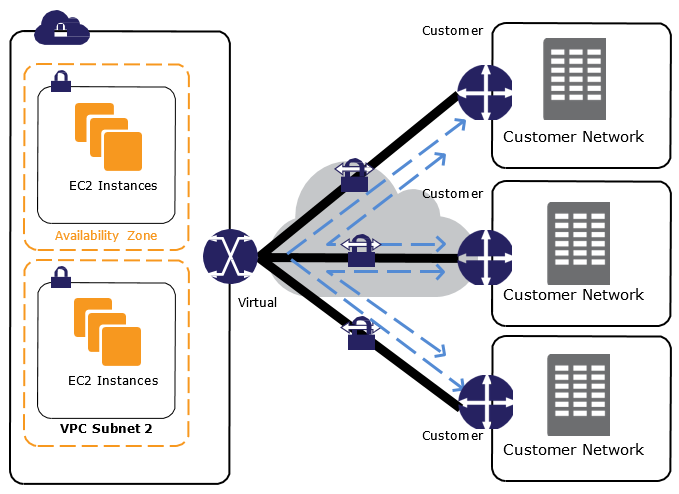
- AWS VPN CloudHub allows you to securely communicate from one site to another using AWS Managed VPN or Direct Connect
- AWS VPN CloudHub operates on a simple hub-and-spoke model that can be used with or without a VPC
- AWS VPN CloudHub can be used if you have multiple branch offices and existing internet connections and would like to implement a convenient, potentially low cost hub-and-spoke model for primary or backup connectivity between these remote offices.
- AWS VPN CloudHub leverages VPC virtual private gateway with multiple gateways, each using unique BGP autonomous system numbers (ASNs).
Transit VPC
⚠️ Note: Transit VPC is a legacy architecture pattern. AWS recommends using AWS Transit Gateway or AWS Cloud WAN for new deployments, which provide managed, highly available hub-and-spoke connectivity without the operational overhead of managing EC2-based virtual appliances.
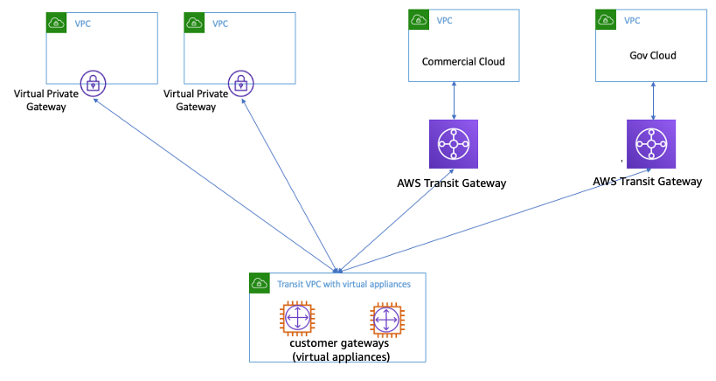
- A transit VPC is a common strategy for connecting multiple, geographically disperse VPCs and remote networks in order to create a global network transit center.
- A transit VPC simplifies network management and minimizes the number of connections required to connect multiple VPCs and remote networks
- Transit VPC can be used to support important use cases
- Private Networking – You can build a private network that spans two or more AWS Regions.
- Shared Connectivity – Multiple VPCs can share connections to data centers, partner networks, and other clouds.
- Cross-Account AWS Usage – The VPCs and the AWS resources within them can reside in multiple AWS accounts.
- Transit VPC design helps implement more complex routing rules, such as network address translation between overlapping network ranges, or to add additional network-level packet filtering or inspection.
- Transit VPC
- supports Transitive routing using the overlay VPN network — allowing for a simpler hub and spoke design.
- supports network address translation between overlapping network ranges.
- supports vendor functionality around advanced security (layer 7 firewall/IPS/IDS) using third-party software on EC2
- leverages instance-based routing that increases costs while lowering availability and limiting the bandwidth.
- Customers are responsible for managing the HA and redundancy of EC2 instances running the third-party vendor virtual appliance
Transit Gateway
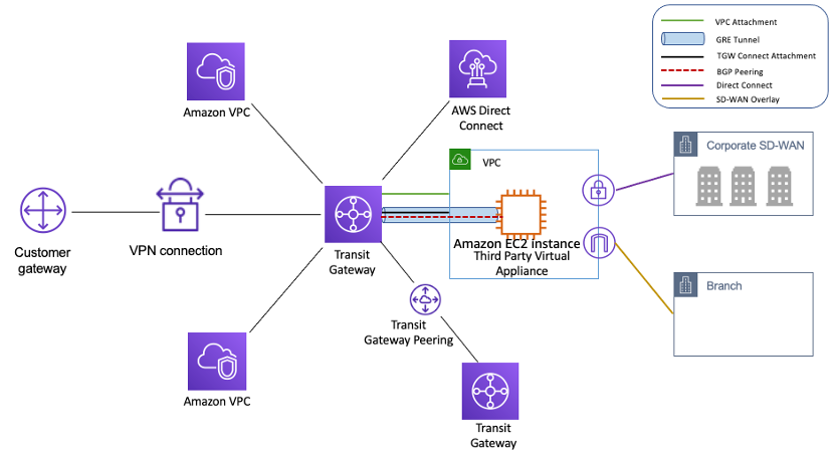
- is a highly available and scalable service to consolidate the AWS VPC routing configuration for a region with a hub-and-spoke architecture.
- is a Regional resource and can connect thousands of VPCs within the same AWS Region.
- TGWs across different regions can peer with each other to enable VPC communications within the same or different regions.
- provides simpler VPC-to-VPC communication management over VPC Peering with a large number of VPCs.
- enables you to attach VPCs (across accounts) and VPN connections in the same Region and route traffic between them.
- support dynamic and static routing between attached VPCs and VPN connections
- removes the need for using full mesh VPC Peering and Transit VPC
- Transit Gateway Flow Logs – enables capturing detailed telemetry (source/destination IPs, ports, protocol, traffic counters, timestamps) for all network flows traversing the Transit Gateway. Logs can be published to CloudWatch Logs, S3, or Firehose.
- Flexible Cost Allocation (Nov 2025) – provides granular control over how Transit Gateway data processing costs are allocated across AWS accounts within AWS Organizations.
AWS Cloud WAN
- is a managed wide area networking (WAN) service that helps build, manage, and monitor a unified global network connecting cloud and on-premises resources.
- provides a central dashboard and network policies to create a global network spanning multiple locations, removing the need to configure and manage different networks using different technologies.
- uses a policy-based automation system to define network segments, attach VPCs, VPN connections, and SD-WAN products.
- simplifies global network management compared to manually managing Transit Gateways across regions.
- key features include:
- Central Dashboard – manage branch offices, data centers, VPN connections, SD-WAN, VPCs, and Transit Gateways from one place.
- Network Policies – define how traffic is routed between segments with policy-based controls.
- Service Insertion (2024) – streamlines integrating security and inspection services (e.g., Network Firewall) into global networks.
- Routing Policy (Nov 2025) – enables route filtering, summarization, and BGP path manipulation for fine-grained traffic control at scale.
- Security Group Referencing & Enhanced DNS (Jun 2025) – simplifies security group management and DNS resolution across Cloud WAN segments.
- can be used as a migration path from Transit Gateway for organizations needing global, multi-Region network management.
- available in AWS GovCloud (US) Regions as of Jun 2026.
Hybrid Connectivity
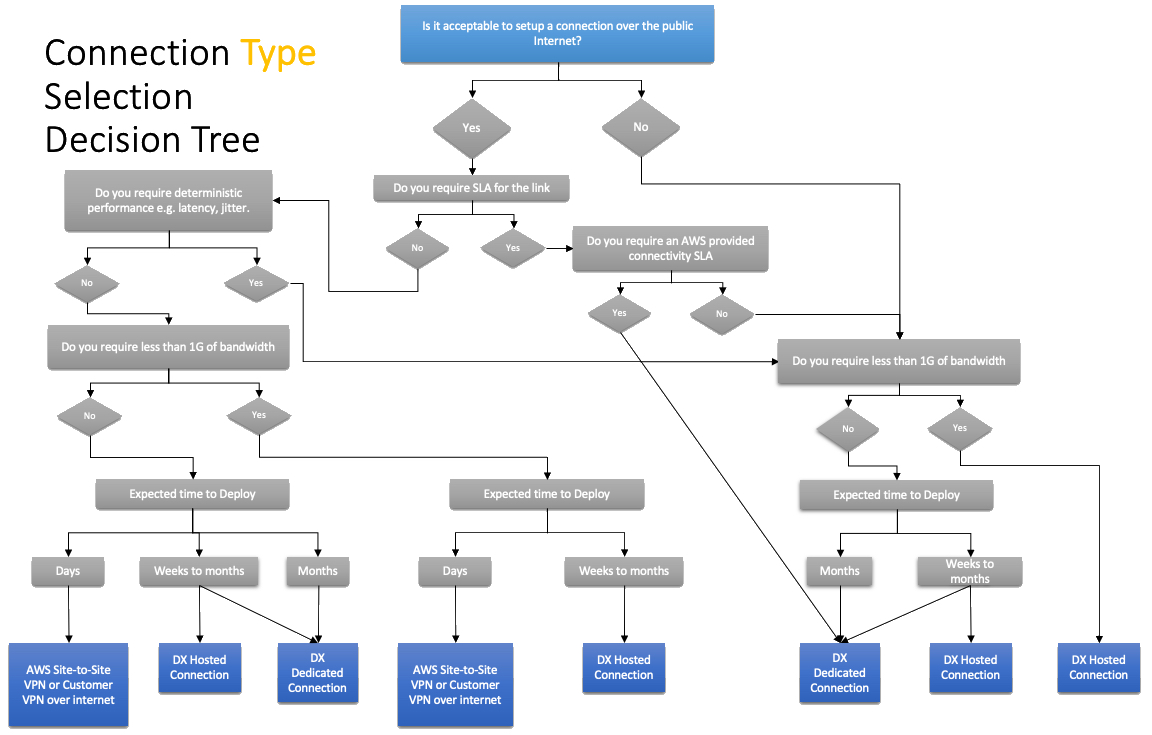
Virtual Private Network (VPN)
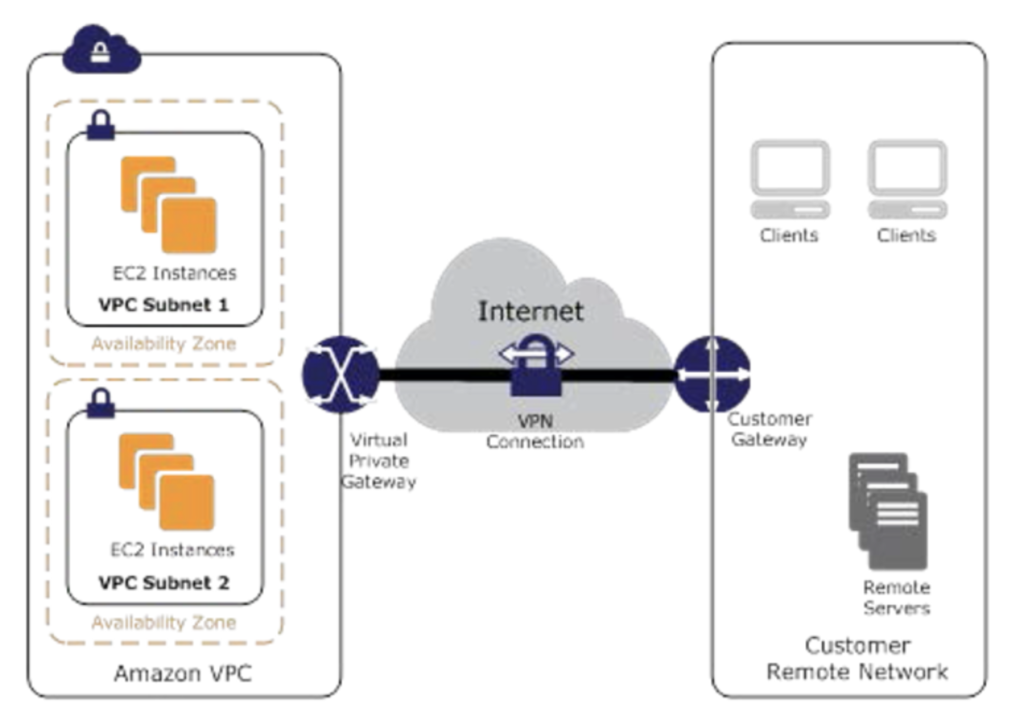
AWS Site-to-Site VPN
- VPC provides the option of creating an IPsec VPN connection between remote customer networks and their VPC over the internet
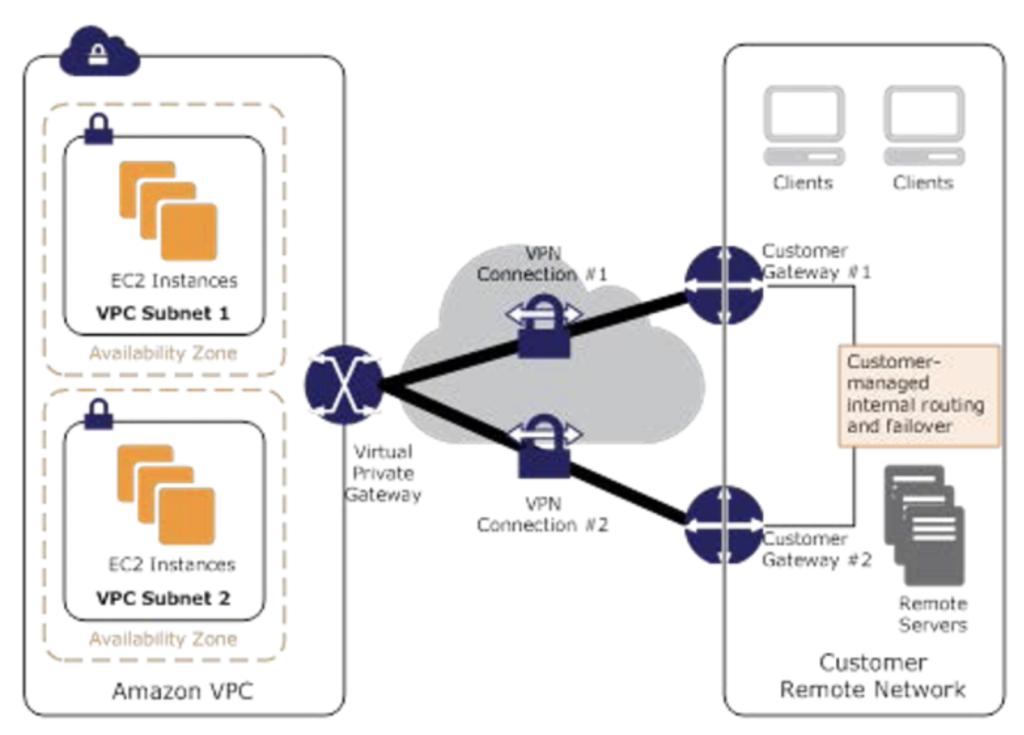
- AWS managed VPN endpoint includes automated multi–data center redundancy & failover built into the AWS side of the VPN connection
- AWS managed VPN consists of two parts
- Virtual Private Gateway (VPG) on AWS side
- Customer Gateway (CGW) on the on-premises data center
- AWS Site-to-Site VPN only provides Site-to-Site VPN connectivity. It does not provide Point-to-Site VPC connectivity (use AWS Client VPN for that).
- Virtual Private Gateway are Highly Available as it represents two distinct VPN endpoints, physically located in separate data centers to increase the availability of the VPN connection.
- High Availability on the on-premises data center must be handled by creating additional Customer Gateway.
- AWS Site-to-Site VPN connections are low cost, quick to setup and start with compared to Direct Connect. However, they are not reliable as they traverse through Internet.
- 5 Gbps Bandwidth Tunnels (Nov 2025) – supports VPN connections with up to 5 Gbps bandwidth per tunnel, a 4x improvement from the previous 1.25 Gbps limit. Beneficial for bandwidth-intensive hybrid applications, big data migrations, and disaster recovery. Bandwidth can be modified on existing connections without changing on-premises configuration (May 2026).
- IPv6 Support for Outer Tunnel IPs (Jul 2025) – supports IPv6 addresses on outer tunnel IPs, enabling full IPv6-only VPN connectivity (IPv6-in-IPv6) and mixed (IPv4-in-IPv6) configurations without IPv6>IPv4>IPv6 translation.
- VPN Concentrator (Nov 2025) – a new feature that simplifies multi-site connectivity for distributed enterprises with 25+ remote sites needing low bandwidth (under 100 Mbps each). Connects multiple remote sites through a single VPN attachment to Transit Gateway with 5 Gbps aggregate bandwidth.
AWS Client VPN
- is a fully managed, scalable VPN service that provides an endpoint for users to establish a secure remote access (Point-to-Site) connection to the AWS network.
- uses OpenVPN-based VPN client software for secure connectivity.
- handles Point-to-Site VPN connectivity that AWS Site-to-Site VPN does not provide (e.g., remote worker/mobile access).
- supports authentication via Active Directory, SAML-based federated authentication, and mutual certificate authentication.
- IPv6 Connectivity (Aug 2025) – now supports full IPv6 connectivity for Client VPN endpoints, allowing connections to IPv6 resources in VPCs and from clients on IPv6 networks.
Software VPN
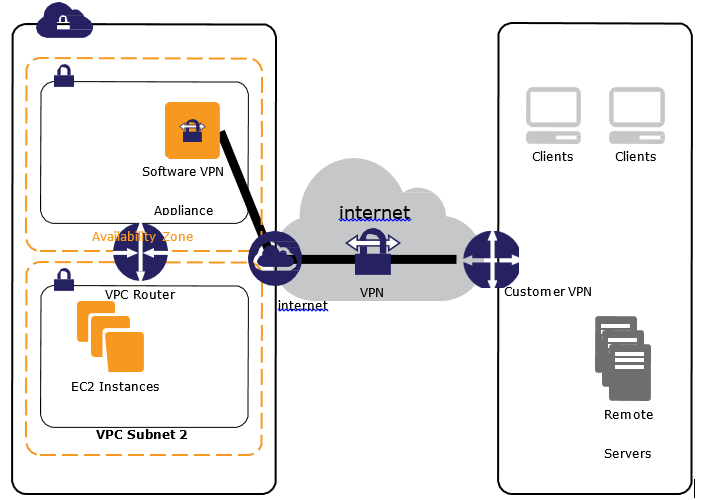
- VPC offers the flexibility to fully manage both sides of the VPC connectivity by creating a VPN connection between your remote network and a software VPN appliance running in your VPC network.
- Software VPNs help manage both ends of the VPN connection either for compliance purposes or for leveraging gateway devices that are not currently supported by Amazon VPC’s VPN solution.
- Software VPNs allows you to handle Point-to-Site connectivity (though AWS Client VPN is now the recommended managed alternative).
- Software VPNs, with the above design, introduces a single point of failure and needs to be handled.
Direct Connect – DX
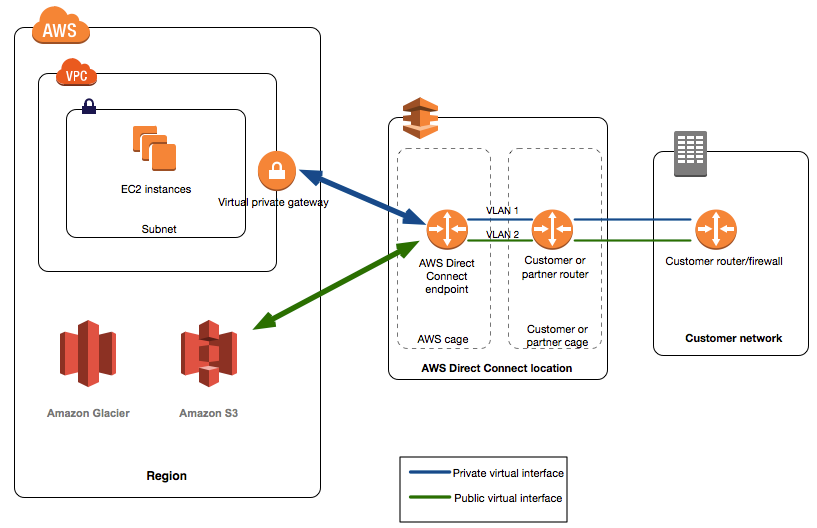
- AWS Direct Connect helps establish a dedicated private connection between an on-premises network and AWS.
- Direct Connect can reduce network costs, increase bandwidth throughput, and provide a more consistent network experience than internet-based or VPN connections
- Direct Connect uses industry-standard VLANs to access EC2 instances running within a VPC using private IP addresses
- Direct Connect lets you establish
- Dedicated Connection: A 1G, 10G, or 100G physical Ethernet connection associated with a single customer through AWS.
- Hosted Connection: A physical Ethernet connection that an AWS Direct Connect Partner provisions on behalf of a customer. Speeds range from 50 Mbps to 10 Gbps.
- Direct Connect provides the following Virtual Interfaces
- Private virtual interface – to access a VPC using private IP addresses.
- Public virtual interface – to access all AWS public services using public IP addresses.
- Transit virtual interface – to access one or more transit gateways associated with Direct Connect gateways.
- Direct Connect connections are not redundant as each connection consists of a single dedicated connection between ports on your router and an Amazon router
- Direct Connect High Availability can be configured using
- Multiple Direct Connect connections
- Back-up IPSec VPN connection
- SiteLink – enables sending data between AWS Direct Connect locations to create private network connections between offices and data centers in a global network, bypassing AWS Regions. Data travels over the shortest path between locations using the AWS global network backbone.
- VIF Rate Limiters (Jun 2026) – supports Virtual Interface Rate Limiters on dedicated connections to prevent network congestion caused by unexpected traffic spikes on a VIF, protecting other VIFs on the same connection.
LAGs
- Direct Connect link aggregation group (LAG) is a logical interface that uses the Link Aggregation Control Protocol (LACP) to aggregate multiple connections at a single AWS Direct Connect endpoint, allowing you to treat them as a single, managed connection.
- LAGs need the following
- All connections in the LAG must use the same bandwidth.
- A maximum of four connections in a LAG. Each connection in the LAG counts toward the overall connection limit for the Region.
- All connections in the LAG must terminate at the same AWS Direct Connect endpoint.
Direct Connect Gateway
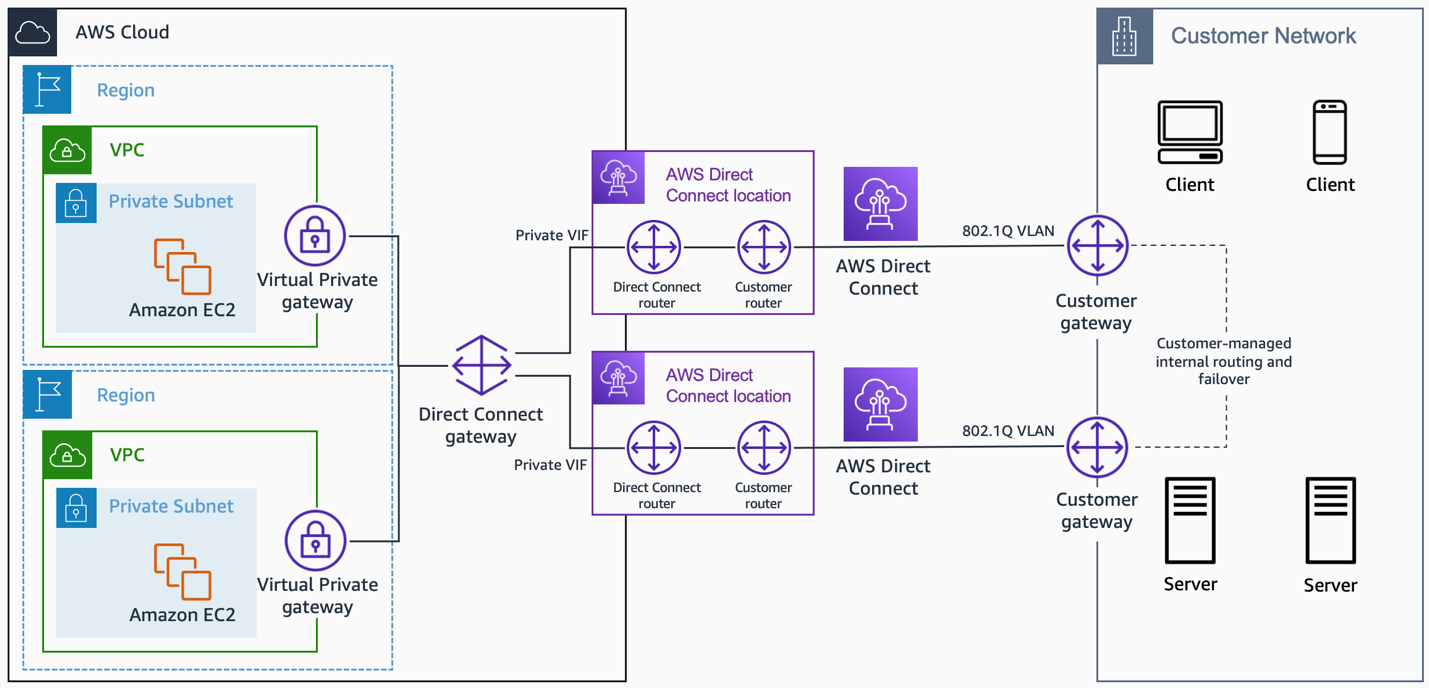
- is a globally available resource to enable connections to multiple VPCs across different regions or AWS accounts.
- allows you to connect an AWS Direct Connect connection to one or more VPCs in the account that are located in the same or different regions
- allows connecting any participating VPCs from one private VIF, reducing Direct Connect management.
- can be created in any public region and accessed from all other public regions
- can also access the public resources in any AWS Region using a public virtual interface.
- supports connecting up to 20 VPCs (via VGWs) globally over a single private VIF.
AWS Interconnect – Multicloud
- is a new managed connectivity service (GA Apr 2026) that simplifies multicloud connectivity between AWS and other cloud service providers.
- provides simple, resilient, high-speed private connections to other CSPs without needing to manage physical cross-connects or third-party providers.
- attaches to a Direct Connect Gateway on the AWS side.
- supported CSPs:
- Google Cloud – Generally Available
- Oracle Cloud Infrastructure (OCI) – Preview (May 2026)
- Microsoft Azure – Coming later in 2026
- offers a Free Tier – fully managed 500 Mbps interconnect to another CSP at no charge on the AWS side (May 2026).
- eliminates complex multicloud networking setups that previously required physical Direct Connect connections and manual peering arrangements.
Amazon VPC Lattice
- is an application networking service that consistently connects, monitors, and secures communications between services and resources across VPCs and accounts.
- automatically manages network connectivity and application layer routing between services across different VPCs and AWS accounts.
- abstracts IP address dependencies, allowing applications to communicate securely without direct network routing.
- supports HTTP, HTTPS, gRPC, TLS, and TCP protocols.
- key features include:
- Service Networks – logical grouping of services with shared access and observability policies.
- Service Network VPC Endpoints – allows VPCs to connect to service networks via VPC endpoints.
- VPC Resources Support (re:Invent 2024) – enables connectivity to TCP resources such as databases, domain names, and IP addresses across VPCs and accounts.
- Auth Policies – fine-grained access control using IAM-based policies at the service network and service level.
- can replace complex Transit Gateway and PrivateLink configurations for service-to-service communication within a Region.
- does not natively support cross-Region service access; requires a proxy solution for external Region connectivity.
Amazon VPC Route Server
- is a new managed service (GA Apr 2025) that enables dynamic routing within Amazon VPC using Border Gateway Protocol (BGP).
- allows deploying endpoints in a VPC and peering them with virtual appliances to advertise routes using BGP.
- filters received routes using standard BGP attributes and propagates selected routes to specified VPC route tables.
- dynamically updates VPC and internet gateway route tables with preferred IPv4 or IPv6 routes for routing fault tolerance.
- eliminates the need for complex scripting or Lambda-based failover mechanisms for virtual appliance routing.
- key use cases:
- Automatic active/standby failover for inspection appliances
- Dynamic routing between cloud applications and on-premises systems via virtual appliances
- Integration with Transit Gateway for centralized inspection architectures
- Logging Enhancements (Jun 2025) – provides real-time monitoring of BGP and BFD session states, historical peer-to-peer session data, with delivery via CloudWatch, S3, Data Firehose, or AWS CLI.