AWS EBS Volume Types
🆕 Major Update – September 2025
Amazon EBS gp3 volumes now support up to 64 TiB size, 80,000 IOPS, and 2,000 MiB/s throughput — a 4X, 5X, and 2X increase respectively over previous limits. Additionally, as of January 2026, Elastic Volumes now supports up to 4 modifications per 24-hour rolling window (previously limited by a 6-hour cooldown between modifications).
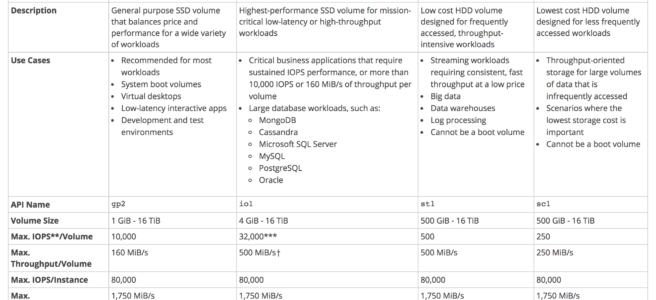
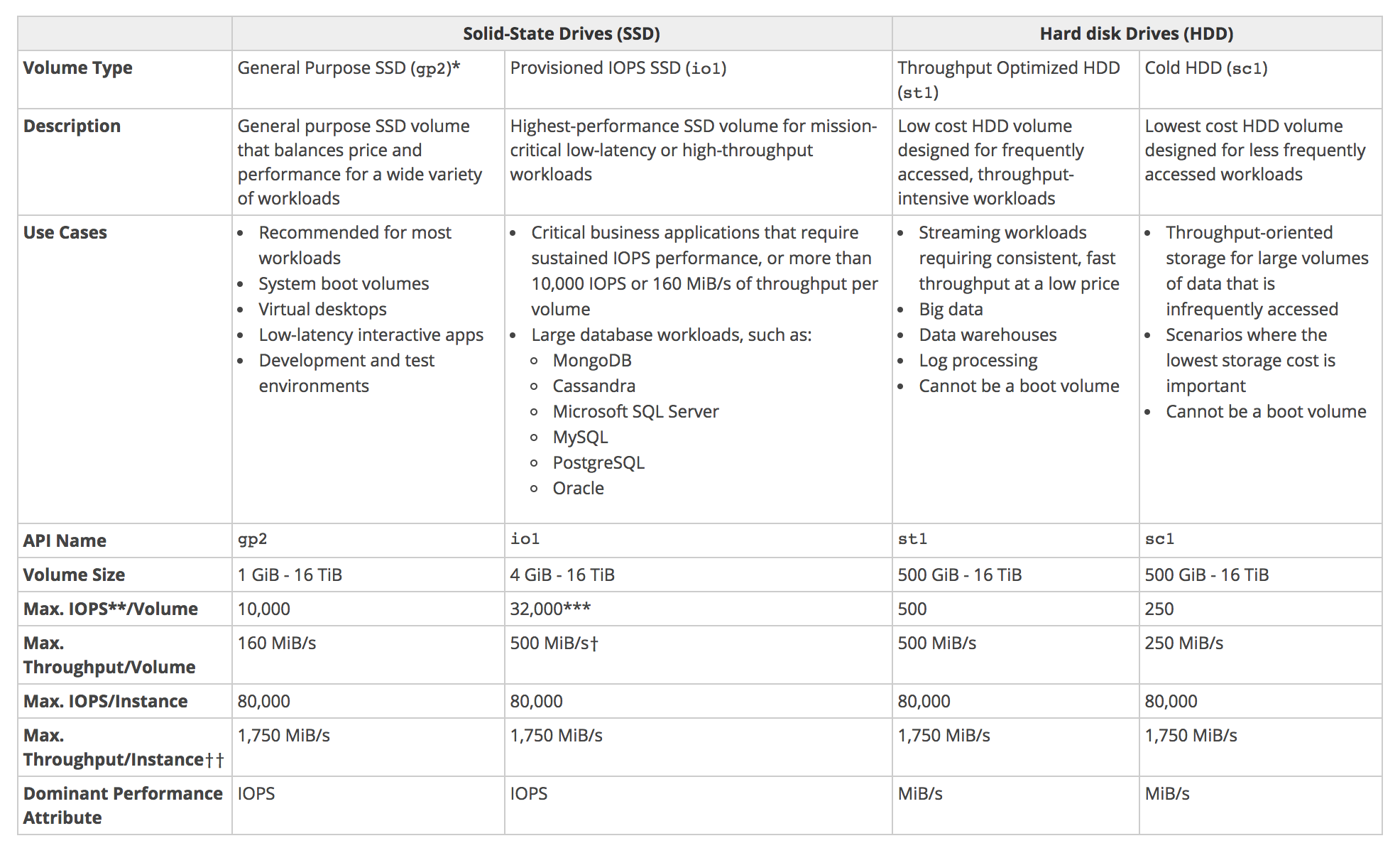
- AWS provides the following EBS volume types, which differ in performance characteristics and price and can be tailored for storage performance and cost to the needs of the applications.
- Solid state drives (SSD-backed) volumes optimized for transactional workloads involving frequent read/write operations with small I/O size, where the dominant performance attribute is IOPS
- General Purpose SSD (gp3/gp2)
- Provisioned IOPS SSD (io2 Block Express/io1)
- Hard disk drives (HDD-backed) volumes optimized for large streaming workloads where throughput (measured in MiB/s) is a better performance measure than IOPS
- Throughput Optimized HDD (st1)
- Cold HDD (sc1)
Magnetic Volumes (standard)(Previous Generation)
EBS Volume Types Summary
Solid state drives (SSD-backed) volumes
General Purpose SSD Volumes (gp3/gp2)
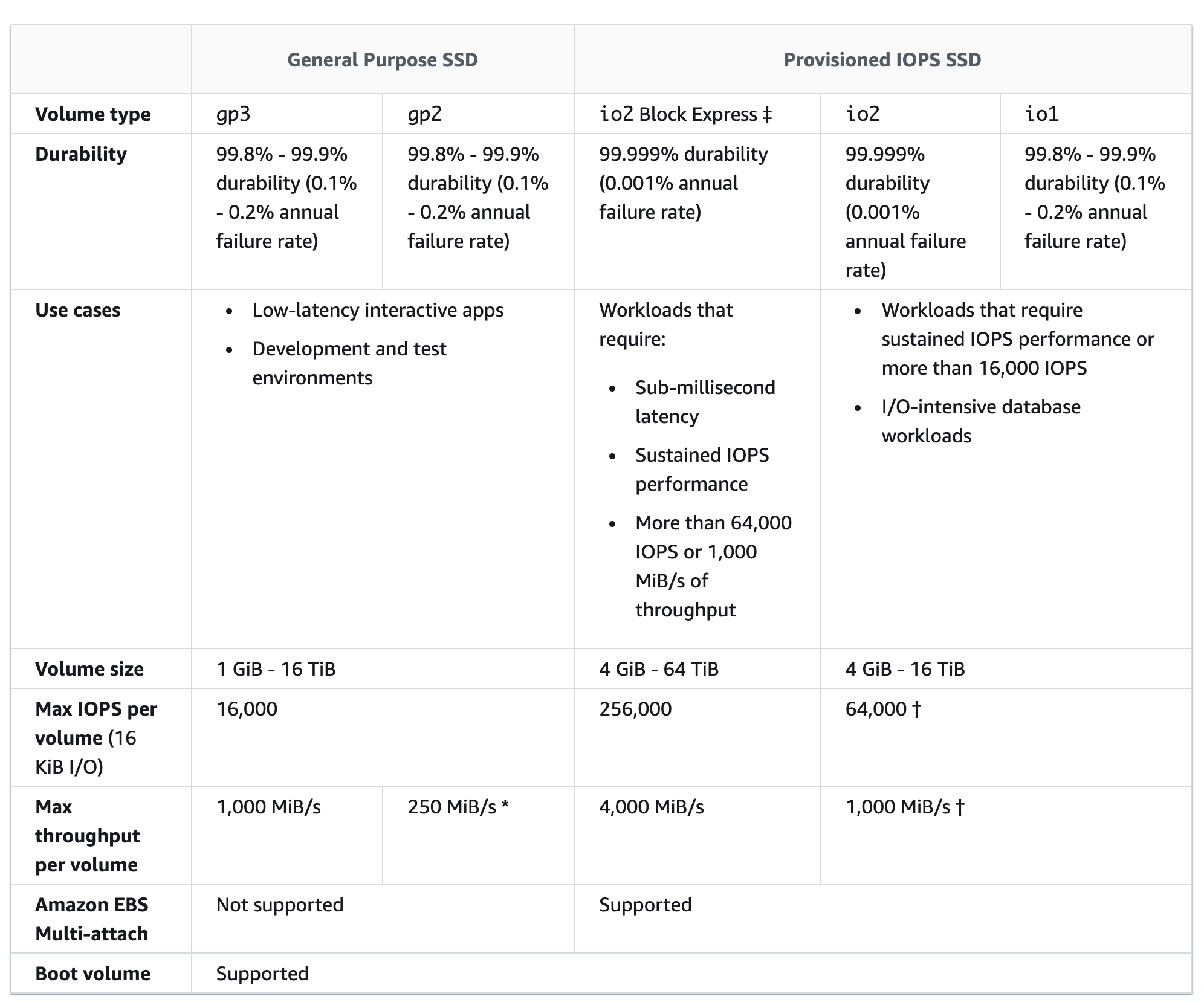
- General Purpose SSD volumes offer cost-effective storage that is ideal for a broad range of workloads.
- General Purpose SSD volumes deliver single-digit millisecond latencies.
- General Purpose SSD (
gp3) volumes (Recommended)- can range in size from 1 GiB to 64 TiB (increased from 16 TiB in September 2025).
- deliver a consistent baseline rate of 3,000 IOPS and 125 MiB/s, included with the price of storage.
- additional IOPS (up to 80,000) and throughput (up to 2,000 MiB/s) can be provisioned for an additional cost.
- the maximum ratio of provisioned IOPS to provisioned volume size is 500 IOPS per GiB.
- the maximum ratio of provisioned throughput to provisioned IOPS is .25 MiB/s per IOPS.
- performance is provisioned independently from storage capacity, allowing even small volumes to achieve high performance.
- provides up to 20% lower price per GB compared to gp2 volumes.
- Note: On Outposts, gp3 volumes support sizes up to 16 TiB, IOPS up to 16,000, and throughput up to 1,000 MiB/s.
- General Purpose SSD (
gp2) volumes- can range in size from 1 GiB to 16 TiB.
- has a maximum throughput of 250 MiB/s (depending on volume size).
- provides a baseline performance of 3 IOPS/GiB.
- provides the ability to burst to 3,000 IOPS for extended periods of time for volume size less than 1 TiB and up to a maximum of 16,000 IOPS (at 5,334 GiB).
- If the volume performance is frequently limited to the baseline level (due to an empty I/O credit balance),
- consider using a larger General Purpose SSD volume (with a higher baseline performance level) or
- switching to a gp3 volume for independent IOPS/throughput provisioning or
- switching to a Provisioned IOPS SSD volume for workloads that require sustained IOPS performance greater than 80,000 IOPS.
- AWS recommends migrating gp2 volumes to gp3 for better performance and lower cost.
I/O Credits and Burst Performance (gp2 only)
- I/O credits represent the available bandwidth that the General Purpose SSD (gp2) volume can use to burst large amounts of I/O when more than the baseline performance is needed.
- General Purpose SSD
(gp2)volume performance is governed by volume size, which dictates the baseline performance level of the volume for e.g. 100 GiB volume has a 300 IOPS @ 3 IOPS/GiB - General Purpose SSD (gp2) volume size also determines how quickly it accumulates I/O credits for e.g. 100 GiB with a performance of 300 IOPS can accumulate 180K IOPS/10 mins (300 * 60 * 10).
- Larger volumes have higher baseline performance levels and accumulate I/O credits faster for e.g. 1 TiB has a baseline performance of 3000 IOPS
- More credits the volume has for I/O, the more time it can burst beyond its baseline performance level and the better it performs when more performance is needed for e.g. 300 GiB volume with 180K I/O credit can burst @ 3000 IOPS for 1 minute (180K/3000)
- Each volume receives an initial I/O credit balance of 5,400,000 I/O credits, which is enough to sustain the maximum burst performance of 3,000 IOPS for 30 minutes.
- Initial credit balance is designed to provide a fast initial boot cycle for boot volumes and a good bootstrapping experience for other applications.
- Each volume can accumulate I/O credits over a period of time which can be to burst to the required performance level, up to a max of 3,000 IOPS
- Unused I/O credit cannot go beyond 54,00,000 I/O credits.
- Note: gp3 volumes do NOT use the I/O credit/burst model — they provide consistent baseline performance of 3,000 IOPS regardless of volume size.
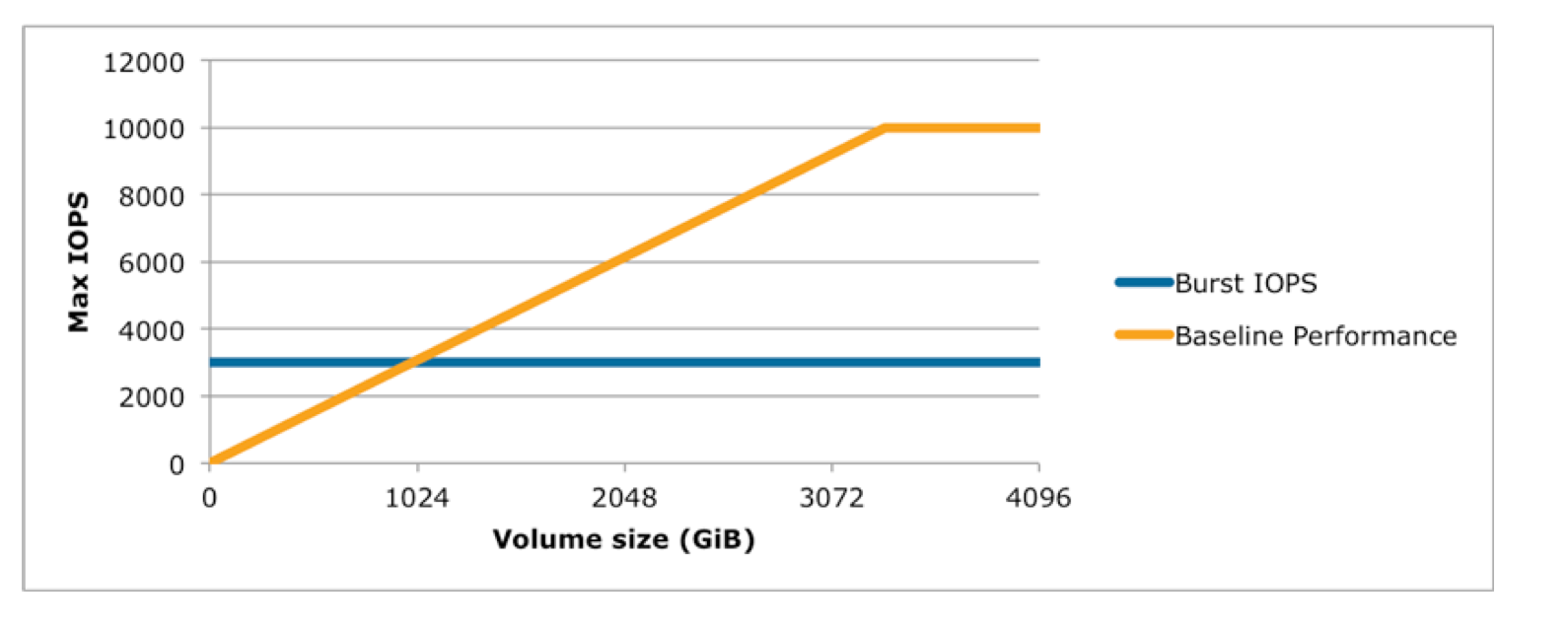
- Volumes till 1 TiB can burst up to 3000 IOPS over and above its baseline performance
- Volumes larger than 1 TiB have a baseline performance that is already equal to or greater than the maximum burst performance, and their I/O credit balance never depletes.
- Baseline performance cannot be beyond 16,000 IOPS for gp2 volumes and this limit is reached @ 5,334 GiB
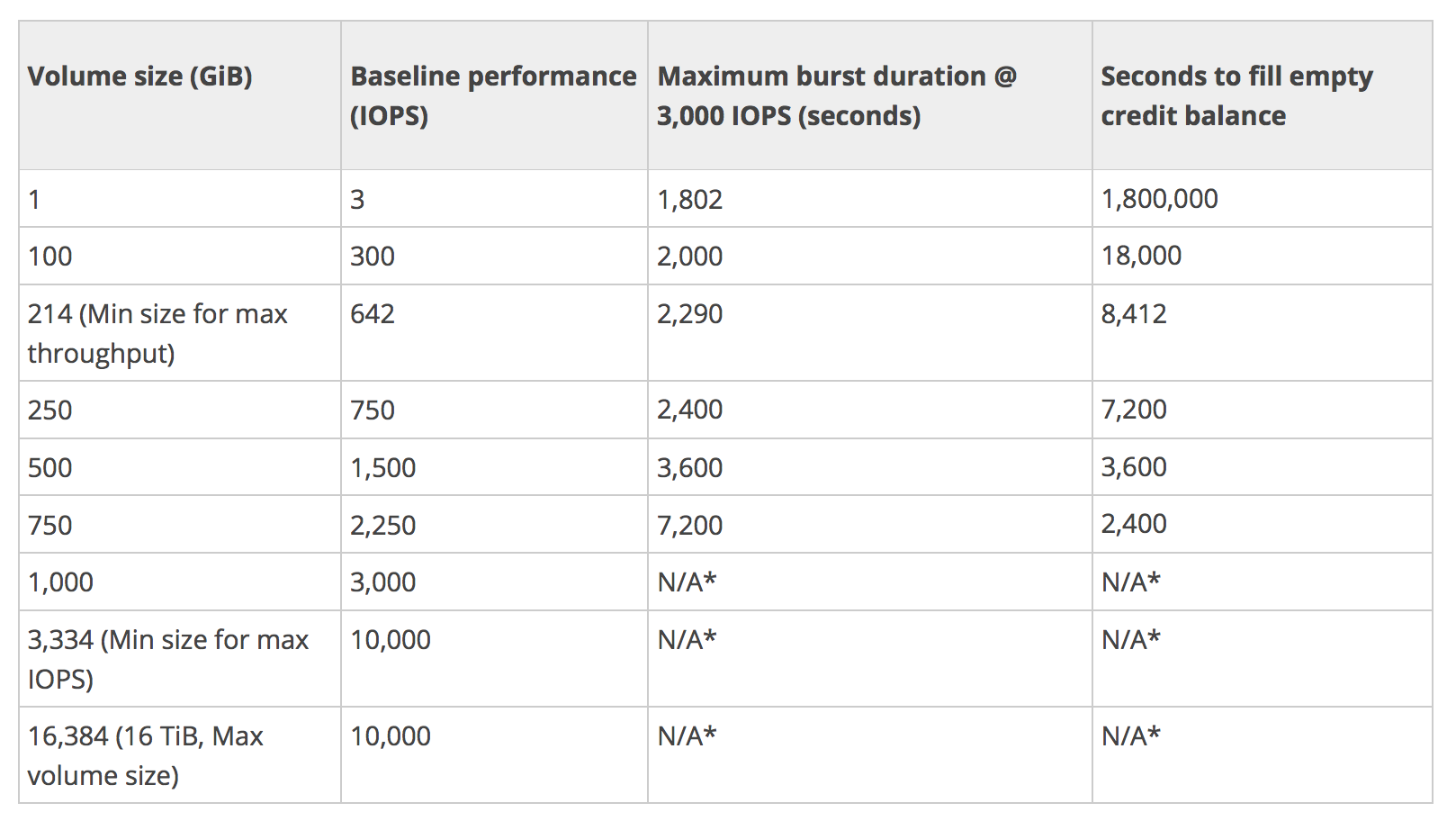
Baseline Performance (gp2)
- Formula – 3 IOPS i.e. GiB * 3
- Calculation example
- 1 GiB volume size = 3 IOPS (1 * 3 IOPS)
- 250 GiB volume size = 750 IOPS (250* 3 IOPS)
Maximum burst duration @ 3000 IOPS (gp2)
- How much time can 5400000 IO credit be sustained @ the burst performance of 3000 IOPS. Subtract the baseline performance from 3000 IOPS which would be contributed by the volume size
- Formula – 5400000/(3000 – Baseline performance)
- Calculation example
- 1 GiB volume size @ 3000 IOPS with 5400000 the burst performance can be maintained for 5400000/(3000-3) = 1802 secs
- 250 GiB volume size @ 3000 IOPS with 5400000 the burst performance can be maintained for 5400000/(3000-3*250) = 2400 secs
Time to fill the 5400000 I/O credit balance (gp2)
- Formula – 5400000/Baseline performance
- Calculation
- 1 GiB volume size @ 3 IOPS would require 5400000/3 = 1800000 secs
- 250 GiB volume size @ 750 IOPS would require 5400000/750 = 7200 secs
Provisioned IOPS SSD (io2 Block Express / io1) Volumes
- are designed to meet the needs of I/O intensive workloads, particularly database workloads, that are sensitive to storage performance and consistency in random access I/O throughput.
- IOPS rate can be specified when the volume is created, and EBS delivers within 10% of the provisioned IOPS performance 99.9% of the time over a given year.
io2 Block Express (Recommended)
- offers the highest performance block storage among EBS volumes with an average latency of under 500 microseconds for 16KiB I/O operations.
- can range in size from 4 GiB to 64 TiB.
- supports up to 256,000 IOPS per volume (16 KiB I/O) — requires Nitro-based instances.
- supports up to 4,000 MiB/s throughput per volume.
- provides 99.999% durability (0.001% annual failure rate) — 100X higher durability than io1/gp2/gp3.
- Ratio of IOPS provisioned to volume size is up to 1,000 IOPS per GiB — 20X higher than io1.
- Available at the same price as io1.
- Supports Multi-Attach — allows a single volume to be attached to up to 16 Nitro-based instances simultaneously.
- Supports NVMe reservations for shared storage cluster coordination.
- delivers better outlier latency compared to General Purpose volumes, reducing the frequency of IOs exceeding 800 microseconds by over 10X.
- AWS recommends migrating io1 volumes to io2 Block Express for higher performance, durability, and IOPS/GiB ratio at no additional cost.
io1 (Previous Generation Provisioned IOPS)
- can range in size from 4 GiB to 16 TiB.
- have a throughput limit of up to 1,000 MiB/s (at 64,000 IOPS on Nitro instances).
- can provision up to 64,000 IOPS per volume.
- Ratio of IOPS provisioned to the volume size requested can be a maximum of 50 IOPS per GiB; e.g., a volume with 5,000 IOPS must be at least 100 GiB.
- 99.8% – 99.9% durability (0.1% – 0.2% annual failure rate).
- can be striped together in a RAID configuration for larger size and greater performance.
- Note: AWS recommends migrating to io2 Block Express for better durability, performance, and IOPS/GiB ratio at the same price.
Hard disk drives (HDD-backed) volumes
Throughput Optimized HDD (st1) Volumes
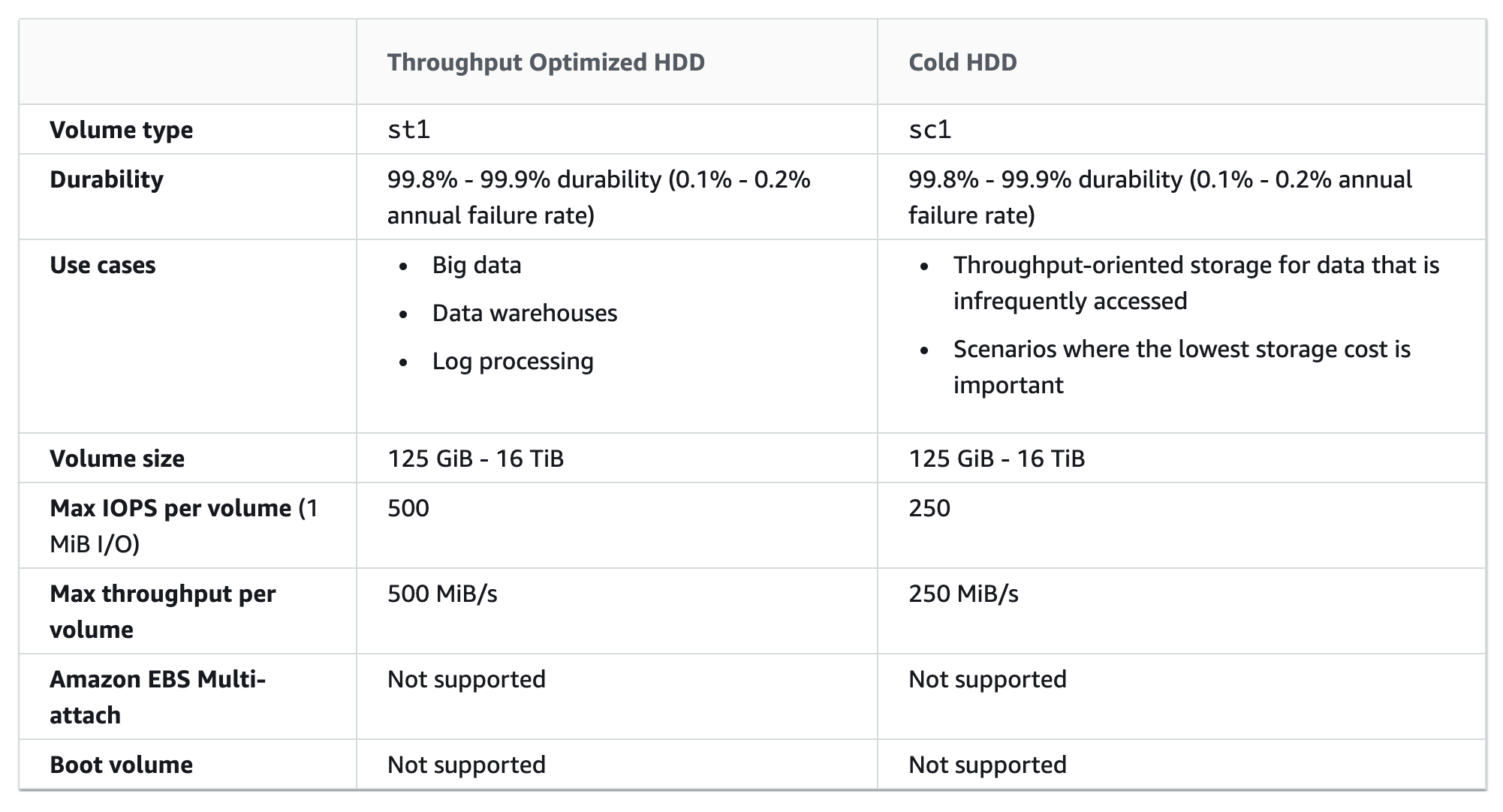
- provide low-cost magnetic storage that defines performance in terms of throughput rather than IOPS.
- is a good fit for large, sequential workloads such as EMR, ETL, data warehouses, and log processing.
- do not support boot volumes.
- can range in size from 125 GiB to 16 TiB.
- are designed to support frequently accessed data.
- maximum throughput of 500 MiB/s per volume.
- maximum IOPS of 500 (1 MiB I/O).
- uses a burst-bucket model for performance similar to
gp2. Volume size determines the baseline throughput of the volume, which is the rate at which the volume accumulates throughput credits. Volume size also determines the burst throughput of your volume, which is the rate at which you can spend credits when they are available.
Cold HDD (sc1) Volumes
- provide low-cost magnetic storage that defines performance in terms of throughput rather than IOPS.
- With a lower throughput limit than st1, sc1 is a good fit ideal for large, sequential cold-data workloads.
- ideal for infrequent access to data and are looking to save costs, sc1 provides inexpensive block storage.
- do not support boot volumes.
- can range in size from 125 GiB to 16 TiB.
- maximum throughput of 250 MiB/s per volume.
- maximum IOPS of 250 (1 MiB I/O).
- though are similar to Throughput Optimized HDD (st1) volumes, are designed to support infrequently accessed data.
- uses a burst-bucket model for performance similar to gp2. Volume size determines the baseline throughput of the volume, which is the rate at which the volume accumulates throughput credits. Volume size also determines the burst throughput of your volume, which is the rate at which you can spend credits when they are available.
Magnetic Volumes (standard) – Previous Generation
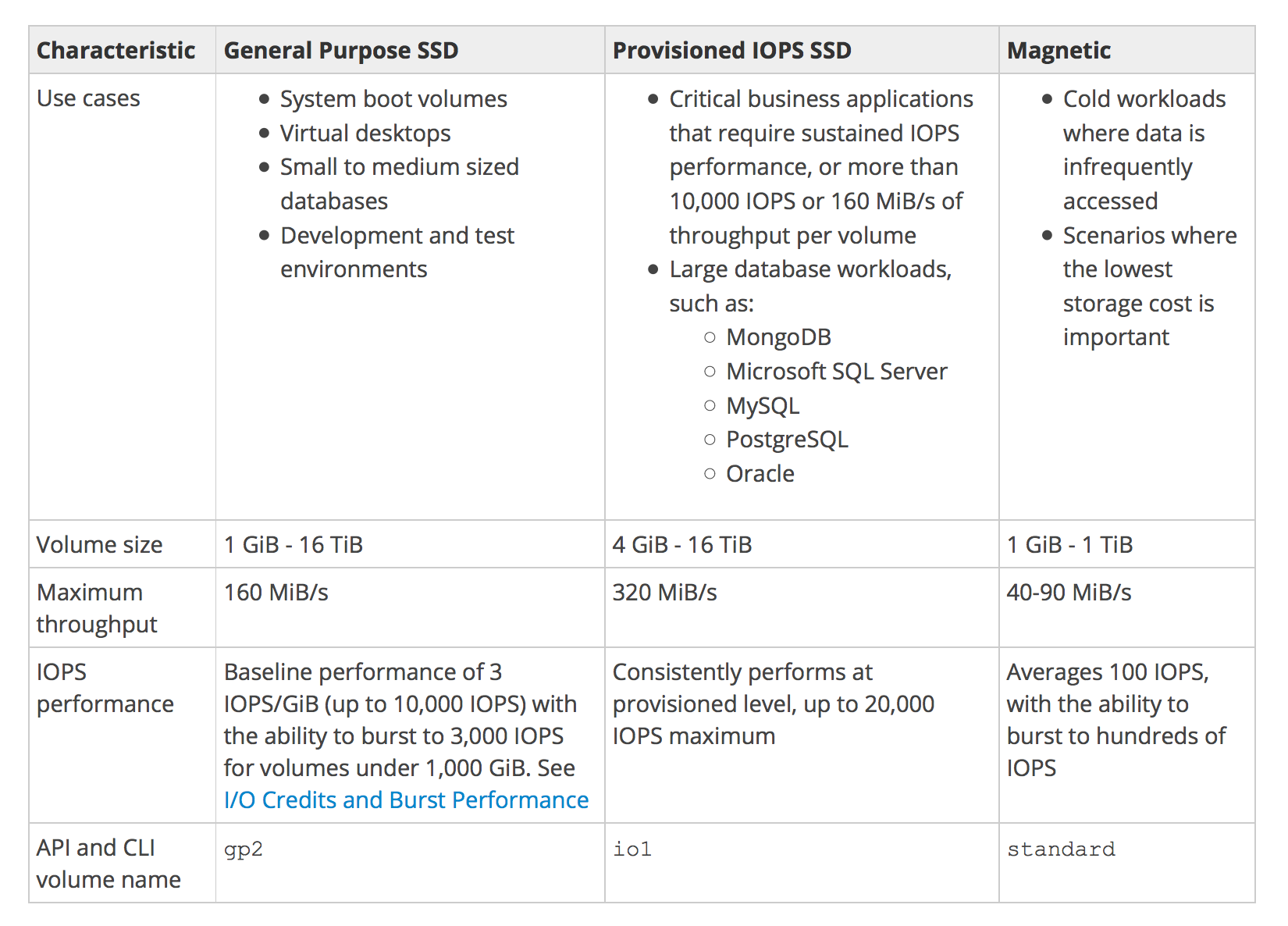
Magnetic volumes provide the lowest cost per gigabyte of all EBS volume types. Magnetic volumes are backed by magnetic drives and are ideal for workloads performing sequential reads, workloads where data is accessed infrequently, and scenarios where the lowest storage cost is important.
Magnetic volumes can range in size from 1 GiB to 1 TiBThese volumes deliver approximately 100 IOPS on average, with burst capability of up to hundreds of IOPSMagnetic volumes can be striped together in a RAID configuration for larger size and greater performance.- Note: Magnetic (standard) is a previous generation volume type. AWS recommends using current generation volume types (gp3, io2, st1, sc1) for better performance and cost-effectiveness. For infrequent access cold data, consider sc1 instead.
EBS Volume Types (Previous Generation – Reference Only)
EBS Elastic Volumes
- Elastic Volumes allows you to dynamically increase capacity, tune performance, and change the type of live volumes with no downtime or performance impact.
- (January 2026 Update) You can now modify a volume up to 4 times within a rolling 24-hour window — the previous 6-hour cooldown between modifications has been eliminated.
- A new modification can be initiated as soon as the previous one completes.
- Supported modifications include: increasing size, changing volume type, and adjusting provisioned performance (IOPS/throughput).
- Note: Volume size can only be increased, not decreased. To reduce size, create a new smaller volume and migrate data.
AWS Certification Exam Practice Questions
- Questions are collected from Internet and the answers are marked as per my knowledge and understanding (which might differ with yours).
- AWS services are updated everyday and both the answers and questions might be outdated soon, so research accordingly.
- AWS exam questions are not updated to keep up the pace with AWS updates, so even if the underlying feature has changed the question might not be updated
- Open to further feedback, discussion and correction.
- You are designing an enterprise data storage system. Your data management software system requires mountable disks and a real filesystem, so you cannot use S3 for storage. You need persistence, so you will be using AWS EBS Volumes for your system. The system needs as low-cost storage as possible, and access is not frequent or high throughput, and is mostly sequential reads. Which is the most appropriate EBS Volume Type for this scenario?
- gp1
- io1
- sc1 (Cold HDD sc1 volumes are designed for infrequently accessed data with lowest storage cost. Note: The original answer was “standard/Magnetic” but for modern deployments, sc1 is the recommended low-cost option for infrequent sequential access. Magnetic (standard) is previous generation.)
- gp2
- Which EBS volume type is best for high performance NoSQL cluster deployments?
- io1/io2 Block Express (Provisioned IOPS SSD volumes are best for: Critical business applications that require sustained IOPS performance, or more than 80,000 IOPS or 2,000 MiB/s of throughput per volume, like large database workloads such as MongoDB. io2 Block Express is now recommended over io1 for up to 256,000 IOPS.)
- gp1
- standard
- gp2
- Provisioned IOPS Costs: you are charged for the IOPS and storage whether or not you use them in a given month.
- FALSE
- TRUE
- A user is trying to create a PIOPS EBS volume with 8 GB size and 450 IOPS. Will AWS create the volume?
- Yes, since the ratio between EBS and IOPS is less than 50 for io1 (or less than 1000 for io2 Block Express)
- No, since the PIOPS and EBS size ratio is less than 50
- No, the EBS size is less than 10 GB
- Yes, since PIOPS is higher than 100
- A user has provisioned 2000 IOPS to the EBS volume. The application hosted on that EBS is experiencing fewer IOPS than provisioned. Which of the below mentioned options does not affect the IOPS of the volume?
- The application does not have enough IO for the volume
- Instance is EBS optimized
- The EC2 instance has 10 Gigabit Network connectivity
- Volume size is too large
- A user is trying to create a PIOPS EBS volume with 6000 IOPS and 100 GB size. AWS does not allow the user to create this volume. What is the possible root cause for this?
- The ratio between IOPS and the EBS volume is higher than 50 (For io1 volumes, maximum ratio is 50 IOPS per GiB. 6000/100 = 60, which exceeds 50. Note: For io2 Block Express, this would be allowed as the ratio limit is 1000 IOPS per GiB.)
- The maximum IOPS supported by EBS is 3000
- The ratio between IOPS and the EBS volume is lower than 100
- PIOPS is supported for EBS higher than 500 GB size
- A company needs a database storage solution that provides consistent sub-millisecond latency, 99.999% durability, and supports up to 256,000 IOPS. Which EBS volume type should they choose?
- gp3
- io1
- io2 Block Express (io2 Block Express delivers sub-millisecond latency, 99.999% durability, and supports up to 256,000 IOPS with 4,000 MiB/s throughput per volume.)
- st1
- A solutions architect needs to consolidate multiple striped gp3 volumes into a single volume for a containerized workload that requires 50,000 IOPS and 30 TiB of storage. Which volume type supports this requirement with a single volume?
- gp2
- gp3 (Since September 2025, gp3 supports up to 64 TiB size and 80,000 IOPS, allowing consolidation of previously striped volumes into a single gp3 volume.)
- io1
- st1
- What is the maximum IOPS-to-storage ratio for io2 Block Express volumes?
- 50 IOPS per GiB
- 500 IOPS per GiB
- 1,000 IOPS per GiB (io2 Block Express supports up to 1,000 IOPS per GiB, which is 20X higher than io1’s 50 IOPS per GiB ratio.)
- 100 IOPS per GiB
- Which of the following are advantages of io2 Block Express over io1? (Select THREE)
- 100X higher durability (99.999% vs 99.8-99.9%)
- 20X higher IOPS-to-storage ratio (1000 vs 50 IOPS/GiB)
- 4X higher maximum IOPS (256,000 vs 64,000)
- Lower cost per provisioned IOPS
- Support for HDD-backed storage
📖 Related: AWS S3 vs EBS vs EFS – Complete Storage Comparison Guide