AWS Transit VPC
⚠️ RECOMMENDATION: Use AWS Transit Gateway Instead
AWS Transit Gateway is the recommended solution for hub-and-spoke network architectures.
Transit Gateway offers the same advantages as Transit VPC, but it is a fully managed service that scales elastically in a highly available architecture. Transit Gateway eliminates the need to manage EC2 instances, provides higher bandwidth (up to 100 Gbps per attachment), and reduces operational overhead.
Recent developments further reduce Transit VPC use cases:
- Transit Gateway-attached AWS Network Firewall (May 2026) – Network Firewall now attaches directly to Transit Gateway, eliminating the need for a dedicated inspection VPC. This provides native AWS security inspection without third-party EC2 appliances.
- AWS Client VPN native Transit Gateway attachment (April 2026) – Client VPN now attaches directly to Transit Gateway, removing the need for a dedicated VPN VPC.
- AWS Global Transit Network Solution removed – The original Transit VPC CloudFormation solution is no longer available from AWS.
When to still consider Transit VPC:
- Specific requirement for third-party vendor appliances (e.g., Palo Alto, Fortinet) not replaceable by AWS Network Firewall
- Connectivity between AWS GovCloud and Commercial Regions
For most use cases, use AWS Transit Gateway instead.
- Transit VPC helps connect multiple, geographically disperse VPCs and remote networks in order to create a global network transit center.
- Transit VPC can solve some of the shortcomings of VPC peering by introducing a hub and spoke design for inter-VPC connectivity.
- A transit VPC simplifies network management and minimizes the number of connections required to connect multiple VPCs and remote networks.
- Transit VPC allows an easy way to implement shared services or packet inspection/replication in a VPC.
- Transit VPC can be used to support important use cases
- Private Networking – build a private network that spans two or more AWS Regions.
- Shared Connectivity – Multiple VPCs can share connections to data centers, partner networks, and other clouds.
- Cross-Account AWS Usage – The VPCs and the AWS resources within them can reside in multiple AWS accounts.
- Transit VPC design helps implement more complex routing rules, such as network address translation between overlapping network ranges, or to add additional network-level packet filtering or inspection
Transit VPC Configuration
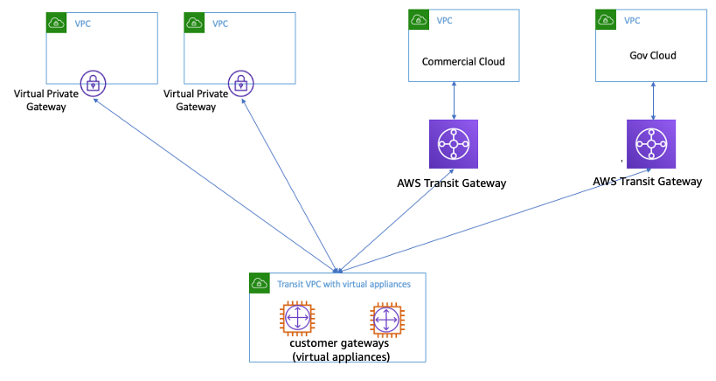
- Transit VPC network consists of a central VPC (the hub VPC) connecting with every other VPC (spoke VPC) through a VPN connection typically leveraging BGP over IPsec.
- Central VPC contains EC2 instances running software appliances that route incoming traffic to their destinations using the VPN overlay.
Transit VPC Advantages & Disadvantages
Advantages
- supports Transitive routing using the overlay VPN network — allowing for a simpler hub and spoke design. Can be used to provide shared services for VPC Endpoints, Direct Connect connection, etc.
- supports network address translation between overlapping network ranges.
- supports vendor functionality around advanced security (layer 7 firewall/Intrusion Prevention System (IPS)/Intrusion Detection System (IDS) ) using third-party software on EC2
- enables connectivity between AWS GovCloud and Commercial Regions or between Transit Gateway and Transit VPC for inter-region connectivity
Disadvantages
- leverages instance-based routing that increases costs while lowering availability and limiting the bandwidth.
- Customers are responsible for managing the HA and redundancy of EC2 instances running the third-party vendor virtual appliances
- Limited throughput per VPN connection (up to 1.25 Gbps per VPN tunnel)
- Additional configuration, management, and resiliency overhead
- Higher costs for running third-party vendor virtual appliances on EC2
Transit Gateway-Attached Network Firewall (2026 Update)
- AWS Network Firewall now supports native attachment to Transit Gateway (announced May 2026), eliminating the need for a dedicated inspection VPC.
- Previously, centralized traffic inspection required creating a separate inspection VPC with firewall subnets and managing complex routing to direct traffic through the firewall.
- With native attachment, Network Firewall attaches directly to Transit Gateway as a “network function attachment” — AWS manages the firewall endpoints in an AWS-managed VPC on your behalf.
- Key benefits over Transit VPC for security inspection:
- No inspection VPC to manage – eliminates VPC, subnets, and route table management
- Flexible cost allocation – Transit Gateway metering policies enable per-account chargeback for firewall traffic
- Fully managed – AWS manages firewall endpoint deployment and scaling
- Native integration – appears as a Transit Gateway attachment, simplifying routing configuration
- Impact on Transit VPC: This significantly reduces the use case for Transit VPC. Organizations using Transit VPC primarily for centralized security inspection can now achieve the same with Transit Gateway + Network Firewall natively attached.
- Transit VPC remains relevant only when specific third-party vendor appliances (Palo Alto, Fortinet, Check Point) are required that cannot be replaced by AWS Network Firewall.
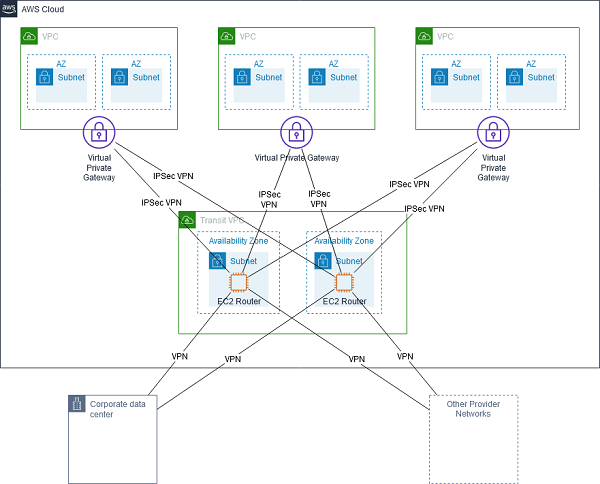
Transit VPC High Availability
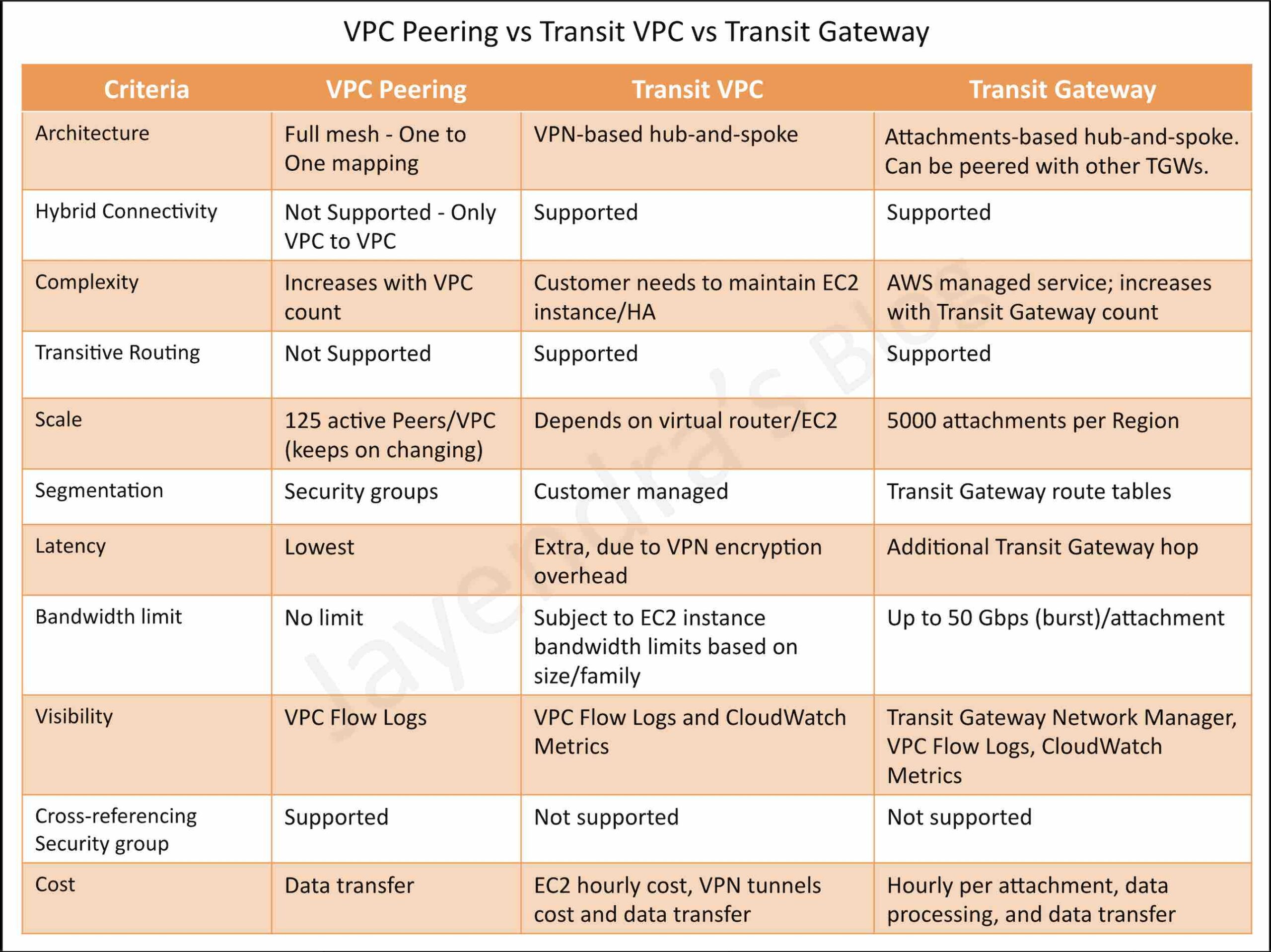
VPC Connectivity Options Comparison
When to Use Each Solution
- VPC Peering
- Best for: Simple, direct connections between a small number of VPCs (typically less than 10)
- Advantages: Lowest latency, no additional cost for connection, simple setup
- Limitations: Full mesh complexity at scale, no transitive routing, limited to 125 peers per VPC
- Transit VPC
- Best for: Specific third-party vendor appliance requirements not replaceable by AWS Network Firewall, GovCloud to Commercial connectivity
- Advantages: Vendor-specific functionality (Palo Alto, Fortinet, Check Point), advanced features beyond AWS Network Firewall
- Limitations: Customer-managed HA, limited bandwidth (1.25 Gbps per tunnel), higher operational overhead, AWS solution template removed
- AWS Transit Gateway
- Best for: Hub-and-spoke architecture with many VPCs (10+), centralized routing, hybrid connectivity
- Advantages: Fully managed, supports transitive routing, scales to 5000 attachments, up to 100 Gbps bandwidth, native Network Firewall attachment, native Client VPN attachment
- Limitations: Additional cost per attachment and data processing, additional hop adds latency
- AWS PrivateLink
- Best for: Service-to-service connectivity, exposing services to multiple consumers
- Advantages: Unidirectional access, no CIDR overlap issues, enhanced security
- Limitations: Provider/consumer model, no full VPC-to-VPC connectivity
- AWS Cloud WAN
- Best for: Global, multi-region network management with centralized policy control
- Advantages: Global scope, policy-based segmentation, multi-region attachments
- Limitations: More complex setup, higher cost for global deployments
- AWS VPC Lattice
- Best for: Application-to-application connectivity, microservices architectures
- Advantages: Service-centric networking, simplified service discovery, built-in security policies
- Limitations: Application-level connectivity only, not for full VPC-to-VPC routing
AWS Certification Exam Practice Questions
- Questions are collected from Internet and the answers are marked as per my knowledge and understanding (which might differ with yours).
- AWS services are updated everyday and both the answers and questions might be outdated soon, so research accordingly.
- AWS exam questions are not updated to keep up the pace with AWS updates, so even if the underlying feature has changed the question might not be updated
- Open to further feedback, discussion and correction.
- Under increased cyber security concerns, a company is deploying a near real-time intrusion detection system (IDS) solution. A system must be put in place as soon as possible. The architecture consists of many AWS accounts, and all results must be delivered to a central location. Which solution will meet this requirement, while minimizing downtime and costs?
- Deploy a third-party vendor solution to perform deep packet inspection in a transit VPC.
- Enable VPC Flow Logs on each VPC. Set up a stream of the flow logs to a central Amazon Elasticsearch cluster.
- Enable Amazon Macie on each AWS account and configure central reporting.
- Enable Amazon GuardDuty on each account as members of a central account.
- Your company has set up a VPN connection between their on-premises infrastructure and AWS. They have multiple VPCs defined. They also need to ensure that all traffic flows through a security VPC from their on-premise infrastructure. How would you architect the solution? (Select TWO)
- Create a VPN connection between the On-premise environment and the Security VPC (Transit VPC pattern)
- Create a VPN connection between the On-premise environment to all other VPC’s
- Create a VPN connection between the Security VPC to all other VPC’s (Transit VPC pattern)
- Create a VPC peering connection between the Security VPC and all other VPC’s
- A company needs to connect 20 VPCs across multiple AWS accounts with centralized routing and management. They do not require advanced third-party security appliances. Which solution is most appropriate?
- Deploy Transit VPC with EC2-based virtual appliances
- Use AWS Transit Gateway with a hub-and-spoke architecture
- Create VPC peering connections between all VPCs
- Use AWS PrivateLink for all connections
- A company currently uses a Transit VPC with EC2-based firewall appliances for centralized traffic inspection across 50 VPCs. They want to reduce operational overhead while maintaining centralized security inspection. They do not require vendor-specific firewall features. Which migration approach is recommended?
- Continue using Transit VPC but add more EC2 instances for redundancy
- Replace Transit VPC with VPC Peering and deploy Network Firewall in each VPC
- Migrate to AWS Transit Gateway with a Transit Gateway-attached AWS Network Firewall
- Replace Transit VPC with AWS Cloud WAN and deploy third-party appliances